Ola Electric’s Post-IPO Reality: ₹57,000 Crore Wiped Out. Is Bhavish Aggarwal’s Pivot To Krutrim Raising Questions?
Less than two years after its market debut, Ola Electric has seen nearly ₹57,000 crore in value evaporate. Market share has slipped, losses persist, and expansion plans have been reset. As Bhavish Aggarwal pushes ahead with AI venture Krutrim, investors are asking: where is the core focus?

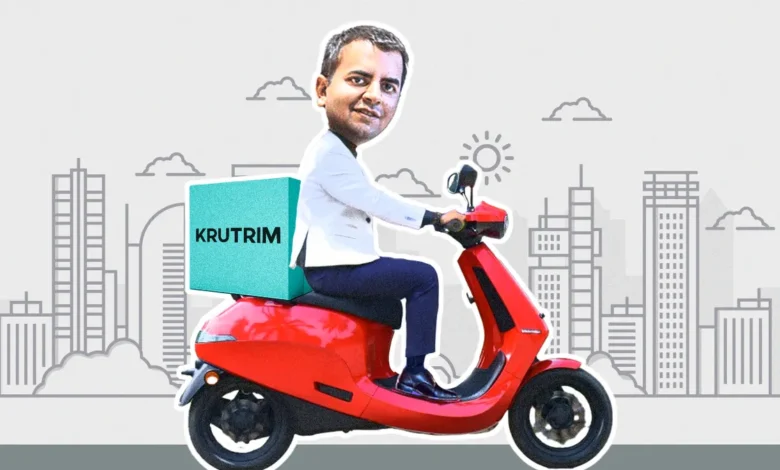
When Ola Electric Mobility listed at ₹76 in 2024, it carried the aura of a category creator. For a brief period after listing, that optimism seemed justified. The stock surged to a record ₹157, fuelled by aggressive growth projections and belief in India’s electric mobility shift.
Today, that optimism has largely evaporated.
The stock now trades below ₹30 – marking an 84% fall from its peak and nearly 70% below its issue price. In market value terms, nearly ₹57,000 crore has been erased.
The speed of the decline is what stands out. In less than two years on Dalal Street, Ola Electric has transitioned from a high-conviction growth story to a stock struggling to find support.
The obvious question is whether this is a cyclical reset in a volatile new industry or whether deeper structural pressures are at play. Because markets can forgive early losses but they are less forgiving when execution begins to wobble.
The Valuation Hangover
The sharp correction is not occurring in isolation. Institutional sentiment has also weakened.
International brokerage Goldman Sachs recently downgraded the stock to Neutral, cutting its target price to ₹26 from ₹52. Its revised estimates factor in significantly lower revenue projections between FY26 and FY28 and a more modest long-term market share assumption – mid-single digits versus earlier expectations in the low teens.
More importantly, Goldman flagged cash burn as a concern. At the current pace of EBITDA losses and capital expenditure, the brokerage believes a fundraise may be required within the next 12 to 18 months.
That is not a minor warning for a company that listed on growth promises.
Citi, just a week earlier, had also cut its target price by over 50%, downgrading the stock to “Sell”. It cited persistent headwinds in volume growth, slowing EV penetration in India’s two-wheeler segment, competitive intensity, and service-related challenges impacting customer perception.
Both brokerages acknowledged margin improvements at the gross level. But they also highlighted a critical gap – operating leverage remains negative.
In simple terms, costs are not yet aligning with scale.
The broader issue here is not just profitability. It is predictability. Public markets demand clarity on how and when losses narrow, how cash burn is funded, and whether market share stabilises.
And this is where the conversation moves from valuation to execution.
Market Share: The Hard Numbers
If valuation is about perception, market share is about reality.
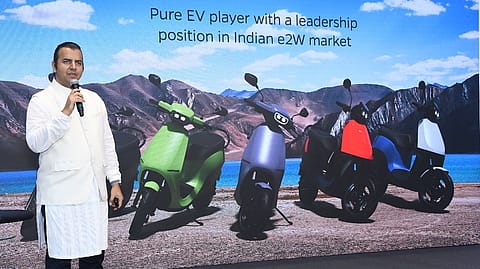
According to VAHAN data, Ola Electric’s share in the electric two-wheeler segment fell to 6.3% in January from around 26% a year earlier. In the first 18 days of February, that number slipped further to roughly 4.2%.
The contrast with the recent past is sharp.
In April 2024, Ola had commanded more than 50% of the segment, selling nearly 34,000 units in a market of around 64,000 electric two-wheelers. It was the undisputed leader.
Fast forward less than two years, and the company has dropped to fifth or sixth position in monthly rankings.
January 2026 sales stood at 7,512 units — down nearly 69% year-on-year. In the first half of February 2026, sales were even lower, with competitors such as TVS Motor, Bajaj Auto, Ather Energy and Hero MotoCorp occupying the top slots.
This is not marginal erosion but displacement. The electric two-wheeler segment itself has not collapsed. Instead, legacy players appear to have consolidated their position.
Which raises another question: Was Ola’s early dominance a function of first-mover advantage rather than durable execution strength?
Because sustaining leadership in automobiles – electric or otherwise – requires more than aggressive expansion. It demands product reliability, service networks, and consumer trust.
And that is where cracks have appeared.
Competition Has Grown Up
The electric two-wheeler space in India is no longer a start-up playground.
When Ola Electric surged ahead in 2023–24, legacy manufacturers were still calibrating their EV strategies. That gap has narrowed and in some cases, reversed.
Today, companies such as TVS Motor, Bajaj Auto, Hero MotoCorp and Ather Energy dominate the segment. Together, they account for nearly 80% of the market.
It was in this context that Bajaj Auto Managing Director Rajiv Bajaj made a remark that drew attention. In a televised interview, he described “Ola and the rest” as “non-entities on the periphery” while discussing consolidation in the sector.
The comment was sharp but it was rooted in numbers.
Bajaj argued that most industries eventually consolidate into a handful of serious players, typically led by the top three. In his view, that process has already begun in electric two-wheelers.
Just a year ago, Ola was ahead of both Bajaj and TVS in monthly sales. Today, it trails them decisively.
The shift suggests that legacy manufacturers may have leveraged their deeper supply chains, established service ecosystems and brand credibility to regain ground. In automobiles, scale without stability can be fragile.
The question is whether Ola underestimated the staying power of traditional players or whether the transition from hypergrowth to operational discipline proved more difficult than anticipated.

Product, Service and Trust
Beyond competition, operational concerns have also weighed on the brand.
Over the past year, Ola Electric has faced repeated criticism over service delays, product quality and customer support. Videos and complaints from customers have circulated widely, highlighting vehicles stuck in service centres for extended periods and dissatisfaction with after-sales response.
There have also been instances of electric scooters catching fire – an issue that, while not unique to Ola, amplified scrutiny around product reliability.
Regulatory compliance has added another layer. Several Ola Electric showrooms and service centres were found operating without valid trade certificates in certain states and were directed to shut down.
None of these factors alone would necessarily derail a growth company but taken together, they shape perception and in consumer markets, perception often becomes reality.
EV buyers are not merely purchasing technology. They are buying reliability, resale value, service access and peace of mind. Once trust erodes, recovery becomes harder.
Sales numbers reflect that strain.
The company has remained in single-digit market share territory since late 2025. Dealership rationalisation has followed. What was once an aggressive retail expansion plan of 4,000 stores has now been scaled back significantly, with store counts reduced as part of what the company describes as a “structural reset”.
That phrase – structural reset – can mean many things.
- It can mean cost discipline.
- It can mean strategic realignment.
- Or it can signal that the original model did not scale as expected.
And this is where the story widens beyond scooters. Because as Ola Electric struggles with execution challenges, another perception has been gathering momentum – one centred not on vehicles, but on artificial intelligence.
Which brings us to Krutrim.

A Structural Reset Or Strategic Retrenchment?
Ola Electric has begun pulling back.
Just a year after announcing an ambitious expansion to 4,000 physical retail outlets nationwide, the company is now cutting its store network to around 550 by March-end. It has already reduced the count to roughly 700 outlets as part of what it calls a “structural reset”.
In its shareholder letter, the company stated that it chose to realign its retail footprint, cost structure and operating model to a “sustainable steady state” rather than optimise for short-term volume.
That explanation reflects a pivot toward discipline. But it also reflects pressure.
For the quarter ended December 31, 2025, Ola Electric reported a net loss of ₹487 crore, compared to ₹564 crore a year earlier. While losses narrowed slightly, revenue from operations fell 55% year-on-year to ₹470 crore.
Deliveries declined 61% year-on-year to 32,680 units.
In growth companies, losses are often tolerated when revenue is expanding rapidly. But when revenue contracts and market share declines simultaneously, the tolerance threshold shifts.
The numbers suggest that Ola is now managing contraction rather than scaling expansion. Whether this reset stabilises operations or signals a deeper slowdown, remains to be seen.
The Stock Market’s Verdict
From a technical standpoint, the market remains cautious.
Analysts note that the stock has breached key psychological support levels at ₹40 and ₹30, with elevated volumes indicating persistent selling pressure rather than routine profit booking.
The stock is trading well below its 50-day and 200-day moving averages often interpreted as confirmation of a broader structural breakdown.
While the Relative Strength Index (RSI) has entered deeply oversold territory, raising the possibility of a short-term rebound, the larger trend remains negative. Former support zones between ₹28 and ₹30 have now turned into resistance bands.
In simple terms, traders see limited conviction.
Markets are forward-looking. They price in not just present weakness, but uncertainty about what comes next.
And that uncertainty is not confined to scooters.
/entrackr/media/post_attachments/wp-content/uploads/2023/10/Bhavish-AI-funding.jpg)
The Krutrim Pivot
While Ola Electric faces pressure in the EV space, Bhavish Aggarwal’s artificial intelligence venture – Krutrim – has been expanding.
Krutrim, founded in 2023 through Aggarwal’s family office, positioned itself as an ambitious generative AI and cloud infrastructure player. Within months, it secured funding that valued it at over $1 billion.
On paper, it represents a bold technological bet – moving beyond mobility into artificial intelligence infrastructure.
But its financial structure raises important questions.
For the year ended March 2025, Krutrim reported revenue of ₹101.7 crore. Of this, nearly 90% came from Ola group entities – including Ola Electric Mobility and ANI Technologies.
In addition, Krutrim shared employees and infrastructure with Ola group companies, reimbursing costs for cloud services, salaries and operating expenses.
The company has stated that all related-party transactions are conducted at arm’s length and comply with transfer pricing norms. It also argues that group-led revenues are natural for a young business building scale.
That may be so.
Yet governance experts suggest that when a promoter-owned private entity derives the bulk of its business from a listed company – especially one facing financial strain – transparency becomes critical.
If Krutrim offers genuine cost advantages, disclosure of comparative benchmarks would strengthen confidence.
If the long-term strategy is to migrate Ola’s technology backbone to Krutrim Cloud, shareholders may reasonably ask: Is this a synergy play or a reallocation of value?
When Ola Electric’s stock has erased ₹57,000 crore in value, and the core EV business is undergoing a reset, the optics of a parallel AI pivot invite scrutiny.
- Is Krutrim a diversification hedge?
- A long-term technological evolution?
- Or a shift in strategic attention at a sensitive moment for the listed entity?
Governance Under The Lens
If Krutrim were simply another independent startup, the conversation would be different.
But it is not.
Krutrim is promoter-owned. Ola Electric is publicly listed. And the financial interlinkages between the two are significant.
Krutrim AI Designs LLP is wholly owned by Bhavish Aggarwal’s family office. Its operating arm, Krutrim SI Designs Pvt Ltd, reported that nearly 90% of its FY25 revenue came from Ola group entities – including Ola Electric Mobility and ANI Technologies.
On the cost side, Krutrim reimbursed Ola entities for shared infrastructure, employees and operational expenses. It also paid group companies for cloud, rent and related services.
The spokesperson has maintained that all related-party transactions are conducted at arm’s length and comply with transfer pricing norms. The company also argues that early-stage businesses naturally depend on group revenues before diversifying externally.
That explanation addresses legality. But governance conversations are rarely about legality alone.
Several governance experts have pointed to the structure itself. When a listed entity routes significant business to a promoter-owned private company, minority shareholders are likely to seek clarity on commercial benchmarks.
- Were independent pricing comparisons conducted?
- How do Krutrim’s service costs compare to external alternatives?
- Is the migration to Krutrim Cloud driven by strategic efficiency or ecosystem consolidation?
Board composition adds another layer.
Three of Krutrim’s five board members also sit on the boards of Ola Electric Mobility and ANI Technologies. Some executives have transitioned between leadership roles across entities.
Cross-directorships are not uncommon in promoter-led groups. But when the listed entity is navigating revenue contraction and market share loss, governance scrutiny intensifies.
It is not a question of impropriety. It is a question of safeguards. Public markets operate on trust and trust often rests on disclosure depth rather than headline compliance.
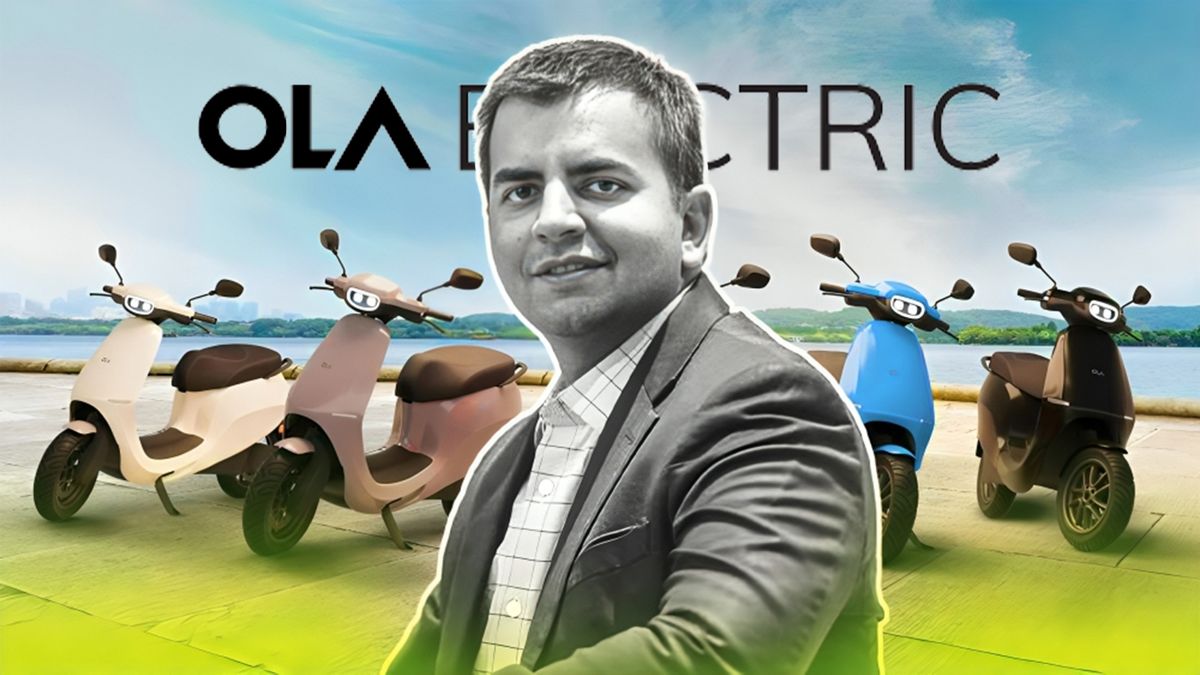
A Strategic Evolution Or A Strategic Distraction?
Stepping back, one broader question emerges.
Is Bhavish Aggarwal building a diversified technology group for the long term or is the AI pivot accelerating at a moment when the EV core needs stabilisation?
From one perspective, the Krutrim move is forward-looking. Artificial intelligence infrastructure, sovereign LLM models and cloud computing are high-growth domains. Building in-house AI capabilities could create synergies across mobility, battery manufacturing and consumer services.
From another perspective, timing matters.
Ola Electric is in the midst of a structural reset. Market share has fallen sharply. Revenue has declined. Losses remain elevated. Brokerages are flagging cash burn and potential fundraising needs.
When a listed company faces operational headwinds, investors typically expect singular focus.
The migration of Ola group entities to Krutrim Cloud in FY26 suggests deeper integration ahead. If Krutrim succeeds independently, it could become a powerful value creator.
But if the EV arm continues to struggle, investors may question whether capital, managerial bandwidth and strategic attention are being optimally allocated.
Leadership bandwidth is finite.
- Can both ambitions scale simultaneously?
- Or does one inevitably demand priority?
This is not the first time a founder has attempted to build parallel verticals. In technology-led businesses, ecosystem building is often the end goal.
Yet markets tend to reward clarity of execution more than breadth of ambition.
And right now, the numbers that investors see – declining market share, reduced store networks, contracting revenue – belong to Ola Electric.
Krutrim, by contrast, remains largely group-supported in revenue terms.
Which brings us back to the core tension of this story:
Is Ola Electric undergoing a painful but necessary recalibration before stabilising?
Or is the centre of gravity slowly shifting from EV manufacturing to AI infrastructure?
The answer may determine whether this ₹57,000 crore erosion marks a temporary reset – or a structural turning point.
The Last Bit, The Final Question
At the heart of Ola Electric’s post-IPO journey lies a difficult but unavoidable question – has leadership focus remained firmly anchored to the listed business at a time when it needed it the most?
High-growth founders often operate with expansive ambition. Building across sectors – mobility, batteries, AI, cloud – can signal vision. But public markets measure outcomes, not intent.
Ola Electric raised capital from public investors on the promise of scale, leadership and execution in the electric mobility space. Within two years, nearly ₹57,000 crore in market value has been erased. Market share has slipped from dominance to single digits. Revenue has contracted. Store networks have been trimmed. Brokerages are flagging cash burn.
Against this backdrop, Bhavish Aggarwal’s visible push into Krutrim (a capital-intensive, long-gestation AI venture) naturally raises questions about prioritisation.
Is the pivot to AI a strategic hedge meant to future-proof the broader group?
Or has the EV business – still in a fragile phase – required deeper operational immersion than it received?
To be clear, diversification is not inherently problematic. Many technology leaders have successfully built multi-vertical ecosystems. But timing and sequencing matter. Investors in Ola Electric did not back an AI holding company. They invested in a pure-play electric mobility story.
If capital, contracts, and managerial bandwidth increasingly flow toward a promoter-owned AI entity while the listed arm navigates operational strain, minority shareholders are justified in seeking clarity.
Even if all transactions are compliant and commercially justified, perception becomes critical. When a company loses market leadership and valuation simultaneously, narratives harden quickly.
For those who invested at the IPO (or near the peak) the experience has been sobering. What was positioned as a category-defining growth engine now faces a rebuilding phase. Trust, once dented, takes time to restore.
The real test ahead is not whether Krutrim succeeds. It is whether Ola Electric stabilises.
- Can market share recover meaningfully?
- Can product reliability and service execution regain consumer confidence?
- Can losses narrow without another round of heavy dilution?
- And can leadership demonstrate unequivocal commitment to fixing the EV core before expanding further outward?
If Ola regains footing, the current phase may be remembered as an aggressive but necessary correction. If it fails to do so, critics may argue that strategic ambition outpaced operational consolidation. The ₹57,000 crore erosion is not just a number. It represents faith placed in a growth narrative that has yet to deliver sustained stability.
Whether Bhavish Aggarwal’s dual focus becomes a masterstroke or a misstep will depend not on vision but on execution, transparency and renewed alignment with shareholder interests.
And that, more than stock price volatility, is the real post-IPO reality Ola Electric must now confront.