Years After Paying For Their Homes BPTP Buyers Are Still Fighting For Power Water And Their Rights
You paid for the home. Then came the maintenance demand before possession, years of delay, power cuts, water shortages and protests for basic utilities. A July 2026 RERA order has now ordered BPTP to return ₹1.16 lakh to a homebuyer. In Faridabad, residents are still fighting for power and water. The question is simple: why does getting what you paid for require another fight?

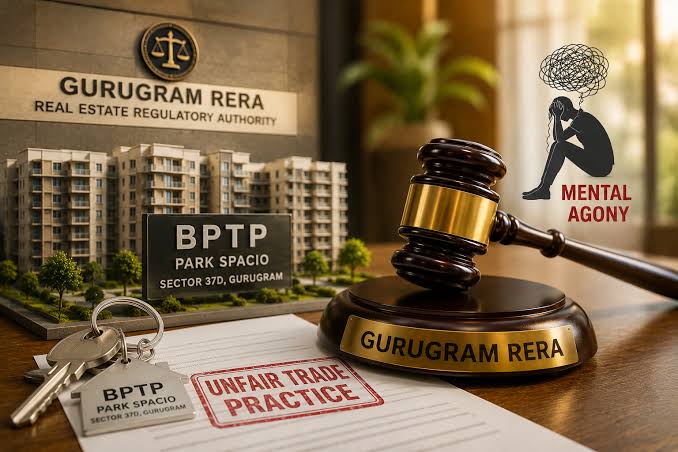
In the first week of July 2026, the Gurugram bench of the Haryana Real Estate Regulatory Authority delivered an order that put a very specific question before BPTP Limited: why was a homebuyer being asked to pay maintenance charges before the home had even been handed over?
The case involved an allottee in BPTP’s Park Spacio project in Sector 37D, Gurugram. The developer had collected ₹1,16,545 as maintenance charges before physical possession of the apartment was handed over.
The authority ordered BPTP to refund the entire amount, along with interest at 11 percent per annum from the date of collection until realisation. It also awarded the complainant ₹1 lakh for mental agony and harassment, along with another ₹50,000 towards litigation costs.
The finding went beyond the amount involved. According to the order, the builder-buyer agreement did not contain a provision allowing BPTP to collect maintenance charges in advance. The authority held that a promoter cannot demand pre-possession maintenance and cannot make payment of such charges a condition for handing over the apartment.
For the homebuyer, that distinction matters. The question was not simply whether ₹1.16 lakh had been wrongly collected. It was whether a buyer who had already committed to purchasing a home could be made to pay an additional charge before receiving possession of it.
The July order answered that question in the buyer’s favour. But it also opens a much larger one. What happens when the dispute does not end with possession?
Because while one BPTP homebuyer was seeking a refund in Gurugram, residents of BPTP developments in Faridabad were taking to the streets over problems that begin after people have already moved into their homes.
When The Fight Continues After Possession
In Greater Faridabad, the dispute has moved beyond what a developer can charge before handing over a home. Residents of several BPTP blocks say they have spent years fighting for something more basic: reliable electricity and water.
Across parts of the long-running Parklands and related developments, residents have complained that individual electricity connections are still unavailable more than a decade after occupation began. Instead, the builder continues to operate through a single-point connection from the distribution company.
For residents, that arrangement has consequences. Power cuts can arrive without notice, while water shortages during the summer have reportedly stretched to 25–40 hours at a time. At the same time, residents have raised concerns over increases in common-area maintenance charges and the quality of services being provided in return.
The frustration has increasingly moved from complaints to public demonstrations. Residents have protested outside BPTP offices, submitted memorandums to the energy minister and other officials, and in some instances resorted to road blockades to draw attention to the issue.
The complaints themselves are not new. Residents have been raising concerns over electricity, water and infrastructure for years. That is what makes the Faridabad protests significant alongside the July RERA order.
In Gurugram, the dispute concerns money demanded before possession. In Faridabad, residents are challenging the conditions they say they continue to face after moving in.
Different projects. Different stages of the homebuying journey. But a strikingly similar question sits underneath both: after buyers have paid for their homes, how long should they have to keep fighting for what they were promised?
The July Order Was Not An Isolated Case
The Park Spacio order becomes more significant when placed alongside the regulatory record involving BPTP’s other projects.
In March 2026, the Gurugram bench of the Haryana Real Estate Regulatory Authority directed BPTP to refund ₹18.12 lakh, along with interest, in a dispute involving units booked in the Park Terra project in Sector 37D.
The units had been booked in 2012. Under the agreement, possession was due by the end of 2016. That deadline passed without the project being delivered as promised.
BPTP had raised a limitation argument in the proceedings. The authority rejected it, holding that the failure to refund the buyer’s money created a continuing liability.
The numbers are different from the Park Spacio case. So is the underlying dispute. But the broader problem is familiar: a buyer commits money to a property based on a contractual promise, the promised timeline passes, and the dispute eventually reaches a regulatory forum.
The same pattern appears in older matters involving projects such as Astaire Gardens in Sector 70A, Gurugram.
Buyers who booked units around 2011 and 2012 were promised possession within roughly three to three-and-a-half years. Instead, many faced delays extending well beyond the contractual timelines. Consumer commissions and RERA benches have subsequently dealt with claims involving refunds, interest and compensation for the delay.
That matters because the latest order cannot simply be viewed as a dispute over one maintenance bill.
The public record contains cases involving different projects, different buyers and different claims. Yet the recurring themes are difficult to miss: delayed possession, disputed charges, demands for refunds, interest on money held by the developer, and compensation awarded after buyers take the matter to a regulator or consumer forum.
For someone looking at BPTP today, the obvious question is no longer just what happened in Park Spacio.
It is how many such cases exist across the wider portfolio.
A Problem That Has Followed BPTP Across Projects
The disputes extend beyond Gurugram.
In Parklands, Faridabad, plotted developments launched in the mid-2000s have generated years of complaints over delayed handover, additional land charges and incomplete infrastructure. Consumer forums have recorded cases in which buyers waited four, six, eight or more years beyond the dates they were originally promised.
Some cases ended with directions to refund the money paid, along with interest. Others resulted in compensation for mental agony and litigation costs.
Then there are projects such as Astaire Gardens, Park Terra, Park Spacio and Amstoria, where buyers have raised different versions of the same fundamental complaint: the experience of owning the property has not matched what was promised when the property was sold.
That distinction is important.
A developer can point to individual disputes and argue that each case has its own facts. And legally, each complaint does have to be examined on its own terms. But for a homebuyer, the cumulative record tells a different story.
Across projects launched between roughly 2005 and 2015, the public record contains disputes over possession timelines, refunds, additional charges, infrastructure and basic services. Regulatory and consumer forums have repeatedly had to step in and quantify what buyers say they were owed.
The figures attached to those cases are not abstract.
₹18.12 lakh ordered back in the Park Terra matter. ₹1.16 lakh refunded in the recent Park Spacio case. Eleven percent interest in the maintenance dispute. ₹1 lakh awarded for mental agony and harassment. Years of delay in projects where possession had originally been promised within a much shorter period.
Taken individually, these are cases involving individual homebuyers.
Taken together, they raise a much harder question about whether the problems should still be viewed as isolated disputes between a developer and a few dissatisfied customers.
And that is where the story moves beyond individual complaints and towards the experience of the BPTP homebuyer as a whole.
What Is A Homebuyer Actually Protected Against?
A builder-buyer agreement is supposed to make the relationship simple. The developer promises a home by a particular date and sets out what the buyer has to pay and when.
But the disputes involving BPTP raise a more uncomfortable question: how much protection does that contract actually provide when one side has considerably more power than the other?
In the Park Spacio matter, the authority found that the agreement did not support the developer’s demand for advance maintenance charges. In delay cases, contractual possession dates have been used to determine whether buyers were entitled to interest or compensation.
The problem is what happens before a buyer gets that legal protection.
A homebuyer may have already committed life savings, taken a home loan and waited years for possession. Challenging an additional charge or a delayed handover means filing a complaint, producing documents, engaging counsel and waiting for an authority or consumer forum to decide the matter.
Even when the buyer ultimately wins, the process itself comes at a cost.
That creates an uncomfortable imbalance. The developer can collect money, set timelines and manage the project. The buyer may have little practical choice but to accept delays or additional demands until the dispute becomes serious enough to pursue legally.
And not every buyer will pursue it.
Some may simply pay the disputed amount to avoid further delays. Others may continue waiting. Some may decide that the time, legal expense and uncertainty involved in fighting a developer are not worth the potential recovery.
Which means the cases that reach RERA or a consumer forum may represent only the visible part of a much larger problem.
The July order therefore matters for more than the ₹1.16 lakh it returned. It shows what can happen when a buyer challenges a demand and the regulator examines whether that demand had a contractual basis.
The bigger question is how many buyers faced the same demand, paid it, and never challenged it.
The Price Of Getting What You Already Paid For
For a homebuyer, the cost of a property does not end with the purchase price.
There are EMIs to service, maintenance charges to pay and, in many cases, years of waiting before the promised home becomes a reality. When basic services remain unresolved after possession, the buyer can find themselves paying for a home while continuing to fight over the conditions in which they actually live.
That is the issue emerging from the Faridabad protests.
Residents say they have been living with single-point electricity supply years after occupation, along with unannounced power cuts and prolonged interruptions in water supply. They have approached officials, submitted memorandums and taken their grievances to the streets.
The question is not whether electricity or water is an additional luxury. It is whether a completed residential development should still leave residents fighting for reliable access to basic utilities years after they have paid for their homes.
The same tension appears in the maintenance disputes.
A buyer can reasonably expect to pay for services that are actually being provided. But when charges rise while residents continue to complain about power, water or infrastructure, the question of where the money is going becomes unavoidable.
This is where the individual cases begin to connect.
The Park Spacio order concerns money collected before possession. The Park Terra matter concerns a project delivered years after its promised deadline. The Faridabad protests concern residents who say that even after occupation, basic services remain unresolved.
Different complaints. Different projects. Different years.
But from the buyer’s side, the experience can feel remarkably similar: money goes out on time, while the promised outcome does not always arrive on time.
And when residents have to protest, approach ministers or go to RERA and consumer forums to secure what they believe they were already entitled to, the question is no longer simply how much a home costs.
It is how much more a buyer has to spend – in money, time and patience – to get what that purchase was supposed to deliver.
When Does A Pattern Become A Pattern?
There is no single case in the public record that answers that question.
What exists instead is a trail of individual orders, complaints and protests spread across different BPTP projects and different years.
One order directs a refund of ₹1.16 lakh with 11 percent interest. Another directs the return of ₹18.12 lakh with interest. Elsewhere, buyers have pursued compensation for delayed possession, mental agony and litigation costs. In Faridabad, residents continue to campaign over electricity, water and infrastructure.
The repetition is what deserves attention.
Pre-possession charges. Multi-year delays. Refund claims. Compensation orders. Infrastructure complaints. Single-point electricity supply. Water interruptions. Maintenance disputes.
How many RERA orders over delayed possession are enough before the issue is considered systemic? How many complaints over basic utilities are enough before they stop being treated as isolated resident grievances? And how many buyers have to win individual cases before the underlying problem is addressed without requiring every new buyer to fight the same battle?
The answers matter because buying a home is not an ordinary transaction. For most people, it is a decade-long financial commitment.
And when that commitment repeatedly ends with the buyer having to chase the developer, the regulator or the authorities for basic contractual or civic obligations, the question becomes much bigger than any single order.
The Last Bit, The Questions BPTP Homebuyers Are Still Left With
The July 2026 RERA order dealt with what BPTP could demand before handing over a home. The Faridabad protests deal with what residents say they are still being denied after moving in.
Together, they cover two very different points in the homebuying journey. And that leaves homebuyers with some very straightforward questions.
How many regulatory findings are required before charges that have been found impermissible are stopped across projects?
How many years can residents remain on a single-point electricity connection before the absence of individual meters becomes an unreasonable delay?
How many prolonged water interruptions are acceptable after residents have paid for and occupied their homes?
And how many RERA and consumer forum orders involving delayed possession, refunds, interest and compensation are needed before repeated disputes are examined as a wider pattern rather than one case at a time?
The public record cannot answer all of those questions. It can, however, establish that the complaints are not new and that some buyers have already secured formal findings in their favour.