For Two Decades, Aashirvaad Sold India The Promise Of Pure Atta. Now The FSSAI Wants To Know What “100%” Really Means
If the flour isn’t the scandal, why has the language on the bag become important enough for India’s food regulator and one of its biggest conglomerates to go to war over it? Aashirvaad built its empire on purity. Now, FSSAI is questioning the promise printed on every packet. But - if a regulator identifies a potentially misleading claim in May 2025, what machinery is supposed to ensure that consumers are protected while the regulator decides what to do about it?

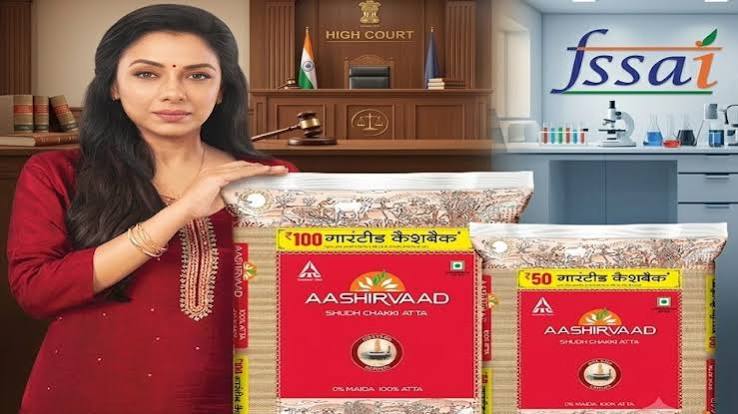
On 10 August 2026, India’s food regulator FSSAI – put a rather uncomfortable question to ITC: why should Aashirvaad’s claims of “100% Atta”, “100% Madhya Pradesh Wheat” and “Made from 100% M.P. Wheat only” not attract action?
Three days later, the Central Licensing Authority in Kolkata followed with an Improvement Notice.
The instruction was blunt: remove “100% Atta & 100% Madhya Pradesh Wheat” and “0% Maida” from labels, advertisements and websites within 15 days, or risk suspension of the FSSAI licence.
That sounds, at first glance, like a story about what is inside the bag, but in actuality it isn’t!
There is no finding on the official record that Aashirvaad has been secretly mixing maida into its atta. There is no established finding that its wheat is coming from somewhere other than Madhya Pradesh. There is no regulatory finding that the flour being sold across India is toxic, adulterated or somehow unfit for the family roti.
Even the old internet horror story about Aashirvaad dough turning into “plastic” does not survive scrutiny. What consumers were seeing was gluten — the protein in wheat that gives dough its elasticity and FSSAI itself has described the plastic claim as a malicious mislabelling of gluten. Courts have also intervened against the circulation of those allegations.
So what, exactly, has brought one of India’s biggest food brands into a regulatory fight?
The answer is sitting in plain sight on the front of the packet. 100%. And beside it: 0% Maida.
Those numbers look reassuring because numbers usually do. They have the visual authority of a laboratory result. But a percentage is only as meaningful as the thing being measured.
FSSAI’s objection is not that Aashirvaad has been caught putting the wrong flour in the bag. Its objection is that the language itself can create what the regulator calls a false impression of purity or superiority.
That is a very different allegation and, in some ways, a more interesting one – because Aashirvaad has spent more than two decades turning a bag of wheat flour into something far bigger than a commodity. It has sold chakki, Madhya Pradesh wheat, shuddhata, motherhood and reassurance in one carefully designed package.
Now the regulator is asking whether the reassurance went too far since the flour may be ordinary but the promise printed above it is anything but.
THE NUMBER THAT ISN’T IN THE LAW
The problem with “100%” began well before FSSAI came knocking on ITC’s door.
On 28 May 2025, the food regulator issued an advisory asking food businesses across the country to stop using “100%” on labels, packs and promotional material.
The accompanying press note made the regulator’s concern unusually clear: the term is not defined under the Food Safety and Standards Act, 2006, or under the Food Safety and Standards (Advertising and Claims) Regulations, 2018.
Hence, the FSSAI was not objecting to percentages as such. It was objecting to what the percentage made a consumer believe.
According to the regulator, the growing use of “100%” claims could create a false impression of absolute purity or superiority. Such language, FSSAI said, could also make consumers believe that products without the claim were somehow inferior or non-compliant. The regulator pointed to Regulation 4(1), which requires food claims to be truthful, unambiguous, meaningful and not misleading, as well as Regulation 10(7), which deals with cms that undermine other manufacturers or distort consumer perception.
That distinction is central to the Aashirvaad case.
FSSAI is not saying that the number “100” has somehow contaminated the flour. It is saying that the number can do something more powerful in the consumer’s mind: it can turn an ordinary description into an assertion of absolute purity.
Consider what happens when a shopper sees “100% Atta” on one packet and nothing comparable on another. The first product appears complete, uncompromised and unquestionably pure. The second does not have to be accused of containing maida for the comparison to take place in the shopper’s mind. The absence of the claim can itself begin to look like a deficiency.
That is why “0% Maida” matters as much as “100% Atta”.
Aashirvaad’s packaging does not merely tell the consumer what the company says it has put into its own product. It establishes a contrast. One packet announces that it contains “0% Maida”; the implication is left for the consumer to complete. If this packet has none, what about the packet beside it? FSSAI’s position is that such language can create precisely the kind of misleading impression the regulations are intended to prevent.
There is another problem with the number. “100%” sounds scientific even when the underlying proposition is not.
It does not, by itself, tell a consumer about the extraction rate of the flour, its ash content, the proportion of bran retained, the precise milling process or any broader measure of nutritional superiority. It simply gives the claim an air of mathematical certainty. The number looks like evidence because it is a number.
That is the power of the packaging.
ITC, however, has challenged the regulator’s approach. In court, the company has argued that the August notices do not actually establish that its “100% Atta” claim is false.
—It has also argued that the May 2025 advisory does not have the force of law and that a binding prohibition cannot be created through an advisory or circular without following the prescribed legal process.
—ITC has further raised objections concerning the timing of the notices and the commercial consequences of removing the claims, including changes to packaging, possible delisting and destruction of existing stock.
Those are serious legal arguments, and they deserve to be heard on their own terms.
But they leave the consumer with a deceptively simple question.
If “100% Atta” is merely a truthful description of what is inside the bag, why does the number need to carry such an absolute promise of purity and superiority?
That is the question sitting underneath the legal dispute.
And it is why this fight is not really about whether Aashirvaad contains maida. It is about whether a company can take a word that sounds like a laboratory conclusion, print it in large type on a staple food, and rely on the consumer to supply the certainty that the law itself never defined.
HOW AASHIRVAAD BUILT THE HALO
When Aashirvaad was launched on 27 May 2002, packaged atta was still a relatively narrow category in India. For generations, households had bought wheat and taken it to the neighbourhood chakki, where the flour was milled for immediate use. The idea that the family’s daily atta could instead arrive in a branded packet was not yet an obvious proposition.
ITC saw an opportunity in that gap.
The company did not simply try to sell another packet of wheat flour. It set out to make packaged atta feel safer, cleaner and more dependable than the loose flour sitting at the local mill. Its sales teams distributed samples at flour mills, putting the branded product directly into a market that had traditionally belonged to the neighbourhood chakki. Within four years, Aashirvaad had overtaken national rivals, while Hindustan Unilever eventually exited the competing atta business.
The strategy worked because ITC understood something that the flour itself could never explain: atta is not bought only as a commodity. It is bought as a decision about the family.
The person choosing the flour is not usually comparing wheat varieties in a laboratory. They are deciding what will become the rotis served at home that evening and for the next several weeks. That makes trust unusually valuable. Once a brand persuades a household that its flour is cleaner, purer and more dependable, the packet acquires a meaning far beyond its contents.
Aashirvaad built precisely that meaning.
The name itself was perfectly suited to the task. “Aashirvaad” means blessing, and the brand steadily surrounded that blessing with a vocabulary of reassurance: shuddh atta, chakki grinding, Madhya Pradesh wheat and, eventually, the emphatic declarations of “100% Atta” and “0% Maida”. The language did not merely describe a product. It helped turn the purchase of flour into an act of responsible household choice.
That distinction became increasingly important as the branded atta market expanded.
Aashirvaad was no longer competing only with another sack of wheat. It was competing with the consumer’s inherited trust in the neighbourhood mill. The branded packet had to persuade the buyer that convenience had not meant compromise and that the factory could somehow reproduce the confidence of the local chakki at industrial scale.
By 2026, that strategy had made Aashirvaad the dominant name in branded atta, with the company claiming more than 45 per cent of the branded atta market. Aashirvaad also contributes more than a third of ITC’s packaged-foods revenue, making the brand commercially significant well beyond the flour aisle.
That is why the words printed on the packet matter and that is the halo FSSAI is now challenging.
BEFORE “100%”, THERE WAS ANOTHER PROMISE
The fight over Aashirvaad’s language did not begin with the number “100%”. A decade earlier, the brand had already found itself on the wrong side of a regulatory complaint over what its advertising allowed consumers to believe.
In August 2016, the Advertising Standards Council of India’s Consumer Complaints Council upheld a complaint against an Aashirvaad Sugar Release Control Atta advertisement.
The commercial promoted the product’s “natural grain mix” and suggested that it could prevent a sudden rise in blood sugar. More importantly, the advertisement told consumers that they could eat rotis without worrying about their sugar levels.
ASCI found the messaging misleading by ambiguity. The problem was not simply whether the product had a lower glycaemic index. The concern was that a consumer, particularly someone dealing with diabetes, could understand the advertisement as giving them permission to eat the rotis without meaningful limits.
That distinction matters because it reveals how advertising can create a promise without ever stating the promise in quite those words.
A product can have a particular nutritional characteristic. The advertisement can then wrap that characteristic in language that makes the consumer infer something considerably bigger.
In 2016, the issue was health and in 2025 and 2026, the issue became purity.
The two cases are not identical, and they should not be treated as proof that Aashirvaad has systematically deceived consumers. They do, however, belong to the same broader history of a brand whose advertising has repeatedly relied on the space between what a product technically contains and what the consumer is encouraged to believe about it.
That space is where marketing becomes powerful.
WHAT IS ACTUALLY IN THE BAG?
This is where the story needs to become uncomfortable in a different way, because the evidence does not support the easiest accusation.
There is no verified finding in the material reviewed that Aashirvaad Shudh Chakki Atta is a disguised packet of maida. The product’s own nutrition panel describes a conventional whole-wheat flour, with approximately 340 calories, 10.5 grams of protein, 76.8 grams of carbohydrate, 10.8 grams of dietary fibre and 1.4 grams of fat per 100 grams.
On that evidence alone, there is nothing remotely resembling the internet’s favourite image of a mysterious industrial substance masquerading as food.
The same caution applies to Aashirvaad’s other variants. Multigrain and high-protein versions may contain ingredients such as soya, oats, psyllium and gram, but that does not make them adulterated flour. They are different formulations sold as different products.
The maida theory also deserves more scrutiny than it has received online. Food technologists and fact-checkers cited in the material have pointed out that the supposed economic incentive is weaker than viral claims suggest, since maida is not simply a dramatically cheaper substitute that allows a manufacturer to make easy money by diluting atta. Packaged atta is also subject to labelling and food-safety requirements governing what can and cannot be added without disclosure.
Then there is the plastic story.
Videos showing dough being washed until a rubbery mass remained were circulated as evidence that manufacturers were putting plastic into atta. What the videos were actually demonstrating was gluten, the wheat protein that remains after starch is washed away. FSSAI has itself addressed the claim and described the supposed plastic as gluten that had been maliciously mislabelled.
That does not mean every complaint against Aashirvaad should be dismissed.
The material also contains consumer complaints concerning insects, larvae, hard lumps in sealed packets and worms found in flour. Those complaints are worth recording because they show that a mass-produced food product can encounter ordinary quality-control and storage problems somewhere between factory, warehouse, retailer and kitchen. But they do not establish a national adulteration scheme, and they cannot substitute for laboratory evidence.
The distinction is important.
A complaint is not a laboratory report. A viral video is not a food-safety finding. And the presence of gluten in wheat dough is not evidence of plastic. The available evidence therefore does not support the dramatic sentence that Aashirvaad has been feeding India “junk flour” since 2002.
But removing that allegation does not make the regulatory dispute disappear. It makes the actual dispute harder to evade.
Because if the flour is not the scandal, then the question returns to the packet.
What exactly is Aashirvaad promising when it says “100% Atta”, “100% Madhya Pradesh Wheat” and “0% Maida”?
And if those claims are being challenged not because the flour has been proved dangerous, but because the language creates an exaggerated impression of purity and superiority, then the real battleground is not the mill but marketing.
THE FIFTEEN-MONTH GAP
The dates matter because they change the character of the dispute.
On 28 May 2025, FSSAI issued its advisory asking food businesses to stop using “100%” on labels, packs and promotional material. The regulator’s position was already on record: the term was undefined and could create a false impression of absolute purity or superiority.
Then came silence.
For roughly fifteen months, Aashirvaad continued to carry the very claims that had been singled out in that advisory. There was no immediate packaging revolution, no visible retreat from “100% Atta”, and no voluntary removal of “0% Maida” from the front of the bag.
Then, on 10 August 2026, FSSAI issued its show-cause notice to ITC. Three days later, the Central Licensing Authority in Kolkata issued an Improvement Notice giving the company 15 days to remove the claims from its labels, advertisements and website, failing which the FSSAI licence could face suspension.
That sequence is difficult to ignore.
The regulator had already announced its position in 2025. ITC had already had months to consider what that position meant for its packaging. Yet the confrontation only became urgent when the regulator moved from an industry-wide advisory to a notice attached to the company’s licence.
That is why the argument over timing matters.
ITC says the advisory itself did not have the force of law and that FSSAI could not transform a circular into a binding prohibition without following the legal process required for making regulations. It has also challenged the manner and timing of the August action, arguing that the improvement notice arrived while the show-cause process was still unfolding.
There is a legitimate legal question here. A regulator cannot simply invent binding law through informal instructions and then punish companies for failing to obey rules that were never properly created. If that were permissible, the distinction between an advisory and a regulation would become dangerously thin.
But there is another question that ITC’s legal argument does not answer.
—If the company believed the 2025 advisory was legally defective, why continue printing the disputed claims for another fifteen months instead of removing them temporarily and challenging the advisory separately?
—And if the company believed the claims were plainly lawful, why did the issue suddenly become serious only when the licence itself was placed at risk?
The answer may be procedural. It may be commercial. It may ultimately be a matter for the courts. But there is an obvious business calculation underneath it.
Changing the front of a packet is not as simple for a company of this size as deleting two words from a website. Aashirvaad operates at enormous scale. Existing packaging has to be replaced, finished stock has to be accounted for, distributors and retailers have to be managed, and the brand has to absorb the reputational effect of suddenly abandoning claims that have been central to its identity for years.
ITC has described those consequences as serious commercial and reputational harm. That is precisely what makes the fifteen-month gap so revealing.
The dispute is no longer simply about whether “100%” is an innocent description. It is about how much a market leader is willing to fight to keep a description that FSSAI has already warned the entire industry against using.
ITC TAKES THE FIGHT TO COURT
ITC did not accept the August notices quietly. It went to the Delhi High Court, and its defence is built around a point that sounds technical until the consequences are considered: FSSAI cannot turn an advisory into a binding prohibition simply by treating it as one.
ITC’s position, as recorded in the proceedings, is essentially that the regulator cannot punish the company for using a claim that no existing regulation expressly prohibits merely because FSSAI has subsequently decided that the claim should not be used.
The company has also challenged the legal status of the May 2025 advisory. Its argument is that an advisory does not carry the same force as a regulation and that a binding restriction cannot be created through a circular without following the prescribed process, including publication and the necessary governmental and parliamentary steps.
There is a procedural argument as well. ITC has pointed to the timing of the August action, including the fact that the Improvement Notice was issued before the 30-day show-cause period had run its course. The company has also warned of the practical consequences of being forced to change the packaging at such scale, including the possibility of stock being delisted or destroyed and the resulting commercial and reputational damage.
None of these arguments is frivolous.
A regulator exercising statutory power has to stay within the law. If FSSAI wants to prohibit a particular form of advertising, there is a legitimate question about whether it can do so through an advisory and then enforce that position through the licensing regime. The distinction between guidance and law exists for a reason, and a large company is entitled to insist that the distinction be respected.
But ITC’s defence also exposes the central tension in the case.
The company is not principally arguing that consumers should be allowed to believe something false. It is arguing that the regulator has not followed the correct legal route to stop it from making the claim.
And that is exactly where the Delhi High Court has temporarily placed it.
On 25 August, Justice Swarana Kanta Sharma directed FSSAI not to proceed with cancellation of ITC’s licence until 9 September. The court did so while the question of jurisdiction itself remained unresolved. FSSAI argued that because the Improvement Notice had originated in Kolkata, Delhi was not the appropriate forum. ITC, in response, argued that its central licensing arrangements and senior management were connected to Delhi and that part of the cause of action arose there.
THE COURTROOM IS NOT THE KITCHEN
There is a strange distance between the argument being made in court and the decision being made at the supermarket shelf.
In court, the dispute is about jurisdiction, procedure, statutory authority and whether FSSAI can enforce its position on “100%” through the licensing process. Those questions matter because regulators, however powerful, are still bound by the law that gives them their power.
But none of those questions is visible to the person buying atta.
That consumer sees a packet carrying a series of unusually confident assurances. The packet says “100% Atta”. It says “100% Madhya Pradesh Wheat”. It says “0% Maida”. The consumer is not expected to read the FSSAI advisory, examine the Advertising and Claims Regulations or decide whether an Improvement Notice was legally issued from Kolkata or Delhi.
The consumer is expected to understand the packet and packaging is designed precisely for that purpose.
A shopper standing in front of a supermarket shelf may have several brands of atta in front of them. Most will look broadly similar. They will all contain wheat flour, carry nutrition information and make some version of the usual claims about taste, quality or processing.
Then one packet tells the shopper that it is 100%. Another tells the shopper that it contains 0% Maida.
The distinction may appear small on paper, but it is commercially enormous. A consumer does not need to consciously conclude that every competing packet contains maida for the comparison to influence the purchase. The claim creates a hierarchy in which one product presents itself as uncompromised and leaves the consumer to wonder what the others might be compromising on.
That is why FSSAI’s argument cannot be dismissed simply as a fight over typography.
The regulator’s position is that the language can create a false impression of purity or superiority. The company’s position is that the regulator cannot enforce that conclusion without the proper legal authority and process. Both questions can exist at the same time.
There is also a reason this matters more for Aashirvaad than it might for an obscure regional flour brand.
THE ITC PARADOX
There is another layer to the Aashirvaad story that makes the language of purity particularly interesting. The brand belongs to ITC, a conglomerate whose modern identity spans cigarettes, hotels, paper, agri-business and packaged foods, but whose historical financial strength was built around tobacco.
That does not make Aashirvaad’s flour unsafe, nor does it make its advertising misleading by itself. Corporate ownership cannot substitute for evidence. But it does create an uncomfortable contrast when a company with such a deep history in tobacco builds one of India’s most successful food brands around the language of purity, wholesome eating and household trust.
Aashirvaad has turned that trust into a formidable commercial asset. It is also why the current regulatory dispute matters more than the removal of two or three words from a packet.
When a small food company changes a claim, the consequences may be limited to a redesigned label. When a dominant national brand changes the language through which millions of consumers have been taught to understand its product, the change can affect the brand’s entire positioning.
The commercial stakes are therefore obvious.
ITC has told the court that removing the disputed claims could require extensive packaging changes, create problems with finished stock and result in serious commercial and reputational harm.
But there is an irony in that argument. The company is effectively saying that the words are valuable because consumers have come to associate them with the brand. That is precisely what makes FSSAI’s objection significant.
THE BILL
The immediate question is what happens on 9 September, when the Delhi High Court is due to take up the matter again. Before the court can get to the larger dispute over Aashirvaad’s claims, it may first have to decide whether Delhi is even the appropriate forum. FSSAI has argued that the Improvement Notice originated in Kolkata, while ITC has maintained that the licensing arrangement and part of the cause of action are connected to Delhi.
That may sound like a procedural detour, but it is hardly irrelevant. If the case remains in Delhi, the court could eventually have to examine whether FSSAI can act against the disputed claims under the existing regulatory framework, and whether its 2025 advisory provides sufficient legal foundation for the action taken against ITC.
If the court sends the matter elsewhere, the argument does not disappear. It simply moves to another courtroom, while the same words remain on the same packets in shops across the country.
And that is where the real consequence of this case lies.
The real question is whether a market leader can use the language of absolute purity to distinguish its product from the rest of the shelf when the regulator believes that language gives consumers a false impression.
That leaves us with two facts that should not be confused.
—FSSAI has formally challenged Aashirvaad’s “100%” and “0% Maida” claims as potentially misleading.
—At the same time, there is no official finding in this dispute that Aashirvaad has been caught selling maida as atta.
The first is the regulatory story and the second is why the story is not a conventional adulteration scandal. What is under examination is the space between a product and the promise attached to it.
WHEN PURITY BECOMES A BUSINESS MODEL
The Aashirvaad dispute matters because the language at issue is not unique to one packet of atta. The food industry has increasingly learned that consumers respond to absolute claims because absolute claims remove doubt. “100%”, “pure”, “natural”, “zero” and similar words are easy to understand, easy to remember and even easier to put on the front of a package.
The problem begins when those words stop describing a measurable characteristic and start creating a hierarchy between products.
In that sense, Aashirvaad is not an isolated case. It is a particularly visible case because of the size of the brand and the intimacy of the product.
Atta enters the most ordinary part of Indian life. It becomes rotis, parathas and food packed into lunchboxes. It is purchased repeatedly, often by people who are not interested in deciphering technical distinctions between milling processes or regulatory definitions. They are looking for a product they can trust.
That makes the front of the packet unusually powerful.
A manufacturer does not have to make an explicit accusation against its competitors to influence that choice. It can simply describe its own product in language so absolute that the alternatives begin to look uncertain by comparison.
This is where “0% Maida” becomes particularly important.
The literal claim concerns what is absent from Aashirvaad. The commercial effect may extend much further. It can make the consumer ask whether maida is present somewhere else, even when no competing brand has been accused of containing it.
That is the genius of comparative advertising when it works.
WHILE THE PACKETS KEPT SELLING
The most uncomfortable date in this story may not be 10 August 2026. It may be 28 May 2025.
That was when FSSAI had already told food businesses across India to stop using “100%” claims on labels, packs and promotional material. The regulator had already identified the problem. It had already said that the expression was undefined and could create a false impression of absolute purity or superiority.
Yet Aashirvaad did not disappear from the shelves. The packets did not suddenly lose their “100% Atta” and “0% Maida” claims. Consumers continued buying them, cooking with them and feeding their families with them.
For another fifteen months, the warning remained a warning.
Then, on 10 August 2026, FSSAI issued its show-cause notice to ITC. Three days later, the Central Licensing Authority in Kolkata issued an Improvement Notice giving the company 15 days to remove the disputed claims from its labels, advertisements and website, failing which its licence could face suspension.
That raises a question that has very little to do with ITC’s lawyers.
If the regulator knew the language could mislead consumers in May 2025, why did consumers have to wait until August 2026 for action against one of the country’s biggest brands?
There may be perfectly legitimate answers. FSSAI does not conduct every enforcement action from one central desk, and food-safety enforcement involves both the national regulator and state authorities. The system also has to deal with inspections, sampling, testing, licensing, adjudication and the legal requirements that stand between an advisory and an enforceable action.
But those explanations only make the question more important.
A regulator can take time to establish a violation. It can take time to test a product. It can take time to investigate a manufacturer. It can take time to build a legally defensible case.
This particular dispute is different. FSSAI had already publicly stated its position on the use of “100%”. So what happened during the fifteen months between the warning and the enforcement action?
That is the peculiar asymmetry of food regulation. A label can be corrected after the fact, but a consumer cannot retroactively unsee the claim, return the rotis already eaten or recover the purchasing decisions made on the basis of a promise that the regulator later determined was potentially misleading.
And this is where the issue becomes larger than Aashirvaad.
If regulatory action routinely arrives only after an advisory, an investigation, a notice and a legal challenge, then the system is necessarily better at correcting the market after the fact than preventing the questionable claim from shaping the market in the first place.
That does not mean every delay is negligence. It does not mean FSSAI could have legally forced every company to change its packaging the morning after the 2025 advisory.
It does mean that the gap deserves scrutiny, particularly when the regulator itself says the language can influence consumers into believing that one product is purer or superior to another.
The question is therefore not simply why ITC continued using the claims. It is also why the system allowed the claims to continue carrying commercial weight after the regulator had already identified the problem.
Because by the time an Improvement Notice arrives, the market has already done what advertising is designed to do. It has created a belief.
Aashirvaad did not build its reputation in thirteen days. It built it over twenty-four years. The “100%” language became part of that accumulated reassurance, and millions of purchasing decisions were made long before the regulator decided that the language needed to come off the bag.
That is the part of the story that cannot be measured by the 15-day deadline in the Improvement Notice. The deadline tells ITC how quickly it must change the packet. It tells us nothing about how many packets consumers had already bought.
And that may be the more important question.
THE LAST BIT, THE QUESTION THAT REMAINS
By the time the court considers the matter on 9 September, the packet may still look exactly as it has for years. The same brand name will be there. The same promises of atta and Madhya Pradesh wheat will be there. The same language that helped turn Aashirvaad into a household default may still be sitting in kitchens across the country.
What may change is what those words are allowed to mean.
That is the real significance of this case.
If ITC succeeds, the company will have established an important legal principle: a regulator cannot turn an advisory into an enforceable prohibition without following the statutory process required to make the prohibition binding. That would be a consequential ruling for food companies far beyond Aashirvaad.
If FSSAI succeeds, the message will be equally significant. Food companies may not be able to rely on technically defensible wording when the overall impression created by that wording crosses the line into misleading advertising. The front of the packet could matter as much as the ingredients printed on the back.
Neither outcome will answer every question about food advertising in India.
But the case has already exposed one uncomfortable truth about the packaged-food business. Consumers do not buy ingredients alone. They buy the confidence created around those ingredients, and the larger the brand, the more valuable that confidence becomes.