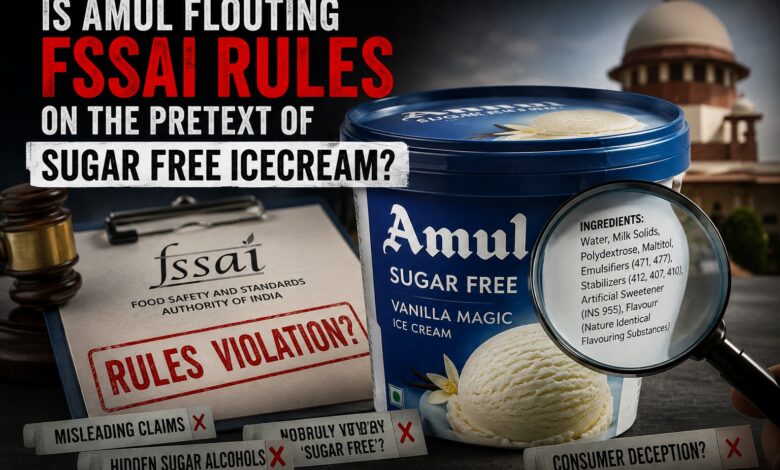
Sugar Free in Name Only: How Amul’s Ice Cream Exploits a Regulatory Loophole While Regulators Look Away
In the crowded freezer aisle of any Indian supermarket, one product stands out with a promise that feels almost too good to be true. “Amul Sugar Free” ice cream, available in vanilla, saffron, and other flavours, is marketed as the guilt-free indulgence for diabetics, health-conscious consumers, and anyone trying to cut down on sugar. The packaging is clean, the branding is confident, and the words “Sugar Free” are printed large and bold. For millions of Indians managing blood sugar or simply watching their diet, that label is decisive. They pick it up, pay a premium, and walk away believing they have chosen a product free of the very substance they are trying to avoid.
The reality is more complicated — and, according to the letter of Indian food law, more problematic.
Under the Food Safety and Standards (Advertising and Claims) Regulations framed by the Food Safety and Standards Authority of India (FSSAI), a product may claim to be “Sugar Free” or “Free of Sugar” only if it contains not more than 0.5 grams of sugars per 100 grams (or per 100 ml for liquids). The definition of “sugars” is clear: it includes all mono- and disaccharides, sucrose, glucose, fructose, lactose, and others. The threshold is deliberately tight. It is meant to protect consumers from being misled by marketing language that suggests a product is virtually devoid of sugar when it is not.
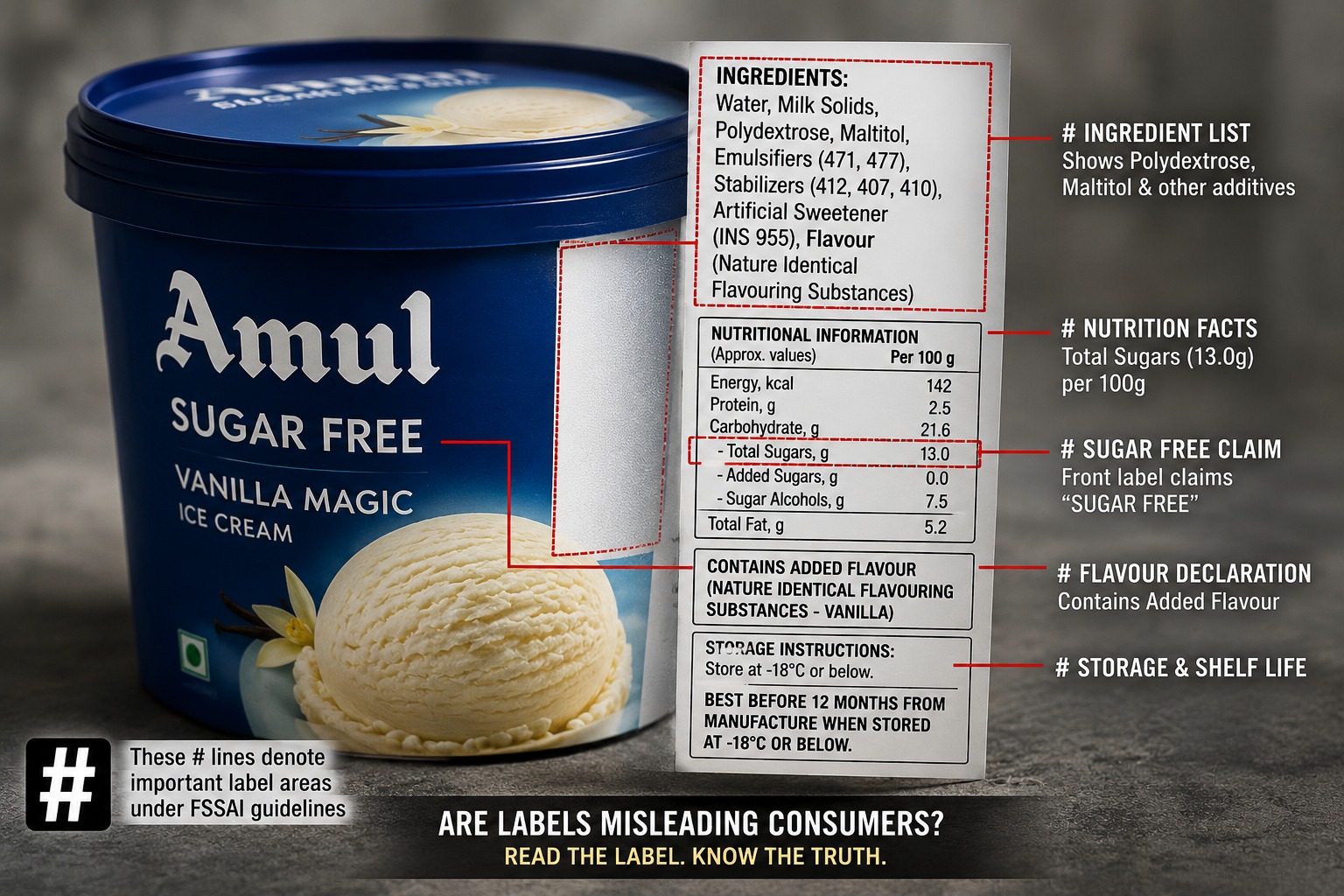
Amul’s “Sugar Free” ice cream does not meet this threshold. Independent nutrition data and product labels show total sugars in the range of approximately 4 to 6 grams per 100 grams, primarily from the natural lactose present in milk solids. In one commonly cited serving size of about 67 grams, total sugars have been reported around 4 grams. That works out to roughly 6 grams per 100 grams, more than 10 times the maximum permitted for a “Sugar Free” claim.
Amul has not added table sugar or other conventional caloric sweeteners. The product relies on polydextrose, fructo-oligosaccharides, and the high-intensity sweetener sucralose to deliver sweetness and texture. In that limited sense it is “no added sugar.” But the FSSAI rule for a “Sugar Free” claim does not distinguish between added sugar and naturally occurring sugar. Total sugars count. And on that measure, the product fails the test.
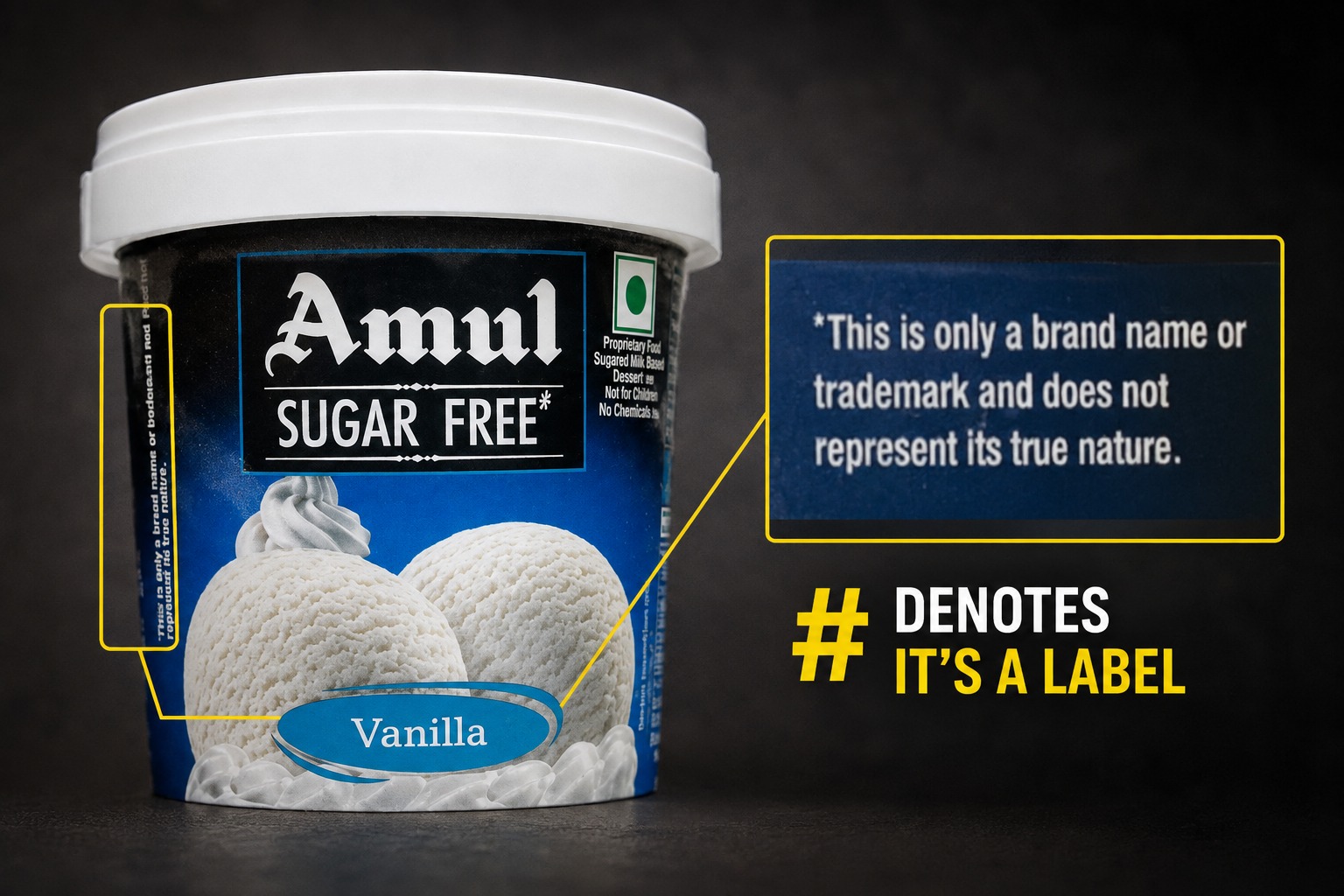
What Amul has done instead is clever, and some would say cynical. On the front of the pack the words “Sugar Free” appear prominently, often accompanied by a small hash or asterisk. On the back, in fine print, a disclaimer appears stating that “Sugar Free# is only a trademark and does not represent the product’s true nature.” In other words, the company is not making a regulated nutritional claim. It is using “Sugar Free” as a brand name, a registered or asserted trademark, and then explicitly disclaiming that the name reflects the product’s composition.
This is a classic regulatory grey-area manoeuvre. By converting a nutritional claim into a trademark, Amul attempts to step outside the strict confines of the Advertising and Claims Regulations while still enjoying the commercial benefit of the most powerful health-related words in the food marketing lexicon. Consumers see “Sugar Free.” Very few read the microscopic disclaimer. Fewer still understand the legal distinction between a trademark and a nutrient claim. The result is predictable: people who should be cautious about sugar intake treat the product as safe.
The practice raises an obvious question. If the product cannot meet the 0.5 g threshold, why is it allowed to carry the words “Sugar Free” at all? The answer lies less in the clarity of the law and more in the practical realities of enforcement against a company of Amul’s size and stature.
Amul is not an ordinary private corporation. It is the brand of the Gujarat Cooperative Milk Marketing Federation, a massive cooperative structure that sits at the heart of India’s dairy economy. It enjoys enormous goodwill, political goodwill, and a reputation built over decades as a successful, farmer-owned enterprise. Challenging Amul is not like challenging a fly-by-night food start-up. It means taking on an institution that employs or supports hundreds of thousands of milk producers, that has deep relationships with state governments, and that commands significant public affection.
Regulators know this. Consumer organisations know this. Competing brands know this. The result is a curious silence. There have been occasional social-media complaints, a few Reddit threads, and scattered articles questioning the labelling. There has been no sustained regulatory action, no high-profile show-cause notice that forced a nationwide label change, and no consumer class-action of the kind that would force a company of Amul’s scale to retreat. The disclaimer remains. The big “Sugar Free” lettering remains. Sales continue.
This is not an isolated case of creative labelling. Across the Indian packaged food industry, “Sugar Free,” “No Added Sugar,” “Low Sugar,” and similar claims are used with varying degrees of precision. Some brands carefully stay within the numerical limits. Others push the boundaries. What distinguishes the Amul case is the explicit admission, printed on the pack itself, that the words do not describe the product’s true nature. That admission turns the marketing into something closer to a legal fiction. The company is effectively saying: we are using these words because they sell, but please do not hold us to their ordinary meaning.
For diabetics and their families the stakes are higher than branding semantics. Lactose is still a sugar. It raises blood glucose, even if less dramatically than sucrose for many people. A product that delivers 5–6 grams of total sugars per 100 grams is not interchangeable with one that delivers less than 0.5 grams. When the front of the pack suggests the latter while the composition delivers the former, the risk of misplaced trust is real. The Reddit post that first drew wider attention to the issue came from a son whose diabetic mother had been consuming the ice cream in the belief that it was safe. That story is not unique.
Defenders of Amul point out that the product is still better than conventional ice cream. It contains no added sucrose, uses alternative sweeteners, and offers a lower-calorie option relative to regular variants. They argue that absolute zero-sugar dairy ice cream is practically impossible because milk itself contains lactose, and that “no added sugar” is the more accurate description. These points have merit. The problem is not that Amul made a healthier ice cream. The problem is that it chose to call that ice cream “Sugar Free” when the regulatory definition of that phrase is precise and the product does not meet it.
A more honest approach would have been straightforward. The pack could have said “No Added Sugar” in large letters and, as FSSAI requires when natural sugars are present, added the mandatory declaration “Contains Naturally Occurring Sugars.” That formulation is accurate, compliant, and still commercially attractive. Amul chose the stronger, more marketable phrase and then attempted to neutralise its legal risk with a trademark disclaimer. The choice reveals a calculation: the commercial upside of the words “Sugar Free” outweighs the regulatory or reputational risk of being called out.
That calculation appears to have been correct so far. Enforcement of claim regulations in India remains uneven. The FSSAI has limited resources relative to the size of the food industry. High-profile actions tend to focus on more egregious or politically safer targets. Taking on Amul over a labelling technicality that the company has carefully papered over with a disclaimer is not an attractive proposition for a regulator that must also maintain working relationships with major dairy cooperatives.
The broader lesson extends beyond one ice cream brand. When a company is large enough, well-connected enough, and skilled enough at legal drafting, the gap between the spirit of consumer-protection rules and their practical application can become wide. “Sugar Free” becomes a trademark. “Natural” becomes a vibe. “Healthy” becomes a colour scheme. The consumer is left to decode fine print that most will never read.
Amul could fix this tomorrow. It could redesign the packaging, drop the “Sugar Free” trademark usage, and switch to the clearer “No Added Sugar – Contains Naturally Occurring Sugars” formulation. It would lose some marketing punch. It would gain credibility. So far it has shown no inclination to make that trade-off. And so far, no regulator, consumer body, or competitor has forced its hand.
Until that changes, the freezer aisle will continue to offer a product that looks sugar-free, is sold as sugar-free, and is understood by many as sugar-free — while containing several times the amount of sugar that Indian law allows for such a claim. The disclaimer is there for anyone who bothers to find it. Most people never will. That, more than any technical reading of the regulations, is the real story.
The question is no longer whether Amul’s labelling sits comfortably within the letter of the rules. The more uncomfortable question is why a discrepancy this visible has been allowed to persist, year after year, on one of the most trusted brands in the country. When the gap between what the pack says and what the rules require is this clear, and when the company involved is this powerful, silence becomes its own form of answer.