RERA: The Regulator That Became A Rescue For Builders, And Not The Homebuyers
CBI’s 18 Chargesheets Expose What RERA Failed to Stop for a Decade. Homebuyers Still Waiting While RERA Collects Salaries and Issues Paper Orders.


RERA: The Institution Created to Save Buyers Now Facilitates Defaulting Builders
Nearly a decade after the Real Estate (Regulation and Development) Act, 2016 was enacted and state authorities began functioning, the Supreme Court of India has delivered one of the sharpest institutional rebukes in recent memory. In February 2026, a bench led by Chief Justice Surya Kant observed that the people for whom RERA was created stand completely depressed, disgusted and disappointed.
The Court went further. It said that except for facilitating builders in default, the institution is doing nothing else, and that it would be better to abolish it. Those words were not casual. They captured the lived experience of hundreds of thousands of homebuyers who have spent years chasing refunds, possession or compensation through a system that promises relief in sixty days and delivers paper orders that often remain unenforced for years.
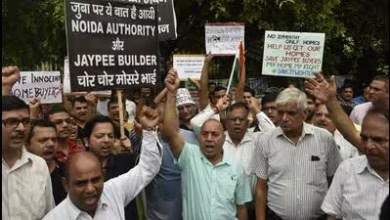
RERA was launched to the Indian public as the long-awaited answer to an unregulated, opaque and predatory real-estate sector. Builders would be forced to register projects, maintain separate escrow accounts, disclose accurate timelines and carpet areas, and face penalties including imprisonment for violations. Buyers would finally have a specialised, time-bound forum instead of the interminable delays of civil courts and consumer commissions. Ten years later the gap between that promise and the reality is so wide that the highest court in the country has openly questioned the continued existence of the RERA.
The most damning evidence of failure lies in the numbers that matter most to homebuyers: actual recovery of money. In Karnataka, official data has shown recovery rates hovering around twelve percent of the amounts ordered by the authority. In Maharashtra, one of the better-resourced RERAs, only about one-third of the ordered recovery amounts have been realised in recent tallies. Across states the pattern repeats.
Buyers win orders directing refund with interest or compensation for delayed possession. Those orders are then converted into recovery certificates and sent to district collectors to be realised as arrears of land revenue. What follows is bureaucratic inertia, repeated adjournments, and in many cases, zero money reaching the buyer’s account. The sixty-day statutory timeline has, in the words of practitioners, become a sixteen-hundred-day reality for large numbers of complainants.
This is not a problem of insufficient complaints or lack of awareness. Tens of thousands of complaints have been filed and disposed of on paper. Uttar Pradesh alone has seen over sixty thousand complaints, with high disposal percentages claimed by the authority. Maharashtra, Haryana-Gurugram and Karnataka also report disposal rates above eighty percent in some periods.
Yet disposal is not delivery. An order that cannot be executed is little more than an expensive piece of paper. Builders routinely file appeals, seek stays, or push projects into insolvency proceedings under the Insolvency and Bankruptcy Code, knowing that the interface between RERA and the insolvency regime remains messy and buyer-unfriendly. The result is that even a “successful” RERA case often leaves the homebuyer no closer to a home or a refund.
The composition of the authorities has drawn particular scorn from the Supreme Court. The Chief Justice described state RERAs as rehabilitation centres for retired bureaucrats. The Act permits the appointment of retired officers, and states have filled the posts accordingly. The consequence, critics argue, is a culture of procedural caution rather than decisive enforcement. Officers accustomed to hierarchical administration and risk-averse decision-making sit in quasi-judicial roles deciding intricate questions of contract, limitation, interest calculation and execution. The institutional incentive structure rewards the issuance of orders, not their enforcement. Salaries are drawn, annual reports (when published) list disposal numbers, and the fundamental duty of protecting the homebuyer remains secondary.
The assertion that RERA is builder-friendly is not rhetorical excess. Several design and implementation features tilt the field. In some states the criminal-liability provisions that could have deterred the most egregious conduct were diluted or never effectively used. Appeals are routinely employed as delay tactics. The requirement that a promoter deposit the awarded amount before appealing is frequently circumvented or rendered ineffective by subsequent stays.
Project registration, meant to be a strict gatekeeping mechanism, has in practice allowed repeated extensions and, in some jurisdictions, projects that should never have been registered in the first place. When buyers finally obtain an order, the absence of dedicated recovery machinery within RERA forces them back into the slow machinery of the revenue department. The builder, meanwhile, continues to market new projects, raise fresh capital, and treat past defaults as a cost of doing business.
The series of chargesheets filed by the Central Bureau of Investigation against multiple builders provides independent corroboration of systemic regulatory failure. Following Supreme Court directions, the CBI has registered dozens of cases involving alleged large-scale cheating of homebuyers, diversion of funds, false promises of possession, resale of already allotted units, and collusion with bank officials. By mid-2026 the agency had filed chargesheets in a substantial number of these matters—reports speak of sixteen, seventeen and in some updates eighteen chargesheets—against companies and their directors, and in several instances against bank officials under the Prevention of Corruption Act.
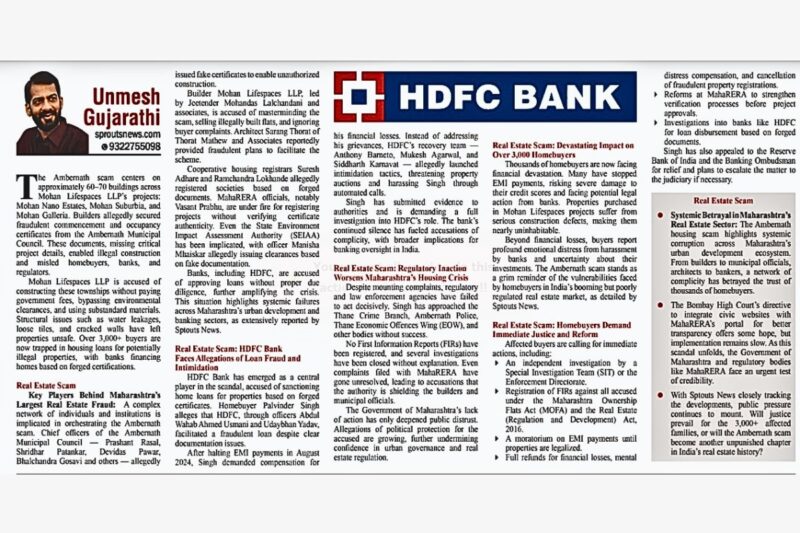
These are not minor contractual disputes. They involve allegations of criminal conspiracy, cheating and criminal breach of trust on a scale that affected thousands of families. That such frauds flourished for years, and that homebuyers had to reach the Supreme Court before a serious criminal investigation was ordered, is itself an indictment of the regulatory architecture that was supposed to prevent or detect them early. RERA’s mandate includes oversight of project accounts, escrow compliance and promoter conduct. The fact that CBI had to step in on the scale it has demonstrates that the specialised regulator either lacked the will, the capacity or the independence to perform that function.
The Supreme Court’s intervention is therefore not an overreach; it is a necessary response to institutional abdication. When the Court says that homebuyers are depressed, disgusted and disappointed, it is describing a national reality. When it suggests abolition, it is forcing a conversation that state governments and the Union government have preferred to avoid. The Court has also had to step in repeatedly in individual cases—warning of imprisonment for non-compliance, prioritising homebuyer claims over other defences, and directing investigations into the builder-bank nexus. Each such intervention is an admission that the specialised statutory mechanism is not delivering.
None of this is to claim that RERA has achieved nothing. Project registration, public disclosure of approvals, and the very existence of a dedicated complaint forum have improved transparency compared with the pre-2016 era. Institutional capital has flowed into the sector in greater volumes. Some state authorities dispose of cases faster than others. Yet these partial gains cannot obscure the central failure: the institution has not protected the homebuyer in the manner and to the degree the law promised. Orders without teeth, recovery rates in the low teens or low thirties, prolonged timelines, and a culture of facilitation rather than accountability have turned a consumer-protection statute into a source of additional frustration.
The question now is whether cosmetic reforms of more staff, better websites, stricter timelines on paper, will suffice, or whether the architecture itself needs fundamental redesign. Appointments must move away from the rehabilitation-centre model toward professionals with domain expertise and a demonstrated commitment to enforcement. Recovery must be internalised within RERA with real powers and dedicated machinery rather than outsourced to overburdened collectors. Criminal provisions must be used, not left dormant. The interface with insolvency law must be clarified so that homebuyers are not endlessly subordinated. And state governments must be held accountable for the performance of the authorities they constitute.

A decade is long enough to judge an institution by its results rather than its intentions. The results are that hundreds of thousands of families remain trapped in incomplete projects or unpaid refunds, that the Supreme Court has openly questioned the value of the regulator, and that the Central Bureau of Investigation has had to file charge after charge against builders whose conduct RERA was supposed to restrain. If an institution created to protect the weaker party ends up facilitating the stronger, then the Chief Justice’s suggestion cannot be dismissed as rhetorical flourish. It is a diagnosis. The only remaining question is whether the political and administrative system has the honesty to accept it and the courage to act.