One year after Jaypee’s Manoj Gaur Was Arrested?
One year after the Enforcement Directorate arrested former Jaypee Infratech managing director Manoj Gaur on 13 November 2025 in a money-laundering case linked to alleged diversion of homebuyer funds, the towers of Wish Town still stand as monuments to unfinished promises. Provisional attachments have been made, interim bail has been granted and withdrawn, and occupancy certificates have been issued for dozens of towers. Yet thousands of families report that lifts do not work, services remain incomplete, and usable possession is still denied. This article examines the arrest, the bail proceedings, the ED’s continuing findings, and the ground reality one year later — and asks why the machinery of law has moved so much further than the keys to the homes.

One Year After Manoj Gaur’s Arrest: Why Are Thousands of Jaypee Buyers Still Without Keys While the Accused Moves Between Custody and Interim Bail?
On 13 November 2025 the Enforcement Directorate arrested Manoj Gaur, former chairman and managing director of Jaypee Infratech Limited and former executive chairman of Jaiprakash Associates Limited, under Section 19 of the Prevention of Money Laundering Act. The arrest followed years of complaints by homebuyers of the Jaypee Wish Town and Jaypee Greens projects who alleged that funds collected for residential construction had been diverted.
According to contemporaneous reporting by The Telegraph, the case was described as a ₹12,000-crore money-laundering matter in which Gaur allegedly misused buyers’ money while the majority of flats remained incomplete across Noida, Ghaziabad and related locations. Other ED statements around the same period placed the figure of collections admitted by the National Company Law Tribunal at approximately ₹14,599 crore from more than 25,000 homebuyers.
What does an arrest of this magnitude actually achieve for the families who paid those sums? The Enforcement Directorate’s own subsequent press release of 9 June 2026 stated that out of approximately ₹32,825 crore collected by JAL and JIL from homebuyers (as per claims admitted by the NCLT), substantial amounts had been diverted for non-construction purposes and siphoned off to related entities.
The agency named destinations that included Jaypee Sewa Sansthan (of which Gaur was managing trustee), Jaypee Healthcare Limited, Jaypee Sports International Limited, and later entities such as JC World Hospitality Pvt Ltd and Investors Clinic Infratech Pvt Ltd. The scale of the allegation is not abstract. It represents the life savings, bank loans and retirement funds of ordinary families who believed they were purchasing shelter. One year later, the central question remains whether the arrest has produced restitution, completed homes, or merely another chapter of procedural delay.
The arrest did not occur in isolation. In May 2025 the ED had conducted searches at 15 locations in Delhi, Noida, Ghaziabad and Mumbai, including premises of JIL and JAL. According to reporting, cash of approximately ₹1.7 crore was recovered along with financial and digital records. Those searches formed part of the investigative foundation for the arrest six months later.
Yet the very fact that it took from the original police FIRs of 2017–2018 until November 2025 for the arrest to materialise raises an interrogative that cannot be brushed aside: how many additional years of incomplete towers and unpaid rent did the delay cost the buyers? Every month that elapsed between the first complaints and the arrest was a month in which families continued to service loans for homes they could not occupy.
The legal process that followed the arrest has itself been a study in partial movement and incomplete resolution. On 13 November 2025 a special court at Patiala House granted the ED five days’ custody. On 18 November Gaur was sent to judicial custody. In the months that followed, interim bail was granted and challenged. On 24 January 2026 the Patiala House Court granted 14 days’ interim bail on the ground of his mother’s deteriorating health, subject to two sureties of ₹5 lakh each.
The Enforcement Directorate challenged that order in the Delhi High Court. On 6 February 2026 the High Court extended the interim bail by ten days while imposing conditions that Gaur not engage in business or banking transactions and not transfer or create third-party rights in properties. Those conditions are revealing: even while granting temporary liberty, the court felt it necessary to freeze the accused’s financial activity.
Regular bail was rejected by the trial court in mid-February 2026. The order recorded that thousands of homebuyers were “running from pillar to post” while the accused was allegedly “enjoying the proceeds of crime by layering of alleged business transactions.”
Gaur surrendered before judicial authorities upon the expiry of the interim bail. Later, in March 2026, following the death of his mother Chandrakala Gaur, the Patiala House Court again granted two weeks’ interim bail so that he could perform the last rites. Each of these steps was lawful. Each consumed time. And each left the fundamental question of the buyers’ homes untouched.
What does a year of such proceedings mean in human terms? For the accused it has meant periods of custody interspersed with interim liberty under strict conditions. For the 25,000-odd homebuyers it has meant another twelve months of uncertainty. The ED’s June 2026 press release confirmed that Gaur remained in judicial custody at that date and that a prosecution complaint arraigning him as an accused had been filed before the Special Court (PMLA) on 8 January 2026. Provisional attachment orders had already been issued.
On 7 January 2026 assets valued at approximately ₹400 crore belonging to Jayaprakash Sewa Sansthan and Page 3 Buildtech Private Limited were provisionally attached. In June 2026 further immovable assets of JC World Hospitality Pvt Ltd (approximately ₹40 crore) and Investors Clinic Infratech Pvt Ltd (approximately ₹60 crore) were attached. The total attached thus moved beyond the initial ₹400 crore figure, yet even the expanded sum remains a fraction of the collections cited by the agency.
Consider the arithmetic that the ED itself has placed on record. If approximately ₹32,825 crore was collected and a substantial portion was allegedly diverted, the attachment of a few hundred crore leaves the overwhelming bulk of the alleged proceeds unaccounted for in the form of frozen assets. Provisional attachment is not final confiscation; further investigation continues.
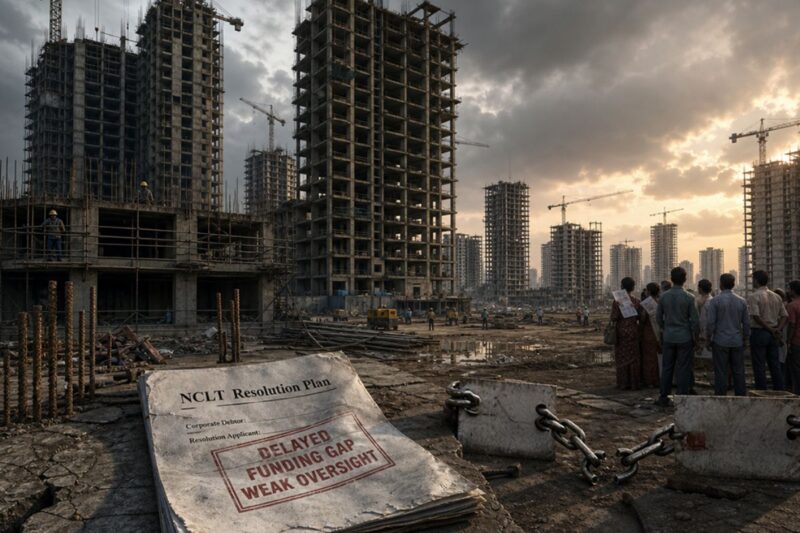
But for the buyer who paid in 2011 or 2012 and is still waiting in 2026, the distinction between provisional and final is academic. What matters is whether any part of the diverted money will return in the form of a finished, usable home. One year after the arrest, that return has not materialised for the majority.
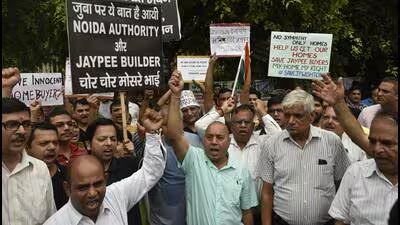
The ground reality at Wish Town underscores the gap between legal process and lived consequence. According to reporting in early October 2026, homebuyers approached Noida Authority officials stating that although occupancy certificates had been issued for 42 towers comprising 4,213 flats, possession had not followed because essential services — including lifts — remained non-functional.
Applications for certificates covering a further 28 towers and 2,385 flats had been submitted. Suraksha Group, the successful resolution applicant that took control after the insolvency process, stated that construction had been completed on 84 of 159 towers covering 7,913 units. Yet buyers reported peeling plaster, incomplete fire-safety arrangements, unfinished water and sewage networks, and shared amenities that remained unusable.
How is it possible that a year after the arrest of the former promoter, and more than two years after Suraksha assumed control, the distinction between an occupancy certificate and a liveable home continues to define the buyers’ experience? An occupancy certificate is a regulatory document. It does not, by itself, guarantee that an elevator functions, that water reaches the upper floors, or that common areas are finished.
When buyers must still petition the Noida Authority for tower-by-tower inspections after certificates have already been issued, the sequence of verification appears inverted. Why were the inspections that should precede certification either incomplete or ineffective? The Uttar Pradesh government has constituted a five-member committee to examine Suraksha’s work and the utilisation of funds. The NCLT has appointed its own committees. The density of oversight has increased. The number of families in actual occupation of finished, functional homes has not been published in any comprehensive public form.
The human cost of this continuing gap is cumulative. A family that booked a flat in the early years of the project has now spent more than a decade paying for housing twice — once through the original payments and loans, and again through rent while waiting. Children have grown up, parents have aged, and the real value of the original investment has been eroded by inflation. The arrest of Manoj Gaur was presented as a decisive step against alleged diversion. One year later, the decisive step that buyers still await is the moment they can turn a key and walk into a home whose lifts work and whose services function. That moment has not arrived for the majority.
The ED’s investigation continues. Further attachments have been made. A prosecution complaint has been filed. Bail has been refused on the merits and granted only on humanitarian grounds for limited periods. All of these are facts of the legal record. Yet the record also shows that the physical project that was supposed to house the buyers remains incomplete in critical respects.
The interrogative that hangs over the entire year is therefore simple and unresolved: if the arrest was meant to address the diversion of funds that left the projects unfinished, why, twelve months later, do so many of those projects still lack the basic attributes of a finished home? Until that question is answered not by further committees or further provisional orders but by actual, usable possession, the one-year mark of the arrest will stand less as a milestone of justice and more as another date in a timeline of delay.
The deeper concern is structural. An arrest under the Prevention of Money Laundering Act is a powerful investigative tool. Provisional attachment is intended to prevent the dissipation of suspected proceeds of crime. Bail proceedings test the balance between individual liberty and the seriousness of the alleged offence. Each of these mechanisms has operated.
What has not operated at comparable speed is the conversion of legal process into completed residential units. The buyers who paid the money that the ED says was diverted are still, in large numbers, waiting outside the doors that the money was supposed to open. One year after the arrest, that waiting continues, and the institutions responsible for ending it have yet to demonstrate that their combined efforts can deliver keys rather than further reports.