Is The Suraksha Takeover Merely The Latest Chapter In A Decade-Long Failure Of Jaypee Infratech That Has Converted Homebuyer Savings Into Prolonged Litigation And Incomplete Construction?
What began as a promise of homes along the Yamuna Expressway has metastasised into a labyrinth of insolvency orders, provisional attachments, competing creditor claims and successive management failures. Thousands of allottees paid life savings for apartments that remain unfinished, uncertified or uninhabitable more than a decade later. An independent NCLT committee has now judged most current complaints against the successful resolution applicant genuine. The Enforcement Directorate has attached assets worth roughly ₹400 crore while former management faces money-laundering allegations. The central, unanswered question is whether any legal process yet devised can force the delivery of usable homes rather than further reports, attachments and adjournments.

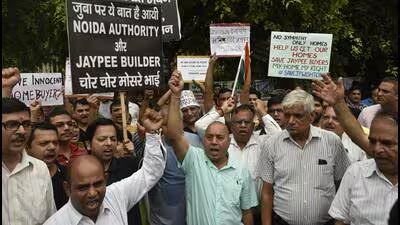
Jaypee Infratech: A comprehensive investigation into stalled housing projects, insolvency proceedings, ED action, CBI allegations and the Suraksha takeover
The Jaypee Infratech controversy is no longer simply a story about a real estate developer that failed to deliver apartments on time. It involves thousands of homebuyers, a prolonged corporate insolvency process, disputes over land and compensation, allegations of diversion of homebuyer funds, investigations by the Enforcement Directorate, proceedings involving the former management, and a new set of complaints concerning the implementation of the resolution plan by Suraksha Group. The central question has changed over time.
Initially, it was whether Jaypee Infratech could complete the homes it had sold. After insolvency proceedings began in 2017, the question became whether a legally approved resolution plan could rescue the company and protect creditors. Following Suraksha’s takeover in 2024, the question is increasingly whether the new management is delivering on the obligations it accepted.
The latest development is particularly significant where an independent committee examining homebuyers’ complaints has reportedly found substantial merit in allegations concerning delays, construction quality, labour shortages and the handling of funds under the new resolution plan.
Separately, the ED announced a provisional attachment of approximately ₹400 crore in assets in January 2026 in its continuing money-laundering investigation into the Jaypee group. Both point to the same underlying failure: the conversion of homebuyer money into incomplete concrete, unresolved claims and institutional inertia.
The latest development: Why is the NCLT monitoring committee controversy important?
According to recent reporting, an independent two-member committee comprising former NCLT members Prasanta Kumar Mohanty and Dr Deepti Mukesh examined homebuyers’ grievances and found that most of the complaints it reviewed were genuine. The committee, appointed in February 2026, submitted its final report covering progress as of 30 June 2026. The reported concerns included delays in handing over apartments, allegations of inadequate construction quality, shortages of labour at construction sites, alleged diversion or inappropriate use of funds allocated to the projects, and failure to arrange the ₹3,000 crore in working capital reportedly contemplated under the resolution plan. The committee called for urgent intervention by the tribunal.
These findings matter because a resolution plan is not simply a financial transaction through which a new investor acquires a distressed company. It is the framework under which the company is supposed to be revived, creditors’ claims are dealt with, and project-completion obligations are implemented. Of JIL’s 250 residential towers, 91 comprising 12,867 units had been completed before the successful resolution applicant took charge. The remaining 159 towers comprised 97 stalled towers with 10,164 units and 62 near-complete towers involving 6,067 units.
The successful resolution applicant was required to complete the residual work on the 62 near-complete towers within 18 months, including a six-month period and one-year grace period. Yet over more than two years, from June 2024 to June 2026, it issued only 3,444 offers of possession and executed 2,614 sub-lease deeds.
How is it possible that a plan approved with 98.66 percent voting share of the committee of creditors, upheld by the NCLAT, and intended to rescue both the corporate debtor and its allottees, has produced such a gap between promise and performance? The committee’s conclusion that the successful resolution applicant failed to complete the projects as promised, thereby breaching its obligations for thousands of allottees, raises a deeper interrogative: does the Insolvency and Bankruptcy Code provide any meaningful enforcement mechanism once the plan is approved, or does it merely transfer the original developer’s delays into a new set of institutional excuses?
There is also a critical difference between completing the physical construction of a tower and delivering a legally and practically usable home. A tower may be structurally complete but still lack an occupancy certificate, functioning lifts, water connections, fire-safety clearances, common-area infrastructure or other essential services.
Even where an occupancy certificate has been issued, possession can remain disputed if essential facilities are not ready. That distinction is central to understanding why homebuyers may continue to complain even after a developer announces that thousands of flats have been completed. The committee’s findings, if accurate, suggest that the gap between certification and habitability has not been closed. What independent verification of site conditions, material quality and labour deployment has the tribunal ordered? Why has the reported shortfall in labour—homebuyers claimed the plan required 12,000 workers while only 3,500–4,000 were present—been allowed to persist without immediate corrective directions?
What is Jaypee Infratech, and how did the crisis develop?
Jaypee Infratech Limited was established in 2007 as a special-purpose vehicle associated with the Jaypee Group. Its business model combined a major infrastructure project, the Yamuna Expressway, with real estate development along the expressway corridor. Its former parent company, Jaiprakash Associates Limited, was central to the original structure.
Jaypee Infratech was responsible for the expressway concession and associated property development, while the wider group had interests in construction, cement, power, hospitality, healthcare and sports infrastructure. This corporate structure is important because JIL and JAL are separate legal entities, even though they were part of the same business group. Investigations into transactions between them and other related entities therefore need to establish which company received money, which company incurred an obligation, who authorised the transaction and whether the transaction was lawful.
In 2003, a concession agreement was executed for the development of the Yamuna Expressway. The project was initially associated with the Taj Expressway Industrial Development Authority, subsequently renamed the Yamuna Expressway Industrial Development Authority. The concession provided for the development and operation of the expressway, toll-collection rights for 36 years, and rights to develop approximately 6,177 acres of land, subject to the agreement. The concession rights and obligations were subsequently assigned to Jaypee Infratech in 2007.
The commercial logic was straightforward: develop transport infrastructure, operate it to generate toll revenue, and develop real estate in the surrounding corridor. But the model also created financial and legal complexity. Land development, infrastructure construction, borrowing, mortgage arrangements and residential construction all involved substantial capital requirements. The use of land and other assets as security for financing became especially important when the group encountered financial distress.
Thousands of buyers paid for apartments in developments marketed under the Jaypee brand. Many expected possession years before they eventually received their homes, while some projects remained incomplete. The resulting problem had several dimensions: delivery risk, financial risk, corporate-structure risk, land and security disputes, and insolvency risk. Once JIL entered the insolvency process, decisions about its assets and projects became subject to the Insolvency and Bankruptcy Code.
The most consequential question was not merely why the projects were delayed. It was whether the money and assets available to the corporate debtor were sufficient to meet the claims of its creditors and complete the unfinished developments. Why were inter-company transfers and related-party arrangements not subjected to earlier, more rigorous scrutiny by lenders and regulators when the first signs of delay appeared?
Jaypee Infratech’s major projects: What was affected?
The principal focus of the homebuyer controversy remains Jaypee Greens Wish Town in Noida, a large integrated development containing multiple residential and commercial projects, including apartments in Sectors 128, 129, 131, 133 and 134. It encompasses developments such as Kosmos, Klassic, Krescent Homes, Kube, Kensington and Garden Isles. Numerous buyers faced delays in possession. Kosmos and Klassic became particularly relevant during the Suraksha takeover because construction in multiple towers was prioritised.
Their status must be examined tower by tower: completion, occupancy certification and actual possession are separate milestones. Kensington Boulevard and Kensington Park are among the projects identified in reporting on the completion programme. Buyers’ concerns include handover schedules, the condition of common areas and whether completed units are genuinely ready for occupation.
The approximately 165-kilometre Yamuna Expressway linking Greater Noida with Agra was a core part of the original infrastructure business model. The concession, toll revenue, associated land and creditor security arrangements became central to the insolvency disputes. Historical project disclosures listed developments including Jaypee Greens Aman, Garden Isles, Krescent Homes, Kube, Orchards, Kosmos, Klassic, Kasa Isles, Kensington Boulevard Apartments, Kensington Park Apartments, Wish Point, Tanishq Square, Sunnyvale Homes and Yamuna Vihar.
For an exhaustive project-level investigation, each development must be mapped against its RERA registration, original completion date, revised completion date, admitted buyer claims, construction percentage at takeover, occupancy certificate and current possession status. A company-wide statement such as “20,000 homes remain pending” does not mean that all 20,000 units have the same construction status or face the same legal obstacle. Why has no publicly accessible, tower-by-tower dashboard of progress, certificates and possession offers been mandated by the tribunal as a condition of continued plan implementation?
The numbers: Homebuyer claims, money collected and alleged diversion
The financial figures in this case need careful treatment because several different totals have been reported. They should not be combined as though they measure the same thing. The Enforcement Directorate’s January 2026 release stated that JAL and JIL had collected approximately ₹14,599 crore from more than 25,000 homebuyers, based on claims admitted by the NCLT. A tribunal-related resolution-plan document reported homebuyer claims admitted as of 29 May 2021 at ₹12,806 crore, comprising principal and interest across active buyers, cancelled bookings awaiting refunds, and buyers with possession-related documentation.
On 7 January 2026 the ED announced the provisional attachment of immovable assets with an approximate current market value of ₹400 crore belonging to Jayaprakash Sewa Sansthan and Page 3 Buildtech Private Limited. The NCLAT’s May 2024 decision required Suraksha to make additional payment of approximately ₹1,334 crore towards compensation associated with YEIDA and affected farmers.
Subsequent reporting has cited higher figures. In August 2026 the ED, during bail proceedings concerning Manoj Gaur, referred to collections of ₹32,825 crore and alleged diversion of ₹13,833 crore, meaning, on the agency’s arithmetic, 42 paise of every rupee collected did not go towards construction. These figures must be treated as investigative allegations until adjudicated.
The ₹14,599 crore figure is the ED’s stated estimate of the collections relevant to its investigation. It is not the same as the amount conclusively established by a criminal court to have been stolen. Similarly, the ₹12,806 crore figure represents admitted homebuyer claims at a specified point in the insolvency process. It is not necessarily the final amount payable in cash to all buyers. Different categories of buyers received different treatment under the resolution plan.
First, the sheer scale of collections from more than 25,000 families represents not merely a commercial failure but a social catastrophe. These were not speculative investments; they were life savings, retirement funds and borrowed money intended to secure shelter. Second, the gap between the amount collected and the incomplete state of the projects raises an interrogative that no resolution plan has yet answered: if the money was paid, where did the corresponding construction go, and who authorised every transfer that left towers incomplete?
The ED investigation: Alleged diversion of homebuyers’ money
The ED investigation is among the most serious developments in the Jaypee controversy because it moves the issue beyond delayed construction and insolvency into possible criminal liability. According to the ED, its investigation arose from multiple FIRs registered by the Economic Offences Wings of Delhi and Uttar Pradesh Police.
Those FIRs followed complaints by homebuyers in Jaypee Wish Town and Jaypee Greens. The allegations included criminal conspiracy, cheating and criminal breach of trust against JIL, JAL and their promoters or directors. The ED subsequently investigated whether funds collected for residential construction had been used for other purposes.
On 23 May 2025, the ED conducted searches at 15 locations in Delhi, Noida, Ghaziabad and Mumbai, including premises associated with JIL and JAL. The agency said it seized financial and digital records relevant to its investigation into alleged money laundering and fund diversion. Searches are investigative measures, however, and do not independently establish the guilt of the people or companies whose premises are searched.
In its January 2026 press release, the ED named three entities that it alleged received some of the funds diverted from the residential projects: Jayaprakash Sewa Sansthan (also referred to as Jaypee Sewa Sansthan), Jaypee Healthcare Limited, and Jaypee Sports International Limited. The ED also alleged that assets associated with JIL and JAL had been diverted to other entities, including Page 3 Buildtech Private Limited, which the agency described as controlled and beneficially owned by Honey Katiyal.
On 7 January 2026, the ED announced the provisional attachment of immovable assets with an approximate current market value of ₹400 crore belonging to Jayaprakash Sewa Sansthan and Page 3 Buildtech Private Limited. The attachment was made under the Prevention of Money Laundering Act, 2002, as part of the ongoing investigation involving JIL, JAL and associated entities. A provisional attachment is intended to prevent the disposal or dealing of property suspected of being connected to proceeds of crime, subject to the statutory process.
It is not equivalent to a final confiscation order, nor does it mean that a court has finally established the criminal origin of every attached asset. The important investigative questions remain: What are the exact properties attached, and where are they located? What is the ED’s basis for linking each property to the alleged proceeds of crime? When and through which transactions were the properties acquired? Were the properties purchased with homebuyer funds, transferred through related entities, or acquired using other funds? What objections have the affected entities filed, and what orders have the competent authorities passed?
The ED stated in its 7 January 2026 release that Manoj Gaur, former chairman and managing director associated with JIL, had been arrested on 13 November 2025 under Section 19 of the PMLA and was in judicial custody at the time of the release. Subsequent court proceedings recorded that a Delhi court had authorised initial ED custody, that interim bail on medical grounds was granted and later extended, and that regular bail was rejected in February 2026, with Gaur surrendering to judicial custody.
The closure reports filed by Uttar Pradesh Police in some of the underlying FIRs are relevant because they show that the criminal complaints did not all have identical procedural histories. A closure report in one FIR does not automatically dispose of a separate PMLA investigation. The final status of each matter must be verified independently. Why has the attachment of ₹400 crore not been accompanied by a public, asset-by-asset schedule that homebuyers and the monitoring committee can examine? How many more years of custody disputes and provisional orders will pass before a final determination of proceeds of crime is reached?
What about the CBI? Has it investigated Jaypee Infratech?
The Central Bureau of Investigation must be considered separately from the ED. The ED investigates money laundering under the PMLA. The CBI investigates specified criminal offences when it has jurisdiction to do so. Delhi Police and Uttar Pradesh Police, including their Economic Offences Wings, have also handled complaints associated with the Jaypee homebuyer matter. The primary material examined for this report establishes an ED investigation based on multiple police FIRs, but it does not establish a definitive, current CBI prosecution covering the entire Jaypee homebuyer controversy. That distinction is important.
It would be inaccurate to state that the CBI has proved a Jaypee fraud merely because the ED has registered a money-laundering case or because homebuyers have filed criminal complaints. For a complete CBI investigation history, the following records would need to be checked: CBI FIRs and regular case numbers naming JIL, JAL or individual directors; special court proceedings, charge sheets and closure reports; any CBI investigation ordered by the Supreme Court or a High Court; and the status of individual criminal complaints that may have been transferred to or separately investigated by the CBI.
Until those records are established, the defensible conclusion is that the ED and the police are documented participants in the investigation, while the precise scope of any separate CBI case remains unverified in the sources reviewed here. Why has the multiplicity of agencies not produced a single, coordinated timeline of accountability that homebuyers can rely upon?
The insolvency proceedings: How did Jaypee Infratech enter the NCLT?
The corporate insolvency resolution process is the central legal mechanism through which JIL’s distressed business and unfinished projects came to be managed. On 9 August 2017, IDBI Bank, a financial creditor, filed a Section 7 application under the Insolvency and Bankruptcy Code. The NCLT admitted the application against JIL on that date. The admission of the application triggered the formal insolvency process, with an interim resolution professional appointed to manage the corporate debtor’s affairs.
The original management consequently lost control over the company’s affairs in the manner contemplated by the IBC. The process was not straightforward. Homebuyers challenged aspects of the insolvency framework and sought protection for their interests. The legal framework was subsequently amended to recognise qualifying allottees as financial creditors, allowing them to participate in the insolvency process through the committee of creditors.
A JIL disclosure dated 31 March 2021 recorded homebuyers with admitted claims alongside banks and financial institutions. At that point, the committee of creditors included active homebuyers, buyers awaiting refunds, buyers with possession-related documentation, deposit holders and institutional lenders. In the resolution-plan proceedings, the homebuyer claims admitted as of 29 May 2021 totalled ₹12,806 crore.
The insolvency process therefore had to reconcile several competing interests: buyers seeking possession of their homes, buyers seeking refunds, banks and financial institutions seeking recovery of secured debts, YEIDA seeking payment of amounts claimed under the land and expressway arrangements, and the resolution applicant seeking a commercially viable structure for completing the projects. Suraksha Realty Limited and NBCC submitted competing resolution proposals. The committee of creditors approved Suraksha’s plan with 98.66 percent of the voting share. The NCLT approved Suraksha’s resolution plan on 7 March 2023. The decision was challenged by, among others, Jaiprakash Associates Limited and Manoj Gaur.
On 21 February 2024, the NCLAT dismissed those appeals against the NCLT’s approval order. On 24 May 2024, the NCLAT addressed YEIDA’s appeal and required Suraksha to pay approximately ₹1,334 crore towards farmer compensation. Suraksha subsequently took control of JIL in June 2024. This was a major turning point: the insolvency process had produced a successful resolution applicant, but the real-world task of completing the homes remained. Why did the high voting percentage in favour of the plan not translate into enforceable, time-bound construction milestones with automatic consequences for non-compliance?
What obligations did Suraksha accept?
The resolution plan was designed to revive JIL, address creditor claims and complete the stalled developments. Its importance is that the new management took over through a formal legal process with obligations set out in the approved plan. The current dispute is whether those obligations are being implemented as intended. Working capital remains a central concern. The October 2026 committee reporting raises a question about the reported ₹3,000 crore working-capital commitment.
The underlying plan, funding documents and actual cash flows need to be compared to establish the exact obligation, deadline, source of funds and extent of compliance. Construction progress must be assessed against physical site inspections and independently verifiable milestones. A tower that was already 90 percent complete when Suraksha took over should not be evaluated in the same way as a tower requiring substantial new construction. Possession and occupancy certification must be compared with fire-safety requirements, utilities, lift readiness, common areas and actual handover records.
Funds intended for a specific project should be tracked through bank statements, invoices, contractor payments, related-party transactions and project accounts. Suraksha’s reported commitment is to complete the remaining homes by March or September 2028. That is a company-reported target, not proof that the delivery obligation has already been fulfilled. How many more committee reports will be required before the tribunal issues binding directions with measurable, weekly compliance metrics?
How much progress has Suraksha made?
There has been measurable construction progress, but the distinction between construction and handover remains crucial. In January 2026, Suraksha said it had completed construction work on 5,989 residential units across 63 towers in Wish Town. It reported occupancy certificates for 31 towers containing 3,135 units, with applications for certificates covering another 32 towers and 2,854 units. These figures provide a useful baseline for evaluating later claims. They do not mean that all 5,989 units had been handed over to buyers.
Subsequent reporting in October 2026 recorded complaints from Wish Town residents that some apartments with occupancy certificates were still not ready for possession because essential services and amenities, including lifts, were incomplete. This creates a three-stage test for any progress announcement: construction completion, regulatory readiness, and actual possession. A credible project audit should report the number of units at each stage, rather than combine them into a single headline figure. Why has the issuance of 3,444 possession offers and 2,614 sub-lease deeds over two years been accepted as adequate progress when 10,164 units in stalled towers remain far from completion?
The Supreme Court and the dispute over creditor claims and assets
The Supreme Court’s role has been significant in the wider Jaypee insolvency dispute. One major issue concerned mortgages and asset transactions involving JIL and JAL. The interim resolution professional challenged certain transactions in which JIL’s assets were allegedly used to secure liabilities associated with the parent company. The Supreme Court proceedings addressed the legal status of these transactions and the rights of creditors. The case record identifies JIL as the corporate debtor and JAL as its holding company, which held approximately 71.64 percent of JIL’s equity as of 31 March 2017.
A corporate debtor’s assets are important to the insolvency estate. If assets are encumbered, transferred or used as security for another company’s debt, the question becomes whether the transactions were lawful and what effect they have on creditors’ recovery. The legal position cannot be reduced to the assertion that every transaction between a parent and subsidiary is fraudulent. The terms of the transaction, applicable company law, insolvency law, security arrangements and the relevant court orders determine the result.
The proceedings are important because they show that the insolvency dispute was not limited to construction delays. It also concerned the control, ownership, security and availability of assets needed to resolve the company’s liabilities. Why were inter-company security arrangements not subjected to earlier, more transparent disclosure that would have allowed homebuyers to understand the true availability of assets?
What legal remedies and proceedings are relevant to the homebuyers?
Homebuyers’ rights are affected by several legal frameworks, each of which addresses a different aspect of the dispute. The Insolvency and Bankruptcy Code governs the corporate insolvency process, creditor participation and the approval and implementation of the resolution plan. Applications concerning compliance with the plan may be brought before the appropriate insolvency forum.
The Real Estate (Regulation and Development) Act, 2016, regulates registered real estate projects and provides mechanisms for addressing qualifying complaints about project registration, construction, possession and statutory obligations. Its interaction with an insolvency process can be complex, so the relevant project registration and applicable orders must be examined. The Consumer Protection Act may, depending on the circumstances and applicable legal restrictions, offer remedies concerning deficiency in service or unfair practices.
The PMLA and criminal proceedings concern alleged money laundering and the handling of funds; criminal liability depends on the statutory requirements and evidence and is separate from the question of whether a buyer is entitled to possession or a refund. Contractual and civil remedies turn on individual allotment agreements, payment histories, refund terms and any subsequent settlement. A buyer’s practical position will therefore depend on the specific project, allotment status, payment record, whether a claim was admitted in insolvency, and whether the buyer seeks possession or a refund. Why has the multiplicity of forums produced fragmentation rather than coordinated, time-bound relief?
Conclusion
Jaypee Infratech’s history raises three connected but legally distinct questions. First, how did the original developer’s financial and operational difficulties leave so many homebuyers waiting for possession? The insolvency record, admitted creditor claims and the ED’s allegations of fund diversion provide the documentary basis for examining that question.
Second, did the insolvency process adequately protect homebuyers while balancing the claims of banks, YEIDA and other creditors? The 2023 NCLT approval, 2024 appellate proceedings and the takeover by Suraksha provide the legal framework for assessing that issue. Third, is the new management fulfilling the obligations attached to the rescue? The latest committee findings, the working-capital concerns, construction-quality complaints and the gap between occupancy certification and actual possession make that question particularly important in 2026.
The key point is that the insolvency process and the change of management did not, by themselves, resolve every homebuyer’s problem. The ultimate test is whether the contractual and statutory obligations are fulfilled, whether the use of funds can be properly accounted for, and whether buyers receive usable homes or the legally applicable alternative relief.