
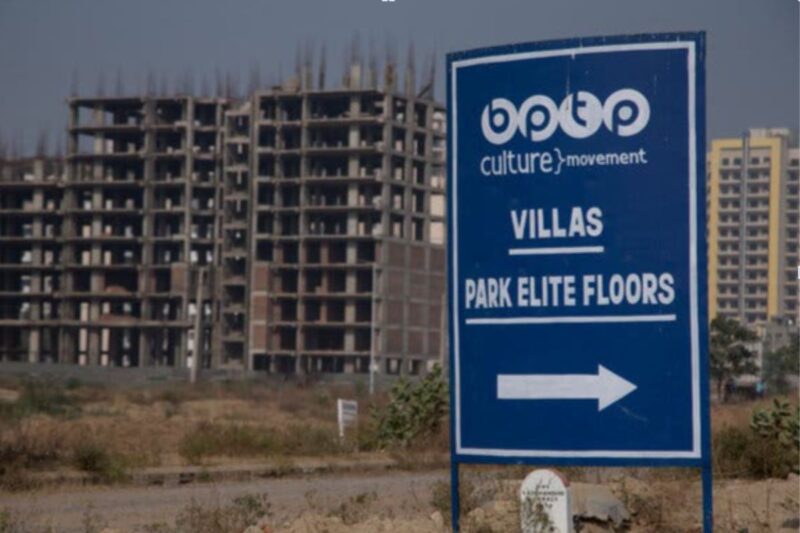
The Haryana Real Estate Regulatory Authority’s recent order against BPTP exposes a familiar and troubling pattern in the real estate sector: the quiet conversion of homebuyers’ money into a source of unearned profit for developers while possession timelines stretch for years. On September 2, Adjudicating Officer Rajender Kumar of HRERA Gurugram directed BPTP Ltd and Countrywide Promoters Pvt Ltd to pay 11 per cent annual interest on the Rs 61,250 collected from allottee Ajay Chaturvedi as Interest-Free Maintenance Security (IFMS).
The Authority held that retaining the interest earned on this amount was not permissible by law. The order is limited in its monetary impact, yet it highlights a practice that has long disadvantaged buyers who already bear the heavier burden of delayed delivery and prolonged financial commitment.
Chaturvedi had booked a 1,225 square foot flat in BPTP’s Spacio project in Sector 37D for Rs 43.12 lakh in 2010.
Possession was contractually due in August 2013. It was finally offered only in February 2021. That gap of roughly seven and a half years is not a minor administrative slip. It represents years of dual financial pressure: continuing loan repayments or opportunity cost on the one hand, and the absence of a usable home on the other.
HRERA had earlier awarded delayed-possession charges at 9.30 per cent per annum from 9 September 2013 to 1 April 2021, while rejecting the complainant’s other claims for compensation. The Authority’s recognition of delay is therefore on record. What the latest order adds is a specific finding on the treatment of the IFMS.
The designation “interest-free” is itself revealing. Developers collect these amounts at the time of booking or during the payment schedule under the stated premise that the money will be held without interest and applied toward future maintenance once the project is handed over to a residents’ association. In practice, the funds sit with the developer for the entire construction and possession period.

During those years the developer can, and in this case did, earn interest or other returns on the pooled deposits. When the Authority examined the Spacio case, it found that the respondents had earned interest on the IFMS collected from the allottee but had not passed any of it on. HRERA held that such retention was not permissible and ordered payment of 11 per cent interest from the date of receipt of the IFMS until realisation. Liability was made joint and several between BPTP Ltd and Countrywide Promoters Pvt Ltd.
This finding is significant because it challenges a widespread industry practice. Interest-free security deposits, IFMS are routinely collected across projects. The justification offered is that the money is held in trust for eventual maintenance. Yet the economic reality is that the developer enjoys the float for years, often a decade or more when possession is delayed. The buyer, meanwhile, has already parted with the capital and continues to service other obligations.
When the project is finally offered for possession, the same buyer is frequently asked to pay further sums toward maintenance or to transfer the security to the association, still without any share of the returns the money generated in the intervening period. The HRERA order in Chaturvedi’s case correctly identifies this as an impermissible retention of benefit.
The broader context of the Spacio timeline makes the issue more acute. A flat booked in 2010 with a 2013 possession commitment was handed over only in 2021. During those intervening years the buyer’s capital remained locked, first in the construction payments and then in the form of the IFMS. The delayed-possession interest already awarded at 9.30 per cent addresses part of the loss arising from late delivery.
The additional direction to pay 11 per cent on the IFMS addresses a separate and distinct form of enrichment: the quiet appropriation of returns on money that was never meant to be a free source of working capital or investment income for the developer. Together the two orders illustrate how regulatory intervention can, even in limited measure, restore some balance.
Yet the scale of the relief remains modest. Rs 61,250 is a small sum relative to the overall consideration of Rs 43.12 lakh. Many buyers in similar projects have paid larger IFMS amounts. When multiplied across hundreds or thousands of allottees in a single township, the aggregate float becomes substantial. The interest earned on that collective corpus over seven or eight years is not trivial.
The fact that a regulator has now held, in at least one case, that the interest belongs to the allottee rather than the developer is a useful precedent. It does not, however, automatically translate into systemic correction. Developers continue to collect interest-free deposits as standard practice. Unless the principle applied by HRERA Gurugram is consistently enforced across projects and across authorities, the economic incentive to treat buyers’ security money as an interest-bearing float will persist.
The Spacio case also underscores the asymmetry of bargaining power that characterises much of the homebuyer–developer relationship. The allottee signs a detailed agreement that includes the obligation to pay IFMS. At the time of booking the buyer has limited ability to negotiate the terms or to insist on interest-bearing escrow arrangements. Once payments begin, exit becomes costly. When possession is delayed by years, the buyer’s leverage diminishes further. Regulatory forums such as HRERA exist precisely to correct this imbalance after the fact. The order directing payment of interest on the IFMS is one such correction. It affirms that the label “interest-free” cannot be used to justify the unilateral retention of all returns generated by the deposited sum.
Critics of such orders sometimes argue that maintenance security is intended for a future collective purpose and that individual interest claims complicate the eventual transfer to a residents’ welfare association. That argument does not withstand scrutiny when the developer itself has already treated the money as a source of private return for years. If the funds are truly held for the collective benefit of the project, the returns earned during the holding period should also accrue to that collective purpose or be accounted for transparently. Retaining them without disclosure or sharing is a different matter. HRERA’s finding that such retention is not permissible by law draws a clear line.
The decision also invites a wider examination of how “interest-free” deposits function across the sector. In an environment of prolonged construction delays, these deposits become de facto long-term, zero-cost funds for the developer. The buyer bears the opportunity cost and the inflationary erosion of the principal. When possession is finally offered, the same buyer may face additional demands for maintenance advances or higher monthly charges.
The net effect is that the financial burden of project delays and incomplete infrastructure is shifted disproportionately onto the allottee, while the developer retains flexibility and the benefit of the float. Regulatory orders that claw back even a portion of that benefit are therefore not merely technical adjustments; they are necessary assertions of the principle that buyers’ money cannot be treated as free capital.
Ajay Chaturvedi’s case is one instance among many. The Authority had already recognised the delay in possession and awarded interest at 9.30 per cent for the relevant period. The further direction on the IFMS completes a more comprehensive accounting of the financial consequences of that delay. It does not erase the years of waiting, nor does it fully compensate for the dual costs of rent and loan servicing that many buyers endure. But it does establish that the interest earned on security deposits collected under an “interest-free” label is not the developer’s to keep. That principle, if applied consistently, would reduce one of the quieter forms of enrichment that have accompanied delayed real-estate projects.

The order of 2 September 2026 is limited to a single complaint and a specific sum. Its value lies in the clarity of the finding: retaining interest on IFMS is not permissible. For a sector in which possession timelines have routinely stretched far beyond contractual commitments, and in which buyers’ deposits have long served as interest-free working capital, that clarity is overdue.
Whether it leads to broader change depends on how readily other authorities adopt the same standard and how effectively developers are required to account for the returns generated by the money they hold in the name of future maintenance. Until then, cases such as Spacio will continue to illustrate the gap between the language of “interest-free” security and the economic reality of who actually benefits from the float.