Apple Doesn’t Need More iPhone Users. It Needs Existing Users To Spend More And The $1,999 Duo Makes That Strategy Clear
Apple has finally entered the foldable-phone market, six years after Samsung helped create it. But the ₹2.99 lakh iPhone Duo is not simply a late arrival. It comes as Apple pushes its entire iPhone business further upmarket, its biggest markets mature, margins face new pressures and the company searches for its next phase of growth. The foldable may be the product. The bigger bet is on how much more Apple can make from the customers it already has.

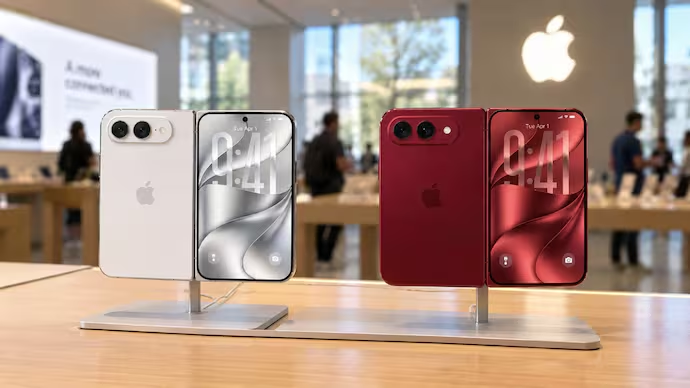
For years, Apple watched Samsung and a growing group of Chinese smartphone makers experiment with folding screens, multiple form factors and increasingly sophisticated hinges. Apple has now entered the market – but in typically Apple fashion, it has chosen neither the cheapest route nor the most conservative one.
The iPhone Duo starts at $1,999 in the US and ₹2,99,900 in India, immediately placing it at the extreme premium end of the smartphone market.
The Duo opens into a 7.6-inch display, turning what looks like a conventional iPhone when folded into something closer to a small tablet when opened. Apple has built the software around that additional space, allowing users to work across multiple applications, use split-screen functions and take advantage of the larger canvas for productivity. The device is also designed to work with Apple Pencil, reinforcing Apple’s attempt to make the foldable more than a novelty phone.
Hardware is equally central to the pitch. Apple has focused on a thin profile, a titanium construction and a redesigned multi-component hinge, while retaining the company’s familiar emphasis on durability and integration between hardware and software. The Duo is also entering the market at a time when foldables are no longer experimental curiosities.
Samsung has been refining them since 2019, while Huawei and other Chinese manufacturers have pushed the technology in directions Apple has yet to explore, including larger and multi-fold designs.
And that ₹2.99 lakh price tag is the first clue that the Duo may have less to do with making foldable phones affordable and much more to do with making the top end of the iPhone business even more valuable.
Six Years Late, But Apple Has Something Samsung Didn’t
Apple’s late arrival is difficult to ignore. Samsung began selling commercially available foldable smartphones in 2019, giving it years to refine the hardware, build consumer awareness and establish a product portfolio. Chinese manufacturers went further, particularly in thinness, camera systems and multi-fold designs. By the time Apple arrived, the foldable market was no longer waiting for a company to prove that a phone could bend.
But Apple is entering with an asset its rivals cannot easily replicate: an enormous existing customer base that already understands the Apple ecosystem.
The company has an installed base of roughly 2.5 billion active devices worldwide. That changes the economics of launching a new form factor.
Samsung had to help create the foldable category and persuade consumers to consider a fundamentally different smartphone design. Apple can instead present the Duo as the next step for people who already own an iPhone, already use iCloud, AirPods, Apple Watch and other Apple products, and are accustomed to paying a premium for the company’s hardware.
That distinction could matter more than who reached the market first.
Apple also has another advantage: distribution. Its retail stores, carrier relationships, global marketing machine and enormous developer ecosystem mean that the Duo does not need to fight for visibility in the same way that an unfamiliar foldable from a smaller manufacturer might.
The question, therefore, is not whether Apple can catch up with Samsung technologically. It is whether Apple can make foldables desirable to a much larger audience simply by attaching the iPhone name to them.
That is a very different proposition from being first.
Samsung spent years proving that foldables could exist. Apple is betting that, with the right product and the right ecosystem, it can convince millions of existing iPhone users that they should want one.
The $1,999 Question: Is Apple Selling Technology or Status?
The price of the iPhone Duo is almost as important as the device itself. At $1,999 in the US, Apple is not attempting to compete with foldables on affordability. It is placing the product in a category where price becomes part of the positioning.
That strategy is familiar to Apple. The company has steadily expanded the gap between its standard iPhones and its Pro models, encouraging consumers who want the newest technology to move higher up the price ladder. The Duo now creates another rung above them – a device for customers willing to pay substantially more for a fundamentally different form factor.
That does not mean Apple expects the Duo to sell in iPhone-like volumes. In fact, it may not need to.
A foldable can work strategically even at relatively modest volumes if Apple can maintain premium pricing and persuade existing customers to trade up.
A customer who might previously have bought a Pro Max now has another, considerably more expensive option. The company gets an additional opportunity to increase the average selling price of its hardware without having to find an entirely new customer.
This is where Apple’s ecosystem becomes particularly valuable. The Duo is not being sold as an isolated piece of hardware. It is an iPhone that sits inside the same ecosystem of apps, services, accessories and devices that customers have already bought into.
Samsung can offer a competing foldable. Chinese manufacturers can offer thinner or more technically ambitious alternatives. But Apple is betting that some consumers will pay more simply because the device is an iPhone and because moving outside that ecosystem carries its own cost.
The $1,999 question, then, is not simply whether the hardware justifies the price.
It is whether Apple’s brand and ecosystem can make a two-thousand-dollar smartphone feel like a natural upgrade rather than an extravagant purchase.
Apple’s Real Problem Isn’t Revenue. It’s Growth.
The most important thing to understand about the Duo is that Apple does not need another product because its existing business is struggling to make money. Quite the opposite. Apple is already one of the most profitable companies in the world. The problem is what happens when a company this large tries to keep growing at a rate investors have come to expect.
Apple generated roughly $416 billion in annual revenue in fiscal 2025 and more than $112 billion in net income. In the June quarter of fiscal 2026 alone, revenue reached about $109 billion, with gross margin at roughly 50%. The iPhone remains the company’s financial centre of gravity, while Services has grown into a business generating more than $100 billion a year.
Those numbers change the nature of Apple’s challenge.
A smaller technology company can grow rapidly simply by finding more customers. Apple already has billions of devices in active use and a dominant position across several wealthy markets. Adding tens of millions of new smartphone users every year is becoming harder, particularly in mature markets such as the US, Japan and much of Europe.
So Apple’s growth equation increasingly depends on getting more revenue from the customers it already has.
That can happen in several ways: selling a more expensive iPhone, encouraging users to move from standard models to Pro models, increasing spending on services and accessories, or creating an entirely new category that gives existing customers another reason to upgrade.
The Duo fits neatly into that last strategy.
A $1,999 foldable does not have to replace the conventional iPhone to matter financially. If it creates a new premium tier and persuades even a relatively small proportion of Apple’s enormous customer base to spend more, it can generate meaningful incremental revenue.
And that is why the foldable launch should not be viewed in isolation. Apple is no longer simply trying to sell more iPhones. It is trying to increase the value of being an Apple customer.
The Apple Machine: iPhone, Services and the Ecosystem
Apple’s ability to keep extracting value from its customers comes from the way its businesses reinforce one another. The iPhone is the entry point, but the economics extend far beyond the handset itself.
Once a customer is inside Apple’s ecosystem, the company has multiple opportunities to earn from that relationship through devices, accessories and subscriptions.
The scale of the iPhone business remains extraordinary. It generated more than $140 billion in revenue in the first half of fiscal 2026, while Services contributed more than $60 billion during the same period. Services has become particularly important because its margins are substantially higher than those of Apple’s hardware businesses.
That combination gives Apple a powerful model: use hardware to build and retain the installed base, then monetise that base repeatedly.
An iPhone owner may subsequently buy AirPods, an Apple Watch, additional iCloud storage or subscriptions such as Apple Music and Apple TV+. The more products and services a customer adopts, the more deeply embedded that customer becomes in Apple’s ecosystem and the harder it becomes to switch to another platform.
The model has worked exceptionally well. But it also creates a new problem for Apple: the company has become so dependent on the economic strength of its ecosystem that regulators are increasingly challenging the rules that govern it.
The App Store and Apple’s control over payments and commissions have attracted antitrust scrutiny in the US, Europe and other markets. Any erosion of those economics could put pressure on one of Apple’s most profitable businesses.
That makes the iPhone even more important.
Apple needs hardware to keep expanding the ecosystem while Services faces regulatory pressure and the smartphone market itself matures. The answer cannot simply be to sell more identical phones.
It needs new reasons for existing customers to upgrade.
The Duo is one such reason. But Apple’s wider product strategy suggests the company is pursuing something broader: a customer who once bought a ₹80,000–₹1 lakh iPhone is increasingly being encouraged to consider whether the next one should cost ₹1.5 lakh, ₹1.8 lakh or, now, nearly ₹3 lakh.
And that takes us directly to Apple’s changing price ladder.
The Price Ladder Is Moving Up
The most revealing part of Apple’s latest launch may not be the foldable at all. It may be what sits beneath it.
The ₹2,99,900 iPhone Duo now occupies the summit of Apple’s Indian smartphone range, but the rest of the ladder has moved upward as well. The iPhone 17 is priced at ₹99,900, the iPhone Air at ₹1,49,900, the iPhone 18 Pro at ₹1,64,900 and the Pro Max at ₹1,79,900.
That creates a striking progression. Apple is not simply adding one extraordinarily expensive phone to an otherwise unchanged portfolio. It is increasingly giving customers reasons to spend more at almost every level of the range.
This is classic premiumisation: rather than relying entirely on selling a greater number of devices, a company tries to increase the amount each customer spends.
For Apple, the strategy makes particular sense in mature markets. There is a ceiling to how many people can be persuaded to buy an iPhone for the first time. There is considerably more room to persuade an existing iPhone customer that the next model should be more expensive.
The Duo also provides a powerful psychological anchor. A consumer who is not prepared to spend ₹2.99 lakh is hardly the target. But when the most expensive iPhone is nearly ₹3 lakh, a ₹1.79 lakh Pro Max can occupy a very different position in the consumer’s mind.
The strategy is not without risk. There is a point at which premiumisation starts pushing consumers towards cheaper competitors rather than encouraging them to trade up. India’s market is particularly important here because Apple still has only a relatively small share of the country’s enormous smartphone market.
But that is precisely why the Indian opportunity is so interesting.
Apple is simultaneously trying to expand its customer base in India and increase what its existing customers spend. The Duo sits at the top of that experiment, while the rest of the iPhone range quietly moves upward underneath it.
America Is Apple’s Fortress. But Even Fortresses Have Limits.
If Apple’s strategy is increasingly about extracting more value from existing customers, there is no better place to see it than the United States.
America remains Apple’s strongest and most mature iPhone market, with the company accounting for roughly a third of global iPhone shipments. The iPhone is deeply embedded in the country’s smartphone market, supported by carrier financing, Apple’s retail network and an ecosystem that extends well beyond the handset.
That gives Apple an unusual advantage when introducing an expensive new category. A US consumer considering the Duo is not necessarily choosing between an unknown foldable and a familiar smartphone. For many, the decision is whether to move from one Apple product to another.
The economics are attractive. Customers in the US have relatively high purchasing power, established credit and carrier upgrade programmes that can make even a $1,999 device look less intimidating when spread across monthly payments. Apple’s installed base also means the company can market the Duo directly to people who already understand its software and services.
But the strength of the US market creates its own strategic problem.
It is increasingly difficult to grow simply by finding new iPhone customers.
The smartphone market is mature, replacement cycles have lengthened and Apple’s penetration is already extremely high. The next dollar of growth therefore has to come increasingly from premium upgrades, accessories, services and new categories.
That makes the Duo less of a gamble in America than it might initially appear. Apple is not asking the average US consumer to suddenly embrace a completely unfamiliar technology. It is offering its existing premium customer another reason to upgrade.
The harder question is whether that formula can work elsewhere.
Apple’s strongest markets are already heavily penetrated. Its biggest opportunities now lie in places where it has either enormous room to increase premium penetration or a strategic fight to win back consumers.
That brings China into focus – and China’s story is considerably more complicated than America’s.
China Is the Market Apple Cannot Afford to Lose
China presents a very different challenge.
It is too large for Apple to ignore, too important to its supply chain to treat casually and too competitive to assume that the iPhone will remain the default premium choice.
Apple has shown signs of a recovery in the country, with Greater China revenue rebounding strongly alongside demand for the iPhone 17. But the competitive landscape remains far tougher than it was several years ago. Huawei has rebuilt its premium smartphone presence, while Xiaomi, Oppo and Vivo continue to develop increasingly sophisticated high-end devices.
And foldables are one area where Chinese manufacturers have had a particularly substantial head start.
Huawei has built a strong position in China’s foldable market, while domestic manufacturers have pushed aggressively on thinness, hinge design, cameras and alternative form factors. Some have already moved beyond the conventional book-style foldable that Apple has adopted with the Duo.
That makes Apple’s timing significant.
The company is entering a category in China where the local competition isn’t waiting for Apple to define what a premium foldable should look like. In some respects, Apple is the follower.
Yet Apple has something its Chinese rivals would find difficult to reproduce at the same scale: a global premium ecosystem and a customer base that already owns Apple products.
If the Duo performs well in China, it could give Apple another mechanism for defending its position among affluent consumers who increasingly view hardware innovation as a reason to switch brands. If it fails, the company risks reinforcing the perception that Chinese manufacturers are moving faster in one of the smartphone industry’s most important new categories.
There is also a broader issue at stake. China is no longer simply a market where Apple sells premium products. It is a market that increasingly produces premium smartphone technology of its own.
That changes the competitive equation.
Apple’s challenge is therefore not merely to sell a ₹2.99 lakh-equivalent product to Chinese consumers. It is to convince them that, despite arriving years after the first foldables, Apple’s version is still the one worth paying the premium for.
And unlike the US, where Apple already dominates the premium conversation, China gives the Duo a much harder test of whether Apple’s brand can still command that premium.

Japan and Europe Show Where Apple Already Has the Premium Consumer
Japan and Europe offer Apple something China does not: large, established pools of consumers who are already comfortable paying for the iPhone.
Japan is particularly striking. Apple commands roughly half or more of the country’s smartphone market, making it one of the company’s strongest positions anywhere in the world. That level of penetration matters because the opportunity is no longer primarily about convincing consumers to enter the Apple ecosystem. It is about keeping existing users inside it and moving them towards higher-value products.
A foldable fits that strategy naturally.
The same is broadly true across Europe, where Apple’s business has continued to grow strongly. Europe is already a major revenue contributor and, unlike some emerging markets, has a sizeable base of consumers with the purchasing power to absorb Apple’s increasingly expensive hardware.
These markets demonstrate an important distinction in Apple’s global strategy.
The company does not need every country to deliver the same kind of growth.
In mature markets such as Japan, the US and much of Europe, Apple can focus on replacement cycles, premium models and ecosystem spending. The customer already exists; the challenge is getting that customer to spend more.
In markets such as China, the priority is more defensive: retain premium consumers while fighting increasingly capable local competitors.
And then there is India, which offers something neither category provides to the same degree – a huge smartphone market in which Apple still has substantial room to expand.
That makes India potentially more important to Apple’s long-term growth story than its current market share suggests.
India Is The Bigger Opportunity Hiding Behind The ₹2.99 Lakh Price Tag
India may be the most revealing market for understanding what Apple is trying to do next.
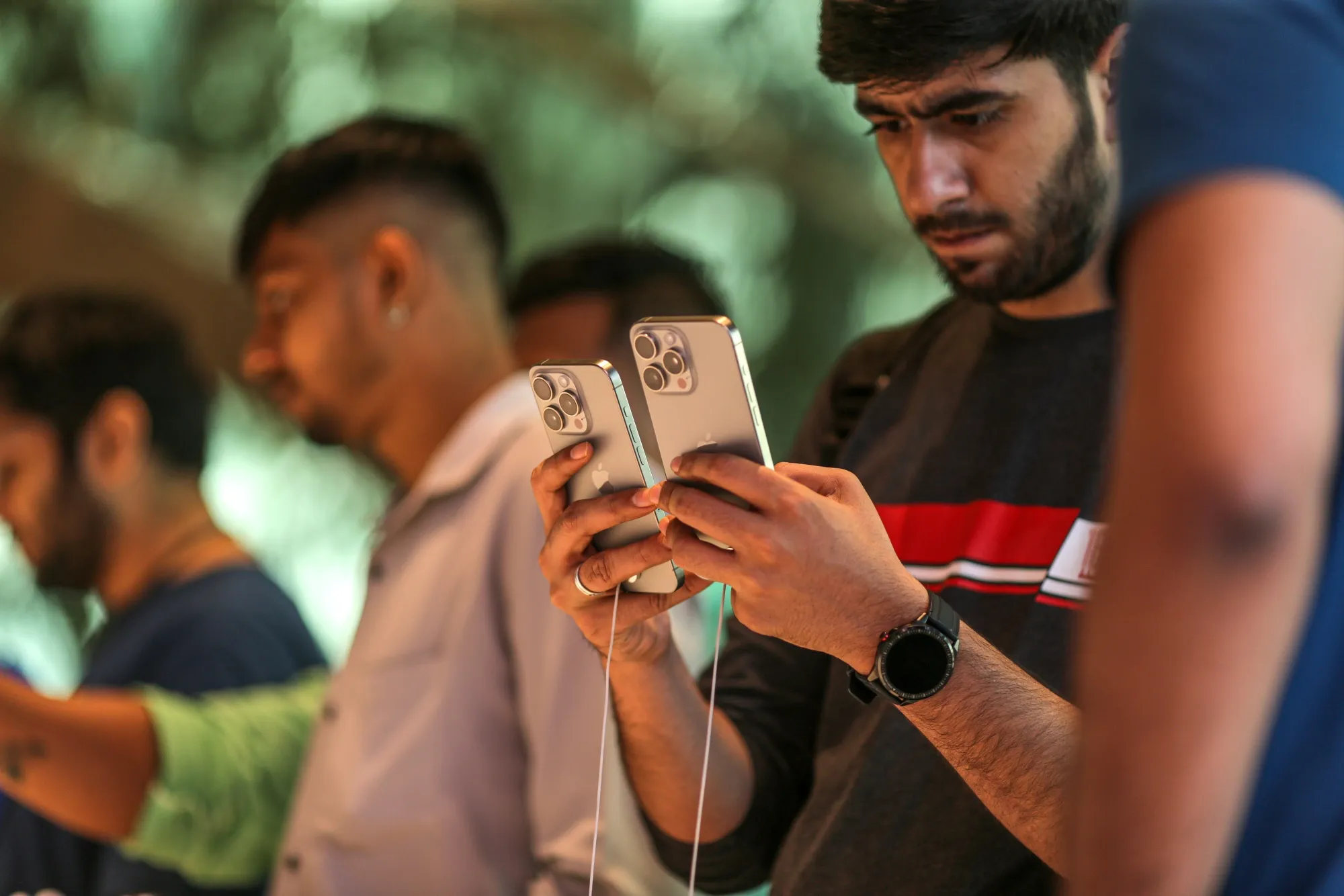
Apple’s iPhone shipments in India have been growing rapidly, and the country has already become one of its largest smartphone markets by volume. Yet Apple’s overall smartphone share remains only around 10%. That is tiny compared with markets such as Japan, where Apple has historically commanded around half of smartphone sales.
That gap is the opportunity.
India is no longer simply a market where Apple can sell a handful of aspirational flagship phones. The country’s premium smartphone segment is expanding, Apple has increased its local manufacturing footprint and the iPhone has become increasingly visible among India’s urban, affluent consumers.
But Apple still has a long way to go before India resembles its strongest markets.
That makes premiumisation particularly important. Apple does not need to capture the entire Indian smartphone market to generate substantial growth. Even a relatively small increase in its share, combined with a higher average selling price, can produce a significant increase in revenue.
The Duo sits at the extreme end of that strategy.
At ₹2,99,900, it is clearly not a mass-market device in India. But it does not need to be. Its role can be to establish the top of Apple’s price hierarchy while the Pro Max, Pro and other models capture customers at progressively lower price points.
The opportunity is especially significant because India’s premium buyers are still a much smaller proportion of the overall smartphone market than in Apple’s mature strongholds. If Apple can persuade a greater number of Indian consumers to move from standard iPhones into Pro models – and eventually into entirely new premium categories – it can increase revenue without needing anything close to dominant market share.
There is another advantage for Apple: India’s smartphone market is still expanding while Apple’s strongest markets are already mature.
That gives the company two very different growth engines. In America, Japan and Europe, Apple can ask existing customers to spend more.
In India, it can potentially do both: bring more consumers into the ecosystem and persuade existing Apple customers to move up the price ladder.
That makes the ₹2.99 lakh Duo less interesting as an Indian volume product than as a statement about where Apple believes India’s premium market is heading.
But Apple’s Margins Are Not Invincible
The premiumisation strategy also has a less glamorous explanation: Apple has to protect the economics of a business that operates at extraordinary scale.
Apple’s gross margins have remained one of the great strengths of the company, but they are not immune to rising costs. Memory prices, component costs, supply constraints and broader changes in the electronics supply chain can all squeeze the difference between what Apple earns from a device and what it costs to make and deliver it.
That matters because Apple’s sheer size magnifies relatively small changes in margins. A one-percentage-point movement in gross margin across hundreds of billions of dollars in sales represents billions of dollars.
Apple’s June 2026 quarter showed just how strong the underlying economics remain, with gross margin around 50%. But its subsequent guidance pointed to a lower range of roughly 47–48%, with supply and component costs among the pressures facing the business.
This is one reason Apple’s pricing strategy deserves more scrutiny than simply asking whether consumers think the new iPhones are expensive.
Higher prices can serve two purposes simultaneously.
They can increase revenue per customer while providing a buffer against rising input costs.
The Duo is the clearest example. A $1,999 starting price gives Apple considerably more room per unit than a mass-market foldable would. Even if volumes remain relatively modest, the product can contribute meaningful revenue without requiring Apple to chase scale at the expense of margins.
But there is a limit.
Apple’s brand gives it enormous pricing power, yet pricing power is not unlimited. If the company pushes prices beyond what consumers perceive as reasonable, some customers will delay upgrades, choose older models or move to competitors.
That risk is particularly relevant in India and other price-sensitive markets.
So Apple’s next phase is a balancing act: raise the value of each customer without raising the price of the ecosystem so far that customers begin looking for a way out.
The Duo represents the most aggressive expression of that strategy yet.
Then There Is the Problem Apple Cannot Solve With a New iPhone: AI
For all the attention around the Duo’s hinge, display and price, Apple’s bigger strategic vulnerability lies somewhere else entirely: artificial intelligence.
The smartphone industry is moving toward AI as a defining layer of the user experience, and Apple has not moved with the same speed as some of its biggest technology rivals. Apple Intelligence has expanded the company’s AI capabilities, but delays around a more capable Siri and the company’s reliance on outside technology have raised questions about whether Apple is falling behind in a race that could eventually matter more than the smartphone form factor itself.
That creates a particularly difficult inheritance for John Ternus, who has taken over as Apple’s chief executive at a moment when the company’s traditional strengths remain enormous but the technology landscape is changing rapidly.
Apple still controls the hardware, operating system and distribution layers of its ecosystem. What it has not yet demonstrated is that it can establish the same kind of leadership in generative AI that it established in mobile computing.
The danger is not necessarily that consumers will suddenly abandon the iPhone.
It is subtler.
If AI becomes the primary interface through which people search, communicate, shop, create and interact with digital services, then the company controlling the best AI experience could capture a much larger share of the value created by the device ecosystem.
Apple cannot rely indefinitely on the argument that its hardware is beautifully integrated if another company’s software is becoming the more important reason people use that hardware.
This is also why the Duo should not be mistaken for Apple’s answer to every growth problem.
A new form factor can extend the iPhone franchise. It can raise average selling prices and create another upgrade cycle. But it cannot by itself solve Apple’s AI problem.
For now, investors appear willing to give Apple considerable room because the company’s cash generation, installed base and ecosystem remain extraordinarily powerful.
The question Ternus now has to answer is whether Apple can use those advantages to catch up in AI before the industry’s centre of gravity shifts somewhere else.
And that makes the timing of the Duo particularly revealing: Apple may be entering one new technology category just as it is trying to avoid being left behind in another.
Samsung Says Apple Is Reheating Leftovers
Samsung, understandably, has little interest in applauding Apple’s arrival.
The company has spent years building the foldable category, starting with the Galaxy Fold in 2019 and refining the technology through multiple generations. After Apple unveiled the Duo, Samsung took the opportunity to remind the market that it had already been selling foldable phones for years, effectively accusing Apple of arriving late and repackaging technology others had already developed.
On the substance, Samsung has a point.
Apple did not invent the foldable smartphone. It did not pioneer the book-style form factor, and it is entering a market where Samsung already has considerable manufacturing experience. Chinese manufacturers have pushed the category even further, particularly on device thickness and alternative designs. Samsung has also moved into three-panel folding with its latest products.
But technological first-mover status does not automatically translate into commercial dominance.
Samsung’s experience is perhaps the clearest evidence of that. Despite years of investment, foldables remain a relatively small part of the overall smartphone market. The industry has solved many of the technical problems, but it has not yet convinced the mass market that a foldable is a necessary upgrade.
That may be precisely the opening Apple sees.
Samsung had to build the category. Apple can potentially monetise it.
Apple has an enormous installed base, a powerful retail operation and customers who are already accustomed to paying premium prices for its devices. If even a fraction of those users decide that the Duo is the form factor they have been waiting for, Apple’s late entry could quickly turn into a serious competitive threat.
That is why Samsung’s “leftovers” jab is amusing – but also potentially premature.
Apple does not need to prove that it got there first.
It needs to prove that it can sell the category better than the companies that did.
What Apple’s Foldable Bet Actually Means
Taken together, the numbers make the iPhone Duo look less like a standalone product launch and more like a piece of a much larger strategy.
Apple is operating from a position of extraordinary financial strength, but the nature of growth changes when a company is already generating hundreds of billions of dollars in annual revenue. The easy gains become harder to find. In mature markets, smartphone penetration is already high. Services faces regulatory pressure. Component costs can squeeze margins. And competitors are moving rapidly in areas such as AI and foldable hardware.
Apple therefore needs to keep finding ways to make its existing ecosystem more valuable.
The Duo addresses several of those challenges at once.
First, it creates another premium hardware category. Apple can sell an expensive new device without replacing the conventional iPhone.
Second, it pushes average selling prices higher. A customer who moves from a Pro Max to the Duo represents a significant increase in hardware revenue, even if the number of Duo buyers remains relatively small.
Third, it gives Apple another upgrade proposition. The company has an enormous installed base, and the longer consumers hold on to their phones, the more important it becomes to offer something meaningfully different from the previous generation.
Fourth, it strengthens the ecosystem. A larger display creates opportunities for new software experiences, productivity applications and potentially greater engagement with Apple’s services.
And finally, it gives Apple a new weapon in markets where the premium smartphone battle is becoming more difficult.
But there is an important distinction between creating a profitable premium niche and creating Apple’s next major growth engine.
Apple has already demonstrated that it can sell extraordinarily expensive products to a loyal customer base. The harder task is making the foldable category large enough to materially affect the company’s growth trajectory.
That will depend less on whether the Duo is technically impressive than on whether consumers begin to see folding phones as the next normal form of the smartphone.
If Apple can achieve that, its late arrival becomes almost irrelevant. If it cannot, the Duo may remain an expensive showcase for Apple’s ability to enter an established market – and charge more for doing so.