When Liberty Has to Fight for Its Freedom: The Akriti Chaudhary Case and the Structural Failures of India’s Justice System
A five-month NSA incarceration, a High Court finding of “no material”, contradictory arrest records, a ₹5 lakh compensation order, and a Supreme Court intervention that stayed the strictures but not the quashing of detention expose a troubling question: how much damage can the State inflict before the judiciary corrects it?

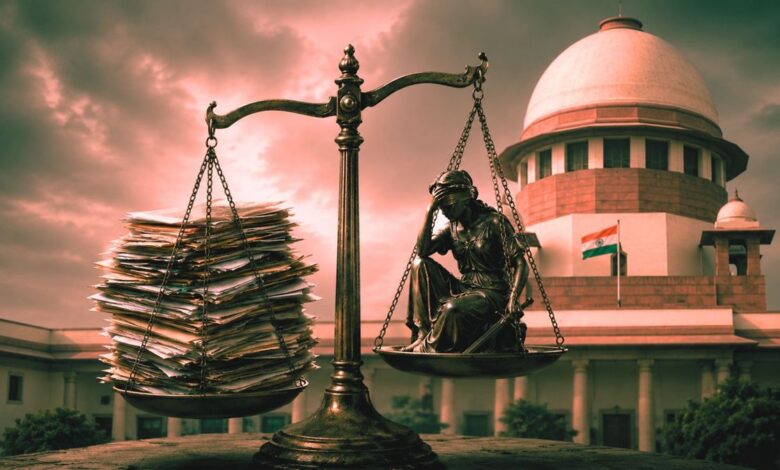
India’s constitutional promise is deceptively simple: the State cannot take away a citizen’s liberty except according to law.
The difficult question is what happens when the machinery of the State itself crosses that line.
The case of Delhi University graduate Akriti Chaudhary has put precisely that question before the country.
She was arrested in connection with the April 2026 workers’ agitation in Noida, subsequently detained under the National Security Act, and remained incarcerated for months. On September 2, 2026, a Division Bench of the Allahabad High Court quashed the NSA detention order and held that her continued incarceration under the NSA violated Article 21. The Court found that the detention order and grounds were “devoid of any material” warranting incarceration under the NSA and had been passed without application of mind.
That finding is not a minor procedural correction.
It goes to the heart of preventive detention: the power to imprison a person not as punishment after conviction, but because the executive claims that detention is necessary to prevent future prejudicial acts.
And when such extraordinary power is exercised on material that a constitutional court says is absent, speculative or inadequate, the problem is no longer merely about one detention order. It becomes a test of whether the institutional safeguards around personal liberty actually function before the damage is done.
The chronology is devastatingly important
The State’s case, as recorded by the Allahabad High Court, alleged that Chaudhary and associates had conspired in early April to foment labour violence and that their subsequent actions contributed to the unrest.
But the dates became central to the Court’s scrutiny.
The State acknowledged that Chaudhary was taken into custody on April 12, 2026, while the violence, according to the State’s own case, commenced on April 13. The High Court described this chronology as an “inescapable” fact: she was already in State custody when the violence erupted.
The petitioner’s case was even more serious. She maintained that police had actually picked her up around 5:30 p.m. on April 11 from Botanical Garden Metro Station in Noida, though the formal arrest was shown later. The Court examined WhatsApp material and found that messages sent to her from 5:56 p.m. onwards on April 11 went unanswered, which it said “probabilise[d]” her version that her phone was no longer with her because she was already in State custody. The Court therefore concluded that the material before it falsified the State’s contention that custody began only on April 12.
That date discrepancy is not an administrative footnote.
It raises the most uncomfortable question in the entire case:
When does a citizen actually become a detainee — when the State takes physical control of her, or when paperwork finally catches up with the custody?
A legal system built around liberty cannot afford ambiguity on that question.
The violence came after the alleged instigator was already in custody
This is where the preventive-detention theory suffered its sharpest evidentiary blow.
The State alleged that Chaudhary’s prior conspiracy caused the subsequent violence.
The High Court examined the WhatsApp conversations and videos produced by the State and repeatedly asked counsel to identify material showing that Chaudhary had incited people to engage in rioting, arson or destruction of property.
The Court recorded that the State could not point to a single WhatsApp message or video demonstrating such incitement, either expressly or by necessary implication.
It further noted that the videos relied upon showed large numbers of people gathered, including men and women, but did not show them armed with sticks, stones or other objects capable of demonstrating an impending violent confrontation. The Court said the material appeared consistent with people exercising a constitutional right to assemble and agitate for higher wages and humane working hours.
The distinction is crucial.
A person may be accused in a criminal case. A person may even ultimately be convicted after trial if the prosecution proves its case.
But preventive detention is a different legal mechanism.
The NSA authorises detention where the Government is satisfied that detention is necessary to prevent a person from acting in a manner prejudicial to national security, the security of the State, public order, or essential supplies and services. It is extraordinary preventive power, not an alternative punishment for someone who might otherwise obtain bail.
That distinction has repeatedly been recognised by Indian courts. The Supreme Court has said that courts examining preventive detention may scrutinise whether the detaining authority considered relevant and vital material and whether its satisfaction was influenced by irrelevant factors or non-application of mind.
The Allahabad High Court applied precisely that logic here.
“NSA is an exception”: the Court’s most important warning
The High Court expressly stated that detention under the NSA is an exception and “not a substitute” for keeping in custody a person who may otherwise obtain bail in ordinary criminal proceedings.
The Court described the detention grounds as repetitive, speculative and opinion-based, saying they did not refer to a “shred of evidence / material” sufficient to sustain the conclusions being drawn.
That observation matters beyond Chaudhary.
Preventive detention exists because the Constitution itself permits a narrow departure from the ordinary criminal-justice model. But the more extraordinary the power, the greater the obligation to scrutinise its exercise.
The High Court put the principle starkly: allegations capable of generating a subjective opinion in the mind of a District Magistrate must still be supported by material. Otherwise, the exercise becomes arbitrary.
The constitutional problem is obvious.
A democratic state cannot logically say:
“We detained you because we feared what you might do, and the evidence establishing that fear need not be demonstrable.”
The statutory doctrine of subjective satisfaction is not a licence for subjective imagination.
The bizarre BNSS timeline
The judgment also raises an extraordinary question about the process by which Chaudhary was taken into custody.
According to the State’s record, a notice under Section 130 of the Bharatiya Nagarik Suraksha Sanhita was said to have been issued on April 12, fixing a ₹50,000 bond for good behaviour. The State claimed she was arrested at 10:20 a.m. after refusing to furnish the bond.
But the High Court noted that the notice itself referred to General Diary Entry No. 37, and the Court found that the diary entry was generated at 10:20 a.m. on April 12.
Justice Achal Sachdev, as recorded in the judgment, pointed out that if the notice had genuinely preceded the arrest, the later-generated GD number could not logically have appeared on the earlier document. The Court therefore found grounds to infer that the notice was prepared after the arrest rather than before it.
That is an allegation of procedural irregularity arising from the Court’s own examination of the documents.
And this should make anyone interested in rule of law uncomfortable.
Because liberty cannot depend on paperwork being reconstructed after the event.
What exactly was missing from the NSA dossier?
The High Court’s answer can be reduced to four broad deficiencies.
First, the Court found no credible material showing that Chaudhary had incited violence.
Second, the material relied upon did not establish that her peaceful mobilisation necessarily threatened public order.
Third, the detention grounds were described as repetitive, speculative and opinion-based.
Fourth, the Court found that the District Magistrate had passed the detention order without adequate application of mind.
The significance is enormous because NSA detention rests on executive satisfaction.
If the underlying record is weak, then the protection of liberty depends on the detaining authority doing the very job the statute expects — examining the material independently rather than mechanically adopting a police dossier.
The Court specifically said that the District Magistrate was expected to examine the record “threadbare” and determine whether there was actual material supporting the allegations and whether ordinary criminal law was inadequate.
That is the point at which administrative power meets constitutional responsibility.
Five months behind bars — and the price of correction
The High Court quashed the detention and ordered Chaudhary’s release if she was not required in another case.
But even here the State advanced an important argument.
The government told the Court that Chaudhary had already been arrested in a criminal case and that her judicial custody would continue because her bail had been rejected. Therefore, even if the NSA detention were quashed, she would remain incarcerated.
The High Court accepted that the periods of NSA detention and judicial custody had effectively merged for compensation purposes. But it nevertheless held that the State’s exercise of authority had violated her constitutional rights and awarded ₹5 lakh compensation.
This produces a disturbing paradox.
A citizen can spend months in custody; a constitutional court can later declare the preventive detention legally unsustainable; the person may still remain in jail because of another case; and the legal system then has to decide how much compensation can meaningfully acknowledge the unlawful deprivation of liberty.
The ₹5 lakh figure was not a declaration of the economic value of five months of freedom. It was the Court’s chosen constitutional remedy after recognising that the detention had violated Article 21.
The High Court did something unusual: it tried to attach a personal price to administrative power
The September 2 judgment did not stop at quashing the detention.
It directed that ₹5 lakh compensation be recovered from the salary of the Gautam Buddha Nagar District Magistrate and other officials who were responsible, “right down to the SHO” who had prepared the initial report.
It also directed that the Court’s displeasure regarding the conduct of the officers involved in preparing the dossier be recorded in their service records.
The language of the judgment was unusually severe. The Court accused the District Magistrate of passing the detention order without application of mind and held that the officer had violated her constitutional oath. It warned that unchecked bureaucratic excess could turn Uttar Pradesh into an “Orwellian Dystopia.”
The rhetorical force of the judgment is striking.
But its institutional significance is even more important.
For decades, one of the recurring weaknesses in public administration has been the perception that the citizen pays the cost of a bad decision while the official rarely pays personally for making it.
The Allahabad High Court attempted to reverse that equation.
Not everyone agrees with such personal financial liability, and the Supreme Court has now put that part of the judgment on hold pending consideration of the challenge.
But the very fact that a constitutional court considered personal accountability appropriate demonstrates how seriously it viewed the administrative failure.
And then came the Supreme Court
The next chapter is where the case became institutionally more complicated.
Medha Roopam and the Uttar Pradesh government challenged the High Court ruling before the Supreme Court.
On September 23, the Supreme Court initially passed an interim order staying operation of the impugned judgment, particularly paragraphs 27 to 33. That triggered confusion over whether the quashing of Chaudhary’s NSA detention itself had been stayed.
On September 24, however, the Supreme Court modified its order.
The revised order stated that only paragraphs 27 to 33 — including the compensation direction and strictures against the District Magistrate — would remain stayed until the matter was heard on merits.
The High Court’s actual quashing of Chaudhary’s NSA detention was not stayed.
That distinction matters enormously.
The popular shorthand that “the Supreme Court stayed the High Court” is incomplete.
The present procedural position is more precise:
the criticism and salary-recovery direction have been stayed; the High Court’s quashing of the NSA detention remains operative.
The matter is listed for further hearing on October 7, 2026.
Did the Supreme Court “protect the DM”?
That is a conclusion that cannot responsibly be drawn from the current orders.
What can be established is this:
The Supreme Court has temporarily prevented the High Court’s adverse observations against Medha Roopam and the salary-recovery direction from operating while her challenge is considered.
At the same time, it has not revived Chaudhary’s NSA detention through the revised order.
There is therefore no legal basis yet for saying that the Supreme Court has finally endorsed the detention order.
The Supreme Court’s intervention is interlocutory, not a final determination on the merits.
That distinction is precisely what investigative reporting must preserve.
The roster question is real — and deserves answers
A separate institutional issue has emerged around the listing of the appeal.
LiveLaw reported that, under the Supreme Court’s July 13, 2026 roster, habeas corpus and preventive-detention matters were allocated to the benches headed by the Chief Justice of India and Justices Vikram Nath, B.V. Nagarathna and M.M. Sundresh.
The publication reported that the Roopam matter nevertheless came before a bench headed by Justice Satish Chandra Sharma, although preventive-detention matters did not appear in that bench’s ordinary roster, leading to questions about whether the case had been specially assigned under the Chief Justice’s “master of roster” authority.
The Supreme Court’s own website confirms that a roster effective July 13, 2026 was in force.
The important point is not to convert that into an allegation of wrongdoing.
The legitimate institutional question is simpler:
If a matter falls into a category ordinarily assigned to other benches, and it is specially assigned elsewhere, should the reason for that special assignment be publicly discernible?
Transparency is not an accusation.
Indeed, transparency is precisely what prevents an accusation from becoming necessary.
The media-access episode adds another uncomfortable question
LiveLaw further reported that during the September 23 hearing, the bench ordered the audio of the video-conference proceedings to be muted, restricting access for reporters who were not physically present in court.
The publication noted that the case concerned actions of public authorities rather than a private matter requiring confidentiality and questioned the absence of a public explanation for restricting access.
Again, this does not prove improper judicial conduct.
But it does raise a legitimate institutional principle:
When the dispute concerns preventive detention, constitutional rights, a senior civil servant and the actions of public institutions, transparency should ordinarily be the default rather than the mystery.
An open court is not truly open merely because the public is technically permitted to attend a room that most people cannot physically enter.
Then there is an extraordinary coincidence of institutional relationships
Medha Roopam is the daughter of Chief Election Commissioner Gyanesh Kumar. This family relationship has been independently reported, including by The Indian Express and Moneycontrol.
That fact is relevant to public-interest scrutiny because Gyanesh Kumar heads the constitutional body responsible for administering national elections.
But it does not, by itself, establish that her Supreme Court relief was obtained because of her father.
Nor does the material reviewed establish the assertion that Gyanesh Kumar is hiding “Gujarat lobby” documents, or that such alleged documents have anything to do with Chaudhary’s detention litigation.
Those are presently hypotheses, not established facts.
A serious investigation must resist the temptation to fill gaps in evidence with the most dramatic possible explanation.
Yet another question has emerged about judicial propriety
LiveLaw reported on September 25 that Justice Satish Chandra Sharma’s son is standing counsel for the Election Commission of India in the Madhya Pradesh High Court. The report noted that this was significant because Justice Sharma had also been involved in proceedings concerning the Election Commission’s appointment law and, in the current episode, the petition filed by Roopam, the daughter of the sitting Chief Election Commissioner.
That reporting has generated questions from lawyers and public figures about judicial propriety.
But once again, the factual line must be maintained.
A family member’s professional role is not itself proof that a judge acted improperly.
The responsible question is whether the relevant disclosures, recusal norms and institutional safeguards were followed, and whether the circumstances provide an objectively understandable basis for public confidence.
The answer requires records, disclosures and judicial explanation — not social-media speculation.
The larger tragedy: this is not just an Akriti Chaudhary problem
The case arrives in a judicial system already carrying an enormous burden.
The National Judicial Data Grid currently records about 5.21 crore pending cases in subordinate courts, including more than 4.09 crore criminal cases. It also records about 33.4 lakh cases as undated, meaning they are pending without a scheduled hearing date in the displayed data.
The High Court NJDG currently shows about 65.16 lakh pending cases.
Its age profile is particularly revealing: roughly 23% of High Court cases have been pending for more than 10 years, while another 20% have been pending five to 10 years. In other words, approximately 43% are more than five years old on the present dashboard.
The India Justice Report 2025 found that across all High Courts, about 49.3% of pending cases were more than five years old as of January 1, 2025. For the Allahabad High Court, the share was more than 60%; the report’s chart shows 23.1% pending five to 10 years and 40.1% for more than 10 years.
That is not merely “delay”.
For someone waiting for possession of property, delay is financial.
For a company, delay is commercial.
For an accused person, delay can become incarceration.
For a detainee, delay is literally measured in lost days of freedom.
The manpower problem is just as serious
As of March 6, 2026, the Department of Justice reported that High Courts had 312 vacancies against a sanctioned strength of 1,122 judges.
That means roughly 27.8% of sanctioned High Court positions were vacant.
The Allahabad High Court alone had 51 vacancies against 160 sanctioned posts on that date.
At the subordinate level, the India Justice Report found that in January 2025 the vacancy rate for judges in Uttar Pradesh’s subordinate courts stood at about 26.9%, while Haryana stood at 29.4%.
A judicial system cannot promise constitutional speed with one hand while carrying structural vacancies with the other.
The Supreme Court is hardly insulated from the backlog crisis
At the end of 2025, the Supreme Court had 92,101 pending cases, according to figures placed before Parliament. The pendency was about 11.4% higher than at the end of 2023.
By August 2026, the Centre informed the Rajya Sabha that the Supreme Court had more than 96,000 pending cases.
Of these, 26 had been pending for more than 30 years and 558 for more than 20 years. More than 10,000 were pending for over a decade.
The apex court itself has had to innovate around its docket.
But the arithmetic remains brutal:
When the final constitutional court is carrying tens of thousands of unresolved cases, even urgent liberty cases exist inside a system of scarcity.
That is a structural problem, not a personality problem.
And then there are the prisons
The crisis becomes still darker when court delay meets incarceration.
The latest NCRB prison data for 2024 show:
5,11,542 prisoners were in Indian prisons at the end of 2024.
Prison occupancy was 112.7% of sanctioned capacity.
And 3,71,440 prisoners — 72.6% of the total — were undertrials, not convicts.
In 2024, 15,93,234 undertrial prisoners were released, and 95.1% of those releases were on bail. Only 627 were released under Section 479 of the BNSS/Section 436A framework.
The implication is unavoidable:
India’s criminal-justice system routinely incarcerates people before guilt has been established.
That does not mean every incarceration is unlawful.
It does mean that procedure, bail, speedy trial and judicial oversight are not technicalities.
They are liberty mechanisms.
Delhi is an especially grim example
The India Justice Report 2025 recorded that 88.8% of Delhi’s prison population were undertrials in 2023, among the highest shares in the country.
Delhi’s district courts also had a 78% case-clearance rate in 2024, according to reporting based on the India Justice Report data, with about 14.9 lakh cases pending as of April 2025.
A capital city in a constitutional democracy should not require citizens to treat litigation as an endurance sport.
Yet that is increasingly how the statistics look.
So what exactly is the failure?
The evidence does not justify saying that “the judiciary” is a single institution acting with a single motive.
In fact, the Akriti Chaudhary case demonstrates the opposite.
One part of the judicial system — the Allahabad High Court — intervened, examined the record, quashed the detention and attempted to impose accountability.
Another part — the Supreme Court — has temporarily stayed the sanctions imposed on the officials while leaving the quashing of the detention intact and will consider the challenge on merits.
This is not a story of one monolithic judiciary.
It is a story of an institutional chain in which liberty may have to travel through several layers before an error is corrected.
That distinction matters.
Because the real question is not:
“Is the judiciary good or bad?”
The more useful question is:
“How many institutional checkpoints exist between an unlawful exercise of State power and an effective remedy for the citizen?”
The most uncomfortable lesson of the Chaudhary case
Suppose the High Court’s findings ultimately stand.
Then a citizen was:
— arrested amid a workers’ protest;
— subjected to a preventive-detention regime intended for threats to public order and security;
— kept in incarceration for months;
— confronted with a detention narrative containing chronological inconsistencies, according to the High Court;
— subjected to grounds that the Court found speculative and unsupported by adequate material;
— and ultimately granted constitutional relief.
But the corrective mechanism activated only after litigation.
That means the system may have worked eventually.
The harder question is whether it worked quickly enough.
A constitutional democracy should not measure success merely by whether a wrongful detention is eventually quashed.
It should also ask whether the machinery of law is capable of stopping the wrongful detention before months of liberty disappear.
Why preventive detention deserves special suspicion
Preventive detention is one of the most controversial powers in the Indian constitutional order precisely because it reverses the ordinary logic of criminal justice.
Normally, the State alleges an offence, investigates it, prosecutes it and attempts to prove guilt.
Preventive detention starts elsewhere:
the State says it needs to stop a future danger.
The danger may be genuine.
The power may sometimes be necessary.
But the cost of error is enormous.
A person can lose liberty without a trial establishing guilt.
That is why the Supreme Court has repeatedly insisted on judicial scrutiny of whether the detaining authority considered relevant material and genuinely applied its mind.
And that is why the Allahabad High Court’s conclusion in Chaudhary’s case is so consequential.
It did not merely disagree with the District Magistrate.
It said the very material necessary to sustain the extraordinary detention was missing.
Accountability cannot end with the word “quashed”
There is another question India’s justice system must confront.
What happens to the citizen after an unlawful detention order is quashed?
Who compensates the citizen?
Who examines the administrative chain?
Who checks whether the police dossier contained erroneous or contradictory information?
Who audits the District Magistrate’s decision-making?
Who examines whether similar detention orders were issued against other protesters using similar reasoning?
Who reviews the officers’ conduct?
Who ensures the same process is not simply repeated in another district six months later?
The High Court tried to answer those questions through compensation, salary recovery and service-record consequences.
The Supreme Court has temporarily suspended those consequences.
That means the accountability question is still alive.
The judicial system’s credibility rests on more than judgments
Judicial legitimacy is not created merely by constitutional language.
It is created by visible fairness.
That requires:
transparent listings,
reasoned orders,
consistent rosters,
speed in liberty cases,
effective bail jurisprudence,
meaningful accountability for unlawful State action,
adequate judicial manpower,
and perhaps most importantly,
an institutional culture in which the citizen does not have to spend months proving that the State was wrong.
The statistics are too large to ignore.
Crores of pending cases.
Millions of undertrials.
Thousands of judicial vacancies.
Cases pending for decades.
A Supreme Court docket approaching six figures.
A High Court system in which roughly half the pending matters have crossed the five-year mark by some measures.
This is not an argument against the judiciary.
It is an argument that the judiciary, like every other institution exercising public power, must be examined against the constitutional promise it is supposed to enforce.
The five questions India should now ask
The Chaudhary case leaves five questions hanging in the air.
First: How did a preventive-detention dossier proceed to the point of incarceration when the High Court later found that the material did not demonstrate the required basis for NSA detention?
Second: Why did the arrest chronology become disputed, and how did a notice apparently containing a later-generated diary entry become part of the official record?
Third: If preventive detention is an extraordinary exception, what internal safeguards exist before a District Magistrate signs such an order?
Fourth: If the detention is ultimately held unlawful, what mechanism ensures personal and institutional accountability beyond merely releasing the detainee?
Fifth: When a constitutionally sensitive case is assigned outside its ordinary roster, what degree of transparency should the Supreme Court provide so that citizens do not have to reverse-engineer the listing process from court records and media reports?
These are not anti-judge questions.
They are constitutional accountability questions.
India does not need a weaker judiciary
It needs a judicial system that is structurally harder to derail.
A system where an ordinary citizen can challenge a detention order before irreversible harm.
A system where police dossiers are independently scrutinised rather than mechanically reproduced.
A system where liberty matters are prioritised.
A system where judicial vacancies are treated as a constitutional capacity crisis rather than an administrative statistic.
A system where a person acquitted or released after years of incarceration is not simply told that the wheels of justice move slowly.
And above all, a system in which constitutional rights do not become retrospective apologies.
The Akriti Chaudhary case is therefore larger than Akriti Chaudhary.
It is about what happens when executive power moves faster than judicial correction.
It is about whether five months of incarceration can ever be treated as merely a procedural mistake.
It is about whether an official who exercises extraordinary detention powers can do so without facing meaningful consequences when a constitutional court finds the exercise unsupported.
It is about whether the public is entitled to understand why a particular bench hears a particular case.
And it is about a question that should trouble every constitutional democracy:
If liberty is the most precious right of the citizen, why does the citizen so often have to fight the machinery of the State before that machinery remembers it?
The Allahabad High Court has already supplied one answer in this case: Article 21 cannot be reduced to a ceremonial sentence in the Constitution.
The Supreme Court will now decide the unresolved questions surrounding the consequences imposed on the officials.
For the rest of India, however, the larger test is already visible.
A judicial system should not merely have the power to correct an injustice.
It should be capable of correcting it before the injustice consumes the years it was supposed to protect.