THE BUREAUCRACY WILL RESIST: SUPREME COURT’S INTERVENTION EXPOSES THE DANGEROUS COST OF GOVERNING THROUGH FEAR
Metro restrictions, mass detentions and allegations of police excesses raise serious questions about constitutional freedoms in the national capital. As the Supreme Court demands explanations from officials, the controversy exposes a fundamental dilemma: can a government claim democratic strength while treating peaceful dissent as a security emergency?

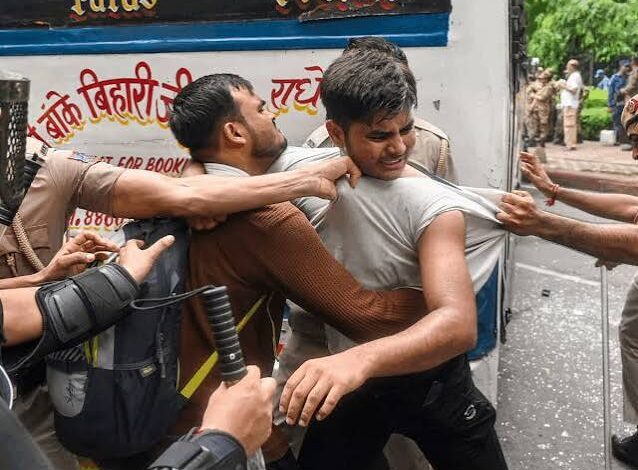
A democracy does not demonstrate its strength by surrounding its capital with barricades, disrupting public transport, restricting internet connectivity and detaining people before they can exercise their right to protest. It demonstrates its strength by maintaining public order without making constitutional freedoms appear conditional on the convenience of those in power.
The developments in Delhi over the October 10–11 protest weekend have put this principle under an uncomfortable spotlight. Following restrictions on Metro and railway services, reports of mass detentions, allegations of police excesses and claims that journalists were obstructed while covering the demonstrations, the Supreme Court of India has issued notices in contempt proceedings concerning the alleged non-compliance with its October 9 order.
The Court’s intervention is significant not because it has already declared the officials guilty of contempt—it has not—but because its directions raise questions that the administrative machinery must now answer through the judicial process.
Why did restrictions affecting essential public transport appear so sweeping that the Supreme Court considered them potentially excessive? What was the legal basis for detaining thousands of people? Were individuals targeted on specific, lawful grounds, or did the security response extend beyond what was necessary? Why were allegations of journalists being obstructed serious enough to require further judicial scrutiny?
These are not trivial procedural questions. They go to the heart of constitutional government.
The administration may describe its actions as preventive policing. Its critics see a familiar and deeply troubling pattern: when citizens threaten to become inconvenient, the machinery of the State begins treating the inconvenience itself as a threat.
The Supreme Court’s intervention has made that contradiction impossible to ignore.
When public order becomes an excuse for public paralysis
The sequence began before the planned protest at Jantar Mantar.
On October 8, the office of the Joint Commissioner of Police, Transport Range, New Delhi, issued a communication to the Delhi Metro Rail Corporation. Another communication followed on October 9, reportedly addressed to zonal railway authorities.
The measures contemplated under these communications were substantial. Metro operations and incoming Mail and Express trains at New Delhi Railway Station and Hazrat Nizamuddin Railway Station were to be stopped or cancelled. Metro frequency was to be reduced across 57 stations, with entry and exit gates scheduled to close from 9 p.m. on October 9 and remain closed during October 10 until the situation normalised.
The stated rationale was the anticipated risk of unruly crowds moving towards sensitive locations.
Public safety is a legitimate governmental responsibility. Authorities are entitled—and sometimes obliged—to assess security threats before a large gathering. No serious account of civil liberties can ignore the possibility of violence, the responsibility to protect public property or the rights of residents who have no intention of participating in a demonstration.
But preventive action must still be necessary, proportionate and legally justified.
That is precisely where the controversy began.
On October 9, while hearing matters in M.A. Baby v. Union of India, a three-judge Supreme Court bench comprising Chief Justice Surya Kant and Justices Joymalya Bagchi and V. Mohana took note of the restrictions.
The Court observed that the notifications appeared to be “overreaching” because they imposed a complete prohibition on essential public transportation. It drew a clear distinction between shutting services down altogether and regulating their operation to address genuine security concerns.
The Solicitor General assured the bench that the authorities would be impressed upon to reconsider the restrictions. The Court clarified that there should be no outright prohibition on Metro movements and that services should operate in a suitable, regulated manner, consistent with proportionality and public convenience.
It also called for a traffic advisory to be published through newspapers and online platforms. Authorities were asked to consider suitable alternative protest locations equipped with basic amenities and to submit a compliance report within four days.
The significance of this intervention should not be understated.
The Court was not ordering the police to abandon security precautions. It was insisting that the administration consider less restrictive measures rather than reach immediately for the most disruptive option.
That is the essence of proportionality: the State must establish not merely that it has a security objective, but that the restrictions imposed are appropriate to that objective and do not unnecessarily burden the public.
Apparently, the question was serious enough to require judicial intervention even before the protest unfolded.
Delhi had become a test of whether a security administration could distinguish between managing a demonstration and effectively placing the surrounding city under extraordinary restrictions.
October 10: A capital under barricades
As the protest approached, Delhi witnessed a heavy security deployment. Police and paramilitary personnel were stationed across important routes, barricades and concrete blocks disrupted movement, and security checks extended across major roads and entry points.
Reuters reported that mobile internet services were suspended in the central business district and that dozens of Metro stations and markets were shut. The planned gathering at Jantar Mantar was obstructed, while the city experienced widespread detentions.
According to Reuters, a government official told the agency that more than 2,000 protesters had been detained on October 10. A Delhi Police spokesperson subsequently put the figure at approximately 2,400 people detained on Saturday, most of whom were released that night.
The contempt proceedings, however, involved a broader allegation that approximately 7,000 people had been detained. That figure was advanced in the petition and should not be presented as an independently verified final count. The discrepancy itself underlines the need for a precise, sworn account of the number of people detained, the locations involved, the legal provisions relied upon and the timing of their release.
When the State exercises coercive powers on this scale, vague assurances are not enough. The public is entitled to know the legal basis for those actions.
Cockroach Janta Party founder Abhijeet Dipke and senior leaders Saurav Das and Ashutosh Ranka were detained when their flight landed in Delhi. Their movement had called for protests demanding the resignation of Chief Election Commissioner Gyanesh Kumar over the controversial revision of electoral rolls.
The government and the police faced a genuine operational challenge in managing a large demonstration in the capital. But the scale of the security response raises a separate question: was the objective to manage the protest safely, or did the approach extend into preventing the protest from taking place at all?
These are legally and democratically different propositions.
A government may impose lawful restrictions on a particular assembly. It does not follow that every person seeking to enter Delhi, every commuter passing through a restricted area, every journalist covering the event or every lawyer attempting to reach a court may automatically be treated as a potential offender.
The public cannot be expected to accept a situation in which the entire city becomes collateral damage in the management of a gathering.
A capital city is not the private security perimeter of its administration. It belongs to its residents, workers, students, patients, business owners and millions of people who depend on its transport network every day.
Shutting down essential services does not merely inconvenience the individuals an administration wishes to control. It imposes the burden on everyone else as well.
The Supreme Court’s contempt notice: An uncomfortable demand for answers
The events prompted applications alleging that the October 9 directions had not been followed and that numerous people had been unlawfully detained.
On October 11, the Supreme Court convened an urgent hearing. A bench of Justices Joymalya Bagchi and V. Mohana considered the contempt allegations and a related habeas corpus petition concerning the detentions.
The petitioners alleged that several Metro stations had remained closed, railway services were affected, internet connectivity had been disrupted, traffic advisories had not been issued as directed and people were being detained beyond the area covered by the prohibitory order.
They also alleged that peaceful demonstrators, lawyers and journalists had been subjected to harassment and that the number of detainees extended well beyond those identified in individual petitions.
The Solicitor General disputed the allegations. He submitted that Metro services were functioning normally, that 45 of Delhi’s 303 Metro stations had been closed to maintain law and order, that the stations were open again from 10 p.m. the previous night and that internet connectivity had been restored. He also said that no one had been illegally detained and assured the Court that lawyers, journalists and other professionals would not be obstructed in performing their duties.
This disagreement is important. The petitioners’ claims and the government’s responses cannot simply be treated as established findings of fact. They must be tested against official records, the Court’s directions, evidence of actual restrictions and the circumstances of individual detentions.
Nevertheless, the bench found that the applicants had made out a prima facie case warranting the issue of notice to the alleged contemnors. It directed the concerned officials to file counter-affidavits and a compliance report by October 13. Notice was also issued in the habeas corpus proceedings.
The notices involved the Union Home Secretary, the Delhi Police Commissioner and the Delhi Metro’s leadership.
A contempt notice is not a conviction. It does not establish that every allegation is true or that any individual official has already been found guilty. It does, however, require the allegations to be answered through the judicial process.
The distinction matters. Constitutional accountability is not served by declaring guilt before evidence is examined; nor is it served by dismissing serious allegations merely because the authorities offer an explanation.
The Supreme Court also issued directions concerning the functioning of public transport, freedom of movement, internet connectivity, detentions and access to courts.
Metro and railway services were to function normally unless regulation was necessary under applicable constitutional restrictions. Movement within Delhi was to be ensured, subject to lawful public-order requirements and traffic regulations. Barricades were to be reviewed immediately to facilitate free movement. Internet facilities were to remain unhindered.
There was to be no unlawful detention, particularly of people engaged in peaceful, unarmed assembly outside the area where Section 163 of the Bharatiya Nagarik Suraksha Sanhita was in operation.
The Court further directed that the notice board stating that Section 163 had been invoked in and around the Supreme Court premises be removed, if it had not already been removed, so that people would not be deterred from entering or leaving the Supreme Court or other courts. Lawyers, journalists and other professionals were not to be obstructed in the discharge of their duties.
The message was unambiguous in principle: lawful security management does not extinguish constitutional protections.
Article 32 is not ceremonial language
Article 32 of the Constitution empowers people to approach the Supreme Court for the enforcement of fundamental rights. It is one of the principal constitutional safeguards against arbitrary State action.
Articles 19 and 21 provide further protections relevant to the present controversy. These include freedoms of speech and expression, peaceful assembly and movement, alongside the protection of life and personal liberty. Such rights are subject to constitutional limitations and lawful restrictions; they are not absolute licences to disregard legitimate public-order requirements.
But the existence of restrictions does not convert executive discretion into unlimited authority.
If the State can close essential transport whenever a demonstration is anticipated, detain people without adequate legal grounds, restrict communication and obstruct those documenting events, then the practical value of constitutional freedoms is weakened even if those freedoms remain written in the Constitution.
A right that exists on paper but becomes inaccessible whenever the government anticipates an inconvenient gathering is a right whose protection demands constant vigilance.
The proper question is not whether the authorities can cite a public-order concern. They almost always can. The proper questions are whether the concern is substantiated, whether the restriction is proportionate, whether less intrusive alternatives were considered and whether the powers were exercised in accordance with the law.
Section 163 of the BNSS provides for preventive orders in specified circumstances involving urgent nuisance or apprehended danger. It is a legal instrument, not a magic phrase that makes every restriction legitimate merely because an authority invokes it.
Nor does the Supreme Court’s direction mean that Section 163 is inherently unlawful. The issue is the legality, necessity, geographical scope and application of the restrictions in the circumstances before the authorities.
A country governed by constitutional law cannot replace reasoned justification with the familiar administrative formula of “security considerations” and expect every consequence to escape scrutiny.
The press becomes a suspect when it records the State
Among the most troubling aspects of the protest episode are the allegations concerning journalists covering the demonstrations.
Reuters reported that several journalists were briefly detained during the protests, including reporters carrying microphones and displaying their press credentials. The Associated Press reported that press freedom groups said more than 30 journalists had been temporarily detained during the crackdown.
The allegations went beyond detention.
Ryan Thomas, a journalist with The Caravan, told the Associated Press that officers dragged him onto a bus, struck him and attempted to take his camera and ordered him to delete video footage. Jahnavi Sen, managing editor of The Wire, said she and two colleagues were briefly detained.
Delhi Police maintained that some protesters had posed as journalists and interfered with police work. That claim, too, deserves examination. Genuine press credentials cannot immunise anyone from lawful action for an independently established offence, and authorities are entitled to verify identities where there are credible grounds for doing so.
But the possibility that a person may falsely claim to be a journalist is not a justification for indiscriminate action against reporters performing legitimate professional duties.
If police believe particular individuals were impersonating members of the press, the answer is to identify those individuals, document the evidence and act lawfully. The answer cannot be to create an atmosphere in which genuine reporters fear being detained, assaulted or forced to surrender footage merely for documenting a public event.
This concern became more serious on October 13, when the Supreme Court took note of allegations that women journalists had been sexually harassed by police personnel while covering the October 10 protests. The Court asked Delhi Police to send a senior officer to assist it on October 15.
Those allegations have not been finally adjudicated and must be investigated fairly. But the fact that they have reached the Supreme Court places an additional burden on the authorities to explain the conduct of personnel deployed to manage the protests.
A press card should not become an invitation to confrontation. A camera should not be treated as a weapon merely because it records an uncomfortable scene. And a journalist asking questions about police conduct should not have to establish personal status or professional connections before expecting lawful treatment.
The larger concern is the chilling effect. If reporters conclude that documenting a demonstration carries a substantial risk of detention or violence, the public loses more than a journalist’s freedom. It loses access to independent accounts of how State power is exercised.
Reporters Without Borders ranked India 157th out of 180 countries in its 2026 World Press Freedom Index, compared with 151st in 2025. That ranking does not prove any individual allegation concerning the Delhi protests. It is, however, a relevant indicator of the broader environment in which the treatment of journalists during politically sensitive events must be assessed.
The government’s response should be to demonstrate, through transparent investigation and accountability, that journalists can perform their work safely—not to expect the public to trust assurances unsupported by scrutiny.
Allegations of assault demand evidence, not administrative indifference
The allegations of physical mistreatment extend beyond media professionals.
In reporting published by The Indian Express, at least three detainees described being assaulted while in police custody. One detainee, Nihal Alam, alleged that he had been picked up while travelling to buy clothes and was beaten inside a police vehicle. A medical-legal certificate recorded a radial head fracture following an X-ray of his elbow.
Another detainee, Arjun Unnikrishnan, alleged that personnel struck and kicked detainees. A third, lawyer Fidal Tom, alleged that police personnel beat him at a police post. His medical-legal certificate recorded swelling, abrasions and multiple contusions and described injuries consistent with blunt-object trauma.
These are serious allegations supported, in the reported cases, by medical documentation. They are not, by themselves, final judicial findings establishing the identity or culpability of the alleged perpetrators.
The police response, as reported by The Indian Express, was that no official complaints had been received and that action would be taken if complaints were submitted.
That response is not necessarily a denial of the underlying allegations, but it illustrates a significant problem with accountability mechanisms. When individuals emerge from detention with documented injuries, the question is not merely whether they have managed to initiate a formal complaint. It is whether the authorities will take credible steps to establish what happened, identify those responsible and preserve the evidence.
Where CCTV footage, duty rosters, detention registers, medical records and other contemporaneous material may exist, the public interest demands that they be preserved and examined through appropriate procedures.
The State cannot reasonably expect the public to regard a medical-legal certificate recording injuries as an inconvenience to be handled only if a complainant masters the entire machinery of the complaint process.
If the allegations are false, a transparent investigation should establish that. If they are true, disciplinary and criminal accountability must follow wherever warranted. Either outcome requires evidence and a process that people can trust.
A police uniform confers authority, not immunity.
Thirteen crore electoral-roll entries: The controversy behind the anger
The protests cannot be understood solely through the police response. Their immediate political backdrop is the controversy surrounding the Election Commission’s Special Intensive Revision of electoral rolls.
The figures are extraordinary. Reporting by Reuters on October 11 cited Election Commission data showing that approximately 130 million names or voter entries had been removed during the verification exercise. The categories cited included roughly 28 million deceased individuals, 63 million people who had relocated and 30 million who could not be traced.
The distinction between an entry removed from an electoral roll and a living citizen unlawfully deprived of voting rights is essential. The headline figure does not establish that 130 million living voters have been illegally disenfranchised. The Election Commission says the exercise is intended to eliminate deceased, duplicate, shifted and otherwise ineligible entries. It has maintained that eligible people whose names were wrongly removed can seek re-enrolment.
Those explanations must be taken seriously.
Accurate electoral rolls are essential to credible elections. Duplicate or invalid entries can undermine the integrity of the electoral process. An independent election authority must be able to verify eligibility and maintain reliable records.
But the opposite danger is equally important: a process intended to clean up voter lists must not wrongly exclude legitimate electors through inaccessible procedures, inadequate notice, faulty records or unreasonably burdensome verification requirements.
The difference between these two possibilities is not academic. Inclusion on the electoral roll is fundamental to the exercise of voting rights.
The public controversy intensified after The Indian Express reported that two colleagues of Chief Election Commissioner Gyanesh Kumar had raised at least 14 formal objections over approximately 10 months concerning voter-roll revisions, registration procedures and digital systems. The Commission has described differences of opinion as a normal part of internal deliberations and has denied allegations of political favouritism.
Opposition parties have alleged that deletions have disproportionately harmed eligible voters, including Muslim voters, and benefited the Bharatiya Janata Party. The BJP and the Election Commission deny wrongdoing.
These allegations require documentary examination, not automatic acceptance or dismissal.
The Election Commission is a constitutionally independent institution; its responsibility for electoral-roll administration should not be conflated with direct proof that the Union government ordered particular deletions. Equally, the Commission’s institutional status should not be used as a shield against legitimate questions concerning its decisions and procedures.
The Supreme Court’s May 2026 ruling upheld the Election Commission’s authority to conduct the Special Intensive Revision in Bihar, while distinguishing electoral eligibility inquiries from a final determination of citizenship. That ruling established an important legal context, but it does not establish that every subsequent deletion in every state was correct or that every individual has received fair treatment.
The Commission must therefore answer a straightforward democratic question: how many eligible people were removed, how many have been restored, how many remain subject to verification, and what safeguards ensure that a person is not prevented from voting because of an administrative error?
There is also a basic numerical transparency issue. The three removal categories publicly cited above total approximately 121 million, not 130 million. Because the figures are rounded and may not exhaust all categories, that difference is not proof of manipulation. But a complete, reconciled explanation of the headline total would help dispel suspicion and enable meaningful scrutiny.
Publishing a transparent breakdown by state, district, category and stage of revision would be more persuasive than asking citizens to accept a number without the information required to understand it.
The right to vote cannot rest on the assumption that a person omitted from a database is necessarily ineligible. Nor can concerns about inaccurate voter rolls be dismissed as political theatre simply because they are raised during an election dispute.
When electoral-roll revisions on this scale trigger sustained protests, the correct institutional response is transparency, independent scrutiny where appropriate, and an accessible process for correction.
Treating questions about electoral fairness as an affront to the State will only deepen mistrust.
The price of a security-first approach
The controversy is also a warning about the wider cost of governing through blanket restrictions.
When Metro services are restricted, workers may struggle to reach workplaces, patients may face delays, students may lose access to educational institutions and businesses may suffer losses. When roads are blocked without adequate public communication, residents who have nothing to do with a protest are forced to bear the consequences.
The Delhi High Court has now sought the government’s response to multiple petitions concerning the protests. Those petitions raise issues ranging from alleged assaults and restrictions on movement to concerns about people being placed under house arrest and the disruption suffered by traders and other members of the public.
These are allegations that will have to be evaluated through the legal process. Their existence nevertheless illustrates the widening range of concerns generated by the episode.
A citywide security strategy may look decisive from an administrative control room. Its costs are experienced very differently by the person trying to reach a hospital, the trader watching business disappear, the journalist attempting to document events or the citizen who is stopped without a clear explanation.
That is why proportionality matters.
A narrowly tailored arrangement, based on an identified risk, may be justified. A sweeping restriction requires a correspondingly strong explanation. If specific intersections or station entrances present security concerns, authorities should examine whether those risks can be managed through targeted deployment, regulated service, access controls and adequate traffic planning.
Such measures require work. They demand coordination, judgement and accountability.
A blanket closure can appear administratively easier because it transfers the burden of the security problem from the State to the public.
But ease of administration is not the constitutional standard.
The Supreme Court’s October 9 order specifically distinguished regulation from complete prohibition. That distinction should not be treated as a technicality. It represents the difference between a government that manages risks while respecting public life and one that attempts to eliminate risks by restricting public life itself.
The government cannot answer every criticism with law and order
The authorities have a legitimate argument when they point to maintaining public peace. Protest organisers cannot claim an unrestricted right to occupy any location, disregard valid restrictions or obstruct public duties. Peaceful assembly does not confer immunity for independently established unlawful conduct.
The events following the Supreme Court’s intervention demonstrate that point.
On October 14, Reuters reported that a court had ordered CJP leaders Saurav Das and Ashutosh Ranka to five days of judicial custody following their entry into Jantar Mantar after crossing police barricades. Police said the action concerned repeated violations and the leaders’ earlier legal undertaking. Their legal position and the grounds for custody remain matters for the appropriate legal process.
This development should not be concealed merely because the broader criticism concerns police conduct. Nor should it be used to retrospectively justify every restriction imposed on every person during the preceding protests.
The lawfulness of action against particular individuals and the proportionality of broader restrictions are separate questions. The evidence that a person crossed a barricade does not establish that another person should have been unlawfully detained. A lawful restriction on a particular protest site does not automatically authorise the suspension of ordinary movement throughout the city.
The same standard applies to everyone: authorities must justify their actions within the law, and protesters must comply with lawful restrictions.
That is the difference between constitutional accountability and partisan convenience.
The administration must also account for the sequence of events. The Supreme Court had already warned against complete prohibitions on essential transport on October 9. On October 11, following allegations of non-compliance and unlawful detention, it issued additional directions and contempt notices.
The question now is whether the authorities can demonstrate, with contemporaneous records and a clear account of the decisions taken, that their conduct complied with the Court’s orders and with the law.
The government’s assurances that services were restored and detainees released are relevant. They do not, by themselves, answer every question about what happened during the restrictions, why particular individuals were detained or whether the original measures were proportionate.
Restoring a service after disruption does not erase the disruption. Releasing a detainee does not automatically establish that the detention was lawful. Promising to protect journalists does not resolve allegations that journalists were obstructed or assaulted.
Accountability requires explanations of past decisions, not merely assurances about future conduct.
The bureaucracy will resist—but constitutional limits are not optional
The phrase “The Bureaucracy Will Resist” captures a longstanding danger in the exercise of executive power.
Institutional resistance does not always take the form of an explicit refusal to obey a court order. It can also arise through defensive paperwork, expansive interpretations of security requirements, poorly coordinated instructions, delayed disclosure, excessive restrictions or a tendency to treat judicial oversight as an obstacle to be managed.
Whether any such conduct occurred in contempt of the October 9 order remains for the Court to determine. It would be premature to pronounce the officials guilty before their replies and the evidence have been examined.
But the broader institutional concern deserves attention.
Bureaucracies can develop a reflex in which restricting activity is easier than accommodating it, detention is easier than individual assessment, closure is easier than regulation, and a reference to public order is treated as a complete answer rather than the beginning of a legal justification.
When such a reflex goes unchecked, the burden of administrative convenience falls disproportionately on ordinary citizens.
The answer is not to weaken the State’s legitimate capacity to maintain public order. It is to insist that every exercise of that capacity remain within constitutional limits.
Police officials should be able to explain the legal grounds for detentions and the basis for restrictions. Public transport authorities should be able to explain how service decisions were made and what alternatives were considered. Officials accused of violating court directions should be required to provide a verifiable account of compliance. Allegations concerning injuries to detainees and interference with journalists should be investigated impartially.
The Election Commission should provide a transparent, reconciled account of the voter-roll revision and an accessible means of correcting wrongful exclusions. The government and ruling party should address concerns about electoral fairness with evidence rather than treating scrutiny itself as an attack on democratic legitimacy.
These are reasonable demands in a constitutional democracy. They are not acts of hostility against the country.
Indeed, a system confident in its own legality should welcome the opportunity to demonstrate that its decisions were justified.
The most damaging response is to confuse accountability with disloyalty and criticism with disorder.
A democratic government is tested when dissent becomes inconvenient
The events in Delhi have brought several questions together: the right to protest, access to public services, freedom of movement, protection against unlawful detention, the safety of journalists and public confidence in the electoral process.
Each question deserves independent scrutiny. Together, they test whether institutions can manage disagreement without undermining the freedoms that give democratic government its legitimacy.
The Supreme Court’s intervention does not mean that every allegation made by protesters is true. It does not establish that every restriction was unlawful or that the entire voter-roll revision was politically manipulated. Those conclusions require evidence and, where contested, judicial determination.
But the intervention does establish that serious allegations about compliance with a prior judicial order have reached the Court and that the concerned authorities have been required to answer them. Its directions also make clear that public transport, connectivity, freedom of movement and professional duties cannot be treated as expendable merely because a protest is anticipated.
The immediate test is practical.
Will the authorities provide a full account of the restrictions and detentions? Will evidence concerning alleged police excesses be preserved and independently scrutinised where necessary? Will reporters be able to document public events without fear of unlawful interference? Will genuine electoral-roll errors be corrected in time for eligible citizens to exercise their voting rights?
And, perhaps most importantly, will the administration recognise that the right to peaceful dissent is not a favour granted by the government to citizens who happen to remain convenient?
India’s democratic credentials cannot be established by slogans, international branding or references to the country’s size. They are demonstrated through the everyday relationship between the citizen and the State: whether a person can travel without unnecessary obstruction, question authority without fear, approach a court without intimidation, report an uncomfortable truth and participate in an election without arbitrary exclusion.
The bureaucratic temptation to overreach is precisely why judicial oversight and enforceable rights matter.
A government that seeks obedience without explanation may achieve temporary control. It cannot, by that method alone, earn public confidence.
A State confident in its democratic mandate should not need to make its citizens feel that a protest somewhere in the capital is an emergency everywhere else.
The Supreme Court has now demanded answers. Those answers must be specific, documented and capable of judicial scrutiny.
Until then, the central question remains painfully simple: if the restrictions were necessary and lawful, why should explaining them be so difficult?
The bureaucracy may resist scrutiny. The administration may defend its decisions. Political parties may trade accusations. But the Constitution does not make fundamental rights conditional on administrative convenience.
The real measure of democratic government is not how efficiently it can barricade a city. It is how faithfully it can protect the rights of the people who live in it.