
The Godrej Properties Paradox India’s Real Estate Superstar Or A Developer Struggling With Delivery, Compliance And Accountability?
How does a real estate developer that has emerged as India's highest-selling listed property company reconcile its extraordinary sales growth with questions over project delivery, environmental compliance, homebuyer grievances and legal disputes?


Godrej Properties Limited (GPL), the real estate arm of the Godrej Industries Group, has established itself as one of India’s most prominent residential property developers. With a presence across major housing markets, a rapidly expanding project portfolio and some of the industry’s highest booking figures, the company has become a formidable force in India’s organised real estate sector. Its performance has also placed it among the country’s largest listed residential developers by sales booking value.
The scale of its growth is evident from its FY2025-26 performance. Godrej Properties reported record sales bookings of ₹34,171 crore, representing a 16% increase over the previous financial year. It sold approximately 17,513 residential units covering 27 million square feet, while customer collections rose 17% to ₹19,965 crore. The company also reported operating cash flow of ₹7,830 crore, its highest-ever annual figure. It said it had retained its position as India’s largest residential developer by booking value for the third consecutive financial year.
Its geographical spread has been another important contributor to this performance. The Mumbai Metropolitan Region generated bookings worth approximately ₹10,312 crore, followed by Bengaluru at ₹8,801 crore and the National Capital Region at ₹7,412 crore. Pune and Hyderabad contributed another ₹3,659 crore and ₹2,360 crore, respectively. The company’s ability to generate substantial sales across multiple metropolitan markets has helped it reduce dependence on any single geography.
However, the headline numbers tell only one part of the story. Real estate is a business in which the transaction is only the beginning of a much longer relationship. A booking must eventually translate into construction, For homebuyersregulatory approvals, completion certificates and possession. , the real measure of a developer’s performance is not simply how many apartments it sells, but whether those apartments are delivered in accordance with contractual commitments and applicable regulations.
This is where the questions surrounding Godrej Properties become important. Its rapid expansion and record bookings have coincided with complaints over delayed possession, project-level regulatory scrutiny, environmental disputes and legal proceedings.
These matters vary considerably in their nature and legal status, but together they raise questions about how a large developer manages execution and compliance across an expanding portfolio.
The challenge, therefore, is to look beyond the company’s sales figures and examine the business model, project execution practices and accountability mechanisms supporting that growth.

The Business Model And The Expansion Machine
Godrej Properties’ growth strategy is built around expanding its development portfolio across India’s major urban markets. Rather than relying exclusively on land purchased and owned outright, the company also uses joint development agreements, development management arrangements and partnerships with landowners. These structures allow it to enter new locations and develop projects without necessarily having to acquire the entire underlying land parcel upfront.
This approach can make expansion less capital-intensive than a traditional land-buying model. It also allows the developer to build a pipeline of projects by collaborating with landowners and other development partners. However, it introduces another layer of complexity: project execution can involve multiple entities, contractual arrangements, approvals and responsibilities. The clarity of these arrangements becomes particularly important when disagreements arise or regulatory obligations are not met.
The company’s FY2025-26 business development figures illustrate the scale of this expansion. Godrej Properties added 18 new projects during the year, with an estimated saleable area of approximately 33.32 million square feet and an estimated future booking potential of ₹42,100 crore. This represented a 59% increase in the value of new business development compared with the previous year.
The company has also expanded its presence beyond conventional residential projects into plotted developments and development-management services. Its arrangements with Godrej & Boyce for the development of land in Vikhroli, Mumbai, represent another significant opportunity within the wider group ecosystem. The strength of the Godrej brand itself has helped the company secure partnerships, enter new markets and attract customers and investors.
However, this expansion strategy also creates operational challenges. Godrej Properties’ own annual report acknowledges that its projects require approvals across multiple central, state and local regulatory frameworks, with differences in land-use policies and approval processes across jurisdictions. It also identifies delays in statutory approvals as a risk that could affect project timelines, delivery commitments and revenue recognition.
The company says it evaluates new projects against strict return thresholds and balances joint development arrangements with selective outright land acquisitions. It has also highlighted increased construction spending, project-management investments and technology adoption as measures to strengthen execution capabilities.
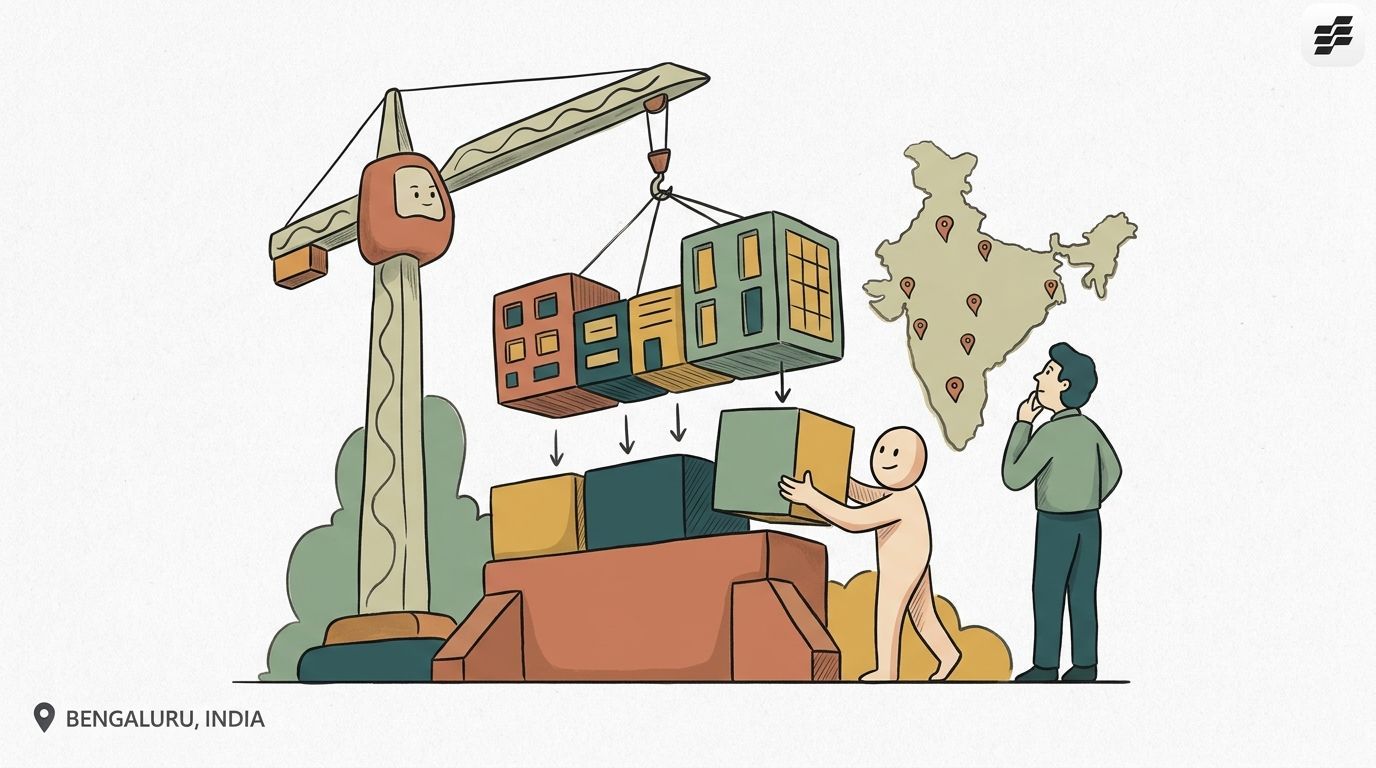
But the larger question is whether these systems can consistently keep pace with the company’s growing geographical footprint and project pipeline. Adding land parcels and securing development agreements can generate enormous future sales potential. Converting that potential into completed, compliant homes across multiple cities is a considerably more demanding exercise.
And that distinction between expansion and execution is central to understanding the questions that follow.
Record Bookings, But Where Are The Deliveries?
Godrej Properties’ sales performance has been impressive, but the more important question is how quickly those bookings translate into completed homes. The distinction matters because a property booking represents a sale commitment, whereas delivery requires construction to be completed, statutory approvals to be secured and an occupancy or completion certificate to be obtained.
The company’s FY2025-26 performance provides an important starting point. Godrej Properties achieved booking value of ₹34,171 crore, exceeding its annual guidance of ₹32,500 crore. It also reported deliveries covering 12.1 million square feet, against its guidance of 10 million square feet. On paper, therefore, the company exceeded both its sales and delivery targets.
However, the latest FY2026-27 numbers present a more complicated picture. For the first half of FY27, Godrej Properties recorded booking value of ₹16,659 crore, an increase of 7% over the corresponding period last year. It sold 7,396 units covering approximately 12.3 million square feet. Collections also increased 25% to ₹9,666 crore, reflecting continued customer payments and strong operating activity.
Yet profitability moved in the opposite direction. For Q2 FY27, the company reported consolidated net profit of ₹154 crore, compared with ₹405 crore in the corresponding quarter a year earlier, a decline of approximately 62%. For the first half, profit after tax fell by approximately 51% year-on-year to ₹505 crore. Total income, meanwhile, increased during the quarter to ₹2,575 crore.
The company has attributed the difference between its operating performance and reported financial results partly to the timing of project completions and revenue recognition. Chairman Pirojsha Godrej indicated that FY2028 would be an important year when the expansion achieved in preceding years becomes more visible in reported financials under project-completion accounting. The company also reported deliveries covering 2.5 million square feet during Q2 FY27.
This distinction is important. A decline in quarterly profit does not automatically establish that projects are being delayed, just as strong bookings do not establish that homes have been delivered. Both figures need to be examined independently.
Godrej Properties has set a delivery target of 13.5 million square feet for FY27, alongside booking guidance of ₹39,000 crore. Whether it can meet these targets will be an important test of its ability to convert an expanding project pipeline into completed residential developments.
The larger concern is not simply whether the company is selling enough homes. It is whether its execution systems, construction schedules and approval processes can consistently keep pace with the scale of its sales ambitions.

The Homebuyer Problem And The Cost Of Waiting
For a homebuyer, a delayed residential project is not merely a missed corporate target. It can mean years of paying EMIs, continuing to pay rent, postponing relocation plans and watching savings remain locked in an unfinished property.
Several Godrej Properties projects have faced homebuyer complaints and regulatory proceedings involving delayed possession, incomplete amenities and disagreements over contractual commitments.
One prominent example is Godrej Meridien in Sector 106, Gurugram. In September 2026, the Haryana Real Estate Regulatory Authority directed Godrej Real View Developers to pay 10.8% annual interest to buyers Madhu Chhabra and Pradip Chhabra for delayed possession of their apartment. The buyers had booked the property for approximately ₹1.9 crore in October 2021 and paid more than ₹1.8 crore. Although possession was contractually due by September 30, 2023, the offer was made only in January 2025.
The developer argued that COVID-19 lockdowns, labour shortages and construction restrictions justified the delay. However, HRERA rejected the additional force-majeure defence and directed payment of interest for the delayed period.
The Meridien dispute was not an isolated complaint. In another proceeding involving the same project, HRERA directed Godrej Real View Developers to compensate buyers Malik Ram and Sarita Verma at 10.8% annual interest. The buyers had booked their apartment under a construction-linked payment plan, with possession originally scheduled for September 2020. After the COVID-related extension, the revised deadline was March 2023, but physical possession was handed over only in November 2024.
The authority rejected the developer’s further explanations involving lockdowns, labour shortages and pollution-related construction bans.
A similar dispute emerged at Godrej Nature Plus in Gurugram. In July 2026, HRERA directed Godrej Highview to hand over a residential unit to buyers Ravi Kant Thakral, Minakshi Thakral and Anuj Thakral and pay statutory interest for delayed possession. The buyers had booked the apartment in 2018, with the contractual possession date set for June 2023. Even after the COVID-related extension to December 2023, possession had not been offered. The authority again rejected the developer’s additional force-majeure arguments.
The experience of buyers at Godrej Nest in Noida’s Sector 150 provides another dimension to the issue. The project, launched in 2017-18, had initially promised possession within approximately three years. Revised deadlines subsequently pushed delivery into 2024 and 2025. In June 2026, possession began in two of its seven towers, covering approximately 550 apartments, according to homebuyers interviewed by The Indian Express.
However, several buyers continued to wait, while some who received keys complained about construction quality, seepage and additional charges.
There have also been disputes over promised infrastructure and amenities. In October 2024, the National Consumer Disputes Redressal Commission ordered refunds totalling approximately ₹4 crore in five cases involving Godrej projects. One of the disputes concerned Godrej Summit in Gurugram, where the commission found that a promised 24-metre-wide connecting road had not been constructed even years after possession was offered. It treated the failure to provide the promised facility as a deficiency in service.
These cases show an important distinction between selling a home and fulfilling the obligations attached to that sale. A developer’s responsibility does not end when a booking is secured or a building receives an occupancy certificate. Contractual possession dates, promised infrastructure, amenities and the quality of the finished property are all part of the commitment made to the buyer.
Godrej Nest And The Questions Around Occupancy, Possession And Construction Quality
The Godrej Nest project in Sector 150, Noida, illustrates how a residential development can become caught between construction delays, regulatory complications and the expectations of homebuyers who have invested substantial sums in a property carrying the Godrej brand.
Launched around 2017-18, the project was marketed as a premium residential development within the larger Noida Sports City area. Buyers were initially expecting possession within approximately three years. However, the project subsequently encountered delays linked to the wider Sports City development controversy, including disputes involving the lead developer, Lotus Green Constructions, and regulatory approvals.
The matter reached the Supreme Court after the Allahabad High Court ruled against Lotus Green in February 2025 over alleged irregularities in the development of the Sports City project. On September 26, 2025, the Supreme Court directed the Noida Authority to issue conditional occupancy certificates for six residential towers of Godrej Nest, providing relief to buyers who had been waiting for their homes.
The issue, however, did not end with the court’s intervention. In July 2026, It was reported that possession had begun for some buyers, while others were still waiting. Homebuyers also raised concerns about seepage, construction quality, unfinished infrastructure and the absence of certain promised facilities, including gas connections and meters. Some alleged that they had to undertake repairs and replacements shortly after receiving possession.
Godrej Properties, in response to the newspaper, maintained that it had applied for the occupancy certificate within the requisite timelines following completion of construction. The company said that the Noida Authority issued the certificate pursuant to the Supreme Court’s directions and that apartment handovers had commenced in phases. It also defended its construction standards, stating that apartments underwent quality inspections and that customer concerns were addressed.
The distinction is important. The Sports City controversy involved regulatory and development issues extending beyond Godrej Properties alone, while the construction-quality complaints are allegations made by individual buyers and should not be treated as established findings against the company.
Nevertheless, Godrej Nest demonstrates the practical difficulties buyers can face when a project is affected by wider land-development disputes and approval-related complications. For purchasers, the ultimate test is whether the home they receive matches the commitments made when they invested their money.
Environmental Scrutiny, Construction Violations And Regulatory Closure Orders
Environmental compliance has emerged as one of the most consequential areas of scrutiny surrounding Godrej Properties. The concerns extend across several cities and involve construction-site pollution, environmental clearances, lake protection, wildlife permissions and compliance with restrictions imposed by regulatory authorities.
The company’s own disclosures have recorded penalties and regulatory actions involving projects such as Godrej Woods in Noida, Godrej South Estate in Delhi and Godrej Emerald Waters in Pimpri, Pune.
A separate ₹5 lakh penalty was also imposed on Godrej Vestamark LLP, a subsidiary, by the Municipal Corporation of Delhi in 2023. These disclosures make it difficult to treat environmental compliance as a concern limited to a single development.
One of the most significant disputes emerged in Bengaluru involving Godrej Reflections near Kaikondrahalli Lake. In July 2021, the National Green Tribunal set aside the environmental clearance granted to the project proponents, including Godrej Properties and Wonder Projects Development Private Limited. The proceedings concerned alleged violations involving wetlands, stormwater drains and construction near the lake’s protected surroundings.
The tribunal imposed environmental compensation of ₹31 crore and issued directions concerning demolition and restoration of the affected lake area. The project developer challenged the decision, making the legal status of the dispute an important qualification when discussing the matter.
The Chandigarh controversy surrounding Godrej Eternia has been equally significant. The commercial complex in Industrial Area, Phase I, became the subject of a dispute over the absence of wildlife clearance despite its proximity to Sukhna Wildlife Sanctuary and City Bird Sanctuary.
The Chandigarh administration had cancelled its occupation certificate in July 2024. The CBI subsequently registered a case in February 2025 concerning alleged cheating and criminal conspiracy involving the developer and unidentified administration officials.
The controversy escalated on September 30, 2026, when the Union Environment Ministry revoked the project’s environmental clearance, holding that prior wildlife clearance was required. Godrej Properties disputed the decision, arguing that the project was outside the applicable notified eco-sensitive zone and that the clearance requirement had been wrongly applied. The company challenged the ministry’s action before the NGT.
More recently, the environmental compliance question resurfaced in Gurugram. On November 14, 2026, the Haryana State Pollution Control Board issued an order directing the closure of operations at Godrej Properties’ group housing project in Sector 3, Gurugram, citing alleged non-compliance with provisions of the Air (Prevention and Control of Pollution) Act, 1981. The observations concerned dust-control measures at the construction site.
In its November 17 stock-exchange disclosure, Godrej Properties said it was taking necessary steps to resume operations and maintained that the order would not have a material impact on its financial position. The company has not described the matter as a permanent shutdown.
The significance of these developments lies in their cumulative effect. The environmental issues involve different projects, different regulatory authorities and different stages of legal proceedings. Some concern penalties for construction-related non-compliance, others involve environmental clearances that have been challenged, while the Gurugram matter involves a specific closure direction over dust-control measures.
For a developer operating across multiple cities and handling projects worth thousands of crores, environmental compliance cannot be treated as a peripheral administrative responsibility. It is central to obtaining approvals, maintaining construction schedules and protecting the interests of both homebuyers and surrounding communities.
The question is whether the company’s internal compliance and monitoring mechanisms are sufficiently robust to prevent such issues from recurring across its expanding portfolio.
The Godrej-Orris Dispute And The Legal Controversies Surrounding Godrej Properties
One of the more significant legal disputes involving Godrej Properties concerned its joint development arrangement with Orris Infrastructure for the Godrej Air project in Gurugram. The dispute brought questions around contractual obligations, partnership arrangements, statutory filings and alleged financial irregularities into the public domain.
The disagreement arose from the development of the Godrej Air project, where Godrej Properties and Orris Infrastructure were associated through a joint development arrangement. The relationship subsequently deteriorated, with the parties raising allegations concerning the management of the project and statutory records of the limited liability partnership associated with it.
In May 2024, an FIR was registered by the Delhi Police Economic Offences Wing following a complaint by Orris Infrastructure. The complaint involved allegations of cheating, criminal breach of trust and criminal conspiracy. Godrej Properties disputed the allegations, maintaining that the matter arose from a commercial disagreement between the parties.
The dispute subsequently acquired another dimension when the Enforcement Directorate registered an ECIR under the Prevention of Money Laundering Act, based on the underlying FIR.
Separately, in March 2026, another FIR was registered at Mumbai’s Vikhroli Police Station following a complaint by a Godrej Properties representative. That complaint concerned alleged unauthorised alterations to statutory LLP records and the filing of allegedly false documents. These were allegations made by the respective complainants, not established findings of guilt.
However, the dispute took a significant turn in August and September 2026. The parties reached a settlement on August 25, 2026, following discussions, and agreed to withdraw their respective claims and allegations. The Delhi High Court subsequently quashed the original Delhi FIR and consequential proceedings on August 25.
The Bombay High Court also quashed the separate Mumbai FIR and related proceedings on September 3, including the Look Out Circulars issued against the petitioners. The commercial dispute was therefore brought to a settlement rather than proceeding to a final adjudication of the competing allegations.
The financial implications of the settlement were also disclosed by Godrej Properties. On September 10, 2026, the company informed stock exchanges that the settlement was expected to have an estimated financial impact of approximately ₹70 crore. It said that the actions contemplated under the agreement were being implemented and that further disclosure would follow as required.
There was another important development on October 28, 2026, when the Delhi High Court quashed the Enforcement Directorate’s ECIR against Godrej Properties. The court noted that the underlying FIR had already been quashed following the settlement and that there was no surviving scheduled offence or proceeds of crime on which the ECIR could independently stand. It also clarified that the proceedings could be revived if the underlying FIR were revived in the future.
The episode is important not because the allegations were ultimately established, but because it demonstrates the legal and financial complications that can emerge from joint-development arrangements. For a developer operating through partnerships and project-specific entities, the governance of contractual relationships, statutory filings and shared responsibilities becomes particularly important.
The settlement and subsequent court orders have brought this particular dispute to a legal conclusion, subject to the possibility of revival specified by the court. It should therefore not be presented as an unresolved criminal case against Godrej Properties.
The Financial Picture Behind The Growth, Bookings, Cash Flows And Profitability
Godrej Properties’ financial performance presents an interesting contrast between its expanding sales pipeline, strong customer collections and fluctuations in reported profitability. While the company has consistently reported record booking numbers, its financial statements also demonstrate why booking value alone cannot be treated as a measure of financial performance.
For FY2025-26, the company recorded booking value of ₹34,171 crore, exceeding its guidance of ₹32,500 crore. Customer collections reached ₹19,965 crore, while operating cash flow stood at ₹7,830 crore. The company also generated free cash flow of ₹628 crore in the fourth quarter. These numbers indicate that the growth was accompanied by substantial customer collections and operating cash generation, rather than being limited to headline sales announcements.
However, the company’s first-half FY2026-27 results revealed pressure on reported earnings. For Q2 FY27, consolidated total income increased 38% year-on-year to ₹2,575 crore, but net profit declined 62% to ₹154 crore from ₹405 crore in the corresponding quarter. Earnings before interest, tax, depreciation and amortisation also fell 72% to ₹171 crore.
For the first half of FY27, consolidated profit after tax declined approximately 50% to ₹504 crore, compared with ₹1,005 crore in the corresponding period last year. At the same time, collections increased 25% to ₹9,666 crore and operating cash flow for Q2 reached ₹1,584 crore, reflecting a 33% year-on-year increase.
Godrej Properties has pointed towards the timing of project completions and the accounting treatment of revenue recognition as important factors behind the difference between operating performance and reported earnings. Under project-completion accounting, revenue from certain developments becomes visible in financial statements when the relevant completion conditions are met.
Consequently, a developer can record substantial bookings and collections without recognising the entire value of those sales as revenue in the same period.
Chairman Pirojsha Godrej has indicated that FY2027-28 will be an important year for the company, when the expansion achieved over the preceding years is expected to become more visible in reported financial performance. The company has also outlined expectations of positive free cash flow and a 20% reported return on equity in FY28. These are management expectations rather than achieved results.
Another important aspect is the scale of the company’s expansion commitments. Godrej Properties added projects with an estimated future booking potential of ₹42,100 crore during FY26, substantially exceeding its business development guidance of ₹20,000 crore. While this creates opportunities for future sales, it also requires substantial construction expenditure, project financing, statutory approvals and execution capacity.
Indeed, the company’s direct construction spending increased 62% during FY26, reflecting the investment required to move its expanding portfolio towards completion.
The financial picture, therefore, is not one of straightforward deterioration or uninterrupted growth. Godrej Properties continues to report strong bookings, collections and operating cash flows, even as quarterly profitability has weakened. Its ability to convert its expanding project pipeline into completed developments, recognised revenue and sustainable profitability will be an important indicator of whether its aggressive growth strategy is delivering the intended financial returns.
The Godrej Brand, Management And The Question Of Corporate Accountability
For Godrej Properties, the brand is one of its most valuable business assets. The company benefits from its association with the wider Godrej Group, a name that has built considerable recognition and consumer trust across generations. In real estate, where buyers often commit their life savings years before receiving possession, this brand association can play an important role in purchasing decisions.
But a strong brand also brings greater responsibility. When a developer operates across several cities, with multiple projects and development partners, ensuring that every project meets its contractual, environmental and regulatory obligations becomes a substantial management challenge.
According to its FY2025-26 Integrated Annual Report, Godrej Properties had 29 unlisted subsidiaries and eight associate companies as of March 31, 2026. Its business also involves several limited liability partnerships through which individual developments and land arrangements are undertaken.
This structure is not unusual for a large real estate developer, where project-specific entities are frequently used to manage investments, partnerships and liabilities. However, it makes effective oversight across the entire project portfolio particularly important.
The company has a formal corporate governance framework comprising an independent Board, Audit Committee, Risk Management Committee and other statutory committees. Its FY26 annual report states that the seven-member Board included four independent directors, representing 57% of its composition. The company also reported that its independent directors had submitted declarations confirming their independence under applicable regulations.
Godrej Properties also describes a three-lines-of-defence risk management system. This includes risk ownership within individual business functions, oversight through executive and zonal risk committees, and independent internal audit. Its Board-level Risk Management Committee is responsible for overseeing the identification, assessment and mitigation of financial, operational, regulatory and environmental risks.
These are important institutional safeguards, but their effectiveness ultimately depends on implementation. The existence of a risk committee or a compliance policy does not, by itself, establish that every project is meeting its obligations.
A further development came in November 2026, when the Tamil Nadu Real Estate Regulatory Authority imposed a ₹1 lakh penalty on Godrej Properties for an alleged violation of Section 11(2) of the RERA Act concerning an advertisement for its Coimbatore project.
The company told stock exchanges that the advertisements had been circulated by third parties without its knowledge or authorisation, involving unauthorised use of the Godrej brand. It said the material had been taken down and that it was evaluating legal remedies.
The episode illustrates another dimension of corporate accountability: the responsibility to protect the brand, ensure that project marketing complies with regulatory requirements and prevent misleading representations from reaching prospective buyers. The company’s explanation must be considered alongside the regulator’s action, rather than treating the penalty as proof that the company itself authorised the advertisement.
Ultimately, the question is not whether Godrej Properties has governance policies on paper. It is whether those systems consistently translate into effective supervision of projects, partners, contractors, marketing practices and regulatory compliance across the country.
The Larger Question Of Accountability To Homebuyers, Investors And Regulators
Godrej Properties is not a company struggling to find customers. Its record bookings, expanding project pipeline and strong brand recognition demonstrate its position in India’s residential real estate market. Yet its growth also brings a responsibility that extends beyond sales targets and shareholder returns.
For homebuyers, the measure of success is a completed home, delivered on time, with the promised facilities and legally required approvals. For investors, it is the ability to convert bookings into collections, completed projects and sustainable profitability. For regulators and surrounding communities, it is whether development takes place within environmental and statutory requirements.
The company has established governance systems and continues to report strong operating numbers. It has also disputed several allegations and defended its position in different regulatory and legal proceedings. These responses deserve consideration. However, the recurring questions across project delivery, environmental compliance and buyer grievances cannot simply be separated from the company’s expanding business ambitions.
The real Godrej Properties paradox, therefore, is not its ability to sell homes. It is whether the company can ensure that the scale of its growth is matched by equally strong execution, compliance and accountability. In a sector where trust is often the first thing a homebuyer purchases, that may ultimately prove to be its most important measure of success.