₹1.5 Crore Taxpayer’s Money Per Day: That’s What The Modi Government Spent On Advertising!

There is a moment from 2022 that deserves to be held up against a very bright light. Prime Minister Narendra Modi, speaking in Delhi, took pointed aim at then-Chief Minister Arvind Kejriwal’s government, accusing it of squandering public money on self-promotional advertising. Modi, with characteristic rhetorical confidence, drew a moral contrast: he, unlike Kejriwal, had chosen the “path of working for the public” rather than burnishing his image with taxpayer funds.
It was a powerful line. It landed in the press. It circulated on social media. And then, several years later, the government’s own data walked up quietly behind it and pulled the rug.
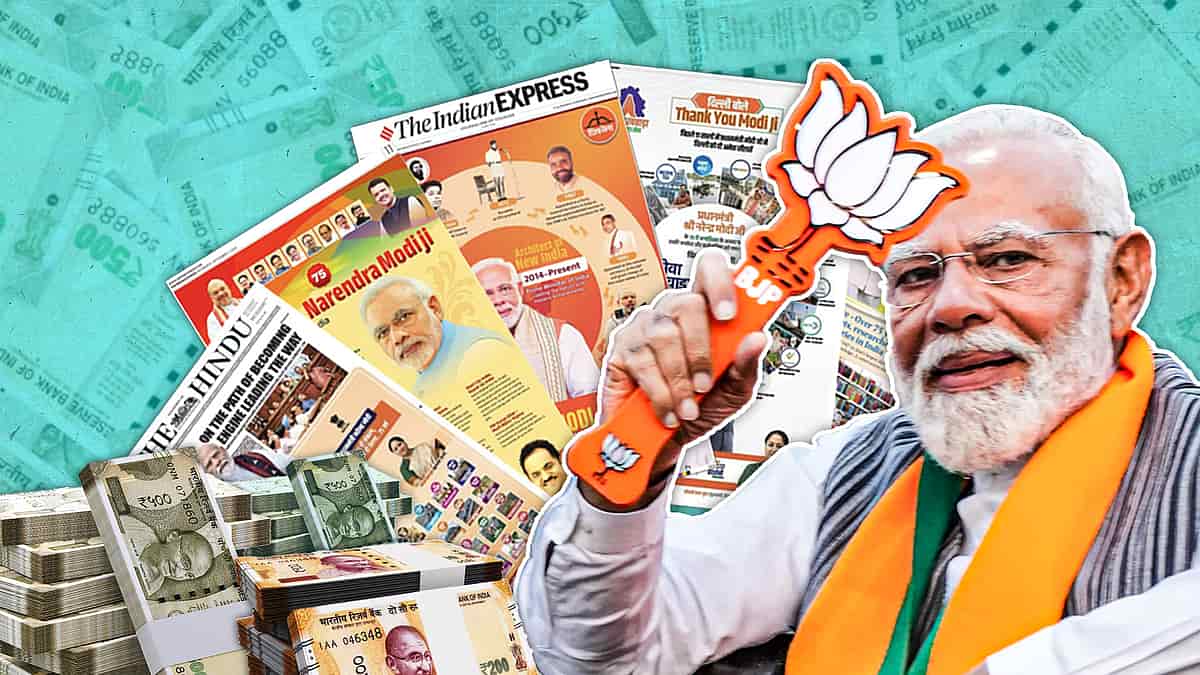
In a written reply in the Lok Sabha to a question raised by Samajwadi Party MP Iqra Hasan and others, the Minister of State for Information and Broadcasting, L Murugan, provided a detailed breakdown of the Central Government’s advertising expenditure over the last eleven years. Between 2014-15 and 2024-25, the Narendra Modi government spent a total of Rs 5,987.46 crore on advertisements, an average of approximately Rs 1.5 crore every single day. In this amount, the government could have funded the annual salary of approximately 8,300 primary school teachers, every single day, for eleven straight years.
It could have built, by conservative estimates, hundreds of rural health sub-centres annually. Instead, a significant and growing portion of that money has flowed into newspapers, television channels, digital platforms, hoardings, and influencer agencies; much of it through a single government body, the Directorate of Advertising and Visual Publicity, now rechristened the Central Bureau of Communication (CBC).
Starting at Rs 765.83 crore in 2014-15, spending climbed to Rs 879.80 crore the following year, eventually peaking at Rs 889.34 crore in 2017-18. The figures then declined sharply, dropping to Rs 281.71 crore in 2020-21 and hitting a low of Rs 214.94 crore in 2021-22, before reversing course, with spending rising to Rs 353.98 crore in 2023-24.
The curious dips in 2020-21 and 2021-22 demand explanation. They coincide precisely with the most devastating phases of the COVID-19 pandemic, years when the government’s public health communication arguably needed to be at its sharpest. The fact that overall advertising outlay shrank in those years suggests that government advertising is (perhaps) not simply a neutral public information exercise but something more deliberate, which is a signal tied to electoral cycles, political confidence, and the management of optics. And it tracks, both 2020-21 and 2021-22 were years without major national elections. The upswing from 2022-23 onwards, culminating in surges ahead of the 2024 general election, fits a pattern as familiar in democratic governance as it is troubling.
Let’s See The Five-Year Picture, What the Money Actually Bought
Over the five financial years from 2020-21 to 2024-25, total government advertising expenditure reached nearly Rs 2,447 crore, averaging roughly Rs 1.34 crore per day. Of this, nearly Rs 985 crore went to audio-visual advertising, Rs 930.24 crore to print, Rs 392.51 crore to outdoor publicity such as hoardings, and Rs 138.71 crore to digital and new media.
The year-wise breakdown of that five-year period is revealing. Rs 409.55 crore in 2020-21, Rs 317.48 crore in 2021-22, Rs 408.37 crore in 2022-23, Rs 656.6 crore in 2023-24, and Rs 654.9 crore in 2024-25. The near-doubling of annual spending between 2021-22 and 2023-24, from Rs 317 crore to over Rs 656 crore, maps almost exactly onto the two-year build-up to the 2024 Lok Sabha election. Governments the world over tend to amplify their communication budgets ahead of electoral contests, and India is no exception. But the scale and the trajectory here make the pattern difficult to dismiss as coincidental.
Zoom out further and the broader budget picture completes the story. The Union Budget 2024-25 allocated Rs 1,089 crore for information and publicity. Then, in the 2025-26 budget, that figure rose again. The government allocated Rs 1,210.76 crore for Information and Publicity. When a government progressively enlarges a line item dedicated to telling the public about itself, the question of whom this ultimately serves, the citizen or the party in power acquires a sharpness that official explanations rarely manage to dull.
Who Gets the Money?
The government does not spray its advertising budget randomly. The distribution of these funds, which publications get how much, which channels receive priority, which digital giants are courted, constitutes a quiet map of power. It is a map that media houses, journalists, and citizens all need to read carefully.
In the financial year 2024-25, the Modi government spent Rs 119.79 crore on print advertisements, distributing the funds across 1,052 newspapers. However, official data shows that more than half of this amount, Rs 63.23 crore, went to just 10 major media groups.
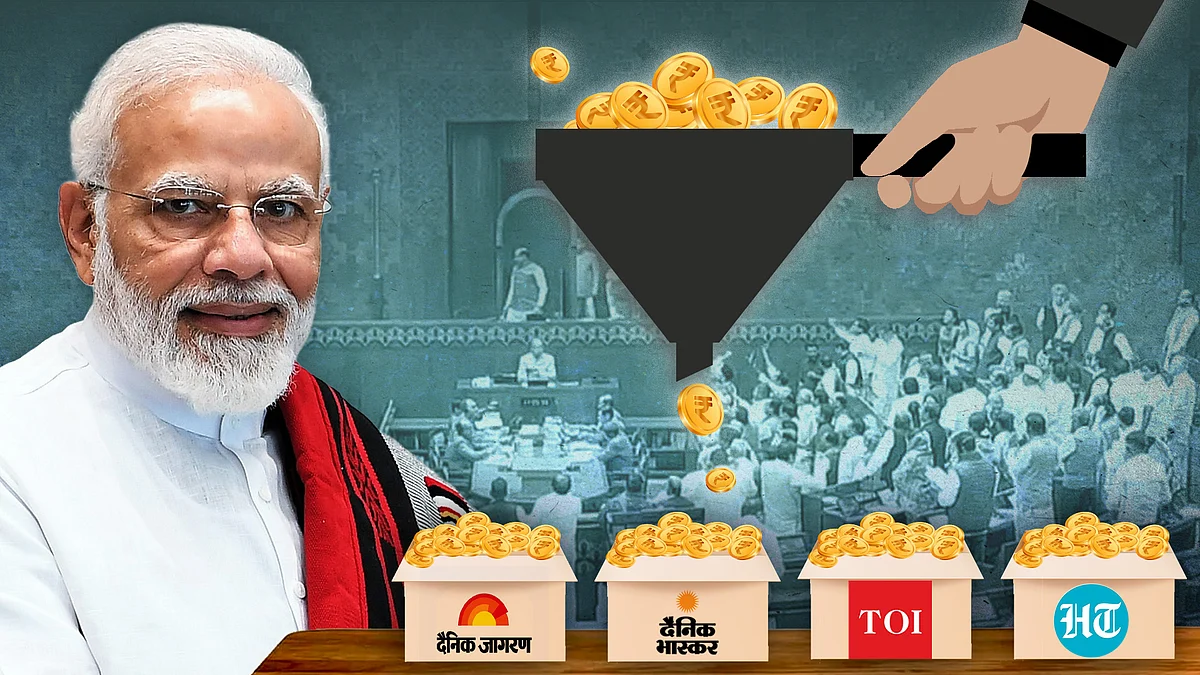
The beneficiary list reads like a who’s who of India’s media establishment. HT Media received Rs 13.56 crore, followed by The Times of India Group with Rs 11.16 crore, Dainik Jagran with Rs 9.63 crore, Dainik Bhaskar with Rs 8.29 crore, and Amar Ujala with Rs 4.93 crore. Other significant recipients included Rajasthan Patrika (Rs 4.79 crore), Deccan Chronicle (Rs 3.33 crore), Navbharat (Rs 3.21 crore), Punjab Kesari (Rs 2.35 crore), and Sakal (Rs 1.98 crore). Among other prominent publications, the Indian Express Group received Rs 1.76 crore.
What does this concentration mean in practice? It means that India’s largest media groups, the ones with the widest reach, the most readers, and therefore the greatest potential influence on public opinion are also the ones most financially intertwined with the government’s publicity machinery. The circular logic embedded here is troubling, that the large circulations attract government ad money, and government ad money sustains large circulations. A publication that falls out of favour with the government can lose access to a revenue stream that, for many publications, is not merely supplementary but existential.
For small and regional publications, which depend more heavily on government advertising, the impact of shifts in government ad policy can be even more pronounced than for large national publishers. A small newspaper in a Hindi-belt district, dependent on DAVP funds for 40-60% of its revenue, exists in a structurally compromised editorial position before a single word of copy is written. The government’s ad rupee, in such cases, functions less like a transaction and more like a leash, invisible but very real.
The Digital Turn — Chasing Eyeballs on Google, YouTube, and Meta
The most strategically significant evolution in government advertising under the Modi decade is not the total volume, though that is striking enough, but the pivot toward digital platforms. The shift reflects a broader global trend, but in India’s context it carries distinct implications.
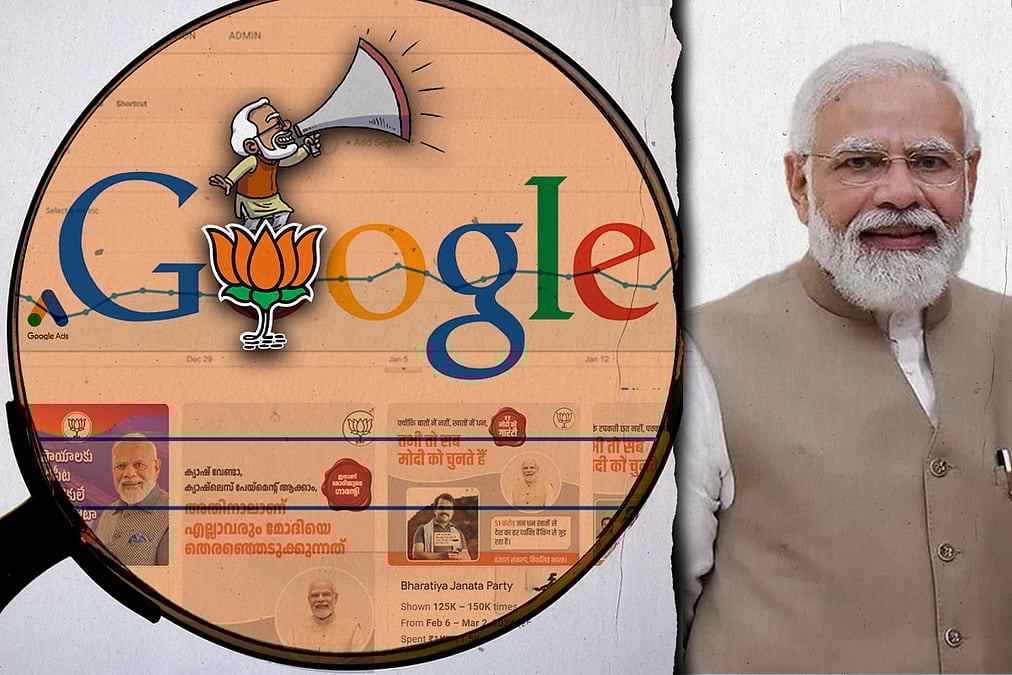
Between 2023-24 and 2025-26, the government directed over Rs 120.13 crore toward Google India and YouTube. During that same period, Meta, the parent company of Facebook and Instagram received approximately Rs 24.45 crore. This shift signals a clear move toward digital dominance alongside traditional media.
Consider what Rs 120 crore to Google India and YouTube buys. It is not mere banner advertisements or search promotions. It is the ability to target specific demographics, specific geographies, specific search behaviours, and specific ideological dispositions. Google’s advertising tools allow an advertiser to reach, with precision that print cannot match, a 35-year-old male voter in semi-urban Uttar Pradesh who searches frequently for news about the BJP. This granularity makes digital government advertising qualitatively different from a full-page ad in a national newspaper, and potentially far more politically potent.
The Meta allocation of Rs 24.45 crore, meanwhile, buys reach on platforms that have, in India’s case, repeatedly demonstrated their capacity to shape public sentiment, spread viral content, and drive political discourse at the grassroots level. Facebook, in particular, remains the primary social media platform for hundreds of millions of Indians in Tier-2 and Tier-3 cities. When the government advertises on Facebook, it does so with the same targeting infrastructure available to political campaign managers — demographic slices, interest-based targeting, geographic precision.
The question that has not yet been answered in any parliamentary reply is this: is the government’s digital advertising content classified as “public information” or as political messaging? The distinction matters enormously. Public health campaigns, disaster warnings, or MSME scheme announcements are legitimately informational. But sponsored posts that frame the Prime Minister as the architect of India’s transformation, or that headline government schemes in ways indistinguishable from election campaign material, occupy a much murkier ethical territory.
The Print Rate Hike, A 26% Sweetener for a Compliant Press?
In November 2025, the government did something that delighted India’s beleaguered print media industry. It approved a 26% hike in DAVP (now CBC) print advertisement rates. In a written reply, Minister of State for Information and Broadcasting L Murugan said the revision followed the unanimous recommendations of the 9th Rate Structure Committee (RSC), set up on 11 November 2021 to evaluate print-media cost structures and propose changes to the DAVP rate card.
The RSC consulted multiple industry bodies, including the Indian Newspaper Society (INS), All India Small Newspapers Association (AISNA), and representatives of small, medium, and large publications, covering cost components such as newsprint price escalation, inflation-driven production expenses, imported paper prices, employee wages, and other operational inputs. Murugan said the government accepted the panel’s recommendations in full.
The industry welcomed this. The government presented it as a rational cost-correction exercise, and there is no reason to dispute that framing entirely — newsprint costs have indeed risen significantly and publishing is genuinely struggling. But context, as always, matters. The 26% hike came in November 2025, roughly six months before a cluster of important state assembly elections scheduled for 2026. Industry experts note that political cycles influence how aggressively governments revise their rate cards, and that election-bound states could offer rate increases as high as 15-20%, while mid-tier states might settle in the 8-12% range.
In the context of Print AdEx, the report projected Rs 21,691 crore in total print advertising expenditure for 2025, a 7% rise, even as print’s share of total advertising slips from 19% to 18%. EY’s outlook places print advertising revenue at Rs 17,890 crore in 2024, with the segment growing just 0.7% that year. Against this backdrop, in FY25, government advertising in print stood at Rs 643.63 crore, reinforcing its continued relevance in the government’s media mix.
What the 26% rate hike effectively achieved, whatever the committee’s stated rationale was to sweeten the government-media relationship ahead of an election season. A media house that sees its government ad revenue rise by a quarter in one stroke is a media house with a stronger financial incentive to maintain a warm working relationship with the government. This is not a conspiracy. It is the ordinary logic of institutional economics. But ordinary logic can produce extraordinary distortions in media coverage, and those distortions have cumulative democratic consequences.
The Architecture of Dependence — DAVP as Financial Gatekeeper
Understanding the full picture requires understanding what DAVP — now CBC — actually is and how it functions as an institutional mechanism. The Directorate of Advertising and Visual Publicity (DAVP) is the nodal agency of the Government of India for advertising by various Ministries and organizations of the Government of India, including public sector undertakings and autonomous bodies. The primary objective of the government in advertising is, officially, to secure the widest possible coverage of the intended content or message through newspapers and journals.
The DAVP policy states explicitly that in releasing advertisements to newspapers and journals, the DAVP does not take into account the political affiliation or editorial policies of newspapers. However, it would avoid releasing advertisements to newspapers which incite or tend to incite communal passion, preach violence, or offend the sovereignty and integrity of India.
The policy language sounds impeccably neutral. But policy and practice are different entities. The absence of a transparent, independently audited formula for how DAVP allocates its budgets — why, for instance, the Indian Express Group received Rs 1.76 crore while HT Media received Rs 13.56 crore, a difference of nearly eight times, means that the government retains enormous discretionary power over which media houses thrive and which merely survive.
The DAVP policy specifies that total advertisements in monetary terms to any channel should not exceed 5% of the agreed budget, except in cases where a specific request comes from that channel. But the existence of the “specific request” exception creates a gateway to flexibility — and flexibility in government distribution without independent oversight is another name for patronage.
The structural dependence this creates is not hypothetical. Government funding has long been a significant source of revenue for India’s media outlets, and media houses that rely on government advertising face financial pressure that can influence their editorial policies. Smaller outlets, heavily dependent on state ads, are particularly vulnerable to this dynamic. This is not a fringe characterisation from a partisan source. It is a structural reality acknowledged by media economists, press freedom researchers, and journalists themselves, across the political spectrum.
The Press Freedom Collapse — Correlation or Causation?
The numbers on advertising expenditure do not exist in a vacuum. They exist alongside another set of numbers, like India’s press freedom rankings that, taken together, tell a story that demands serious attention.
India ranked 151st out of 180 countries in the World Press Freedom Index 2025, moving up from 159th in 2024 and 161st in 2023. Despite this marginal improvement, India remains in the “very serious” or “severe” category, indicating ongoing concerns about media autonomy and freedom. Following a declining trend that emerged in 2017, India’s press freedom rank dropped further in subsequent years, even as the government’s advertising budget expanded.
This inverse relationship, a government spending more on media while that same media ecosystem becomes less free, is not inevitable. A genuinely pluralistic government could conceivably spend heavily on advertising while newspapers remained robustly independent. But the specific patterns of concentration in India’s advertising distribution, top-heavy disbursements to large, politically quiescent publishers; marginal allocations to editorially assertive ones suggest that the money is not neutral.
India’s position in the press freedom index has been described by RSF as “still unworthy of a democracy,” with the organisation noting very strong pressure on journalists in the country.

The concentration of media ownership among a few companies raises concerns about editorial independence and media pluralism. RSF’s assessments of India’s media landscape have consistently highlighted the ongoing pressure on journalists and the growing judicial persecution of dissenting voices. The use of legal tools to discourage critical reporting is a perennial concern, with journalists suffering arrest, prosecution, and jail for their efforts.
RSF’s report on India states that Reliance Industries group, whose chairman is a personal friend of the Prime Minister, owns more than 70 media outlets that are followed by at least 800 million Indians. The NDTV channel’s acquisition at the end of 2022 by the Adani Group signalled what RSF described as the end of pluralism in the mainstream media.
This context transforms the government advertising story from a question of fiscal propriety into a question about the structural conditions of Indian democracy. When the largest recipients of government advertising money are also controlled by business conglomerates with strong political alignments, and when those same publications are receiving a growing share of an expanding government ad budget, the notion of an editorially independent press becomes increasingly difficult to sustain.
What Could Have Been — The Opportunity Cost of Rs 5,987 Crore
A society’s choices reveal its priorities. For all the official justification, public information, scheme dissemination, welfare communication, nearly Rs 6,000 crore spent on government advertising over eleven years represents choices about what matters and what does not.
Consider a few alternative uses of that money, drawn from India’s own budgetary universe. The National Health Mission, which funds frontline health workers across rural India, operates on an annual budget of roughly Rs 30,000 crore, meaning the eleven-year advertising total represents approximately 20% of a single year’s NHM outlay. The Pradhan Mantri Gram Sadak Yojana, which builds rural roads, typically spends between Rs 12,000 and Rs 15,000 crore a year. The entire 11-year advertising budget could have funded roughly five to six months of that programme.
None of this is to suggest that government communication serves no legitimate purpose. It demonstrably does. Citizens need to know about PM Kisan, about Jan Dhan accounts, about vaccination campaigns, about disaster relief. Public information is a constitutional function of government in any democracy. The question is not whether to advertise. The question is: how much, to whom, under what transparency standards, and for whose benefit?
And that is where the gap between the government’s stated rationale and its observable behaviour becomes, on the evidence, very hard to bridge. A government that genuinely prioritised public information over image management would distribute its advertising with a rigorously transparent formula tied to circulation, language reach, and regional coverage. It would not concentrate over 50% of print ad revenue in 10 media groups. It would not leave a parliamentary answer on influencer payments partially unanswered, as Murugan’s reply to TMC MP Rachna Banerjee did — where he uploaded only two annexes in response to a multi-part question that included year-wise influencer payments and empanelment of influencer agencies.
The BJP’s Own Ad Spend — Compounding the Picture
The government’s advertising expenditure must also be read alongside the BJP’s own party advertising, which adds another dimension to the total promotional ecosystem surrounding the Modi government.
Separately from DAVP-routed government advertising, the BJP has been one of India’s largest political advertisers, particularly in election years. The party has consistently spent hundreds of crores on TV, print, and digital advertising during election cycles — spending that, while technically separate from government advertising, contributes to a totality of political communication in which the ruling party’s image and the government’s image are often deliberately blurred. Schemes are branded with party-proximate language. The Prime Minister’s face appears with roughly equal frequency in government welfare advertisements and in BJP campaign material. The line between statecraft and political campaigning in India’s advertising ecosystem has never been thinner.
Comparing From International Comparisons — Is This Normal?
Critics of this piece might reasonably ask: don’t all governments advertise? Don’t democracies everywhere spend public money on public information? The answer is yes, but with important qualifications.
In the United Kingdom, government advertising is managed through the Central Office of Information (now the Government Communication Service), which operates under strict Cabinet Office guidelines requiring demonstrable public benefit for each campaign and independent post-campaign evaluation. Australia’s Department of Finance maintains a Communications Expenditure framework that requires signed ministerial attestation that advertising is not party-political. Canada requires that government advertising be non-partisan, demonstrably in the public interest, and subject to independent audit.
India has no equivalent framework. The DAVP policy speaks to channel eligibility criteria and rate structures, but it contains no requirement that campaigns be independently evaluated for public benefit, no prohibition on content that blurs government achievement with partisan messaging, and no mandatory audit of whether advertising funds correlate to editorial independence outcomes. The policy specifies that DAVP does not take into account the political affiliation or editorial policies of newspapers or channels in releasing advertisements — but the policy itself is self-certified. There is no external body empowered to verify compliance with that principle.
The Newspaper Economy and the Silence It Creates
Print AdEx in India was projected at Rs 21,691 crore for 2025, and even as print’s share of total advertising slips, the government’s revised rate card, offering a 26% hike, provides a meaningful revenue support that smaller publishers in particular welcome.
The arithmetic is simple and damning. BCCL’s CEO Sivakumar Sundaram noted a 10% increase in government print spends over the April-December period of FY25-26 over the same period the previous year, describing print as an important vehicle for taking government schemes and policies to the country at large. When a newspaper group’s senior executive publicly celebrates government advertising growth in terms of its role in carrying government messaging, rather than in terms of independent journalism, the structural alignment is essentially self-described.
The DAVP budget revision’s cascading effect on state governments, where state governments typically revise their print ad rates 6 to 18 months after a central DAVP revision, means that the Centre’s largesse creates a multi-layered system in which both central and state government advertising flows animate the financial survival of regional and local media houses. A regional Hindi newspaper in Madhya Pradesh, dependent on both Central DAVP money and state government advertising from the BJP-governed state, exists in a layered financial relationship with the ruling party at both levels. Editorial independence under such conditions requires extraordinary institutional courage — courage that many smaller publications, operating on thin margins, simply cannot afford.
The World Press Freedom Index, in its 2025 edition, notes that economic pressures are emerging as a major threat to independent journalism globally, with advertising monopolies and corporate ownership threatening the independence of news organisations. In India’s case, the largest single advertiser in the media ecosystem is not a private corporation. It is the government itself, the very institution that journalism’s independence exists to scrutinise.
The GST Bachat Utsav Footnote — When Campaign Budgets Reveal Priorities
Among the many specific advertising campaigns run by the Modi government, one offers a particularly revealing glimpse into how public funds get channelled into specific promotional exercises. A campaign called the GST Bachat Utsav generated Rs 4.76 crore in print advertising spending, as revealed by an RTI, underscoring print’s continued importance for large-scale, credibility-led public communication. Nearly five crore rupees to promote a sale event tied to GST compliance — a legitimate policy, but also a programme whose promotional packaging serves the government’s narrative that GST is a celebrated, citizen-friendly success story.
This is where the line between information and propaganda becomes genuinely difficult to locate. GST is real and consequential. Informing citizens about GST-related events is a legitimate function of government communication. But spending Rs 4.76 crore to tell citizens that GST is wonderful — rather than simply that a compliance event is happening — is a different proposition entirely, and one that, in most mature democracies, would trigger the kind of partisan advertising review that India’s framework entirely lacks.
Why There Is Initially Silence In The Parliament and then, the Limits of Disclosure?
One of the most consequential revelations from the pattern of Lok Sabha replies on government advertising is not what has been disclosed, but what has been withheld.
In response to a question from Trinamool Congress MP Rachna Banerjee, who sought details on year-wise and group-wise DAVP spending over five years, agency-wise empanelment of influencer agencies, and year-wise payments made to influencers for promotional content — Murugan’s reply uploaded only two annexes: one detailing print advertising expenses for FY 2024-25, and another covering television advertising for FY 2020-21. The ministry did not fully address all parts of the query.
The portion of the question that went unanswered is, arguably, the most important part. Influencer payments, the money flowing to social media personalities and content creators to promote government schemes represent the newest and most opaque frontier of government advertising. Unlike DAVP print advertisements, which are at least tracked and partially disclosed, influencer payments operate in a significantly less transparent ecosystem. An influencer on Instagram or YouTube who receives payment to promote a government scheme is not required to prominently disclose that payment in the way a traditional advertisement must be labelled. The persuasion is embedded. The sponsorship is often obscured. And the cumulative scale of this spending is precisely what the government declined to disclose.
What a Transparent Framework Would Look Like
The purpose of this piece is not to suggest that government communication is inherently illegitimate. It is to argue, on the basis of official government data, parliamentary replies, international press freedom indices, and media economic research that the current framework governing India’s government advertising is structurally opaque, financially distorting, and in need of fundamental reform.
A genuinely accountable framework would require, at minimum, four things. First, independent audit of all government advertising campaigns, with mandatory evaluation of whether each campaign’s content is genuinely informational and non-partisan. Second, a transparent, publicly available formula governing how DAVP/CBC distributes its budget across media organisations, tied to verifiable metrics such as certified circulation and regional reach, rather than discretionary ministerial decisions.
Third, mandatory full disclosure of all influencer payments, including the names of empanelled agencies, the individuals or channels paid, the amounts disbursed, and the content produced, available on a real-time public database. Fourth, a statutory prohibition on government advertising content that uses government schemes as a vehicle to promote the political achievements of the ruling party rather than informing citizens about entitlements and procedures.
None of these reforms is utopian. They exist, in various forms, in the UK, Australia, and Canada. They are consistent with India’s Right to Information Act and with the constitutional requirement that public funds be spent in demonstrable public interest. The only obstacle to implementing them is political will, and the fact that the current system serves the interests of those who control it.
Conclusion: The Price of Narrative
Rs 5,987.46 crore over eleven years. Rs 1.5 crore every single day. These are not estimates or opposition talking points. These are figures provided by the Government of India’s own Minister of State for Information and Broadcasting, in a written reply to the Indian Parliament.
They do not prove that every rupee was misspent. They do not demonstrate that every newspaper that received DAVP money bent its editorial line. Individual journalists, editors, and media institutions have, throughout this period, produced courageous, independent, critical journalism despite their financial entanglements with government advertising.
But the structural conditions created by this spending, the concentration of funds in the largest and most politically proximate media groups, the opacity around influencer payments, the absence of independent audit, the timing of rate hikes aligned with electoral cycles, the partial answers given to parliamentary questions, collectively paint a picture of a government that has become, over eleven years, the dominant financial patron of the very press that should be holding it to account.
When a Prime Minister accuses a rival of spending public money on his own image while his own government spends Rs 1.5 crore a day on its image, the contradiction is not merely hypocritical. It is a window into a system where the management of political narrative has been elevated to the status of government policy — funded by the public, insulated from scrutiny, and calibrated to reward silence while crowding out inconvenient truth.
In a democracy, no institution should be too big to question. And no advertising budget should be too large to explain.