Ayurveda Or Abuse Of Trust? Why The Patanjali Empire Must Be Investigated For Public Interest.
We are calling for a government probe into the Patanjali empire, examining its legal, ethical, financial, and public health failures. The piece focuses on misleading advertisements, potential tax and corporate governance violations, communal controversies, and systemic regulatory gaps.


Patanjali’s Privilege and the Rule of Law
Why does Patanjali Ayurved, a sprawling yoga guru business empire, seem to be treated differently from every other company in India? As citizens, we have watched in growing alarm as one corporate house after another is held to account, Gensol being the recent one; but Patanjali skates run on its branded charisma. The evidence is mounting that Patanjali’s empire may be riddled with illegal practices, yet our regulators and courts have only acted reluctantly and episodically.
A recent GST case, the Ministry of Corporate Affairs’ probe, repeated show-cause notices for false health claims, Supreme Court slap of deceptive ads, and even compromising communal speech by its top promoter all paint a picture of a company treating India’s laws as optional. We demand a formal, transparent investigation into Patanjali Ayurved, exactly as we would demand for any other company, so that justice and public safety are not sacrificed at the altar of Hindutva branding.
The GST Penalty Case: Reckoning with “Circular Trading”
Consider the Allahabad High Court’s recent judgment. On May 29, 2025, the court dismissed Patanjali Ayurved Limited’s petition against a ₹273.5-crore GST penalty. This penalty arose from a Directorate General of GST Intelligence (DGGI) probe that uncovered “suspicious transactions involving firms with high Input Tax Credit (ITC) utilisation but no income tax credentials”. In other words, tax investigators allege that Patanjali orchestrated chains of bogus sales invoices, purchasing from one entity, selling on paper to another, and repeatedly claiming and passing on input tax credits without any real supply of goods.
The court’s verdict did not mince words: it noted allegations that Patanjali, “acting as a main person, indulged in circular trading of tax invoices only on paper without actual supply of goods”. In plain terms, the firm is accused of creating a paper trail to cheat on GST. Although Patanjali argued that such penalties are “criminal in nature” and should go through a trial, the High Court upheld that the penalty proceedings were civil and could proceed in a tribunal. After detailed analysis the court rejected Patanjali’s arguments and allowed the ₹273 crore penalty demand to stand.
This is not just a procedural defeat for Patanjali; it is confirmation of very serious financial irregularities. According to the tribunal’s findings, every commodity showed more units sold than ever purchased, meaning Patanjali claimed more input credit than goods it actually handled. Instead of paying the standard GST on those inputs, Patanjali allegedly passed the entire credit claim further down the chain.
In effect, taxpayers and honest traders subsidized the tax liability for these allegedly fictitious transactions. That ₹273.5-crore figure is not arbitrary: it is the amount of tax benefit Patanjali is accused of claiming by these circular trades. The High Court has now made clear that Patanjali cannot duck this liability by hiding behind procedural objections. If the allegations are true, this is massive tax evasion at high corporate levels, and the law says Patanjali must answer for it just like anyone else.
A Corporate Affairs Probe: Scrutiny at Last
As if the GST case were not enough to raise eyebrows, reports indicate that the Ministry of Corporate Affairs (MCA) has reportedly launched an investigation into Patanjali Ayurved under Section 210 of the Companies Act. This provision allows the government to order an inquiry into a company’s affairs if there is reason to suspect mismanagement, fraud or public interest issues.
Patanjali’s official line is the firm “has not received any communication” from the MCA; in fact, Patanjali Foods Ltd (its publicly traded sister company) had to file a stock-exchange disclosure clarifying that “Patanjali Ayurved Limited has not received any communication from the Ministry of Corporate Affairs”. Yet the media narrative, citing unnamed government sources is clear that this is not simply a rumor. Many report that “the Centre has asked Patanjali Ayurved to explain some transactions deemed suspicious”, after an economic intelligence wing flagged “abnormal and dubious” deals.
If these accounts are accurate, it suggests the corporate regulator is finally probing Patanjali’s books, looking into potential fund diversion or governance breaches. This is long overdue. Not long ago Patanjali had trumpeted its net worth and business growth without any accountability; now even the private-sector arm feels the need to publicly deny rumors. In short, both the GST investigation and the MCA probe hint at deep questions about Patanjali’s financial house. Why did it take newspaper leaks and press coverage to spur official action? Why are answers coming grudgingly? Whatever the outcome, these events confirm that Patanjali is under more scrutiny than ever; scrutiny that should apply equally to any other firm of its size.
False Health Claims and Regulatory Warnings of Patanjali
Over the past few years Patanjali has also repeatedly found itself in hot water for making misleading health claims. Most famously in mid-2020, when Patanjali promoted Coronil as a cure for COVID-19, the Ministry of AYUSH had to step in. On July 3, 2020 the AYUSH Ministry formally ordered Patanjali to halt advertising Coronil until it could verify the claims.
The government demanded full disclosure of Coronil’s composition and trial data, reminding Patanjali that “advertisements of drugs including Ayurvedic medicines are regulated under the Drugs and Magic Remedies (Objectionable Advertisements) Act, 1954”. In short: stop claiming a coronavirus cure until you prove it. Despite Patanjali’s initial hype of 100% trial success, regulators froze its promotion and demanded compliance with existing laws. This was a clear show-cause notice backed by legal authority, yet it is just one example among several.
Patanjali has been hit with multiple warnings under the same act for touting unverified remedies. Activists note that Patanjali even violated its undertakings. For instance, in 2022 Patanjali publicly pledged to stop ads that claim curing diabetes, asthma, cancer and other ailments. Yet in July 2022 it promptly released new ads for five drugs, again marketing them as cures for diabetes, glaucoma, goitre, blood pressure and cholesterol. Such claims are expressly prohibited by the Drugs and Magic Remedies Act (DMRA) and related rules.
One RTI activist, Dr. K. V. Babu, criticized the state regulators for inaction, noting that Uttarakhand’s drug licensing authority “took up a mild treatment of Patanjali and show caused it under a rule, Rule 170, which was sub judice. The Ayush ministry, too, concurred that no action could be taken under this rule”. In other words, our own bureaucracy hid behind a technicality while obvious violations continued. Even when the Supreme Court chastised the state for inaction, Uttarakhand still preferred letters over prosecutions.
What is clear is this pattern: Patanjali frequently markets its products as miracle Ayurvedic cures without clinical proof, flouting the Drugs Act. Each time, authorities eventually react, but only after being pushed. The Union AYUSH Ministry’s 2020 order on Coronil came only after mass advertising had already convinced many people of a false cure. Likewise, only after a major scandal did regulators suspend Patanjali’s licenses for 14 Ayurvedic medicines (in early 2024), and then the Supreme Court had to ask if sales had stopped. These are reactive stumbles, not proactive policing. It should not take media uproar and court intervention to make Patanjali follow the law that all other drugmakers must follow.
The Supreme Court’s Scathing Rebuke
Indeed, Indian courts have had to step in repeatedly. In late 2023 and early 2024, the Supreme Court tore into Patanjali for its misleading advertising. In November 2023 a bench warned Patanjali that it could impose fines of up to ₹1 crore on each product if Patanjali falsely claimed it could “cure” specific diseases.
The Court explicitly ordered Patanjali to “immediately halt all false and misleading ads” and even asked the government to propose broader reforms for Ayurvedic advertising. This was in response to an IMA petition documenting Patanjali’s defamation of modern medicine and unverified cure-claims. The Justices reminded Patanjali that its ads violated both the 1954 DMRA and the Consumer Protection Act, and they would hold everyone, advertisers and publishers, accountable.
But Patanjali’s troubles did not end there. In early 2024 the Supreme Court again rebuked the company for continuing to flout its orders. Judges Hima Kohli and Ahsanuddin Amanullah grilled Patanjali’s leadership. They noted that Patanjali’s advertisement department could not “have been unaware” of the Court’s previous directives, since Ramdev and his co-founder still held a press conference pushing the very ads the day after undertaking not to do so.
The Bench stormed, “Take this contempt seriously. … You flouted this order! You had the courage and guts to come up with this advertisement after the order of this Court!”. In one explosive moment a Justice thundered, “The entire country is taken for a ride! … Not just SC, every order passed by courts across the country has to be respected.” The Court branded Patanjali’s behavior “absolute defiance” of judicial authority, called its apology “lip service,” and warned that the contempt case would be taken “to its logical conclusion”.
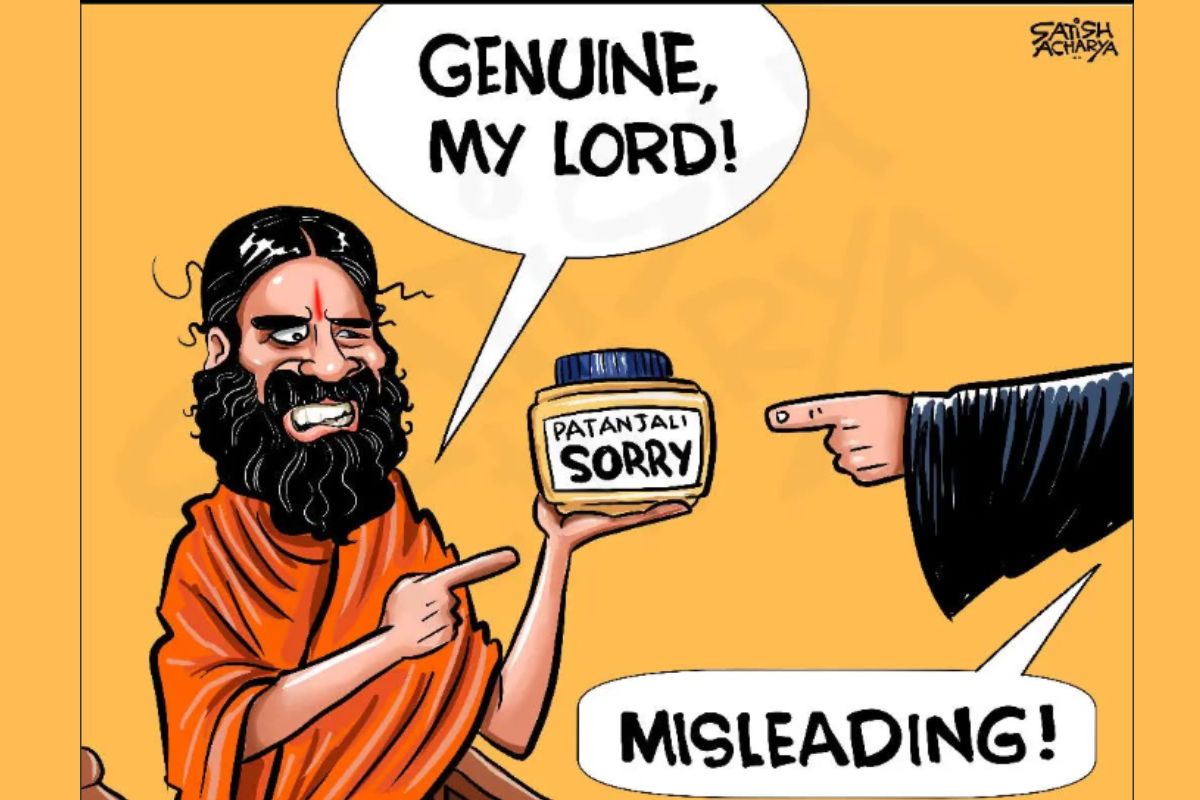
It took public humiliation for Ramdev to back down. Only days later, on April 16, 2024, the yoga guru finally “pleaded” in court with folded hands and apologized “for defying its orders to stop misleading advertisements”. This was no humble moment, the Court had already refused to accept two earlier lawyer-signed apologies, sternly admonished a drug regulator for not acting, and demanded more than a token statement. The message was clear: the law applies to Patanjali too. Yet every reprimand seemed to slide off the company’s skin until it turned into a full-blown contempt proceeding. Why, in a democracy, must courts resort to such admonitions and threats before a popular and politically connected firm respects legal norms?
Gulab Sharbat and Communal Provocations
While the courts were hectoring Patanjali about its ads, the company’s chief icon engaged in a very different kind of defense: outright communal agitation. In April 2025, Baba Ramdev starred in a viral video promoting Patanjali’s new “Gulab Sharbat” (rose syrup). But instead of focusing on the product, he attacked the 119-year-old Hamdard company (maker of Rooh Afza) on religious lines. In the video Ramdev declares (and this is his exact claim): “If you drink that sharbat [Rooh Afza], there will be masjids and madrasas made.

But if you drink Patanjali’s gulab sharbat, then gurukuls, Acharyakulam Patanjali University, and the Bharatiya Shiksha Board will be built.” In other words, he urged Hindus to boycott Rooh Afza, implying its sales funds Islamic institutions, while Patanjali’s syrup would fund Hindu schools and universities. He even called Rooh Afza “Sharbat Jihad,” linking it to other communal tropes. This was not subtle marketing; it was a deliberate provocation blending commerce with religious identity.
Unsurprisingly, the backlash was fierce. Social media erupted, and activists lambasted the Food Safety and Standards Authority of India (FSSAI) for letting Patanjali label Gulab Sharbat as “ayurvedic medicine.” A quick ingredient check shows why: the label calls it an “Ayurvedic proprietary medicine”, yet it contains 99.06% sugar and just 0.2% preservative. (As a consumer complained, “‘Baba ka nakli ayurveda hai’” – “Patanjali’s Ayurveda is fake”.)
If a health guru touts a nearly pure sugar drink as medicine, ordinary people might sue, but here the product sails through until the ire of the Internet sets in. The FSSAI, responsible for food standards, had no visible response to the “99% sugar” formulation. Instead, Ramdev’s focus was on demagogic rhetoric against a competitor.
The controversy even ended up in court. Hamdard filed a lawsuit against Ramdev and Patanjali Foods Ltd. By May 2, 2025 Ramdev was forced to give an undertaking in the Delhi High Court that he would cease making communal remarks about Hamdard’s Rooh Afza. The apology was grudging; he simply agreed not to repeat the “Sharbat Jihad” line or similar hate speech. But the episode exposed a shocking tactic: brand propaganda wrapped in religious bigotry. In a country that demands religious harmony, a corporate titan’s cheerleading of sectarian slogans should alarm us. Here again Patanjali flouted norms, not just consumer laws, but societal norms, banking on muscle (and perhaps political insulation) to escape consequence.
Regulatory Inaction and the Culture of Impunity
Why does Patanjali get away with so much? Part of the answer lies in reactive regulators and craven officials. Notice how every major issue around Patanjali required intervention: only after news broke or courts rapped knuckles did anything happen. Food safety regulators only awakened when Twitter users posted 99% sugar lab reports.
One meme even quipped that the FSSAI was “in hibernate mode” while Patanjali sold its sugary “medicine”. The AYUSH Ministry and drug controllers moved sluggishly: for years Ramdev’s ads violated the DMRA, but it took Supreme Court scoldings to force even a token recall. Many state drug controllers simply “shut their eyes” as Patanjali ran pan-India ads, though technically every state FDA could have prosecuted under the DMRA.
Alarmingly, even states unfriendly to Ramdev ignored the infractions. As one columnist noted, “Why then did not a single state take action?” Not even Kerala’s left-wing government, which has often clashed with Baba Ramdev, launched prosecutions when Patanjali’s ads ran in its newspapers. It seems no political party wanted the PR fight of prosecuting a popular guru. When push finally came to shove, the Supreme Court had to ask the Uttarakhand SLA if sales of 14 products (license-suspended for safety issues) had stopped, and conduct contempt hearings to get affidavits. Ordinary companies get raids and penalties; Patanjali got letters and ultimatums.
The corporate regulators too have been tardy. Only after press leaks did the MCA reportedly start investigating Patanjali’s books. Even stock-market regulators were reluctant. Patanjali Foods, the listed arm, received a freeze on 292.58 million promoter shares in early 2023 because public shareholding was only 19.18%, which was well below the required 25%. That freeze was a routine SEBI enforcement, but only happened after years of inaction (dating back to the Ruchi Soya takeover).
Patanjali had been transformed overnight into the owner of the Rs. 50,000-cr edible-oils firm Ruchi Soya, which meant the public float collapsed. It took a follow-on public offering in 2022 to raise the float to 19.18%, still short of the 25% target. Finally the exchanges acted, but not before insiders profited and retail investors had been left in the dark.
Even now, Patanjali Foods must publicly confirm disclosures: in June 2025 it filed an exchange notice disclaiming any MCA summons to Patanjali Ayurved, clearly prompted by news reports. And when it announced it would buy Patanjali Ayurved’s personal-care division for ₹1,100 crore in 2024, the reason given was “to help the company become an FMCG company”; nothing about corporate governance lapses. Despite all these contortions, Patanjali’s ratings stay strong.
Credit agencies grade Patanjali Foods as A+ (stable), and analysts like Jefferies rate its stock “Buy” given high margins and brand power. Banks and funds have lined up behind it. Why? Possibly because the business is big, profitable and fed by government support of Ayurveda. Or maybe because many investors simply skip over the mud when the glamour of “nation’s pride” is on display.
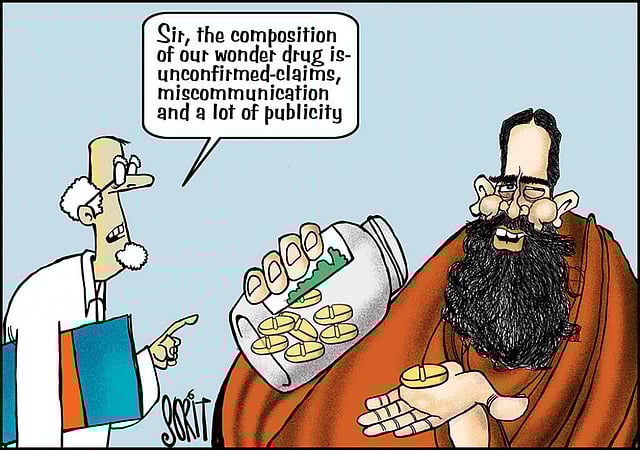
What about the Ministry of AYUSH and the Advertising Standards Council of India (ASCI), the bodies meant to police quackery? They have done little more than issue statements. AYUSH has only belatedly recalled products or withdrawn draft rules under pressure. A proposed pre-vetting of all ayurvedic ads (Rule 170 of the Drugs Rules) was quashed in court, effectively tying regulators’ hands. Even after the SC warned in 2023, Ayurvedic advertisers continue to violate the ban.
ASCI’s code relies on voluntary compliance, and Patanjali simply pushed ads even after ASCI admonished it; until the Supreme Court intervened. FSSAI sat silent until social media shamed it. The MCA is now investigating, but only after months of speculation. All in all, the enforcement pattern has been “reactive”, not preventive. By contrast, the ordinary Indian consumer who violates food or drug laws gets immediate lockdowns. This double standard erodes faith in our institutions.
Financial Power and Opaque Disclosures
None of this should surprise us if we consider the scale and opacity of Patanjali’s finances. Patanjali Foods, the listed edible-oil powerhouse spun out of Ruchi Soya, now has a market capitalization around ₹60,000 crore. Its shares (trading around ₹1,700 in mid-2025) changed hands as high as ₹2,030 in the past year. Yet despite this enormous value, the business fundamentals are modest: edible-oil sales volumes barely budged between FY24 and FY25, and profit margins are average. The company’s latest results (Q4 FY2025) reported a record revenue of ₹9,692 crore, but profit of only ₹359 crore, reflecting heavy expenses. Institutional investors have still been piling in, dazzled by the story of growth, as analysts at Jefferies and others laud the brand.
However, the valuations raise questions. Patanjali Foods now trades at roughly 5.4 times book value and has a P/E near 50 – sky-high multiples for any company. This suggests the market is pricing in something beyond fundamentals, likely the Patanjali brand, or government influence. Meanwhile, the core company Patanjali Ayurved remains privately held. Officially, its last known financial filings (now many years old) do not reflect the scale of its ambitions. There are only vague third-party estimates of its “billion-dollar” valuation, but no audited figures in the public domain. This opacity is troubling.
The only official disclosures we see are from Patanjali Foods: even it had to file formal statements about its links. For instance, on June 1, 2025, Patanjali Foods released an exchange filing (per SEBI’s LODR rules) explicitly stating that Patanjali Ayurved “has not received any communication from Ministry of Corporate Affairs”. This rare peek came only after media reports of an MCA probe, showing that normal disclosure rules had to be invoked to get a hint of what Patanjali Ayurved is doing.
Large related-party transactions also cloak the finances. In mid-2024 the group approved a “slump sale” in which Patanjali Foods would buy the entire home-and-personal-care business of Patanjali Ayurved for ₹1,100 crore. On paper, this was justified as accelerating Patanjali Foods’ transition into a broader FMCG company. In practice, it appears to be moving valuable assets between sisters, possibly to maximize tax and credit advantages in the listed entity.
The true justification and financial logic have not been fully explained, beyond generic regulator filings. All of this, a sky-high market cap, starry analyst coverage, and complex inter-company deals, means Patanjali stands on significant financial muscle. Yet citizens have almost no way to verify if that money was honestly earned. No wonder some fear there is a “shadow empire” behind the scenes.
Faith, Nationalism, and Media Manipulation
Patanjali’s strategy has long blended commercial success with Hindu nationalist sentiment. By branding itself as “Swadeshi” and invoking Ayurveda’s spiritual heritage, the company has won a loyal base among consumers who see its products as a cultural project, not just a business. Government support has helped. India’s Ministry of AYUSH now has an annual budget of roughly $500 million, and the state actively promotes Ayurveda at home and abroad. Patanjali’s rise has coincided with this official patronage; it is no accident that this “billion-dollar” company emerged under a Hindu-nationalist government. When the ruling party and its affiliates cheer on Ayurveda, Patanjali gets a freer ride.
The media environment has also been permissive. Patanjali could fill full pages of major newspapers with adverts touting miracle cures or pure-toothpaste that “kills 14 kinds of bacteria”. Notably, even Times of India, normally proud of its journalistic standards, ran Patanjali’s Corona advertisements in 2020 without protest, and then publicly kept silent about the legal challenge. A media critic observed that it was not just Patanjali’s ad team at fault, but that “the press which is liable for publishing misleading advertisements” was similarly culpable.
In short, mainstream outlets published questionable Patanjali ads while burying or ignoring the controversy; a friendly editorial stance that no small business would ever enjoy. Similarly, friendly TV channels air Ramdev’s programs and ads constantly. In this way Patanjali has turned publicity into a shield. When regulators or courts complain, public sympathy often flips to Patanjali as a populist hero. Any critic, whether journalist, doctor or official, is accused of conspiracy against India’s heritage.
The blurring of business and religious nationalism reaches its extreme in Patanjali’s messaging. Ramdev’s “Sharbat Jihad” outburst is just the latest example of mixing commerce with communal identity. By framing Patanjali purchases as patriotic duty (and derogating competitors by religion), he created a tense atmosphere in the market. Observers noted that Patanjali was weaponizing “religious identity to sell products”. Such tactics may mobilize a base, but they also distract from legitimate regulatory scrutiny. A corporate empire that claims divine blessing for its brands tends to assume it has divine exemption from scrutiny. If society allows religious posturing to overshadow legal enforcement, the marketplace is no longer fair or safe.
Yet despite all this media mystique, the core remains business. Patanjali’s true immunity comes from its sheer size and intertwined network of government ties. Consider that in 2019 Patanjali Ayurved won the resolution to take over Ruchi Soya, a major edible-oil bankrupt entity worth tens of thousands of crores. That move alone made Patanjali Foods a top-10 FMCG company overnight.
The promoters retained control even while keeping a huge chunk of shares locked up. Even today the founding trust “Yogakshem” holds a significant stake, far above regulatory norms until forced to sell. In other words, Patanjali is run more like a family business backed by political clout than a transparent corporation. And yet regulators treated it for years as if it were a benign cultural institution.
A Citizen’s Call to Action
All of these facts, large penalties, probes, warnings, contempt orders, product failures and slick PR, lead to a single conclusion: Patanjali must be held to the same standards of law and public safety as any other company. No privilege is written in our Constitution for a business because it wears saffron robes or quotes Charaka Samhita. Every allegation of wrongdoing (whether tax evasion, misleading medicine or hate speech) must be investigated openly, with findings made public.
We, the citizens, demand that Parliament and all relevant agencies take up this case. Let Parliament question officials about why enforcement bodies took so long to act. Let CBI or ED examine all transactions hinted at by the investigations. Let the CAG (Comptroller & Auditor General) review any government contracts or subsidies benefiting Patanjali. Let the Supreme Court oversight (as it has already begun) proceed to ensure that no court order or law is flouted again without penalty.
Our demand is simple: Patanjali is not above the law. If it has committed fraud or broken regulations, the people deserve to know the extent and to see the culprits punished. If it has truly done no wrong, a full investigation will clear its name and restore trust. We must not allow communal slogans or a cult of personality to drown out the dispassionate application of law.
Patanjali claims to champion Indian tradition and health, but tradition is betrayed if its products are false, and public health is endangered if false cures spread unchecked. The laws on drugs, finance, taxation and commerce exist to protect us all; none of these can be waived for a flashy brand. We urge the Prime Minister, the Finance Minister, the Union Health Minister and the entire Cabinet to launch a transparent inquiry into Patanjali Ayurved’s affairs immediately.
The Delhi High Court on Thursday, May 1, said yoga guru Ramdev was “not in control of anyone” and “lived in his own world” as it held him in prima facie contempt of its order over his ‘Sharbat Jihad’ remarks against Hamdard’s Rooh Afza.
“He (Ramdev) is not in control of anyone. He lives in his own world,” the judge remarked.
So shall we believe that one person today is above India’s supreme law status?
Shall we believe that just because ‘he’ lives in his own world, so ‘he’ has the right to insult any religion or community in the nation and compromise the sanctity of India’s supreme document, ‘The constitution of India’?
Shall we believe that Indians have to bow down to any random person just because ‘he’ is living in his own world? Even our esteemed judges, who are the law protectors of the nation, will be helpless and cannot stop someone from spreading hate speech because ‘he’ lives in his own world?
So, are WE, THE PEOPLE OF INDIA, should be ready to be harassed by any random person, because ‘he’ lives in his own world, and ‘he’ is way more powerful to mislead the taxpayers and vote banks of the nation, by his misleading advertisements, and the law cannot punish ‘him’?
Democracy depends on equal treatment under law. Let no corporation, however popular, wield undue influence or immunity. The majestic rule of law must be upheld, not just on paper but in practice. It is time to lift the veil on Patanjali’s empire. Only then can we be sure that public faith in governance and public health is not being sold at the premium price of silence and symbolism. Uphold justice. Hold Patanjali accountable, like any other company, for the sake of law, equity and the safety of all Indians.
Indian regulators and Parliament must launch a full, public investigation into Patanjali Ayurved – its finances, its advertising, and its corporate practices – immediately, with the same rigor applied to any other company, so that no business, religious or secular, is allowed to operate outside the law.