Force Majeure: How Indian Real Estate Mafias Tried To Exploit This Clause To Justify Their Delay In Deliveries Of Homes?

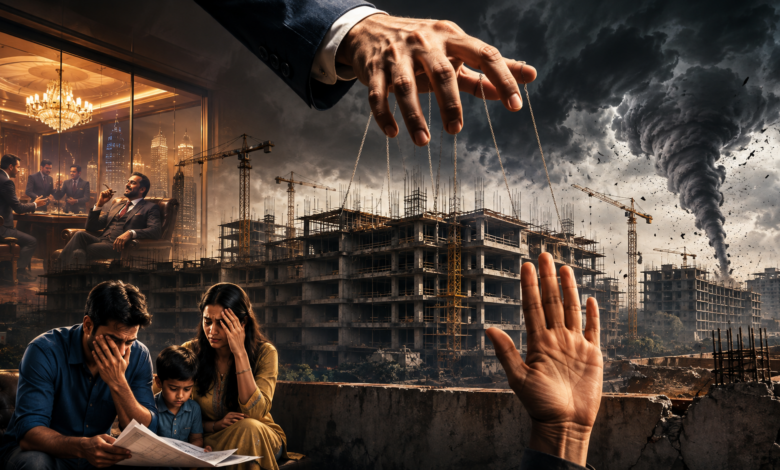
For more than a decade, hundreds of thousands of Indian homebuyers have watched their life savings disappear into incomplete towers while developers invoked a phrase, force majeure, to escape liability. The clause, meant for genuine acts of God or unforeseeable catastrophes beyond human control, was stretched into a blanket defence covering everything from delayed building-plan approvals and contractor defaults to routine regulatory processes, labour shortages, and even the developers’ own illegal construction. Courts and RERA authorities have repeatedly dismantled these claims. The pattern that emerges is not isolated misfortune but a structural abuse of unequal bargaining power, one-sided contracts, and token compensation clauses designed to leave buyers holding the risk while developers retained the money and the timelines.
The data shows a consistent judicial response: foreseeable commercial risks and self-created delays do not qualify as force majeure; contractual compensation rates of Rs 5–10 per square foot per month are unfair trade practices; and buyers are entitled to meaningful interest or refund with interest when possession is delayed beyond the committed date.
The Contractual Trap of force majeure: Token Compensation and Broad Force-Majeure Language
Most builder-buyer agreements followed a near-identical template. Delivery was promised within a fixed period (often 36–48 months plus a short grace period). Delay compensation was fixed at a derisory rate, typically Rs 5 or Rs 10 per square foot of super area per month. Simultaneously, a broadly worded force-majeure clause listed events that could suspend the delivery obligation: regulatory approvals, stop-work orders, contractor defaults, non-availability of materials, labour shortages, government inaction on infrastructure, and any circumstance beyond the control of the developer.
Courts have described these agreements as contracts of adhesion, aka the documents drafted entirely by the stronger party and presented to the weaker party on a take-it-or-leave-it basis. In Ireo Grace Realtech Pvt. Ltd. v. Abhishek Khanna (2021), a three-judge Supreme Court bench held that incorporation of wholly one-sided and unreasonable clauses constitutes an unfair trade practice under Section 2(1)(r) of the Consumer Protection Act, 1986.
The Court noted that buyers faced heavy penalties (often 18–24 per cent interest or forfeiture of earnest money) for delayed instalments, while the developer’s liability for multi-year delays was capped at roughly 1 per cent per annum equivalent. Similar observations appear in Pioneer Urban Land and Infrastructure Ltd. v. Govindan Raghavan and subsequent RERA and NCDRC orders.
Let’s see a Case-by-Case Judicial Rejection of Force-Majeure Claims
DLF Limited. In the Capital Greens matters, DLF argued that delay in approval of building plans and stop-work orders issued after fatal accidents at construction sites constituted force majeure. The Supreme Court rejected the defence. Delay in obtaining building-plan approval, the Court held, is a normal incident of construction projects that a developer must factor into its committed timeline.
Stop-work orders arising from the developer’s own safety failures could not be treated as external events. The Court directed additional compensation at 6 per cent per annum on the amounts deposited, over and above any contractual rate already paid, until actual delivery. In a parallel line of cases involving DLF Southern Homes and Annabel Builders, the Court observed that the buyers’ agreements did not reflect an even bargain; terms binding the purchaser were considerably more stringent than those imposed on the developer.
Unitech Limited. Unitech’s agreements contained expansive force-majeure definitions and the familiar Rs 5-per-square-foot delay compensation. When confronted with thousands of delayed units across Delhi-NCR, the company cited regulatory approvals, construction challenges, and market conditions. The NCDRC repeatedly held that such clauses constitute unfair trade practice. The Commission stated that clauses providing only Rs 5 per square foot per month had been consistently rejected. The matter escalated beyond civil liability; the Supreme Court eventually took control of the company, treating large-scale non-delivery and fund mismanagement as matters attracting criminal consequences for promoters in addition to civil and RERA liability.
Raheja Developers Limited. For the Revanta project in Gurugram Sector 78 (launched around 2011), Raheja invoked incomplete external infrastructure — roads, sewerage, water, electricity, firefighting — and later COVID-19. The NCLT recorded that possession had not been handed over within the contractual period, financial debt and default were established, HRERA had made adverse findings, certain RERA orders remained uncomplied with, and settlement arrangements acknowledging delay had not been honoured.
HRERA ordered refunds exceeding Rs 18 crore with interest at 10.45 per cent per annum. COVID-19 force-majeure claims were rejected once the six-month RBI/RERA extension had been exhausted; further delay was held to be the builder’s responsibility. The NCLT also held that delays arising from statutory compliance obligations cannot automatically be treated as force majeure.
Emaar MGF Land Limited. In the Palm Gardens project (Gurugram Sector 83), contractual possession was December 2015; actual offer came in October 2019 — nearly four years late. Emaar cited contractor defaults, insolvency of the contractor, and non-payment by other allottees. Consumer courts and subsequent HRERA orders found no merit in the force-majeure defence. One order directed refund of Rs 50.21 lakh with 12 per cent interest plus Rs 50,000 for mental agony. In multiple later HRERA rulings, the authority directed payment of interest at approximately 10.85 per cent for six-year delays, consistently setting aside the force-majeure plea.
Pioneer Urban Land and Infrastructure Limited. The NCDRC held that the reasons advanced were not genuine force-majeure events. The Commission observed that the developer was merely taking shelter behind the veil of force majeure because the cited causes were neither unforeseen nor unanticipatable. Refund with compensation was ordered. The ruling restated a core principle: the essence of force majeure is genuine uncertainty; pre-existing or foreseeable causes do not qualify.
IREO Grace Realtech Private Limited. IREO cited pending fire-safety clearances and environmental conditions. The Supreme Court’s 2021 judgment in Ireo Grace Realtech Pvt. Ltd. v. Abhishek Khanna went further than any previous decision. It characterised the allotment agreements as contracts of adhesion, held that one-sided clauses constitute unfair trade practice, and affirmed that consumer fora possess the power to strike down such terms. HRERA and subsequent forums have applied the ratio extensively, directing interest at the prescribed rate from the contractual possession deadline until actual handover.
KBC Global Limited (formerly Karda Constructions). In the Hari Vasant project at Nashik, possession was promised between December 2020 and June 2022. MahaRERA ruled that even where a court injunction created a temporary force-majeure window, the builder remained liable for interest from 1 July 2022 onwards until actual handover. The authority also noted an undisclosed encumbrance in favour of a lender and ordered delay interest for all periods outside the genuine force-majeure window.
Microtek Infrastructures Private Limited and Deepanshu Projects. These developers cited ongoing litigation and general infrastructure delays. HRERA rejected the defence, observing that the plea of force majeure and pendency of litigation does not absolve the respondents of their liability, particularly when the project stands unregistered and development work has remained incomplete for more than a decade. The delay was held to be admitted and unjustified. The authority directed payment of Rs 40.16 lakh towards loss of property appreciation in addition to refund of deposited amounts.
Godrej Properties (joint-venture projects). Authorities found attempts to treat periodic construction bans and labour shortages as continuing force-majeure events. These were rejected as recurring and foreseeable. Directions were issued to obtain occupation certificates, deliver units in habitable condition, pay delay interest from the due date, and refrain from levying charges not contemplated in the buyers’ agreements. In some matters, refunds were ordered where buyers alleged they had been induced by the Godrej brand even though the formal developer was a joint-venture entity.
Sobha Limited. In the Sobha City (Gurugram) project, the contractual possession date was 31 October 2021. HRERA granted a six-month COVID extension, pushing the deadline to 31 October 2022. When delivery still did not occur, further reliance on force majeure was rejected. Buyers were held entitled to interest for any delay beyond the extended date.
Jaypee Infratech. Broad force-majeure language and low-penalty clauses appeared in agreements for the Wish Town township in Noida. The company entered insolvency under the Insolvency and Bankruptcy Code. Force-majeure defences were superseded by the insolvency process; homebuyers were classified as financial creditors — a significant legal recognition — though completion timelines remained extended for years.
Amrapali Group. Delay defences referenced regulatory approvals, market conditions, and government infrastructure. Supreme Court-appointed forensic auditors uncovered systematic diversion of homebuyer funds to hundreds of shell companies. The Court cancelled Amrapali’s RERA registration, vested properties in NBCC for completion, cancelled bank loans secured against homebuyer receivables, and directed action against promoters. The force-majeure narrative collapsed once the underlying diversion was established.
Supertech Limited. The company constructed floors in excess of sanctioned plans. When stop-work orders and ultimately a Supreme Court demolition order for the Emerald Court twin towers in Noida followed, Supertech attempted to characterise the regulatory intervention as force majeure. The Supreme Court rejected the argument: a builder cannot claim force-majeure protection when the regulatory action was caused by its own violations. Supertech later entered insolvency.
Wave Infratech. Land-acquisition disputes, regulatory clearances, and infrastructure challenges were cited for multi-year delays in Noida and Greater Noida projects. Multiple RERA and NCDRC orders directed refund with interest. A Delhi High Court bail matter in 2023 underscored that where developers over-promise, double-sell, or mislead on approvals, criminal provisions for cheating and breach of trust can apply irrespective of contractual force-majeure language. Insolvency petitions by homebuyers as financial creditors followed.
BPTP Limited. Across projects including Park Spacio, Park Terra, Amstoria, Parklands, and Astaire Gardens, BPTP repeatedly advanced regulatory confusion (notably the Self-Certification Scheme notified in 2010 and clarified in 2015), procedural hurdles, and later COVID-19. In the Parklands Pride matter, the NCDRC held that ambiguity over the Self-Certification Scheme was not a force-majeure event and could not excuse a three-year delay; a review application was dismissed. In the Amstoria case, the force-majeure defence was found unsubstantiated and a full refund with 9 per cent interest was ordered.
In a related matter the Supreme Court in 2025 directed refund of Rs 43.13 lakh with 18 per cent interest — matching the punitive rate the builder’s own agreements charged defaulting buyers. HRERA rejected COVID claims for delays that pre-dated the pandemic by years and held that a full and final settlement signed by only one allottee did not bind others. In 2026, further orders directed refund of unlawfully collected pre-possession maintenance charges with interest, mental-agony compensation, and costs. The cumulative record shows systematic deployment of every available procedural argument to reduce or eliminate liability.
Quantitative Pattern and Public Cost
Across these matters the contractual delay compensation of Rs 5–10 per square foot per month typically equated to an effective interest rate of under 2 per cent per annum on the buyer’s investment — far below the cost of home loans (8–12 per cent) or the opportunity cost of capital.
Courts and RERA authorities have therefore substituted rates ranging from 6 per cent to 12 per cent (and in punitive cases 18 per cent). Refund orders frequently carry interest from the date of each deposit. In aggregate, the sums involved run into thousands of crores across NCR alone; individual project orders have directed refunds of Rs 18 crore, Rs 50 lakh-plus with interest, and comparable figures in dozens of parallel proceedings.
COVID-19 was treated as a genuine force-majeure event for a limited window. Most RERA authorities granted a one-time six-month (or in some states longer) extension. Claims that sought to convert that limited relief into an open-ended suspension of liability were rejected once the extension period expired.
What We Can Infer Is A Systemic Failure of Accountability
From the standpoint of the ordinary citizen who saved for years, took a home loan, and paid instalments on the promise of a roof, the record is damning. Force majeure was not invoked as a narrow legal shield for true catastrophe; it was deployed as a standard commercial strategy. Developers knew that building-plan approvals take time, that contractors sometimes fail, that infrastructure agencies move slowly, and that labour and material markets fluctuate. These are ordinary risks of the business. By writing them into force-majeure clauses and pairing them with token compensation, the industry transferred the entire downside to the buyer while retaining control of the money and the project.
RERA was enacted precisely to end this asymmetry. Section 18 creates a near-absolute right to interest or refund for delayed possession. Yet enforcement remains uneven, and many buyers still face years of litigation before receiving relief. The Supreme Court’s insistence that one-sided clauses are unfair trade practices, the NCDRC’s consistent rejection of low-rate compensation, and RERA’s refusal to treat foreseeable events as force majeure have clarified the law. What remains is the willingness of authorities to apply that law swiftly and the willingness of the industry to stop treating homebuyers as an interest-free source of capital.

Until delivery timelines are treated as binding commitments rather than aspirational targets, and until force majeure is confined to genuine, unforeseeable, external events, the clause will continue to function less as a legal doctrine and more as a licence to delay. Homebuyers have already paid the price in lost years, mounting interest, and eroded trust. The judicial record shows that the defence has been tested and found wanting. The public interest now requires that the same clarity be enforced at the first instance, before another generation of buyers is left waiting for homes that were promised years earlier under the protective shadow of a misused Latin phrase.