In a last-ditch attempt to ride out the rough economy, Japanese electronics giant Panasonic announced that it will eliminate 10,000 jobs worldwide—4% of its 230,000-strong global workforce.
The reductions will be split evenly, with 5,000 lost in Japan and 5,000 abroad. The huge reduction is the initial phase of the company’s strategy to come out a leaner, more nimble company as it struggled with falling profits and a more volatile global trading environment.
The news came with more depressing fiscal news: a 17.5% decline in annual profits for the fiscal year to March, with profits falling to 366 billion yen ($2.5 billion) from 443 billion yen last year. Sales were essentially flat, falling only 0.5% to 8.46 trillion yen ($58 billion). Panasonic Chief Executive Yuki Kusumi explained at the somber press conference that his “heart felt heavy” when he announced the cuts—a unusual display of feeling in Japan’s usually stoic business culture.

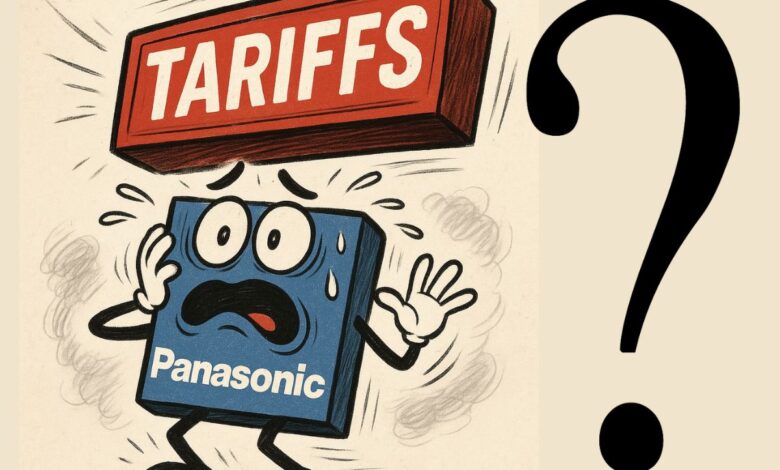
Panasonic blamed its underperformance on the weak global economy and lower demand for electric vehicles. One huge omission was not made: the effect of U.S. tariffs. The reluctance of the company to point a finger at U.S. trade policy is a telling question: To what degree are these tariffs the cause of Panasonic’s performance?
Is It All Resembling With The Dancing Around The Tariff Topic?
Panasonic’s CFO recently took a gamble by not factoring in anticipated U.S. tariff impacts on the company’s fiscal year 2025/2026 financial forecasts. Such a bullish forecast would be unrealistic to some analysts, particularly given the escalating trade tensions between Japan and the United States. The company is optimistic because some of its most significant products are presently shielded from steep tariffs. But as Bob Dylan once so famously sang, “The times they are a-changin'”—and trade regulations can change dramatically over the next couple of months.
The prevailing tariff environment is bullish for Panasonic. The United States imposed a whopping 24% tariff on imports from Japan from July 2025, but comprehensive exemptions within the United States Harmonized Tariff Schedule of the United States (HTSUS) have spared numerous electronics from Panasonic. Smartphone, computer, and flat-panel display items—such as those classified by 8471, 8524, and the 8541 series—remain tariff-exempt.
Take HTS 8524, for example. It includes flat-panel displays, which are downright essential to Panasonic’s television and monitor businesses. And HTS 8541 exemptions include semiconductors and integrated circuits—materials that are truly essential to the company’s automotive electronics and Internet of Things uses. These exemptions, starting April 2025, not only enable Panasonic to escape paying the 24% tax but also to recover money on taxes paid during the remainder of the year. It is like finding an umbrella at the moment it starts raining.
The CFO’s Calculated Risk
To understand why Panasonic’s CFO excluded tariffs from financial estimates, we need to look at three main reasons that reflect such confidence.
First, there is short-term stability from such exclusions, which protect Panasonic’s core electronics until at least July 2025.
Second, the company has strategically diversified its supply chains, with more than 60% of production now outside China—this greatly minimizes the impact of U.S. tariffs on Chinese-made goods.
Third, Panasonic has already taken cost-saving steps, such as a 5% price increase on U.S. products in 2024 to cover previous tariff costs.
But this rosy outlook is predicated on the shaky assumption that there will be no further tariff increases—a bet that is growing more precarious by the day. Warning signs are already fluttering over the Japanese economy. The Bank of Japan’s highly respected Tankan survey in March 2025 reported that sentiment among large manufacturers declined to 12 from 14, driven primarily by tariff fear. Even firms that are currently benefiting from exemptions are feeling the chill wind of uncertainty.
Storm Clouds on the Horizon
Panasonic’s good fortune relies on significant assumptions that can unravel in a hurry. One major concern is the unsettled status of existing exemptions. The White House has already indicated that it intends to impose “special tariffs for semiconductors” by the third quarter of 2025, targeting key components such as memory chips and processors. For Panasonic, which relies heavily on these components for its automobile electronics and consumer goods, such tariffs would add costs of around $500 million annually, according to the company’s semiconductor purchase data for 2024. That’s a big number, even for a large corporation.
In addition to these issues, there is also exposure to global supply chains. The 25% already in place by the U.S. auto tariff directly threatens Panasonic’s automotive business, which provides batteries and sensors to automobile manufacturers around the world. As the last straw, the yen has also depreciated, dropping to 147.06 per dollar in 2025, which only adds to the expense for Japanese exporters such as Panasonic even further. It is like attempting to swim against increasingly faster currents.
Geopolitical risk complicates this already challenging scenario further. Japan’s GDP will decline by 0.8% due to U.S. tariffs, government estimates predict. The Nikkei’s massive 9% plunge on April 7, 2025, indicates just how nervous the market is—this is not a positive sign for Panasonic’s worth and for investors’ trust. As the saying goes, “When America sneezes, the world catches a cold,” and Japan’s economy appears particularly susceptible to this economic ailment.
Steering the High-Wire Act
Panasonic’s choice to leave out tariffs from its financial forecast is a careful risk that could either be very smart or very foolish. Current exemptions give about $1.2 billion each year in protection from tariffs, based on the company’s 2024 export data—a big help against trade challenges. However, if these exemptions end and new semiconductor taxes come in, these benefits could quickly disappear, putting the company at risk from America’s strict trade rules.
For investors looking at Panasonic’s future, there are both negative and positive points to look at. Silver linings are short-term relief from exemptions and cost-pass-through measures, which are some consolation. Recent news from the company about new partnerships to provide EV batteries to Japanese car makers Mazda Motor Corp. and Subaru Corp. also offers potential growth in this crucial sector despite present setbacks.
On the down side, there is a potential loss of $500 million to $1 billion annually if tariffs are newly levied. That loss would be added to the weak yen and the losses on the auto side. As Warren Buffett has opined, “Only when the tide goes out do you discover who’s been swimming naked,” and the shrinking of global trade could reveal weaknesses in Panasonic’s business model that were previously concealed by favorable circumstances.
Looking Beyond the Short-Term Problem
In spite of these massive challenges, Panasonic is hopeful for the future. The company is projecting its profit to increase by at least 150 billion yen ($1 billion) by March 2027, and by a strong 300 billion yen ($2.1 billion) by March 2029. To realize these goals, the company will need to undertake major changes in management, close down loss-making sections of the business, and set up systems that can quickly react to developments in the business world.
Short term, Panasonic acknowledges it will be a while before things get back to normal and profits will drop even lower in the current fiscal year. During the fiscal year ending March 2026, the firm is forecasting a slim profit of 310 billion yen ($2.1 billion) on sales of 7.8 trillion yen ($54 billion)—figures indicating it will be deep into the future before business gets back to normal.
Panasonic’s bullishness about EV batteries, as reflected in its new alliances with Mazda and Subaru, is an indication of where Panasonic is looking for future growth opportunities. But this must be balanced against the reality that the EV market itself is not insulated from uncertainties, such as possible effects of trade policy and changes in consumer sentiment. It’s a question of attempting to change tires while the vehicle already in motion.
The main point here: Pay attention.
Panasonic’s history illustrates the challenge international producers now have with protectionism and economic nationalism. The firm is presently vulnerable despite its strategy and intentions to diversify. The CFO’s perspective indicates temporary strength, but long-term success will be determined by the growth of supply chains and resistance against severe policies that could destroy the company’s plans to recover.
Today, the share is up 12% from April 2025, which indicates that investors believe there will be exemptions and the company will be able to handle adverse conditions. But, as any seasoned sailor will tell you, the weather can turn around in a flash, and the investor must be aware as the trading conditions turn. An ancient Chinese proverb reminds us, “When the winds of change blow, some build walls while others build windmills.” The test for Panasonic will be to construct sufficient windmills to harness these powerful economic winds and not be blown off course by them.

In this critical business strategy game, players like investors, competitors, and policymakers will keenly watch Panasonic’s actions in the next few months. Success of the company in changing according to new trade regulations as well as executing its restructuring strategies will decide if it will be a leaner and more profitable firm or will struggle during hard times. With Panasonic’s long history and technology prowess, most believe that changing will lead to success, but the coming days are likely to be challenging.