Why Do Airtel And Jio Increase Tariffs At The Same Time? Isn’t This A Cartel Formation In The Telecom Sector?

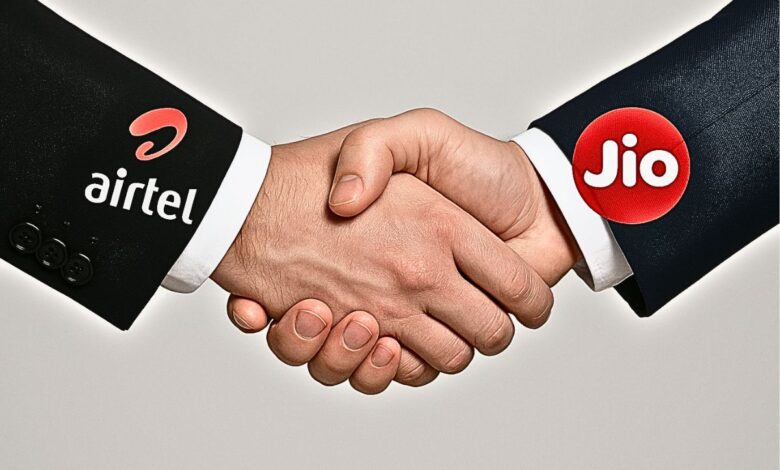
India’s telecom giants Reliance Jio and Bharti Airtel shocked the nation by simultaneously hiking up prepaid mobile tariffs by double-digit %ages in July 2024. This coordinated price hike, the first major increase in nearly 30 months, was no accident or coincidence. It exposed the reality that India’s once-competitive telecom sector has become an oligopoly cartel, with only a few dominant players operating in lockstep.
Instead of protecting consumers, regulators and ministers have effectively turned a blind eye to this “cartelisation,” enabling two private conglomerates to act as if they were one. The result is a naked betrayal of public interest; over 109 crore Indian mobile subscribers now face a sharper pinch in their monthly bills, all to fatten corporate profits. This op-ed lays bare how lax or complicit government oversight and regulatory capture have protected the Airtel–Jio oligopoly, and why millions of ordinary citizens are demanding an immediate overhaul of telecom governance.
India’s mobile network runs on thousands of cell towers like this one, yet the government has essentially allowed two private firms to dominate them. Behind this infrastructure lies an abusive market structure: Jio and Airtel (plus a struggling Vodafone Idea) have concentrated 91–92% of all subscribers, reducing any real competition to dust. In mid‑2024 these dominant telcos colluded silently to raise their prices at once.
On July 2, 2024, Jio announced massive hikes up to 25% on popular plans and the very next day Airtel matched with increases of 11–21%. Both companies had been offering new 5G service to all users at the old 4G rates, effectively postponing revenue gains. Now they have made up for that “free upgrade” by slapping customers with hefty bills. Vodafone Idea (Vi) followed suit with its own 11–21% hikes, though even these could not mask the fact that Airtel and Jio control nearly 87 crore users between them – a virtual duopoly.
The raw statistics are staggering. According to telecom regulator TRAI’s latest data (cited by Congress leader Randeep Surjewala), 109 crore mobile subscribers, about 91.6% of all users in India are now effectively in the grip of this three‑player oligopoly. Of these, Jio accounts for about 48 crore users and Airtel 39 crore, with Vi’s 22.4 crore users trailing far behind. In contrast, state‑owned BSNL/MTNL combine for only about 10 crore users barely 9% of the market. With so little competition left, Jio and Airtel have felt free to raise prices in lockstep. Each of their new tariff plans is now roughly 15–20% higher than before, a de facto additional tax on connectivity.
For ordinary Indians, the impact is immediate and painful. Surjewala’s calculations, quoting TRAI data, show that the common subscriber is being compelled to pay a total of an extra ₹34,824 crore per year compared to the old rates. In other words, these two giants are pocketing an extra ₹34,824 crore from the pockets of the people, thanks to the quiet nod of the authorities.
Every ₹199 recharge for a basic unlimited voice plan is now ₹20 higher; monthlies that used to be ₹455 are ₹509; even high‑end plans have jumped by hundreds of rupees. As one former regulator noted, “the tribals with feature phones feel it the most,” but the truth is no one is safe: everything from daily data packs to annual plans costs significantly more than before.
-
Consumers Affected: 109 crore mobile subscribers (91.6% market share) now pay the new rates.
-
Dominant Duopoly: Reliance Jio (48.2cr users) and Bharti Airtel (39.2cr) together serve ~87 crore, making them a de facto duopoly.
- Annual Consumer Burden: Tariffs up ~15–20%; together the hikes will extract an extra ~₹34,824 crore per year from Indian pockets.
These figures expose the institutional betrayal at work. The country’s telecom regulator (TRAI) is supposed to ensure fair competition and protect consumers, while the Ministry of Communications is responsible for public interest in communication services. Instead, as critics have pointed out, both have been strangely passive even enabling during this episode. Opposition leaders have blasted the government for effectively helping profiteering by private telcos, calling it the continued era of “the same old crony capitalism” under the current administration.
The most upsetting fact is that the tariff hikes took place with zero resistance from the authorities. Within hours of these hikes being reported, the official government line was not to cap or question them, but to claim they were nothing unusual. The Ministry of Communications issued a statement insisting that telecom prices are determined by market forces and “government does not intervene”. It further boasted that India already enjoys some of the lowest mobile rates in the world quoting an average $1.89 per month for 18GB and unlimited calls as if that somehow absolves anyone from their sudden tariff creep.
This market‑forces mantra is sophistry. Despite repeated pleas from users and opposition parties, the government refused to even discuss imposing a price ceiling or investigating the hikes. Instead it defended its inaction by comparing India’s overall telecom costs with other countries as if global averages matter when millions of our citizens are being squeezed. By pointing to low baseline prices, the government pretends the 11–27% shock is insignificant.
In reality, the authorities have completely abdicated their constitutional duty. As Surjewala rightly asked: Why have the Modi government and the TRAI “abdicated their duty and responsibility” towards 109 crore subscribers? His words echo a 1987 Supreme Court ruling that said regulators must act as “active trustees for the public good,” not idle onlookers. Yet the current telecom regulator is doing neither: it has neither intervened to protect users nor acted to curb the obvious cartel‑like behavior.
In fact, Surjewala explicitly noted the oddity: “How can all private cellphone companies increase their average tariffs by the same range of 15–16 per cent, despite different profitability and CAPEX requirements? Why is the Modi government then turning a blind eye?”. This “blind eye” is exactly the problem. The synchronized hikes reek of collusion and the only way such price fixing could happen is if the regulatory guard dogs are asleep.
Indeed, the absence of any probe by TRAI or the Competition Commission of India (CCI) is glaring. When ordinary firms collude, anti‑trust agencies step in. But here, the Big Two colluding at will and lining their pockets has drawn not a peep from the watchdogs. It is classic regulatory capture: the industry has captured the regulator, and the regulator has left consumers defenseless.
It does not stop there. The Ministry of Communications, which should be protecting citizens, has been implicitly shielding these telecom monopolies. For example, during parliamentary debate one minister smugly pointed to international comparisons and assured MPs that things are fine. Meanwhile, insider news reports reveal that government-owned bodies are quietly making opaque deals to keep these private players afloat.
In April 2025, in fact, the government converted ₹36,950 crore of Vodafone Idea’s spectrum auction dues into equity, raising its own stake in the failing company to 49%. In other words, taxpayers bailed out the struggling monopoly rather than strengthening competition. Yet even as billions were poured into rescuing one operator, the same government allowed Jio and Airtel to double down on squeezing customers, a hypocrisy that would be startling if it weren’t so familiar.
This is crony capitalism in action. The regulators and ministries speak loftily of “investments” and “spectrum auctions,” but ignore the very real harm to ordinary Indians. Millions of our citizens students, workers, farmers, the elderly now have to pay significantly more for the same mobile service. The cost of data and calls has suddenly jumped for every family’s budget. It is the rule of the racket, not the rule of law.
Behind every statistic are real people. The elderly retiree who now pays more for a plan she barely uses. The migrant worker who relied on unlimited voice calls to keep in touch, now sees a 15% spike in his phone bill. The student on a tight budget who loaded his prepaid account for summer usage, only to find its value shrunk by the mid‑year hike. Across the country, from villages to cities, millions are quietly reeling.
Imagine a family paying ₹179 per month for an unlimited voice+2GB plan. Overnight, that jumps to ₹199. A small ₹20 increase might sound trivial, but it amounts to hundreds of rupees extra over a year. Multiply this by 109 crore users, and you get the ₹34,824 crore annual windfall for the telcos. That sum could have delivered subsidized data plans, free Wi-Fi, or emergency relief; instead it vanishes into corporate balance sheets. No wonder Congress complained that the government is effectively “fleecing” consumers to line the pockets of cell companies.
To ordinary Indians who have borne the brunt of price hikes after every “spectrum auction” or new technology rollout, this feels like a historic betrayal. The telecom sector was once the poster child of India’s growth story revolutionized by Jio’s entry and 4G rollout. But that very disruption has been twisted into an oligopoly regime. Today’s synchronized hikes prove that once smaller rivals were driven out or absorbed, leaving two giants free to act as cartels. There has been no meaningful check on them.