Can Removing ‘Judicial Corruption’ From NCERT Books Clean The Judiciary’s Image; Does The Corruption Disappear Or Is The Truth Just Buried?
The move to delete references to “judicial corruption” from NCERT textbooks has sparked more than just a curriculum debate. It raises a deeper question - does removing uncomfortable truths protect institutions, or does it expose an even greater discomfort with scrutiny itself?


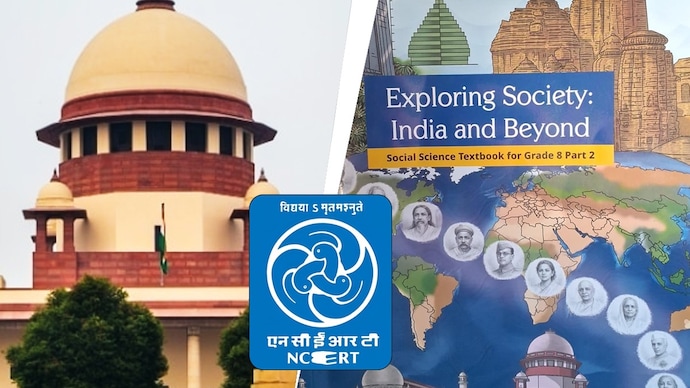
The controversy began with a clear and deliberate decision – references to “corruption at various levels of the judiciary” would be removed from Class 8 textbooks published by NCERT.
Government sources were unequivocal in their reasoning. The section, they said, “should not have been written,” arguing that bringing up such issues was “not appropriate” and that educational material at this level should focus on “inspirational things” instead.
The objection was not limited to the theme alone. Even the inclusion of remarks by former Chief Justice B. R. Gavai drew criticism, with sources calling it “not right” and “not appropriate.” It was also pointed out that the current Chief Justice had expressed displeasure, signalling that the discomfort ran deep within institutional corridors.
This was not a quiet editorial correction – it was a firm intervention. One that effectively drew a line around what should, and more importantly, what should not be introduced to young students about one of the country’s most powerful institutions.
What The Textbook Actually Said
Lost in the outrage, however, is the content of the chapter itself – what exactly was being taught.
The revised chapter, titled “The Role of the Judiciary in Our Society,” did not abandon the basics. It still explained the structure of courts, their functions, and access to justice. But it went a step further – acknowledging the challenges that the system faces, including case backlogs and concerns around accountability.
The numbers alone were telling. Nearly 81,000 pending cases in the Supreme Court, over 6.24 million in High Courts, and an overwhelming 47 million in district and subordinate courts.
What should be noted here is that – these were not opinions – they were realities placed before students to understand the scale of the system they live under.
The chapter also outlined that judges are bound by a code of conduct governing both their professional and personal behaviour. It spoke of internal accountability mechanisms and pointed students towards formal grievance systems such as CPGRAMS, through which complaints can be filed.
Crucially, the text did not present corruption as an unchecked norm, but as a challenge being addressed. It spoke of efforts at both state and Union levels to improve transparency, leverage technology, and act swiftly against misconduct.
And then came the line that has now become the centre of the storm – drawn from former Chief Justice B. R. Gavai, who had acknowledged that instances of corruption and misconduct can erode public trust, and that rebuilding this trust requires transparency and accountability.
Which raises an uncomfortable question – so what exactly seems to be the problem here – was the problem the content itself, or simply the fact that it was said out loud?
Supreme Court Pushback
What may have begun as a curriculum issue quickly escalated into an institutional flashpoint once the Supreme Court stepped in.
Expressing “grave concern,” the court noted that members of the judiciary, including High Court judges, were “perturbed” by the inclusion of references to judicial corruption in a school textbook. The reaction was not muted – it was emphatic and immediate.
Chief Justice Surya Kant made the court’s position clear, stating that it would not allow anyone to “defame the institution.” He further indicated that the court had taken cognisance of the matter and could initiate suo motu proceedings.
The language was telling. This was not framed as a disagreement over pedagogy or nuance – it was positioned as a question of institutional dignity.
The issue was brought into sharp focus by senior lawyer Kapil Sibal, who flagged the textbook in court and called it a matter of “grave concern.” But in doing so, he also raised a question that would linger through the debate – why isolate judicial corruption while ignoring corruption across other arms of governance?
What followed was a rare moment where discomfort became visible. Judges, lawyers, and the executive all appeared to converge – not necessarily in agreement, but in unease.
Because once the court framed the issue as one of “defamation,” the conversation shifted. It was no longer just about what should be taught; it became about what can be said. And perhaps that is what may have been seen as “too close to the truth for comfort”.
The Legal & Institutional Reactions
Now let’s take a deeper look at the reactions.
Outside the courtroom, the responses were far from uniform. If anything, they revealed a deeper divide on how institutions should be understood and represented.
Kapil Sibal questioned the selective outrage, pointing out that corruption exists across political and administrative systems as well. His argument was not a defence of the textbook as much as it was a challenge to the framing of the issue – why single out one institution while others remain untouched?
Senior lawyer Abhishek Manu Singhvi echoed this sentiment, calling out the “selectivity” of the approach. The concern here was not denial; it was imbalance.
On the other hand, voices like Sidharth Luthra took a different route altogether. His argument was rooted in pedagogy rather than politics – that school education, especially at the Class 8 level, is meant to introduce structures, not complicate them. At that stage, he argued, students should first understand how institutions function before being exposed to their flaws.
Similarly, Pragya Parijat Singh raised concerns about the lack of “critical analysis” in the chapter. Mentioning corruption without contextual depth, she argued, risks creating a distorted perception – especially among young, impressionable minds.
And that is where the debate begins to split.
Is the concern about what is being said – or how and when it is being said?
Because between outright rejection and cautious inclusion lies a far more complex question – not whether institutions have flaws, but whether acknowledging them early strengthens understanding or erodes trust.
The Government’s Damage Control
As the controversy escalated, the response from the government moved from justification to containment.
A review panel was constituted to examine the contentious chapter – bringing in former Supreme Court judges Indu Malhotra and Aniruddha Bose, along with former Attorney General K. K. Venugopal.
On the surface, this appeared to be a measured institutional response – bringing legal expertise into the review process. But it also signalled something else: the matter had clearly moved beyond education policy and into the realm of institutional sensitivity.
The Supreme Court, having already taken suo motu cognisance, directed a closer examination not just of the content, but also of those involved in drafting it. The textbook itself was withdrawn, and the chapter in question effectively erased from circulation.
What was unfolding was no longer a debate; it was a correction in real time. But correction of what, exactly? The content or the discomfort it caused?
Can You Teach Corruption To A 13-Year-Old?
Beneath the institutional reactions lies a far more nuanced question – one that was almost entirely overshadowed in the noise.
Should a 13-year-old be taught about corruption within the judiciary?
At first glance, the answer appears straightforward. Children today are not insulated from reality. They are exposed – through conversations, media, and observation – to ideas of power, failure, and misconduct far earlier than textbooks acknowledge.
But exposure is not the same as understanding.
Developmental psychology has long suggested that the ability to process abstract, layered realities takes time to mature. The early teenage years – roughly the age of Class 8 students – are marked by a strong sense of idealism, but a still-developing capacity to critically analyse complex systems.
—Introduce nuance too early, and it risks confusion.
—Introduce it without context, and it risks cynicism.
This is where the criticism of the chapter gains some ground – not necessarily because it mentions corruption, but because of how it does so. Without a deeper framework, without a balancing perception of institutional evolution, reform, and contribution, such references can appear incomplete – if not misleading.
And yet, removing the discussion altogether presents its own problem.
Because if the goal of education is to prepare students for the world as it is – not just as it should be – then shielding them from systemic realities raises questions of its own.
So the dilemma isn’t simple.
- It is not about whether corruption exists.
- It is about when, how, and to what extent young minds should be introduced to it.
- And more importantly – who gets to decide that boundary?
The Irony Nobody Wants To Address
Strip away the reactions, the outrage, the urgency and one detail stands out.
Not a single sentence from the textbook was publicly demonstrated as false.
The objection was not built on factual inaccuracy. It was not argued that the data was incorrect, or that the reference to corruption was fabricated. In fact, the very line that triggered the backlash came from former Chief Justice B. R. Gavai himself—acknowledging that instances of misconduct within the judiciary can erode public trust.
Which raises an obvious contradiction.
Because this is not new. Over the years, members of the judiciary themselves have spoken about the need for transparency, accountability, and internal reform. The system has, at various points, admitted its own imperfections.
And yet, when that same acknowledgement finds its way into a school textbook, it suddenly becomes problematic. There is another layer to this.
The court, in its strong reaction, framed the issue as one of institutional dignity – of protecting the judiciary from being “defamed.” But if a statement is factual, sourced, and even reflective of internal acknowledgment, can its mere repetition be called defamation?
Or is the discomfort rooted elsewhere – not in what is being said, but in where it is being said, and who is hearing it? It begins to resemble a familiar paradox – the truth is acceptable, as long as it remains contained.
As George Orwell once wrote, “If liberty means anything at all, it means the right to tell people what they do not want to hear.”
Which is precisely where the tension lies; because this is no longer just about a textbook. It is about whether inconvenient truths lose their legitimacy when they reach a wider audience.
The Institutional Contradiction
Even more striking is the gap between what is acknowledged within the system and what is allowed to be said about it.
Data placed before Parliament revealed that over 7,500 complaints were received against judges of the Supreme Court and High Courts between 2016 and 2025. The existence of an “in-house mechanism” to deal with such complaints is itself an admission that accountability structures are necessary.
Which makes the reaction to the textbook harder to reconcile. If systems exist to address misconduct, then the possibility of misconduct is already recognised. If complaints are being filed and processed, then the issue is neither hypothetical nor imagined. So why does its mention become unacceptable in an educational context?
This is where the contradiction sharpens. On one hand, the system acknowledges that accountability mechanisms are essential. On the other, it resists the articulation of why such mechanisms are needed in the first place.
The result is a curious imbalance – transparency in process, but discomfort with disclosure. And perhaps the most telling irony of all – by attempting to remove a few lines from a textbook, the issue has not been contained.
It has only been amplified. What was once a paragraph read by a limited audience is now a national conversation.
Which brings us back to the question that started it all – Was this about protecting the institution? Or about controlling the story around it?
When Questioning Becomes Risky
If the intent was to contain the conversation, the aftermath suggests otherwise.
The controversy has not remained confined to textbooks or courtrooms – it has spilled into campuses, conversations, and individual expression. A law student questioning the Supreme Court’s decision reportedly faced pressure from his university to take down his criticism, citing “reputation” and institutional concerns.
His response was blunt; he refused.
What followed was telling. The concern was no longer about a chapter in a textbook, but about who gets to question the judiciary, and how far that questioning can go without consequences.
Because this is where the issue takes a sharper turn.
When criticism begins to invite pressure (formal or informal) it creates a chilling effect. Not through explicit censorship, but through the anticipation of it. The boundaries are never clearly stated, but they are understood.
And once that happens, silence becomes easier than scrutiny. Which raises a deeper concern. If even law students – those being trained to understand and engage with the legal system – feel the weight of that pressure, what does it signal to everyone else? That questioning is allowed, but only up to a point.

The Last Bit, You Can Remove The Text From NCERT Textbooks; Not The Reality
At its core, this was never just about a school textbook.
It was about whether acknowledging imperfection weakens an institution or strengthens it.
Because institutions do not lose credibility when their flaws are discussed. They lose credibility when those discussions are shut down, dismissed, or quietly erased. Removing a paragraph may offer momentary comfort, but it does little to address the reality it reflects.
If anything, it does the opposite. It shifts the focus from the issue itself to the act of removing it. From corruption, to the discomfort of admitting it. From reform, to restraint.
And that is where the real question lies.
Not whether young students should be taught about corruption.
But whether a system that acknowledges it internally can afford to deny it publicly. Because erasing the words does not erase the problem. It only makes the silence louder.