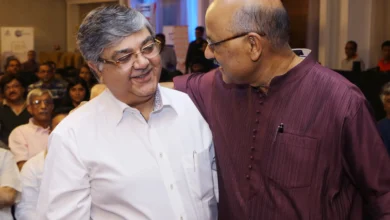
ED arrests Ozone Urbana Infra Developer’s CMD in ₹927.22 crore homebuyer alleged fraud case. When Is ED Going To Arrest Nayan Raheja Of Raheja Builders?
An investigative opinion on two very different enforcement stories—and one uncomfortable question: when an agency has allegedly traced thousands of crores, provisionally attached assets worth nearly ₹2,400 crore, searched premises linked to a promoter’s son, and confronted allegations of repeated non-cooperation, how long should the public wait before seeing decisive action?


The Enforcement Directorate’s arrest of S. Vasudevan, CMD and promoter of Ozone Urbana Infra Developers, has once again brought a fundamental question to the centre of India’s real-estate enforcement regime: does enforcement end with searches and property attachments, or does it eventually reach the individuals whom investigators believe were responsible for the alleged financial architecture?
In the Ozone Urbana case, the ED did not stop at searches and attachment. Vasudevan was arrested on September 30, 2026 under Section 19 of the Prevention of Money Laundering Act and produced before a special court, which granted 14 days of ED custody. The agency alleges a ₹927.22 crore homebuyer fraud involving non-delivery of units and diversion of buyer funds. ETRealty.com
That development makes the ongoing Raheja Developers investigation impossible to discuss merely as another real-estate dispute.
Because the numbers are enormous.
The ED says Raheja Developers Ltd. collected approximately ₹2,425.99 crore from around 4,600 homebuyers in connection with various residential projects. Its own April 2026 press release alleges that a substantial portion of those funds was siphoned off through related entities and shell companies and ultimately transferred to entities controlled by the company’s director, family members and close associates, allegedly for purposes unrelated to the projects, including acquisition of assets and personal uses. Enforcement Directorate
The agency has since provisionally attached properties in three major rounds: approximately ₹1,113.81 crore, then ₹503.48 crore, and then ₹782.36 crore, taking the cumulative estimated value of attached property to approximately ₹2,399.65 crore. Enforcement Directorate
And yet the headline question remains:
When is the ED going to arrest Nayan Raheja—if, after completing its investigation, the agency concludes that his custodial interrogation is legally warranted?
That is not a declaration of guilt.
It is a question of enforcement consistency, investigative urgency and public accountability.
The Raheja case is no longer merely about delayed possession
For years, disputes involving large developers have often been reduced to the familiar language of “delay”, “force majeure”, “approval issues”, “infrastructure problems” and “possession timelines”.
But the Raheja matter has moved into an entirely different regulatory universe.
The ED’s April 28, 2026 press release says its PMLA investigation arose from multiple FIRs registered by the Economic Offences Wing on complaints from numerous homebuyers. It says searches were conducted on June 27, 2025 and again on April 25, 2026. During the April 25 operation, the agency says it recovered incriminating documents and digital evidence, besides jewellery and bullion valued at approximately ₹15.82 crore and foreign currency worth approximately ₹15 lakh. Enforcement Directorate
The agency’s allegation is not simply that flats were delivered late.
It says its analysis of seized documents and other evidence indicated that a substantial portion of the homebuyers’ money was allegedly routed through a complex network of related entities and shell companies and ultimately transferred to entities controlled by the director, his family members and close associates. The ED alleges that the money was then used for purposes unrelated to the housing projects. Enforcement Directorate
That is the allegation now requiring the sharpest scrutiny.
Because if the allegation is merely that a developer failed to complete a project, the dispute may often remain essentially civil or regulatory.
But if funds collected for construction were systematically moved elsewhere through related entities and were used to acquire unrelated assets, that potentially raises a much more serious question of proceeds of crime, layering, beneficial ownership and money laundering.
That is precisely why the ED’s investigation matters.
₹2,425.99 crore collected. ₹2,399.65 crore provisionally attached. And the questions are multiplying.
The arithmetic alone should make regulators uncomfortable.
According to the ED’s April 2026 press release, approximately ₹2,425.99 crore was collected from around 4,600 homebuyers. Enforcement Directorate
By July 31, the cumulative estimated market value of properties provisionally attached had reached approximately ₹2,399.65 crore. ETRealty.com
Of course, these are not economically identical numbers. A collection figure is not the same thing as the value of attached property, and provisional attachment is not final confiscation.
But the proximity is striking enough to deserve explanation.
More importantly, there is an inconsistency in publicly reported figures that the investigative agencies should clarify rather than leave hanging in the air.
The April ED press release states the collection figure at ₹2,425.99 crore from around 4,600 homebuyers. Enforcement Directorate
Yet The Times of India, reporting on the October 1, 2026 Delhi High Court proceedings involving Nayan Raheja’s anticipatory-bail matter, reported the ED as stating that Raheja Developers had collected ₹2,699.1 crore from around 4,600 homebuyers and allegedly diverted ₹1,353.3 crore for purposes unrelated to construction. The Times of India
Those numbers may reflect different investigative stages, different calculations, or different pools of transactions.
But they should be reconciled.
A money-laundering investigation involving thousands of crores cannot afford arithmetic ambiguity.
The public deserves to know:
What exactly is the proceeds-of-crime figure?
What amount was collected?
What amount was allegedly diverted?
Through which entities?
Which transactions have been traced?
Which assets are alleged to represent the corresponding proceeds?
And ultimately:
Who controlled those transactions?
The most uncomfortable name is no longer merely Navin Raheja
The ED’s case has publicly centred on Navin M. Raheja, but the name of his son Nayan N. Raheja is now firmly present in the investigation.
News reports on the April 25, 2026 searches stated that the ED covered seven locations across Delhi-NCR and premises linked to Navin Raheja, his son Nayan Raheja, family members and company directors. Moneycontrol
Nayan Raheja is not some random name picked from the corporate register.
Raheja Developers’ own website describes him as an entrepreneur who has been a “growth driver” for the company and says he contributed to new systems, processes and product delivery. The company profile also credits him with being at the forefront of strategic initiatives including bringing major international construction companies into India and working on large luxury developments. Raheja Developers
That public corporate narrative is therefore important when viewed against his present defence.
Because before the court, Nayan’s side has argued that he was not involved in the day-to-day management or decision-making of Raheja Developers Ltd.
According to the defence position reported in the September 2026 proceedings, Nayan says he was a director from January 15, 2003 to January 12, 2008, and again from August 16, 2010 to November 26, 2010, after which he claims he held no management position in the company. He is stated to hold 0.81% of the company’s shares and to receive salary for architectural-drawing advisory work. Web India News
The ED’s position is different.
The agency argued that there was sufficient material to indicate that Nayan was looking after the affairs of Raheja Developers or, at minimum, was a director of subsidiary companies into which homebuyer money was allegedly diverted for non-construction purposes. Web India News
There is therefore a very simple factual issue for investigators to settle:
Was Nayan merely an architect and minority shareholder—or was he an active participant in the corporate structure through which the alleged funds moved?
That question can be answered by documents, bank statements, board records, emails, digital devices, beneficial ownership records and transaction trails.
Not by public relations.
The summons issue: five appearances missed out of seven
This is arguably the most serious development concerning Nayan personally.
In September 2026, the Saket District Court rejected his anticipatory-bail application.
According to the reported order, the court noted that out of seven occasions on which summons were served, Nayan appeared before the ED’s Gurugram Zonal Office on only two occasions and failed to personally appear and cooperate on five occasions, citing different reasons. Gradient E Business
The court also noted the earlier undertaking given before the Delhi High Court on July 30, 2026 that Nayan would fully cooperate with the ED. That undertaking appears in the Delhi High Court’s order itself. Indian Kanoon
The trial court concluded that the statutory twin conditions under Section 45 of the PMLA were not satisfied and that Nayan had not demonstrated reasonable grounds for believing that he was not guilty of money laundering. The court also considered his conduct regarding non-appearance relevant to the grant of anticipatory bail. Gradient E Business
This does not mean that the court convicted Nayan.
It did not.
But it does mean that a judicial record now contains an adverse observation concerning his cooperation with the investigation.
That deserves to be reported honestly.
The legal chessboard is getting crowded
Nayan did not simply sit back after the ED investigation began.
On July 30, 2026, he approached the Delhi High Court in W.P.(CRL) 2256/2026 against the Union of India and the ED. The High Court issued notice and directed filing of a status report. Crucially, the order recorded Nayan’s undertaking that he would fully cooperate with the ED. The matter was listed for October 15, 2026. Indian Kanoon
On August 4, a Delhi court also granted interim protection from arrest to Navin M. Raheja and Nayan N. Raheja, while hearing the ED’s request for open-ended non-bailable warrants. The court directed them to join and cooperate with the investigation. The ED had argued that despite earlier participation, they subsequently failed to appear on repeated occasions and did not comply with summonses in April 2026. Hindustan Times
Then came the September 19 rejection of Nayan’s anticipatory bail.
And on October 1, the Delhi High Court heard his fresh anticipatory-bail plea. The ED opposed the plea and sought time to respond, while Nayan’s counsel said he was willing to cooperate. The matter was listed for October 6, 2026; as of October 4, there is no final merits decision from that hearing in the public report available to us. The Times of India
So the legal record is not static.
It is moving.
The Raheja projects: the homebuyer story is older than the ED investigation
The most uncomfortable feature of the Raheja story is the chronology.
The controversy did not begin with the ED.
The homebuyer disputes predate the money-laundering investigation by years.
Raheja Revanta
The Raheja Revanta project in Sector 78, Gurugram has generated repeated homebuyer disputes and regulatory proceedings.
The Haryana RERA record identifies the project as a residential group-housing development registered under RERA registration No. 32 of 2017, involving an area of about 18.72 acres. Haryana RERA
In one NCDRC matter concerning Revanta, the record stated that the apartment was booked through the developer represented by Nayan Raheja, with an agreement dated December 27, 2012. Possession was promised within 48 months plus a six-month grace period—effectively around mid-2017. The purchasers were recorded as having paid approximately ₹1.296 crore, or 95% of the total cost of about ₹1.369 crore. The proceeding concerned failure to deliver possession within the stipulated period. CaseMine
In another public buyer protest in December 2022, purchasers said they had been waiting for possession for years and alleged that they had paid as much as 90% of the flat price. Nayan Raheja was reported to have reached the protest site and interacted with buyers. Buyers also alleged that orders had been passed directing refunds. The company, however, said infrastructure constraints—including roads, electricity and water arrangements—were major impediments to occupation. The Tribune
Those competing narratives are important.
Buyers say: deliver the homes.
The developer says: give us the infrastructure needed to deliver them safely.
But the ED has introduced a third question:
What happened to the money collected while the homes remained incomplete?
That is the issue that cannot be answered by citing infrastructure alone.
Revanta has now entered insolvency proceedings
The matter became even more serious in 2026.
The Insolvency and Bankruptcy Board of India’s records show that the Raheja Revanta Project entered the Corporate Insolvency Resolution Process following an NCLT order dated 8 June 2026. The public insolvency process has progressed into a resolution-plan stage, with an EOI process and a Resolution Professional in place. Insolvency and Bankruptcy Board of India
That is a remarkable development for a project marketed as a major luxury residential development.
A developer can point to approvals.
A developer can point to government infrastructure.
A developer can point to historic achievements.
But once a project reaches insolvency proceedings, those arguments no longer answer the central problem confronting purchasers:
Where are the homes, and how will the money be protected?
Raheja Shilas: possession promises dating back to 2012–13
The picture is not confined to Revanta.
In relation to Raheja Shilas (Low Rise), 43 homebuyers filed a Section 7 petition under the IBC in 2023. The NCLT order records that possession under the Builder-Buyer Agreements was supposed to be delivered around 2012–13. The NCLT found that the debt was due, that default had occurred, and that the occupation certificate had not been received. CaseMine
The NCLAT subsequently dealt with the scope of the insolvency proceedings and on March 20, 2026 held that the CIRP should be confined to the Raheja Shilas (Low Rise) project, rather than indiscriminately threatening other projects. Live Law Biz
This is important because it shows that the judicial system is itself trying to strike a balance:
Protect the affected homebuyers without unnecessarily destroying the interests of buyers in other projects.
That distinction deserves to be maintained throughout the Raheja investigation.
Krishna Housing Scheme: another insolvency battle
The Raheja Krishna Housing Scheme provides another example.
NCLAT records show that 129 homebuyers filed a Section 7 application concerning the project. The project involved 1,644 units plus commercial units, with possession required by June 10, 2019. The CIRP was subsequently confined to the Krishna Housing Scheme. Indian Kanoon
Again, the issue is not merely that one buyer had a disagreement.
The judicial record contains multiple groups of financial creditors, intervention applications and grievances from buyers in different projects. NCLAT’s 2026 judgment expressly records intervention by purchasers from other projects who raised grievances regarding defaults and non-completion. Indian Kanoon
That is not a picture of one isolated contractual disagreement.
It is a picture of a developer facing litigation across multiple projects and multiple institutional forums.
And then there is the financial-creditor trail
There is another less-publicised but revealing piece of litigation.
In Catalyst Trusteeship Ltd. v. Nayan N. Raheja & Ors., a dispute arose around secured non-convertible debentures. The plaintiff sought relief concerning an alleged outstanding amount of approximately ₹217.77 crore and relied upon personal guarantees given by Nayan and Navin Raheja, along with guarantees involving Raheja Developers and other entities. latestlaws.com
The Delhi High Court ultimately dismissed the suit as not maintainable, while making clear that the plaintiff could pursue the appropriate remedy. Costs of ₹8 lakh were awarded. CourtKutchehry
This case should not be misrepresented as a fraud conviction or money-laundering finding.
It was not.
But it does demonstrate something broader: the Raheja ecosystem has for years been exposed to substantial financing, security, guarantee and insolvency litigation.
There are even criminal case records—but caution is essential
A separate Jammu court database record lists Nayan Navin Raheja, Naveen M. Raheja and an ICICI Bank official as respondents in a criminal complaint registered in 2025 under Sections 420, 465, 467, 468, 471 and 120-B of the Ranbir Penal Code. The case was registered on November 8, 2025 and shown as disposed on November 26, 2025. The publicly accessible case record does not provide enough reasoned material to responsibly describe the merits or outcome of the allegations. eCourtsIndia
That distinction is vital.
A case number is not a conviction.
An FIR is not proof.
A complaint is not guilt.
And journalism that collapses those distinctions ceases to be investigative journalism and becomes propaganda.
The FIR trail continues
Raheja Developers is also fighting litigation arising from FIR No. 54/2021 registered at Police Station EOW, New Delhi, invoking Sections 406, 420, 467, 468, 471 and 120-B IPC.
In a Delhi High Court order dated September 15, 2026, the company and another petitioner sought quashing of the FIR. The dispute involved a shop booking, payments routed through broker Nitin Jain, subsequent cancellation and forfeiture. The High Court recorded a prima-facie view that the dispute could at least potentially be civil in nature, but it did not quash the proceedings at that stage; notice was issued and the matter was listed for January 28, 2027. Indian Kanoon
That case therefore deserves careful treatment rather than sensationalism.
The real investigative weight comes from the aggregate picture of multiple EOW FIRs, the ED’s PMLA investigation, searches, successive provisional attachments, insolvency proceedings and the separate allegations relating to fund diversion.
So why the question about Nayan’s arrest?
The answer should not be emotional.
Nor should it be predetermined.
The law does not require the ED to arrest somebody merely because journalists demand it.
But the converse is equally important:
The fact that a person has not yet been arrested cannot become a substitute for accountability if investigators believe custodial interrogation is necessary and legally justified.
The Ozone Urbana case demonstrates one route.
The ED investigated.
It searched.
It gathered material.
It alleged diversion and layering.
It arrested the promoter.
The court then authorised 14 days of ED custody. ETRealty.com
The Raheja investigation, meanwhile, has seen:
₹2,425.99 crore allegedly collected from about 4,600 buyers;
₹15.82 crore of bullion/jewellery and about ₹15 lakh in foreign currency seized during the April 2026 search;
₹1,113.81 crore provisionally attached in April;
another ₹503.48 crore attached in June;
another ₹782.36 crore attached in July;
and approximately ₹2,399.65 crore in cumulative provisional attachments. Enforcement Directorate
There is also a judicial record saying Nayan appeared on only two of seven summonses, and a prior Delhi High Court undertaking that he would fully cooperate with the ED. Gradient E Business
Against that backdrop, asking the ED what remains to be done and why is not unreasonable.
The real question is not “Will ED arrest Nayan?”
The real question is:
What evidence does the ED have about Nayan’s exact role?
Was he merely an architect?
Was he a minority shareholder?
Was he involved in subsidiary-company management?
Did he approve transactions?
Did he receive money directly or indirectly?
Did entities linked to him receive alleged diverted funds?
Did he participate in decisions concerning the projects?
Did he have knowledge of where customer collections were being routed?
Did his digital devices contain evidence relevant to those allegations?
Were corporate structures used merely for legitimate business purposes—or for layering transactions?
Were the attached properties actually acquired out of alleged proceeds of crime?
These questions can be answered.
And they should be answered quickly.
The biggest casualty is not the promoter’s reputation—it is the homebuyer’s time
There is a brutal imbalance in Indian real estate.
A developer can spend years litigating.
A financial institution can restructure.
A corporate entity can seek insolvency protection.
An investigation can continue.
A court case can be adjourned.
But the homebuyer continues paying rent, bank interest and EMI.
That person does not get a legal holiday from life.
The passage of time is therefore not neutral.
For a homebuyer, ten years is not merely ten years.
It is:
ten years of rent,
ten years of EMI,
ten years of opportunity cost,
ten years of uncertainty,
and often ten years of watching a promised home remain unfinished.
That is why enforcement cannot be congratulated merely for attaching property.
The ultimate test is whether the money trail is traced, the responsible persons are identified, assets are preserved and lawful recovery or restitution actually reaches the affected stakeholders.
The Raheja defence must also be heard
A credible investigation cannot become one-sided.
Raheja Developers has categorically denied fraud and fund diversion. Following the April 2026 searches, the company said it had invested significantly more into the Revanta project than it had collected from customers, cited a RERA-supervised forensic audit, and blamed delays substantially on missing government infrastructure and the inability to safely commission a 61-storey structure without water, electricity, sewerage and firefighting infrastructure. Moneycontrol
Nayan’s legal position is also clear: he has argued that he was not involved in day-to-day management, was not implicated or charge-sheeted in the predicate FIRs, had only a small shareholding and had an architectural-advisory role. Web India News
Those are serious defences.
They must be tested.
But the appropriate place to test them is through documentary evidence and judicial proceedings—not through public relations campaigns.
India does not need another endless builder-vs-buyer saga
The danger now is institutional fatigue.
One search.
One press release.
One attachment.
One hearing.
Another hearing.
Another petition.
Another interim protection.
Another insolvency proceeding.
Another appeal.
And somewhere in the middle, the homebuyer disappears from the headlines.
That cannot be the outcome.
The law-enforcement objective should be straightforward:
Follow the money.
Identify the beneficial owners.
Map every related-party transaction.
Trace the alleged proceeds of crime.
Test the shell-company allegations.
Examine the role of every director and decision-maker.
Reconcile the financial figures.
Secure the assets.
Complete the investigation.
File the prosecution complaint where warranted.
Put the matter before the competent court.
And then let the court decide guilt or innocence.
A demand for speed—not a demand for predetermined guilt
The question posed by this article is not that Nayan Raheja should be arrested because public opinion has already convicted him.
That would be irresponsible.
The question is whether the same enforcement intensity applied in comparable large-scale homebuyer investigations should also be applied here, and whether the ED has adequate grounds for custodial interrogation or other coercive steps consistent with law.
The ED has already done enough in the Raheja matter to demonstrate that this is not being treated as an ordinary consumer dispute.
The agency has conducted multiple searches.
It has invoked PMLA.
It has provisionally attached assets worth almost ₹2,400 crore.
It has described the alleged diversion as large-scale.
It has identified thousands of homebuyers.
And Nayan has already had one anticipatory-bail application rejected, with the trial court expressly considering his alleged lack of cooperation. Enforcement Directorate
So the public-interest question is perfectly legitimate:
What exactly is the ED waiting for?
If the evidence does not justify arrest, the agency should say what investigative grounds support continued freedom.
If the evidence does justify custodial interrogation, then the agency should act in accordance with law.
What should not happen is a third option:
years of investigation while thousands of buyers continue waiting.
Ozone Urbana vs Raheja: the uncomfortable comparison
Ozone Urbana demonstrates that where the ED alleges a substantial homebuyer fraud, it can move from investigation to arrest.
Raheja represents an investigation where the ED itself has publicly alleged an even larger financial scale—around ₹2,425.99 crore from approximately 4,600 buyers, followed by provisional attachments totaling about ₹2,399.65 crore. ETRealty.com
That does not mean the two cases are legally identical.
They are not.
Nor does the scale of an attachment automatically require an arrest.
It does, however, raise the legitimate question of why enforcement outcomes differ and what specific investigative considerations explain that difference.
Consistency is essential to public confidence.
The message from the enforcement system should never be that one promoter gets arrested while another investigation simply keeps accumulating property attachments and adjournments without explaining the next step.
The message should be:
Evidence determines action.
Not influence.
Not wealth.
Not corporate stature.
Not public relations.
And certainly not the ability to prolong litigation.
The Bitter Bottom Line
The Raheja matter has now crossed too many regulatory and judicial thresholds to be dismissed as merely an unfortunate construction delay.
There are thousands of aggrieved buyers.
There are multiple EOW FIRs.
There is an ED money-laundering investigation.
There have been repeated searches.
The agency alleges diversion of homebuyer funds through related entities and shell companies.
There are three major rounds of provisional attachment totalling approximately ₹2,399.65 crore.
There are insolvency proceedings involving major projects.
There are continuing court battles.
And now there is a direct personal legal battle involving Nayan Raheja, including a failed anticipatory-bail application and judicial observations concerning his cooperation with the ED investigation. Enforcement Directorate
At this stage, the fairest—and sharpest—question is therefore not:
“Is Nayan Raheja guilty?”
No responsible journalist can answer that before trial.
The sharper question is:
“Has the investigation progressed far enough for the agencies to determine whether Nayan Raheja played a substantive role in the alleged financial transactions—and if so, why should the investigation not proceed with every lawful coercive measure necessary to secure evidence and his presence?”
That question deserves an answer.
And the 4,600 homebuyers deserve one even more.
Editorial Disclaimer / Legal Notice
This is an investigative opinion article based on publicly available court records, Enforcement Directorate statements, regulatory records and published news reports. Allegations attributed to the ED, EOW, complainants or other parties remain allegations unless and until established before a competent court of law.
Neither Nayan N. Raheja, Navin M. Raheja, Raheja Developers Ltd. nor any other individual or entity discussed in this article should be treated as convicted merely because an FIR, investigation, search, provisional attachment, insolvency proceeding or bail proceeding exists.
No court of law has, on the material reviewed for this article, convicted Nayan N. Raheja of money laundering or the alleged diversion of homebuyers’ funds. The September 19, 2026 rejection of anticipatory bail is not a conviction. Likewise, provisional attachment under the PMLA is a preventive investigative measure and is not by itself a final adjudication of guilt. The Delhi High Court proceedings concerning Nayan remain pending, with a further hearing reported for October 6, 2026, while his separate writ petition was listed for October 15, 2026. Gradient E Business
Raheja Developers and the concerned individuals have denied wrongdoing and have advanced explanations concerning project infrastructure, investment into projects and the role of Nayan Raheja. Those positions have been included because investigative journalism must scrutinise power without prejudging guilt. Moneycontrol
What is unquestionably in the public record is that the investigation is continuing.
The public-interest demand, therefore, is simple: faster investigation, tighter financial tracing, preservation of assets, prompt completion of the investigative process, and speedy trials wherever charges are ultimately filed—without compromising due process, the presumption of innocence or the rights of the accused.
Justice delayed is particularly cruel in real estate, because the people waiting are not waiting for a paper judgment. They are waiting for the keys to their homes.