From Mumbai to Dubai: How HDFC Bank Is Pioneering The Art Of Disappointment Across Continents!


How HDFC Bank Is Degrading Customer Trust – At Home and Abroad
HDFC Bank has long been a poster child of India’s liberalised financial sector. Founded in 1994 as the first private-sector bank approved by the Reserve Bank of India (RBI), it grew from a handful of branches into the country’s largest private lender, boasting more than 8,000 branches and serving nearly half of India’s urban households. For years, it cultivated an image of efficiency, reliability and customer‑centricity. Even as public‑sector banks struggled under the weight of non‑performing assets and corruption scandals, HDFC Bank’s strong balance sheet and slick marketing made it a trusted name among middle‑class Indians and non‑resident Indians (NRIs) alike.
But in recent years, the bank’s pristine reputation has begun to show cracks. A string of controversies, from allegations of aggressive loan recovery tactics and fraudulent subvention schemes to mis‑selling complex financial products to NRIs abroad has raised questions about governance and consumer protection at the “blue‑eyed boy” of Indian banking. Regulators in India and overseas have slapped penalties and opened investigations. Customers have taken to social media and courts to narrate harrowing experiences. This investigation pieces together evidence from court documents, regulatory orders, mainstream reportage and credible reports to understand how HDFC Bank is degrading customer trust, both at home and on foreign shores.
The Dubai Fiasco: Mis‑selling AT‑1 Bonds and Regulatory Action
DFSA bars HDFC Bank’s Dubai branch from onboarding new clients
In September 2025, the Dubai Financial Services Authority (DFSA) took the unusual step of issuing a decision notice against HDFC Bank’s branch in Dubai’s International Financial Centre (DIFC). The notice barred the bank from onboarding or soliciting any new clients, advising on financial products, arranging deals or credit, providing custody services or making financial promotions until further notice. In other words, the branch could continue to serve its existing 1,489 clients—but it could not add a single new customer or sell any new product. The DFSA noted that it had “concerns around financial services provided to customers not fully on‑boarded and issues linked to its onboarding process”.
The restrictions came in the wake of a high‑profile scandal involving additional tier‑1 (AT‑1) bonds issued by Credit Suisse. These complex instruments were marketed to NRIs by HDFC Bank’s Middle Eastern operations, often using funds from their fixed deposits. When Credit Suisse ran into trouble and was acquired by UBS in March 2023, its AT‑1 bonds were written down to zero—wiping out investors’ money and sparking global outrage. According to the DFSA notice, regulators were examining whether HDFC Bank had mis‑sold these bonds and whether clients were properly onboarded. The branch’s small size—it contributed less than 0.1% to HDFC Bank’s overall business—did not deter the regulator from imposing stiff sanctions.
Misuse of NRI fixed deposits to buy AT‑1 bonds
An in‑depth report revealed that at least four NRIs in Nagpur, Chandigarh and Gurgaon filed complaints with the Economic Offences Wing (EOW), alleging that HDFC Bank’s Middle East officials misused their fixed deposits worth ₹25–30 crore to purchase Credit Suisse AT‑1 bonds.
The bank officials allegedly inflated the customers’ eligibility, raising one client’s annual income from $40,000 to $140,000 to qualify them for high‑risk bonds. The customers were promised returns of 12–13% and were not provided full copies of the agreements. Once the bonds were written off in 2023, the bank adjusted the loans against the clients’ fixed deposits, causing massive losses. Authorities in the Middle East reportedly opened an investigation, while the DFSA’s decision notice suggested serious deficiencies in HDFC Bank’s onboarding and product‑suitability processes.
HDFC Bank maintains that it has taken steps to address the DFSA’s concerns. In its disclosure to the stock exchanges, the bank emphasised that its DIFC branch is not material to overall business and that it is “working with the DFSA to address the observations”. The events, however, have dented the bank’s image among expatriate clients, many of whom expect world‑class compliance and transparency when dealing with Indian banks abroad.
The Subvention Scheme Scandal: Homebuyers Caught Between Banks and Builders
What is a subvention plan?
Under a typical subvention plan (sometimes called an “80:20” scheme), a homebuyer pays a small upfront sum (often 10–20% of the property price) while the bank disburses most of the loan amount directly to the builder. In return, the builder is supposed to service the interest (EMIs) on the buyer’s behalf until possession of the property. The arrangement allows developers to access capital quickly and helps buyers defer payments. However, if the builder fails to complete the project or defaults on interest payments, the bank may start demanding EMIs from the buyer, leaving them liable for a loan on an unbuilt apartment.
Supreme Court flags “unholy nexus” and orders CBI probe
The subvention model came under judicial and investigative scrutiny after thousands of homebuyers in the National Capital Region (NCR) complained that banks and builders colluded to siphon funds, leaving buyers stuck with loans but no homes. In July 2025, The Telegraph reported that the Central Bureau of Investigation (CBI) registered 22 FIRs on the Supreme Court’s orders to probe the “unholy nexus” between builders and financial institutions.
The FIRs named prominent developers such as Jaypee Infratech, Logix, Ajnara and Saha Infratech. Crucially, the source cited by the report noted that banks and housing finance companies such as State Bank of India, Indiabulls Housing Finance, Piramal Finance, HDFC Bank, ICICI Bank, Tata Capital Housing Finance and PNB Housing Finance were also named in the FIRs.
Homebuyers allege that they were forced to pay EMIs without having received possession of their flats. Over 1,200 petitioners told the court that under subvention plans, loan amounts were disbursed to builders, who were supposed to pay the interest until handing over possession; when builders defaulted, banks started recovering payments from buyers. The Supreme Court found prima facie evidence of collusion and allowed the CBI to convert preliminary inquiries into regular cases. The case underscores how HDFC Bank and other lenders may have prioritised loan disbursement over due diligence, jeopardising consumer trust.
Example: Homebuyer harassment case involving HDFC Bank
One case often cited by activists involves a Delhi‑based couple who purchased a flat in 2016 under a subvention scheme financed by HDFC Bank. The developer, after receiving most of the loan, failed to deliver the apartment. When the builder stopped paying the interest, HDFC Bank allegedly demanded EMIs from the buyers, threatened legal action and tarnished their credit scores.
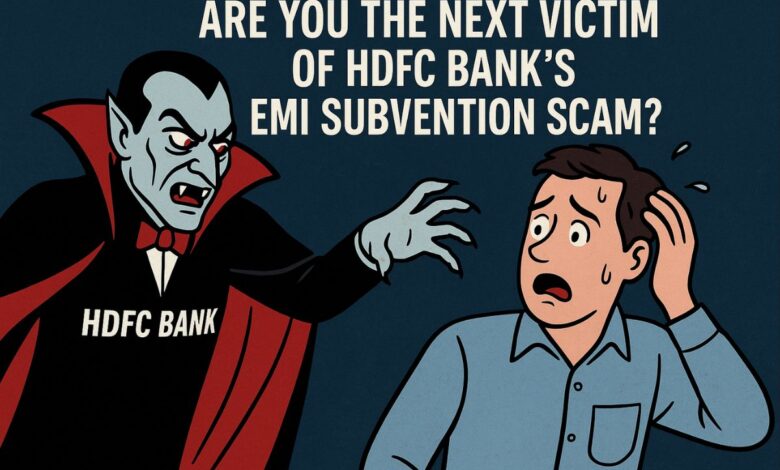
According to court filings (not publicly accessible but summarised in various complaints), the couple approached consumer courts and even the National Company Law Tribunal (NCLT) but faced prolonged litigation. In April 2025, the Supreme Court admonished banks for acting like “property dealers”, with one justice asking if bank officials had “forgotten that they are bankers, not agents of builders.” The case, while still under litigation, reflects a broader pattern where banks such as HDFC allegedly ignored risk factors of stalled projects and colluded with builders to offload liability onto end‑buyers.
Aggressive Recovery Practices: Harassment and Tragedy
RBI penalises HDFC Bank for violating recovery agent guidelines
In September 2024, the Reserve Bank of India imposed a ₹1 crore penalty on HDFC Bank for failing to adhere to its code of conduct regarding recovery agents. A Business Standard report explained that the RBI’s inspection found that HDFC Bank’s recovery agents had contacted customers outside the permissible 7 a.m. to 7 p.m. window. The agents’ calls and visits beyond designated hours violated the central bank’s directives on recovery agents, which emphasise dignity, privacy and respect for borrowers. The RBI also flagged lapses related to interest rate disclosures and customer service. The penalty underscores regulatory frustration with banks that outsource collections to third‑party agents using aggressive tactics.
Beyond the monetary penalty, the article emphasised that borrowers have rights: the right to verify a recovery agent’s identity, the right to privacy and humane treatment and recourse to legal action if agents harass them. That the RBI deemed it necessary to remind India’s largest private bank of these basic standards signals the depth of the problem.
Death of a loan borrower following alleged harassment
In June 2019, a 63‑year‑old environmental activist in Kerala, V. J. Jose, collapsed after an HDFC Bank recovery agent reportedly visited his house at dawn to demand two months’ overdue instalments on a two‑wheeler loan. As reported by New Indian Express, the agent threatened to seize the bike if the dues were not paid, causing an altercation; Jose, who had high blood pressure, collapsed and died on the way to hospital. The incident sparked protests outside the bank branch, with locals accusing HDFC Bank of harassment. The bank defended its procedures, saying the visit was within guidelines, but the tragedy illustrates how aggressive recovery can have fatal consequences.
Suicide linked to debt collector harassment
Later that year, a 41‑year‑old Mumbai resident, Amol Vaity, died by suicide after leaving a note blaming harassment by multiple loan and credit‑card recovery agents. According to a Times of India report, Vaity said he was abused and threatened by a recovery agent, which led him to take his life. While the report did not identify the bank involved, it highlights how industry‑wide pressures to collect dues quickly can lead to severe psychological trauma for borrowers. HDFC Bank, as the largest private lender, is part of this system. The combination of penalties, tragic incidents and complaints suggests that HDFC Bank needs to overhaul its recovery mechanisms and ensure that agents adhere to regulatory guidelines.
Relationship Manager Fraud and Weak Internal Controls
₹3 crore siphoned from fixed deposits
Fraud allegations are not limited to frontline recovery agents. In December 2024, LawBeat reported that the Bombay High Court criticised the Mumbai Police and issued notice to HDFC Bank and the RBI after a relationship manager allegedly siphoned ₹3 crore from a customer’s fixed deposits. The petition filed by 53‑year‑old Meenakshi Kapuria accused her relationship manager, Payal Kothari, of breaking her fixed deposits and transferring the money to various accounts. Kapuria claimed she received no SMS or email alerts when the funds were moved. She also alleged that Kothari took blank signed cheques, promising to invest the money in mutual funds and gold bonds, only to divert the funds.
The High Court questioned HDFC Bank’s internal controls, asking how such a large sum could be transferred without the bank noticing. It demanded accountability from both the police and the bank. Though the bank eventually reimbursed ₹2.9 crore to the customer—according to other reports, which the petition indirectly prompted—this case exposed weaknesses in HDFC’s systems meant to prevent employee fraud. For an institution that prides itself on technology and compliance, such lapses further erode customer trust.
Betul branch embezzlement case (an allegation)
Separately, regional media outlets reported in 2023 that employees at HDFC Bank’s Betul branch in Madhya Pradesh allegedly misappropriated customer funds and funnelled them into illegal cricket betting. While these reports could not be independently verified by major national newspapers and did not lead to formal charges, they were widely shared on social media and referenced in activist articles. The bank stated that it had suspended the employees and was cooperating with local authorities. This story, whether fully substantiated or not, illustrates how repeated incidents of embezzlement feed a perception of lax oversight within the bank’s branches.
The Lilavati Trust Controversy: Bribery Allegations and Defamation Suit
Background of the Lilavati Trust dispute
The Lilavati Kirtilal Mehta Medical Trust runs one of Mumbai’s most prestigious private hospitals, the Lilavati Hospital. The Mehta family, which founded the Trust, has been embroiled in a long‑standing dispute among siblings over control of the institution. HDFC Bank became entangled in this family feud due to loans given to Splendor Gems Limited, a business venture of the Mehta family. When Splendor defaulted, the bank initiated recovery proceedings against guarantors, including family patriarch Kishor Mehta.

FIR against HDFC Bank CEO and his response
In May 2025, the Bandra Police registered an FIR accusing HDFC Bank’s Managing Director and CEO, Sashidhar Jagdishan, and eight others of accepting bribes of over ₹2 crore to help one faction of the Mehta family retain control of the trust. The complainant, trustee Prashant Mehta, alleged that his late father was harassed during recovery proceedings and that a diary detailed payments totalling ₹2.05 crore to Jagdishan and others. The case stems from the broader family dispute and loan recovery process; still, the allegations of bribery against a sitting bank CEO are serious and unprecedented.
Jagdishan approached the Bombay High Court seeking quashing of the FIR. As reported by India Today, he argued that the complaint was retaliatory, arising because the bank continued to pursue recovery of loans owed by the Mehtas. He contended that the FIR failed to disclose any cognisable offence, that no bribe was accepted, and that it was filed to intimidate him and stall recovery.
The petition also pointed out that the bank was part of a consortium that had extended loans to Splendor Gems in 1995 and that the Mehtas owed over ₹65 crore. The case remains sub judice, with the Bombay High Court yet to adjudicate the petition. Regardless of the outcome, the controversy has attracted negative publicity and raises questions about the bank’s due diligence and conflict‑management practices.
Bank’s media statement and defamation suit
Following the FIR, HDFC Bank issued a press statement denying the allegations and filed a ₹1,000‑crore defamation suit against Lilavati Trust officials. While the statement is not accessible in this research environment, it reportedly called the allegations “baseless and malicious,” accusing the Mehtas of trying to destabilise the bank’s leadership. The Bank emphasised its recovery rights and stressed that the case had nothing to do with its normal banking operations.
Whatever the truth, the episode underscores a deeper issue: large financial institutions often find themselves entangled in complex corporate and family disputes when loans go bad. Their recovery actions may trigger accusations of high‑handedness or, as in this case, bribery. The drawn‑out litigation further erodes public trust.
Mis‑selling and Poor Transparency: Insurance and Investment Products
While the DFSA case pertains to mis‑selling of high‑risk AT‑1 bonds, domestic customers have long complained about mis‑selling of insurance and investment products by bank employees. Consumer forums and online complaint boards are replete with stories of customers who visited an HDFC branch to open a simple savings account only to be pressured into buying a unit‑linked insurance plan (ULIP) or a health insurance policy. Many only realised later that the policy premiums were non‑refundable or that the product was unsuitable for their needs.
Regulators have noted rising complaints about insurance mis‑selling across the industry, but HDFC Bank’s large customer base means that even a small percentage translates to thousands of aggrieved customers. In early 2025, the Insurance Regulatory and Development Authority of India (IRDAI) highlighted that mis‑selling and commission‑driven sales remained the biggest source of grievances in life insurance. While not specific to HDFC Bank, the bank’s cross‑selling strategies—especially to credit‑card and home‑loan customers—have drawn criticism for prioritising revenue over customer welfare.
Customer Service Failures and KYC Penalties
Rs 75‑lakh penalty for KYC non‑compliance
In March 2025, the RBI fined HDFC Bank ₹75 lakh for non‑compliance with know‑your‑customer (KYC) norms. A Times of India report noted that HDFC Bank was penalised for lapses in monitoring high‑value transactions and failure to ensure proper due diligence. (Punjab & Sind Bank was penalised alongside HDFC.) Such lapses may appear technical, but they speak to the bank’s basic responsibility to prevent money‑laundering and fraud. Repeat infractions suggest systemic weaknesses in compliance.
Customers locked out of accounts
Numerous customers, particularly senior citizens and small businesses, have complained on social media about being locked out of their accounts for minor KYC discrepancies. In 2023, after the RBI directed banks to update KYC records, HDFC sent automated notices threatening account freezing. Customers alleged that branches provided inconsistent instructions and long wait times. This heavy‑handed approach stands in contrast to the bank’s own lapses (as indicated by RBI penalties) and further frustrates clients.
Patterns and Root Causes: Why Do These Problems Persist?
- Sales‑driven culture: HDFC Bank’s rapid expansion has been fuelled by a culture that rewards sales numbers—new accounts, credit cards, insurance policies—often incentivising employees to push products regardless of suitability. In the case of NRIs, mis‑selling AT‑1 bonds may have been driven by high commissions and the bank’s desire to deepen fee‑based income.
- Outsourcing of collections: The bank heavily outsources loan recovery to third‑party agencies. Despite RBI guidelines, these agencies often operate with minimal oversight, leading to harassment and abuse. The ₹1 crore penalty for contacting borrowers outside permitted hours shows that the bank either ignored or failed to control these agents.
- Weak internal controls: Incidents like the ₹3 crore FD fraud reveal gaps in internal monitoring and alerts. Without robust systems to track large transfers or unusual employee access, employees can exploit customer trust.
- Lack of accountability: Even when complaints surface, banks often downplay them as isolated incidents or attribute them to rogue employees. HDFC Bank has seldom acknowledged systemic issues. The delayed arrest in the relationship‑manager case and the bank’s initial reluctance to refund the money highlight a defensive posture.
- Regulatory leniency: While RBI has imposed penalties, critics argue that fines of ₹1 crore or ₹75 lakh are minor compared to HDFC Bank’s profits. Activists claim that such penalties are seen as the “cost of doing business” and do little to change behaviour. Only when the Supreme Court or foreign regulators threaten criminal investigations, as in the subvention scheme and Dubai cases, does the bank face real pressure.
Impact on Customer Trust
Trust is the currency of banking. When a bank is accused of harassing borrowers until they collapse, misusing fixed deposits to bet on high‑risk bonds, colluding with developers to trap homebuyers, or siphoning funds out of fixed deposits, customers begin to question the safety of their money. Social media amplifies individual grievances, turning them into reputational nightmares. NRIs who hear about the Dubai scandal may hesitate to channel remittances through HDFC Bank. Young salaried professionals may opt for fintech players or public‑sector banks that appear less aggressive in sales. Senior citizens, seeing news of relationship managers siphoning off FDs, may become reluctant to entrust large sums.

For homebuyers, the subvention scheme scandal is particularly damaging. Buying a house is often the largest financial commitment of a middle‑class family. When banks appear to be in cahoots with errant builders, the very institutions that were supposed to help them secure a roof over their heads become part of the problem. This betrayal of trust has spurred legal activism and regulatory intervention, but lasting damage has been done.
Conclusion: Rebuilding Trust Requires More Than PR
HDFC Bank’s success story was built on trust. As India’s middle class grew, millions entrusted the bank with their salaries, savings, and dreams of homeownership. NRIs opened accounts in its branches abroad, believing they were dealing with a well‑regulated Indian institution. Yet the events of the past decade—harassment scandals, mis‑selling of complex bonds, alleged collusion with builders, internal fraud and high‑profile lawsuits—paint a troubling picture. These are not isolated missteps but signs of systemic issues that threaten the bank’s credibility.
To regain trust, HDFC Bank must go beyond crisis‑management statements and litigation. It needs to acknowledge where it went wrong, compensate victims fairly, overhaul its sales and recovery practices and embrace transparent governance. Regulators must ensure that large private banks, regardless of their market clout, adhere to the same standards they expect of smaller players. For customers in India and abroad, trust once broken is hard to restore; HDFC Bank’s path forward will depend on whether it can genuinely put people before profits.