India Inc’s Double-Digit Dream Was Built On Cheap Oil; How Long Before $110 Crude Breaks The Numbers?
India Inc’s double-digit earnings dream is beginning to look fragile as crude surges past $110 and a deepening West Asia conflict tightens its grip on global supply chains. What was expected to be a recovery year is now at risk of turning into a reset - driven not by fundamentals, but by forces far beyond India’s control.

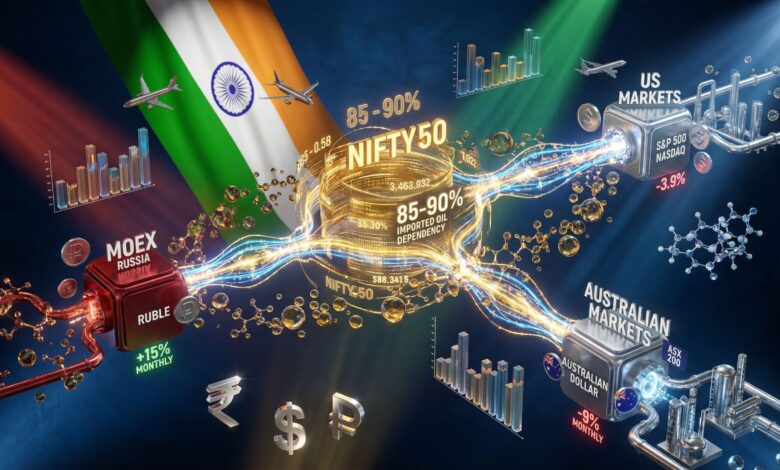
For India Inc, the shock has already arrived, not coming, already here. The disruption is no longer a distant risk – it is already showing up where it matters most: earnings expectations.
For months, the perception around India Inc rested on a comfortable assumption-steady demand, easing inflation, and a return to double-digit profit growth. That assumption is now being tested, and not gently. With crude breaching the $110 mark, input costs are rising faster than companies can adjust, and margins are beginning to feel the strain.
The timing could not be more critical. The Q4 FY26 earnings season, beginning with Tata Consultancy Services, was expected to reinforce confidence in a recovery cycle. Instead, it now threatens to do the opposite. What should have been a validation quarter may well turn into the first visible sign of stress – where management commentary begins to acknowledge what markets have so far only cautiously priced in.
Brokerages are already flagging the risk. If companies signal weak pricing power, rising cost absorption, or early signs of demand fatigue, earnings downgrades will follow. And once that cycle begins, it rarely stays contained to a single quarter.
What makes this moment particularly uncomfortable is the speed of change. Just weeks ago, the conversation was about growth acceleration. Today, it is about how much of that growth survives.
The War Behind The Numbers – Hormuz, Iran, And A Supply System Under Siege
To understand the numbers, one has to look beyond balance sheets and into geopolitics, because this crisis is being shaped far from India’s shores.
At the center of it lies the Strait of Hormuz, a narrow maritime corridor through which nearly a fifth of the world’s oil and liquefied natural gas flows. Any disruption here is not just a regional concern – it is a global shock.
And that disruption is no longer hypothetical.
Escalating tensions involving Iran, the United States, and Israel have pushed the region into dangerous territory. Supply routes are under pressure, shipments are being delayed, and uncertainty has become the dominant market force. Iran’s signalling around restricting access – particularly for Western-linked vessels – has only added to the volatility.
The ripple effects are already visible. Saudi Arabia has raised crude prices for Asian buyers to record premiums, reflecting both tightening supply and heightened risk. Global oil benchmarks have surged, and fuel costs across major economies are climbing in tandem.
This is what makes the current situation fundamentally different from a routine price spike. It is not driven by cyclical demand or temporary imbalance; it is rooted in geopolitical instability that has the potential to persist.
And as long as that instability remains, oil is unlikely to return to comfortable levels anytime soon. Which means the pressure on companies is not just immediate; it could be prolonged.

Who Gets Hit First And Hardest
The impact of rising crude is rarely uniform. It travels unevenly through the economy, hitting some sectors immediately while others feel the pain with a lag. This time, however, the spread is both wide and unforgiving.
At the front of the line are energy-intensive industries – paints, chemicals, tyres, ceramics, glass – businesses where petroleum derivatives are not just an input, but the backbone of production. For them, the surge in crude is not a margin headwind; it is a direct assault on cost structures. Add to that the shortage and rising prices of LNG, and the pressure only intensifies. In some cases, production itself becomes unviable.
Then come sectors like automobiles and aviation, where fuel is a defining cost. Here, the damage is twofold. Companies face higher operating expenses even as consumers begin to pull back. As fuel prices rise, discretionary spending tightens, delaying purchases and weakening demand just when companies need it most.
The IT sector, often seen as relatively insulated, is not untouched either. Global uncertainty has a way of freezing decision-making. Deal closures get delayed, client budgets become cautious, and growth visibility weakens. Currency movements may offer some relief, but they cannot fully offset the broader slowdown in demand.
Logistics, oil marketing companies, and export-driven sectors such as gems and jewellery are also facing choppy waters – caught between rising costs, volatile demand, and shifting global trade dynamics.
There are, of course, pockets of resilience. Upstream oil companies benefit from higher prices, and defence spending tends to rise in times of conflict. But these are exceptions, not offsets.
The broader picture is clear, meaning – the pain is not isolated; it is systemic. And once it begins to show up across sectors, it becomes far harder to contain.
OPEC+, Policy Support, And Optimism That May Not Hold
In moments like these, markets look for reassurance – signals that the system still has levers to pull, that the damage can be contained. And those signals are being offered.
OPEC+ has moved to increase production, attempting to calm fears of a prolonged supply crunch. Policymakers, too, are expected to step in where needed, cushioning the impact through targeted measures. Brokerages continue to argue that while earnings may come under pressure, the broader growth trajectory remains intact.
But beneath this layer of optimism lies a more uncomfortable reality.
Increasing output on paper does not immediately translate into stable supply on the ground – especially when infrastructure is under threat and key shipping routes remain vulnerable. Repairs take time. Logistics remain uncertain. And as long as the Strait of Hormuz continues to operate under a cloud of tension, supply risks cannot be wished away.
Even the more optimistic estimates come with caveats. Yes, earnings growth may still hold in double digits over a longer horizon but only if the disruption proves temporary. That assumption is doing a lot of heavy lifting.
The more cautious view is harder to ignore. If crude prices remain elevated for longer than expected, the impact will not stay confined to input costs. It will seep into margins, pricing power, demand, and eventually, earnings expectations across the board.
What markets are clinging to, in essence, is the belief that this will pass quickly. What they are not fully accounting for is the possibility that it may not.
India’s Hidden Vulnerability, When Shortage Replaces Supply
If oil is the visible shock, natural gas is the quieter crisis unfolding underneath and it reveals just how exposed India really is.
The ongoing conflict has already slashed India’s gas imports sharply, with disruptions in key supply routes forcing the government into an unusual position: stepping in to control distribution. What would normally be dictated by markets is now being managed through prioritisation.
A pooling mechanism is being put in place. Supplies are being diverted. Pricing is being standardised. And sectors are being ranked by importance.
Households, CNG for transport, and LPG production sit at the top of that ladder. Fertiliser plants and industries follow, but with restricted access. In effect, this is no longer a system responding to demand – it is a system coping with shortage.
That shift matters.
Because once allocation replaces availability, the stress is no longer theoretical. It begins to show up in production cycles, in cost structures, and eventually in prices paid by consumers. Even the debate around additional charges – despite the government stepping in – reflects how tight the system has become.
This is the part of the crisis that does not always make headlines, but often leaves the deepest mark.
The Bigger Warning – What If This Doesn’t End Soon?
The real risk is not the spike itself; it is the duration.
If crude prices stabilise quickly, much of the damage can still be contained. Margins may take a hit, growth may slow briefly, but the broader trajectory could remain intact.
But if prices stay elevated, the consequences begin to compound.
Higher input costs lead to margin compression. Companies attempt to pass on costs, but demand begins to weaken. Consumption slows. Investment decisions get delayed. And what starts as a cost-side shock gradually transforms into a demand-side problem.
At that point, earnings downgrades are no longer a possibility, they become inevitable.
What makes this cycle particularly dangerous is that it is being driven externally. Companies cannot control it. Policymakers can only cushion it to an extent. And markets, despite their forward-looking nature, can misjudge how long such disruptions last.
There is also a deeper structural concern. Signals emerging from the region suggest that the stability of critical routes like the Strait of Hormuz may not return to what it once was. If that proves true, the world may be looking at a more volatile energy regime, not just a temporary disruption.
And that would change far more than just one year’s earnings.
The Last Bit, When Growth Meets Reality
India Inc’s double-digit growth story was built on a foundation that few questioned – stable energy prices, predictable supply chains, and a relatively benign global environment.
That foundation is now under strain.
What is unfolding is not just an oil shock, nor just a geopolitical flare-up. It is a reminder of how quickly external forces can disrupt carefully built expectations. Markets may have priced in some near-term pain, but the deeper risk lies in underestimating how long this lasts.
If crude remains elevated and supply disruptions persist, the question is no longer whether earnings will be downgraded; it is how far they will fall before reality fully catches up.