Macron Declares Freedom Under Siege As Trump Tightens The NATO Noose. As France Charts Its Own Path Has NATO Unity Truly Cracked Under Trump’s Second Term?
At the heart of Macron’s message was a substantial commitment to ramp up France’s military spending, with the defense budget set to reach nearly $75 billion by 2027. That figure would mark a doubling of military investment since Macron took office in 2017, even as the nation wrestles with broader fiscal challenges. “You have to be feared in this world,” Macron asserted. “And to be feared, you have to be strong.”

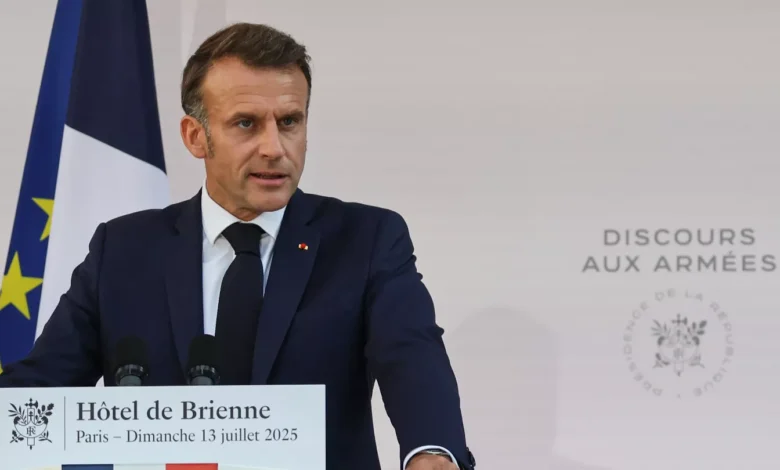
Standing before the French armed forces on the eve of Bastille Day, President Emmanuel Macron delivered one of his most forceful addresses yet – a sharp and solemn warning to France and its European allies that the postwar security order is unraveling, and Europe must now take charge of its own defense.
“Our freedom has never been so threatened,” Macron declared in a speech loaded with urgency and geopolitical unease. “There are no more rules, it’s the law of the strongest that wins.”
The message being – France and Europe can no longer rely on traditional alliances especially with an increasingly unpredictable United States under President Donald Trump to guarantee their safety in a world brimming with new and volatile threats.
At the heart of Macron’s message was a substantial commitment to ramp up France’s military spending, with the defense budget set to reach nearly $75 billion by 2027. That figure would mark a doubling of military investment since Macron took office in 2017, even as the nation wrestles with broader fiscal challenges. “You have to be feared in this world,” Macron asserted. “And to be feared, you have to be strong.”
A Major Shift in France’s Strategic Thinking
Macron’s remarks mark a turning point in France’s strategic posture, signaling a definitive turn away from what has long been a cornerstone of European security: reliance on the United States. While France has often flirted with the idea of “strategic autonomy,” the president’s latest comments elevate that aspiration to an imperative – fueled by mounting concern over Russian aggression, growing global instability, and what Macron views as a vacuum of leadership in Washington.
Indeed, Macron did not shy away from implying that President Trump’s policies have directly contributed to Europe’s current security predicament. The transatlantic partnership, once sacrosanct, has become strained under the weight of Trump’s America First agenda.
The French president has openly expressed his frustration at Trump’s combative foreign policy style, his disdain for diplomacy, particularly regarding the Israeli-Palestinian issue and his penchant for economic threats. Just last week, Trump threatened a sweeping 30% tariff on EU goods if a trade agreement isn’t finalized by August 1, a move Macron slammed as “poisonous” to ongoing negotiations.
The culmination of these grievances has pushed Macron to publicly question the reliability of the U.S. as a strategic partner. “American disengagement” from global security responsibilities, he warned, leaves Europe little choice but to build its own shield.

A Dangerous Global Scene
The president’s remarks come at a time when European leaders are facing an increasingly dangerous and complex world order. From Russia’s war in Ukraine to fresh instability in the Middle East including the recent bombing of Iran, which Macron referenced obliquely without naming the perpetrators the rules-based international system appears to be fraying at the edges.
General Thierry Burkhard, France’s top military officer, echoed the sense of foreboding last week when he described France as having effectively become “Russia’s main adversary in Europe.” Against this backdrop, Macron’s call for increased military preparedness feels less like political posturing and more like a response to a genuine strategic recalibration.
France, as the EU’s only nuclear-armed state and its most powerful military force, now appears poised to assume greater leadership in Europe’s collective defense. The recent NATO directive for all 32 member states to increase defense spending to 5% of GDP by 2035 adds further pressure. France currently spends around 2%, and while the projected increases are substantial, they will still fall short of this new NATO benchmark.
Domestic Constraints and Diplomatic Frustrations
Despite the urgency of Macron’s message, his ability to translate ambition into action may be constrained at home. A fragmented and gridlocked Parliament could still resist the proposed budget increases, especially amid rising public discontent over domestic economic issues.
Internationally, Macron’s diplomatic efforts have been a mixed bag.
His initiatives in Ukraine have found more traction than his work in the Middle East, where his support for Palestinian statehood and leadership of a now-postponed UN conference have been derailed by escalating regional conflict. Trump’s antagonism toward France’s diplomacy, including reports of personal insults and undermining gestures, has only complicated Macron’s international standing.
A New Strategic Doctrine
French Defense Minister Sébastien Lecornu reinforced Macron’s message in a concurrent interview with La Tribune Dimanche, stating bluntly that “nobody in France wants our country to depend on others in military terms.” Lecornu emphasized that self-reliance in defense would demand a broad effort—financial, intellectual, industrial, and moral.
Taken together, the statements from Macron and Lecornu reflect more than just increased defense spending they represent a philosophical shift. The era in which France could operate under the American security umbrella appears, in their view, to be drawing to a close.
“In effect, they are signaling the end of a postwar security paradigm,” said one Paris-based geopolitical analyst. “This isn’t just about military budgets. It’s about recalibrating the way France and the EU see themselves in the world.”
As France prepares to celebrate Bastille Day, commemorating the revolutionary ideals of liberty and national sovereignty, Macron’s invocation of that legacy felt deliberate and calculated. “Let us be faithful to the people of the Revolution,” he said, invoking 1789 and the enduring French belief in universal freedom.

Trump’s Second Term and the NATO Stress Test; Is the Transatlantic Alliance Fracturing or Evolving?
As NATO commemorates its 76th anniversary in 2025, on a broader level – the alliance finds itself at a historical inflection point. What was once regarded as a pillar of postwar security and transatlantic unity now faces one of the most consequential challenges in its existence, redefining its purpose, structure, and sustainability in the shadow of a second Trump presidency.
At the heart of this challenge is the issue of burden-sharing, or more precisely, Washington’s growing impatience with Europe’s perceived freeloading. Under President Donald Trump’s renewed tenure, NATO has been thrust into an uncomfortable reckoning: either ramp up defense spending to unprecedented levels or risk being cast adrift from the core U.S. security umbrella.
The consequences of this ultimatum are reverberating across Europe, where debates over sovereignty, spending, and strategic autonomy have gained new urgency. While NATO has endured past crises from the Cold War to the Balkan wars, and more recently Russia’s annexation of Crimea, Trump’s transactional worldview and confrontational diplomacy represent a systemic strain that goes beyond policy disagreements.
Trump’s Demands: A Two-Tier NATO?
President Trump’s posture toward NATO has evolved little from his first term. Then, as now, he has been unrelenting in his assertion that the U.S. shoulders a disproportionate share of the financial and military burden in ensuring collective defense. What has changed is the escalation of his demands.
Trump is now pushing NATO allies not only to meet the long-standing 2% GDP defense spending target, but to increase it to a staggering 5%. This figure, which far exceeds any historical commitment within the alliance, has effectively introduced a “two-tier NATO” concept: full U.S. defense guarantees – including the sacred Article 5 mutual defense clause – would be reserved for nations that meet the 5% threshold.
“If they don’t pay, I’m not going to defend them,” Trump declared during a recent press briefing, reiterating a position that has become a rhetorical hammer in his arsenal of leverage. In Trump’s view, alliances are not built on shared values or common threats but on clear transactional benefit. His defenders argue that this fiscal accountability is long overdue and rooted in fairness. Critics see it as the unraveling of NATO’s founding principle: unconditional solidarity.
Pressure and Pushback, Legislative Firewalls
Trump’s stance is not without institutional friction. After whispers of a potential U.S. withdrawal from NATO in his first term, Congress moved quickly to curtail presidential powers on this front.
Public statements, backchannel ultimatums, and policy brinkmanship remain the president’s primary tools of coercion. European capitals now find themselves perpetually on edge, trying to balance between appeasing Trump’s fiscal demands and preserving NATO’s strategic cohesion.

Europe’s Dilemma, Recalibration or Redundancy?
The implications of Trump’s demands are not merely financial, they are existential. NATO’s European members are indeed struggling with fundamental questions: If U.S. support is conditional, can the alliance still be trusted? And if not, what comes next?
This uncertainty has accelerated parallel efforts to build an autonomous European defense architecture. France, under President Emmanuel Macron, has long advocated for “strategic autonomy,” and has doubled down on its military investments and leadership in initiatives like Permanent Structured Cooperation (PESCO) and the European Defence Fund. Macron’s administration sees Trump’s NATO posture not as a threat but as a wake-up call, a signal that Europe must now stand on its own legs.
Germany, for its part, has taken a more measured approach. While pledging to increase defense spending, Berlin remains cautious about simply throwing more money at the problem. Defense Minister Boris Pistorius has emphasized efficiency, oversight, and industrial scalability, pointing to Europe’s limited capacity to absorb sudden surges in funding. Germany is also deepening military ties with neighbors, such as the Netherlands, and supporting joint procurement projects under the EU’s “ReArm Europe” initiative.
Eastern European nations, however, remain staunchly aligned with Washington. Countries like Poland, Estonia, and Lithuania have ramped up defense spending dramatically, some even pledging over 5% of GDP, in hopes of securing continued American military presence and deterrence against Russian aggression. For them, NATO remains indispensable, and Trump’s pressure is seen more as a motivation than a menace.
The Strategic Divide
These divergent responses reveal a growing schism within the alliance: a Western Europe hedging its bets with strategic autonomy and an Eastern flank clinging tightly to the U.S. security umbrella. NATO, once unified by the Soviet threat, now finds itself split by differing risk perceptions, economic realities, and views on Washington’s reliability.
Further complicating matters is the Russia-Ukraine war, which has exposed Europe’s defense vulnerabilities in real time. Ammunition shortages, logistics bottlenecks, and limited military stockpiles have forced European leaders to confront the hard truth: current defense frameworks are inadequate. Trump’s criticism, while politically abrasive, is not entirely without merit Europe’s military underinvestment has long been a soft spot.
A NATO at the Crossroads
As 2025 unfolds, NATO faces not just a test of unity, but of identity. Will it remain the backbone of transatlantic security or fracture under the weight of diverging expectations and asymmetric commitments?
Several possible trajectories are now in play:
The Concession Path: European allies meet or approach the 5% defense spending target, preserving U.S. security guarantees and buying more time for NATO’s traditional model.
The Dual-Track Model: A de facto two-tier NATO emerges, with full U.S. protection offered only to high-spending nations, fundamentally altering the alliance’s solidarity clause.
European Autonomy Rises: The EU, driven by Macron and von der Leyen, intensifies efforts to build a standalone security framework that could eventually complement or compete with NATO.
The Breakdown Scenario: Continued friction and mixed messages from Washington erode trust irreparably, resulting in NATO’s strategic irrelevance or even disintegration.
The Last Bit,
What’s clear is that the Trump presidency has transformed NATO from a military alliance into a geopolitical fault line and as pressures mount, Europe’s response whether fragmented, united, or ambivalent will ultimately shape the alliance’s fate.
Hence, for Europe, the dilemma is as strategic as it is existential: how to prepare for a future where NATO may be conditional, while avoiding actions that could fracture it in the present?
Initiatives like PESCO and the EDF are ambitious, but even their most enthusiastic advocates acknowledge that they cannot replicate NATO’s military capabilities especially its nuclear deterrence anytime soon. Europe is trying to build redundancy without redundancy, autonomy without rupture; it is a balancing act on a geopolitical wire.
What’s increasingly clear is that Trump’s second term has served as a geopolitical accelerant. His transactional view of alliances and open disdain for NATO’s collective ethos have catalyzed deep introspection across European capitals. No longer can the continent assume that Washington will reflexively come to its aid; commitments once considered sacrosanct are now subject to negotiation and cost.
In that light, the future of NATO will hinge less on the pronouncements from Washington and more on how Europe chooses to respond. Will the continent rise to the occasion with strategic clarity and coordinated investment? Or will diverging national interests, economic constraints, and bureaucratic inertia allow the cracks to widen?
Ultimately, the alliance’s survival and relevance in this shifting world order depend on more than military budgets. It will rest on political will, shared purpose, and the recognition on both sides of the Atlantic that security is not a zero-sum transaction, but a collective commitment forged in trust.
Whether NATO can adapt to this new reality or risks being overtaken by it remains the central question of Europe’s defense debate in the years ahead.