Red, White & Tariffed; How Trump’s Hardball Trade Game Enters A Dangerous New Phase Putting Global Trade On Edge As He Lobs A 30% Tariff Grenade…Again
And as the world’s biggest trading partners gear up for another round of costly talks before the August 1 deadline, the question now is not just what Trump wants, but how far he’s willing to go to get it and whether the rest of the world is ready to call his bluff this time.

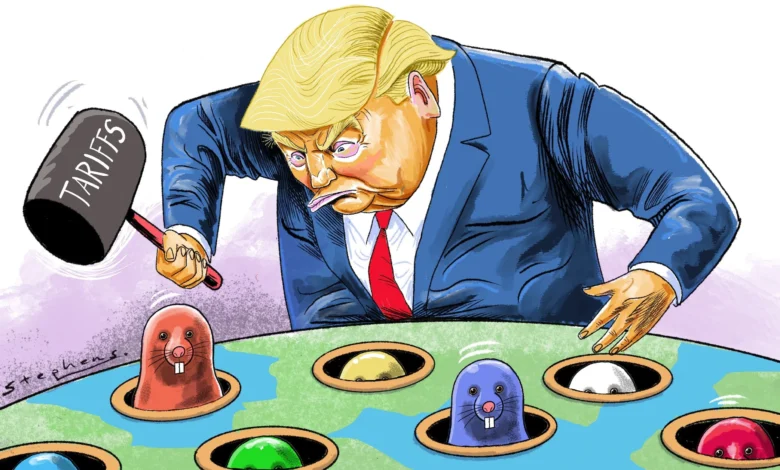
In a bold and potentially destabilizing move, President Donald Trump on Saturday threatened to impose a sweeping 30% tariff on imports from Mexico and the European Union starting August 1. The announcement, made via letters addressed to European Commission President Ursula von der Leyen and Mexican President Claudia Sheinbaum, then posted on Trump’s Truth Social platform, comes after weeks of inconclusive negotiations with two of America’s most critical trading partners.
The threat marks an escalation in a trade war that has already frayed diplomatic ties and unsettled investors worldwide. Trump’s aggressive stance signals yet again the confrontational trade policy he has championed, one that pits “America First” stance against complex, multilateral economic relationships.
Both Mexico and the EU swiftly denounced the proposed tariffs, calling them “unfair” and “disruptive,” yet stopped short of immediate retaliation. Instead, they emphasized the need for continued dialogue in hopes of reaching a broader trade agreement before the looming deadline.
“I’ve always said that in these cases, what you have to do is keep a cool head,” said President Sheinbaum during an event in Sonora, Mexico. While expressing confidence in reaching an agreement, yet drawing a firm red line: “There’s something that’s never negotiable, the sovereignty of our country.”
But Mexico and the EU weren’t the only ones on Trump’s radar. In a sweeping outreach, the U.S. president sent similar letters to 23 other trading partners, including Canada, Japan, and Brazil, setting proposed tariff rates ranging from 20% to as high as 50%, alongside a specific 50% tariff on copper.
Importantly, Trump clarified that the 30% blanket tariff would be “separate from all sectoral tariffs,” indicating that existing levies – 50% on steel and aluminum, and 25% on automobiles – would remain intact.
With the August 1 deadline acting as both a threat and a negotiating window, many analysts see this as classic Trump negotiations tactic with market watchers and global trade experts having noted a familiar pattern: high-stake threats, short-term volatility, followed by partial walk-backs and hastily brokered deals.
Still, undoubtedly, the message this time is louder and more expansive. The letters signal a revival of Trump’s aggressive posture last seen in April, when reciprocal tariffs sent markets reeling before being temporarily shelved.
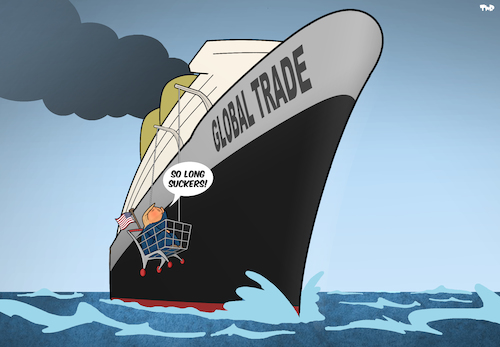
Yet, in the present, emboldened by record stock market highs and a resilient U.S. economy, Trump appears to be doubling down. Despite promising to use the 90-day delay since April to finalize dozens of new trade agreements, his administration has only managed to ink framework-level pacts with Britain, China, and Vietnam, far from the comprehensive deals touted earlier.
The EU, for its part, had hoped to reach a full-fledged trade agreement covering its 27-member bloc. But Trump’s demand was blunt: “The European Union will allow complete, open Market Access to the United States, with no Tariff being charged to us, in an attempt to reduce the large Trade Deficit.”
Von der Leyen warned that such steep tariffs “would disrupt essential transatlantic supply chains, to the detriment of businesses, consumers, and patients on both sides of the Atlantic.” While reiterating the EU’s preference for dialogue, she also made it clear that Brussels is prepared to defend its interests. “We will take all necessary steps to safeguard EU interests, including the adoption of proportionate countermeasures if required,” she said.
Mexico’s Economy Ministry also weighed in, confirming that the U.S. communicated its intentions during a Friday meeting. “We mentioned at the roundtable that it was unfair treatment and that we did not agree,” the ministry stated.
Allies, Accusations, and a Clock Ticking Toward August 1
What should be noted is that not all tariff threats from Washington have been delivered equally. While Mexico faces a 30% levy, Canada’s proposed tariff stands higher at 35%, despite significantly lower fentanyl inflow across its border.
Trump’s justification sits on national security, once again – this time tied to drug enforcement and cartel activity. “Mexico has been helping me secure the border, BUT, what Mexico has done, is not enough,” Trump declared in his letter. “Mexico still has not stopped the Cartels who are trying to turn all of North America into a Narco-Trafficking Playground.”
Yet official U.S. data tells a more nuanced story. While fentanyl remains a severe concern, most of the synthetic opioid originates from China, not directly from Canada or Mexico. Still, Mexico, whose economy is intricately bound to the U.S. through decades of trade liberalization, finds itself disproportionately exposed. Over 80% of Mexico’s exports head north, and it overtook China last year as America’s largest trading partner.
Across the Atlantic, Europe faces its own share of friction. Initial hopes of a comprehensive EU-U.S. trade deal have gradually dimmed. The bloc has pivoted towards securing a broader framework agreement akin to what the UK managed- flexible, but not without complications. Internally, EU member states remain divided. While Germany is urging fast-track negotiations to shield its industrial backbone, France and others are warning against a rushed, imbalanced settlement.
Bernd Lange, who chairs the European Parliament’s trade committee, minced no words. “This is a slap in the face for the negotiations,” he said, calling for immediate retaliatory steps. Brussels-based experts like Jacob Funk Kirkegaard warn of a dangerous feedback loop reminiscent of the U.S.-China tariff skirmishes that once shook financial markets. “Tariffs went up together, and they came down together, not fully, but the scars remained,” he noted.
While the Trump administration frames its tariff blitz as economic leverage, the policy is generating a windfall for U.S. coffers. Customs revenue crossed the $100 billion mark in the fiscal year through June, according to Treasury data. But the broader cost may be strategic: long-standing allies are starting to reconsider their economic and security dependencies. Japan has signaled a need to reduce reliance on the U.S., and Canada, along with several EU nations, is exploring non-American defense procurements.
Still, diplomacy hasn’t been entirely replaced by brinkmanship. Brussels has opted to delay its retaliatory tariffs, originally set to kick in Monday, buying time for a potential breakthrough. “This is now the time for negotiations,” said Ursula von der Leyen in a Sunday press briefing, emphasizing the bloc’s preference for dialogue over confrontation. Retaliation, she added, is still on the table but will be held back until August 1.

Europe’s high-value exports to the U.S., from pharmaceuticals and chemicals to automobiles and aircraft, make up a significant portion of its transatlantic trade, valued at over $2 trillion in 2024 alone. Any disruption would echo across industries and economies.
Italian Foreign Minister Antonio Tajani is now in Washington, attempting to act as a diplomatic bridge. Italy’s government, under Giorgia Meloni, has positioned itself as a transatlantic facilitator, with Rome being the only EU capital that sent a head of state to Trump’s inauguration.
The Trump White House maintains that the tough stance is necessary. “He’s seen some sketches of deals… and the president thinks the deals need to be better,” said Kevin Hassett, Director of the National Economic Council. The letters, he explained, were sent as a signal to “put a line in the sand.”
That signal, however, is creating ripples far beyond Washington. From French vineyards to German factories, uncertainty now defines the business climate. Trade ministers across the EU are convening to evaluate next steps not just with the U.S., but also in managing parallel tensions with China.
Speaking from Jakarta alongside Indonesian President Prabowo Subianto, von der Leyen framed the unfolding situation as a broader lesson in economic diversification. “We need predictable trade partnerships based on trust,” she stressed, while the Indonesian leader echoed the need for a strong and multilateral Europe.
As the clock ticks toward Trump’s self-imposed August 1 deadline, the question is not just whether deals will be struck but whether the global trading system can weather another shockwave.
What Trump Really Wants from All These Trade Deals
As the world watches the clock wind down to Trump’s August 1 tariff deadline, one question beneath the mounting economic pressure and diplomatic friction: what exactly is the endgame?
President Trump has pitched tariffs as more than just leverage, they’re the cornerstone of an economic doctrine aimed at reshaping global trade and reviving American industry. From podium speeches to policy memos, Trump’s rationale for tariffs spans four key ambitions: restore U.S. manufacturing, reduce the trade deficit, pressure foreign nations into better trade terms, and boost domestic revenue.
To supporters, tariffs are a bold corrective measure after decades of uneven globalization. To critics, they’re economic shock therapy with uncertain results.
Trump’s administration claims early wins. Some firms, including Apple, GE Appliances, and GM, have announced large-scale investments in U.S. manufacturing, moves that the White House has quickly attributed to tariff policies. Tariff revenues have soared, adding tens of billions of dollars to federal coffers. In April, America’s trade deficit was cut nearly in half, a rare feat that the administration points to as evidence of progress.
But many economists caution that these early victories are more flash than foundation.
A closer look reveals that several high-profile investment decisions preceded tariff announcements or were already in the works. Factory planning and capital expenditure cycles often span years, too long to credit to policy changes from just months ago. More critically, the U.S. faces a chronic shortage of skilled manufacturing labor. The Labor Department recently reported over 400,000 unfilled manufacturing jobs, and experts say higher domestic labor costs make large-scale reshoring difficult and expensive. An iPhone built entirely in the U.S., for instance, could cost upwards of $3,000.
Despite Trump’s declarations – “We’re going to have open factories. It’s going to be great”, manufacturing job growth tells a different story. While there was a bump early in his term, recent labor data shows a net decline in factory jobs since Trump’s return to office. Gains have reversed, with losses mounting over the past two months.
)
Even the fiscal benefits of tariffs may be overstated. While tariff revenues have topped $100 billion this fiscal year, they remain a drop in the ocean compared to the U.S. budget deficit, particularly after Trump’s sweeping tax cuts and domestic spending promises.
Yet Trump remains unwavering. His administration argues that the broader goal isn’t just to raise money but to alter global behavior. The message is simple, but sharp: make your product in America, or pay up. “If you don’t make your product in America… you will pay a tariff,” he warned in his joint address to Congress in March. For Trump, tariffs are less a tax and more a litmus test of patriotism and economic nationalism.
Still, there’s a limit to how far threats alone can push negotiations. Allies are growing weary of the whiplash diplomacy, while adversaries have begun responding in kind. The EU, Canada, and even some Indo-Pacific partners are drafting contingency strategies, exploring non-U.S. suppliers, and preparing retaliatory frameworks.
Raising Revenue, The Trillion-Dollar Question
President Trump’s rhetoric around tariffs has never been modest. From the campaign trail to Air Force One, he’s repeatedly claimed that tariffs could bring in trillions in revenue, enough, he says, to eliminate income taxes altogether.
“We’re going to make a lot of money… and it’s possible we’ll do a complete tax cut,” Trump told reporters earlier this year after returning from Pope Francis’ funeral. “I think the tariffs will be enough to cut all of the income tax.”
The numbers, however, tell a different story.
In theory, replacing the $3 trillion the U.S. raises annually through income taxes would require 100% tariffs on all $3 trillion of imported goods. But in reality, economics is not that clean-cut.
As prices rise from steep tariffs, demand falls and fast. Torsten Slok, chief economist at Apollo Global Management, estimates the effective rate would need to be closer to 200% across the board to generate enough revenue to make up for income taxes.
Currently, even with the sharp increase in levies under Trump’s second term, the Treasury has collected less than $100 billion in total tariff revenue since his return to office. Monthly collections hover around $20 billion, hardly enough to bankroll sweeping tax cuts, let alone replace the entire income tax system.
Even more paradoxical: many of Trump’s most aggressive tariffs, like the 25% levies on China, Canada, and Mexico over fentanyl concerns, are meant to be temporary. If these countries comply with U.S. demands, the tariffs are designed to come off. And several new trade deals include provisions that would lower, not raise, tariff rates over time.
In short, while tariffs can contribute to the Treasury’s income, they’re unlikely to become a permanent fiscal pillar.

Restoring Fairness, Trump’s Vision of Trade Justice
One of Trump’s most consistent themes is the notion of fairness. He believes the United States has long been the victim of unequal treatment, undercharged when exporting, overcharged when importing.
In Trump’s words, America is the world’s “best department store” and tariffs are simply the “cost of doing business here.”
To correct what he calls “rip-offs,” the Trump administration rolled out “reciprocal tariffs” on April 2. These were calculated by halving the U.S. goods trade deficit with each country, penalizing nations from which America imports heavily but exports little. The result: the largest and most uneven trading relationships, such as with China, faced the steepest penalties.
While economists argue that trade deficits aren’t losses, and in fact often reflect a healthy, growing economy, Trump has weaponized the deficit story to galvanize political support.
Initially, the strategy seemed to bear fruit. The U.S. goods trade deficit shrank from roughly $130 billion in April to $60 billion in May, largely due to 145% tariffs on Canadian goods that also squeezed Chinese shipments entering via Canada.
But the effect proved short-lived. When some of the tariffs were lifted in May, the deficit widened again. Imports rebounded, and foreign buyers began pulling back on U.S. goods in retaliation.
Most economists agree that tariffs alone won’t meaningfully rebalance global trade. Many goods simply can’t be competitively produced in the U.S. or at all. Others, like tropical produce, rare earth metals, and low-cost electronics, are inherently more cost-effective to source abroad.
And ironically, a narrowing trade gap could signal not strength, but shrinking consumer power, a troubling signal for the broader economy. Trump’s foreign policy playbook treats tariffs as leverage, blunt-force pressure tools to coerce other nations into trade or policy concessions.
But the track record is uneven. Tariffs have not curbed fentanyl flows into the U.S., nor have they convinced companies like Apple to manufacture iPhones domestically or pushed Hollywood studios to bring production home. General Motors and other U.S. automakers still operate plants in Mexico and Canada.
Moreover, when tariff threats do succeed in drawing concessions, they often undercut Trump’s own fiscal arguments, if tariffs are removed after deals are made, the revenue dries up.
When Tariffs Actually Worked
While President Trump’s sweeping tariff regime has yielded mixed results in restoring American manufacturing or fundamentally redrawing global trade patterns, it has proven effective in one particular domain – negotiations.
And in a few key moments, that tactic worked.
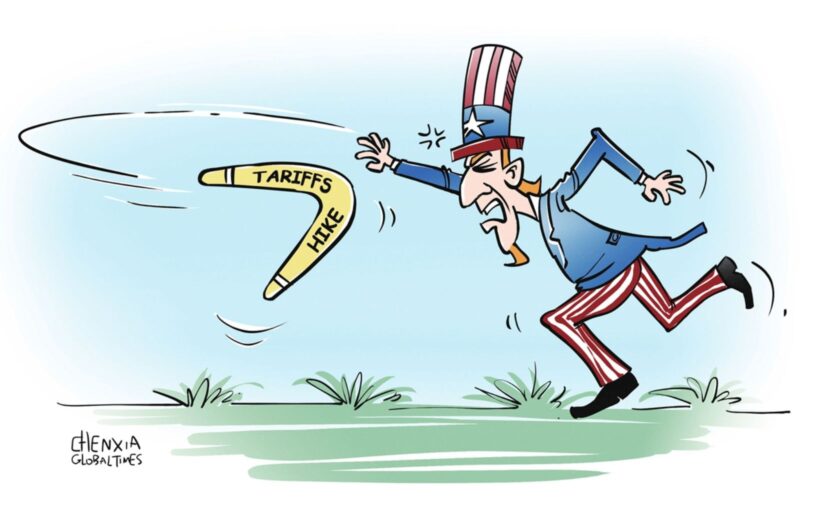
1. Canada: A Digital Tax Rolled Back Under Pressure
Over the weekend, Canada became the latest example of Trump’s tariffs achieving their intended outcome. Ottawa had been preparing to impose a Digital Services Tax (DST) targeting large online platforms, many of them U.S.-based, a move that Trump swiftly denounced as discriminatory.
The White House threatened to end trade negotiations altogether and impose new tariffs by the end of the week. Within 48 hours, Canada blinked.
“To support those negotiations,” read a statement from Canada’s Ministry of Finance, “Canada would rescind the DST in anticipation of a mutually beneficial comprehensive trade arrangement with the United States.”
By Monday morning, trade discussions had resumed between the two countries. Canadian Prime Minister Mark Carney acknowledged the compromise: “It’s part of a bigger negotiation… We’re making progress toward a final deal.”
It was classic Trump: public pressure, tariff threats, and a fast-moving diplomatic pivot – all leading to a result.
2. Colombia: Migrant Flight Dispute Defused
In late January, Colombian President Gustavo Petro blocked U.S. military aircraft from landing in the country as part of Trump’s mass deportation policy. The administration responded swiftly, threatening to impose 25% tariffs on Colombian exports, with the rate climbing to 50% unless Colombia cooperated.
Colombia reversed its stance within days, agreeing to accept deportees and avoid a trade spat.
“You can’t go out there and publicly defy us in that way,” a senior administration official said at the time. “We’re going to make sure the world knows they can’t get away with being nonserious and deceptive.”
The tariffs were ultimately shelved. The message was delivered.
3. European Union: Negotiations Accelerated
Perhaps the most globally consequential example came in May, when Trump abruptly called off trade talks with the European Union, citing a lack of progress. He announced a blanket 50% tariff on all EU imports, effective in weeks.
“Our discussions with them are going nowhere!” Trump declared on Truth Social.
Within three days, European Commission President Ursula von der Leyen was on the phone with the White House, promising to fast-track negotiations. Trump agreed to delay the tariff deadline until July 9.
Although a final deal remains elusive, the EU’s sudden urgency marked a clear shift from its earlier, slower approach. From Washington’s perspective, the tactic worked, at least temporarily.
Where Tariffs Fell Flat
Manufacturing Realities & Corporate Pushback – Despite these headline-grabbing wins, not every threat produced results. Often, the limits of U.S. manufacturing capacity, and the hard economics of global production, clashed with the administration’s expectations.
Take Apple. Frustrated by the tech giant’s plan to import iPhones from India, Trump threatened a 25% tariff on all Apple products entering the U.S. The administration extended the threat to Samsung as well.
But neither company budged.
Smartphone manufacturing is labor- and logistics-intensive, requiring highly skilled workers, tight supply chains, and precision equipment. Apple and Samsung cited both cost and feasibility: shifting production to the U.S. would spike retail prices, possibly tripling the cost of a single iPhone.
The White House quietly let the threat drop.
In another instance, Trump floated a 100% tariff on movies produced outside the U.S., a move aimed at reviving domestic film production. But the entertainment industry was left puzzled: Would it apply to foreign studios only? Would Hollywood productions shot overseas be penalized?
Ultimately, the administration admitted it was “just a proposal.” Still, it sparked a broader debate around bringing production back to California. Governor Gavin Newsom even offered state-level support for such an effort, a rare moment of two-party convergence driven by a Trump policy threat.
And even where tariffs did shift plans – as in the case of GE Appliances, which moved washing machine production from China to Kentucky – it’s often difficult to draw a straight line between threat and outcome. The company acknowledged its decision had been made independently, but the escalating trade war accelerated the timeline.
The Last Bit, Trump’s Tariffs, A Blunt Tool, With Occasional Precision
Trump’s tariff strategy is rarely subtle. It’s built on confrontation, brinkmanship, and short-term pain for long-term gain. Sometimes it yields fast results, particularly when trading partners are vulnerable, or political optics demand a response. Other times, it runs aground on complex realities: global supply chains, labor shortages, and the basic economic principle that tariffs are, ultimately, taxes paid by Americans.
Yet Trump’s use of tariffs as a negotiation trigger remains one of the most distinctive and disruptive elements of his trade policy arsenal.
And as the world’s biggest trading partners gear up for another round of costly talks before the August 1 deadline, the question now is not just what Trump wants, but how far he’s willing to go to get it and whether the rest of the world is ready to call his bluff this time.