Two Streets. Same Delhi Police. Two Very Different Responses?
Thousands detained before a protest. Women and students allegedly assaulted on camera. Four arrests after the videos went viral. Delhi Police must answer the uncomfortable question: Is the law enforced equally, or does political identity influence the urgency of enforcement?

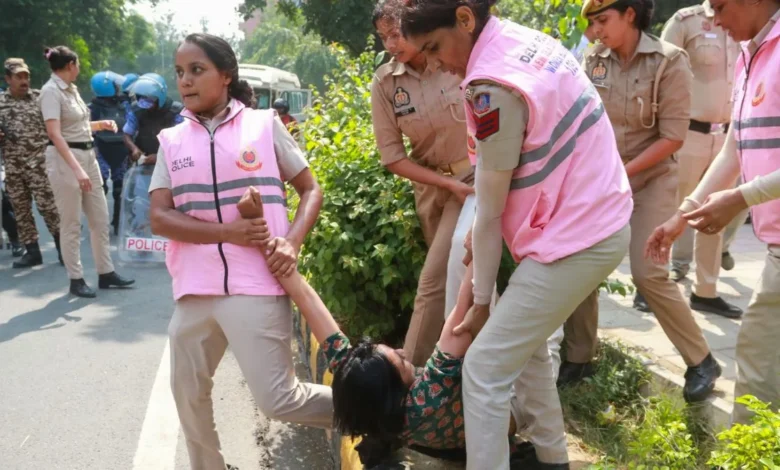
Delhi’s streets have become the setting for a question that should trouble every citizen who believes that the law is supposed to be blind.
On October 10, 2026, Delhi Police mounted a sweeping security operation to prevent a planned protest by the Cockroach Janta Party (CJP), which was demanding the resignation of Chief Election Commissioner Gyanesh Kumar over alleged irregularities in electoral-roll revisions. Thousands of people were detained, the capital witnessed extraordinary security restrictions, and prominent political figures, activists, students and content creators found themselves in police custody.
On the same day, videos circulated showing young people, including women, allegedly being punched, pushed and assaulted by a group of men on Delhi’s streets. A police officer was visible in footage of the incident, raising immediate questions about whether the victims received adequate protection when the violence occurred.
By the morning of October 11, Delhi Police had arrested four men in connection with the assault videos. The four reportedly claimed affiliation with the right-wing Hindu Raksha Dal, according to The Indian Express, which cited a senior police official.
Those arrests matter. They also make it necessary to be precise: the claim that police took no action whatsoever is no longer accurate. The more serious question is why a sprawling preventive operation was mounted against an anticipated protest while an apparent street assault generated such public scrutiny before the reported arrests—and whether the police response at the scene was adequate.
The Indian Express report on the four arrests and the Times of India report on the assault videos provide the central facts. Together, they expose a disturbing accountability gap that the authorities must close with evidence, not public-relations statements.
The issue is not whether Delhi Police can arrest people after a video goes viral. The issue is whether every citizen receives police protection before, during and after violence—regardless of political opinion, ideology or religious affiliation.
1. The first street: A protest that the state was determined to stop
The scale of the operation on October 10 was extraordinary.
According to an Indian Express report published on October 11, Delhi Police deployed more than 40,000 personnel across the capital on Saturday, while more than 7,000 people had been detained by the end of the day. Other reports, including Reuters, put the reported number of detentions at more than 2,000. The figures are not directly reconciled in the available reporting, making publication of an authoritative police tally an essential first step toward accountability.
The operation was not confined to the designated protest location at Jantar Mantar. Protesters were reportedly intercepted at multiple locations, including railway stations, the airport, hotels, residential areas and roads leading to the proposed gathering. Some were transported to stadiums and other temporary detention facilities.
CJP leaders Abhijeet Dipke, Saurav Das and Ashutosh Ranka were detained upon arriving in Delhi. Students, lawyers, political figures, activists and content creators were also among those detained. Restrictions on movement and access to central Delhi made it difficult for demonstrators to reach their intended destination.
The Indian Express’s detailed account of the October 10 crackdown and its subsequent reporting documented the extensive deployment and mass detentions.
The police had a stated justification. Joint Commissioner of Police Nupur Prasad said the protest application had been received on October 7 for an event planned on October 10. According to the police, the applicable guidelines required applications to be submitted at least ten days in advance. The authorities also cited alleged non-compliance with directions during an earlier demonstration, alongside public-safety, traffic-management and law-and-order concerns.
Those explanations must be taken seriously and examined on their merits. Organisers are not entitled to disregard lawful restrictions, and police are not required to ignore credible threats of violence.
But neither does an application submitted late automatically justify every restriction subsequently imposed, nor does an alleged violation by some participants establish the guilt of everyone associated with a protest.
The critical question is proportionality: Were the measures necessary, properly authorised and individually justified, or did the response sweep up people against whom there was no specific evidence of wrongdoing?
A police force capable of identifying organisers, monitoring arrival points, establishing detention centres and controlling access to central Delhi must also be capable of explaining the individual legal basis for detaining thousands of people.
The number of uniforms on the street is not proof of good policing. The quality, legality and fairness of police decisions are.
2. The second street: When the cameras captured alleged violence
The footage emerging on October 10 raised an entirely different set of questions.
According to the Times of India, videos published or circulated by The Indian Express, The Quint and other accounts showed protesters being manhandled, punched, slapped and kicked in areas including Connaught Place and around Jantar Mantar. One video described by the newspaper showed a man being attacked by a group of around 19 people. Another showed a man and a woman being assaulted, with the woman reportedly punched and thrown to the ground.
The reports placed the principal incident involving the four arrested men on DDU Marg, within the jurisdiction of Kamla Market police station.
The footage reportedly showed a police officer at the scene as the assault unfolded. One account published by the Times of India described an assailant calling out to a policeman, who then stopped the assault and led the assailant away.
That detail must not be omitted. Nor should the presence of an officer in a video, by itself, be treated as conclusive proof that the officer deliberately assisted an attacker. The sequence, context, officer’s conduct and surrounding events require a proper investigation.
Nevertheless, the footage raises a legitimate and urgent question: what protection did the people being hit receive at the moment they needed it?
When an individual is visibly being struck or a woman is being pushed to the ground in a heavily policed area, the public is entitled to expect officers to intervene promptly, separate those involved, secure the victims, identify witnesses and prevent further violence.
The purpose of policing is not merely to make a city look controlled. It is to protect people within it.
If a citizen is surrounded by a group of assailants while officers are nearby, the effectiveness of the response cannot be assessed solely by asking whether arrests were eventually made the following day. Investigators must establish what officers actually saw, what they did, whether they had a reasonable opportunity to prevent or stop the assault, and whether anyone failed in their duties.
CJP subsequently alleged on social media that police personnel had appeared to assist the assailants or discourage the recording of the incident. That is an allegation, not an established finding. It should be tested against the complete, original footage, CCTV recordings, officer statements and other available evidence.
An independent investigation is the only responsible way to determine the truth.
3. Four arrests—but a question remains about the timing
On October 11, The Indian Express reported the arrest of four men:
- Raman Saini, 50.
- Vivekanand, alias Vivek, 32.
- Kapil Kumar, 27.
- Ravinder Singh, alias Govind Hindu, 35.
A senior police official told the newspaper that the four accused claimed to be members of the Hindu Raksha Dal.
That description must be treated carefully. A reported claim of affiliation is not, by itself, proof of formal membership, organisational direction or involvement by the organisation’s leadership. Nor does an arrest establish guilt. The accused are entitled to due process, and their responsibility must be determined through lawful proceedings.
But the reported arrests make one aspect of the timeline especially important.
In its October 11 report, the Times of India quoted Delhi Police as saying that action would be taken if a complaint was received, while also reporting that police were attempting to reach the person seen in the video. The subsequent Indian Express report said no formal complaint had been filed, but police received confidential inputs suggesting the accused might try to leave the Delhi-NCR region and go into hiding. The police then reportedly took suo motu action and arrested the four men.
This sequence presents an important distinction between the initial public response and the later police action. The available reporting does not establish that the arrests were made only because of political pressure, or that officers deliberately delayed action. It does establish that public circulation of the footage, the initial complaint-related response and the eventual arrests all form part of a timeline that deserves scrutiny.
Three questions follow.
First, when did the police first become aware of the assault? Was information communicated through police personnel on the spot, the police control room, CCTV operators, social media monitoring or another channel?
Second, what action did officers take before the incident was widely publicised? Did they intervene, identify the individuals, obtain details of the victims and begin collecting evidence? If so, when? If not, why not?
Third, why was the eventual identification and arrest process publicly described in different stages? The answer may be entirely consistent with lawful police procedure. The point is that the timeline should be documented rather than left to speculation.
The four arrests are a welcome development if supported by evidence. They are not the end of the accountability exercise.
A force that can mobilise tens of thousands of personnel for preventive security should be able to produce a clear chronology of what happened under its watch.
4. Is the law operating at two speeds?
This is the central question behind the comparison.
For the planned CJP protest, the police response was preventive, extensive and highly visible. Authorities mobilised substantial forces, detained people across multiple locations, controlled access to the protest area and maintained restrictions into the following day.
For the assault incident, the initial reports described alleged violence taking place in the presence of police personnel. The public then saw the videos circulate, followed by a police response and reports of four arrests.
These are different operational situations. Preventing a large gathering and investigating an assault are not identical tasks. It would be inaccurate to suggest that a force should use precisely the same tactics for both.
But the underlying standards should be identical: legality, necessity, proportionality, prompt action and impartiality.
An unlawful assembly can warrant intervention. A counter-protester cannot claim immunity for assaulting people merely because the intended demonstration has been denied permission. Equally, a protest organiser cannot excuse violence against police officers or the public by invoking freedom of expression.
The law should distinguish between peaceful participants, people who commit specific offences, and bystanders who happen to be present. It should also distinguish between peaceful counter-demonstration and physical attacks.
There is evidence that police have investigated allegations of violence on both sides of CJP-related confrontations. In July, the Delhi Police registered an FIR after Rapid Action Force personnel were allegedly assaulted during a CJP-linked clash near Jantar Mantar. That case, too, required evidence-based investigation. No political movement should have a monopoly on legal protection, and none should receive immunity for criminal conduct.
The question, therefore, is not whether one political camp is always innocent and another always guilty. It is whether the police apply the same rules to identifiable individuals when the evidence points to wrongdoing.
When a protester is swiftly detained for participating in a gathering, but a person filmed allegedly attacking a protester is not immediately restrained—or when the public is left uncertain about what officers did—the appearance of unequal enforcement becomes unavoidable.
The correct response is neither to prejudge the officers nor to excuse them. It is to investigate the discrepancy and publish the findings.
5. An important precedent: The Supreme Court’s warning about proportionality
The controversy did not arise in a legal vacuum.
On October 9, the Supreme Court intervened over sweeping restrictions on transport ahead of the planned CJP protest. In its consideration of restrictions affecting Delhi Metro and railway services, the Court cautioned the authorities against using a disproportionate response to a potential law-and-order problem, with the widely reported observation that one should not use a “hammer to kill a fly.”
The Court’s intervention concerned the scale of public-transport restrictions, not a final determination of the assault allegations. Nevertheless, its broader message about proportionality is highly relevant to the way preventive security is designed and implemented.
The state has legitimate responsibilities to prevent violence, protect public infrastructure and maintain public order. But restrictions should address an identifiable risk rather than automatically burdening everyone who might wish to assemble.
Article 19 of the Constitution protects freedom of speech and the right to assemble peacefully and without arms, subject to constitutionally permitted restrictions. These rights do not create a licence to assault others or disobey every lawful police direction. They do, however, require the state to justify restrictions rather than treat dissent itself as wrongdoing.
The United Nations Human Rights Committee’s General Comment No. 37 on peaceful assembly similarly emphasises that restrictions should not be discriminatory or disproportionate, and that authorities have responsibilities to protect participants against violence by other members of the public.
That last point is crucial. The state’s responsibility is not fulfilled simply by dispersing or detaining protesters. It includes protecting people from violence by third parties and counter-demonstrators.
A protest may be unauthorised, yet an individual assault remains a separate matter requiring investigation. Conversely, a counter-demonstration may express a perfectly legitimate political or religious viewpoint, but that freedom does not extend to beating opponents.
The law must be strong enough to prevent violence and restrained enough not to criminalise dissent by default.
6. A troubling precedent from July—and an unanswered follow-up
The October footage also raises questions about whether authorities have developed a sufficiently transparent way of responding to assaults captured on video.
In July 2026, Hindustan Times reported on another viral video involving Satyam Pandit, identified by the newspaper as a right-wing activist and self-styled head of the Hindu Veer Sena. The video reportedly showed him abusing and striking two young protesters near Jantar Mantar. Pandit told the newspaper that he had confronted the protesters over what he said were abusive remarks about Hindu religious figures. He also said he would do so again if he witnessed what he considered religious disrespect.
At the time, the newspaper reported that Delhi Police said no formal complaint had been filed.
The July incident is separate from the October DDU Marg case. There is no basis to claim that the same individuals were involved, and the reporting reviewed for this article does not establish the final legal outcome of the July matter. It must not be presented as proof that no action was ever taken.
But it illustrates why complaints about politically charged street violence cannot simply be dismissed as online controversy. Where footage appears to show physical assaults, police should promptly establish what occurred, identify the people involved, locate the victims and determine the appropriate legal action.
A complaint is important evidence and may be necessary for particular offences or procedures. It should not become a reflexive public-relations answer that substitutes for examining what police themselves witnessed or what independently available evidence establishes.
In the October case, the reported arrests demonstrate that police can act even when no formal complaint has been filed. That makes it all the more important to explain the process and the timeline.
Hindustan Times’ July report on the earlier video should form part of the background material considered by any serious review of how Delhi Police handles such incidents.
7. The other side of the record: Policing must be fair to everyone
An investigative report should scrutinise state power without turning allegations into verdicts.
Delhi Police said the October 10 protest application was late, cited previous non-compliance with lawful directions and expressed concerns about public safety and traffic. Those assertions require proper consideration. The fact that many people were detained does not automatically establish that every detention was unlawful.
Similarly, the existence of assault footage does not prove that every officer present failed in their duty. One published account says a police officer intervened after an assailant called out to him. A full investigation must examine that conduct fairly, rather than selecting only the moments that support a preferred conclusion.
The same standard applies to the accused men. Their reported arrests should not be treated as convictions, and any allegation against the Hindu Raksha Dal’s leadership must be supported by evidence rather than inferred solely from the accused individuals’ reported claims of affiliation.
But fairness is not a reason for silence. It is a reason to demand stronger evidence, a transparent timeline and a credible process.
If the police acted properly, the evidence should demonstrate it. If officers intervened promptly, their actions should be documented. If officers failed to protect victims, the inquiry should identify why. If the assault allegations are substantiated, those responsible should face a timely trial.
The standard is simple: no collective punishment for a political identity, and no individual immunity because of one.
8. What Delhi Police must disclose now
The arrests should be followed by a transparent, time-bound investigation. The Commissioner of Police should ensure that the following questions are answered publicly to the extent permitted by law and the requirements of a fair investigation.
1. Publish the verified chronology. Establish when police first received information about the assault, when officers reached or became aware of the scene, when the video was identified, when the suspects were traced and when the arrests took place.
2. Preserve all available evidence immediately. This should include CCTV recordings from DDU Marg and adjoining roads, original social-media videos, police body-camera footage if available, police control-room and PCR records, deployment registers, duty rosters and relevant communications. The evidence should be preserved in its original form, with its chain of custody documented.
3. Investigate the conduct of officers present. Identify the officers visible in the footage and obtain their accounts. Establish whether they intervened, whether they had an opportunity to prevent further assault and whether any instructions were given to the individuals involved. Any allegation of misconduct should be investigated independently of the immediate operational team.
4. Clarify the criminal case. Disclose the FIR or other applicable case-registration details, the statutory provisions invoked and the status of the investigation, subject to lawful limits on disclosure. Identify and interview victims and witnesses, arrange medical documentation where relevant, and assess any additional evidence of offences.
5. Publish a consolidated detention account. Explain the difference between the detention figures reported by various outlets. Record the total number of people detained, the legal grounds relied upon, where they were held, how long they remained in custody and when they were released or otherwise dealt with. Any wrongful or disproportionate detention should be addressed through the appropriate legal process.
6. Protect witnesses, victims and journalists. People who report violence should not face intimidation or retaliation. Journalists must be able to document public events and police conduct, subject to lawful restrictions. Newslaundry reported that its journalists and an intern were detained while covering the October 10 protest, with phones seized and one reporter allegedly pushed. The outlet subsequently reported their release. Those accounts also deserve prompt examination.
7. Set clear investigation and trial deadlines. Senior police officials should supervise the investigation, identify outstanding evidence and publish lawful progress updates. The case should proceed to the appropriate court without avoidable delay. Prosecutors should seek an expedited hearing timetable consistent with the governing law and the accused persons’ right to a fair trial. Speed must mean efficient investigation and adjudication—not pressure to secure convictions regardless of evidence.
8. Apply the same standards to every group. Any allegations of violence by CJP protesters, right-wing activists, counter-demonstrators or police personnel must be investigated on their individual merits. Neither political support nor ideological hostility should determine who is investigated, who is detained, who receives protection and who faces prosecution.
These are not extraordinary demands. They are basic requirements of accountable law enforcement.
9. No ideological exemption from the law
There is a profound difference between disagreeing with a protest and physically attacking its participants.
A person who objects to a political movement is free to criticise it, challenge its claims, organise a peaceful counter-demonstration and express religious or political convictions within the law. The right-wing activists implicated in the October footage, like everyone else, are entitled to due process and the presumption of innocence.
But if the evidence establishes that an individual punched a woman, assaulted a student or participated in an unlawful attack, the person’s political opinions cannot serve as a defence to the alleged conduct.
Equally, supporters of CJP cannot invoke democratic rights as immunity for violence, obstruction or assault. If particular protesters committed offences, those cases should be investigated with the same rigour.
The police cannot operate with one standard for the political movement being prevented from assembling and another for people allegedly using physical force against its supporters. If that is not what happened, the authorities should be able to prove it through a transparent account of the decisions taken.
The danger is not limited to one party, one movement or one afternoon in Delhi. It concerns the public’s confidence that the state will protect a person who is unpopular, politically isolated or opposed to powerful interests.
When the authorities act against peaceful dissent, they must justify their restrictions. When private individuals threaten or attack dissenters, the authorities must protect the victims and investigate the offence. These responsibilities coexist; neither cancels the other.
Conclusion: A uniform is not a political argument
Two streets. One police force. Two very different operational pictures.
On one side, an enormous preventive operation designed to stop an anticipated protest. On the other, footage reportedly showing people being physically assaulted, with a police officer visible in the scene and questions arising about the immediate response.
By October 11, four men had been arrested. That fact must be acknowledged, and the investigation must be allowed to establish individual responsibility. But the arrests cannot erase the question of what happened before they were made.
The public needs to know why a protest involving thousands was met with a security operation of this scale, whether individual detentions were legally justified, how officers responded when violence broke out, and why the initial public explanation emphasised the absence of a formal complaint before the subsequent arrests were reported.
The answer cannot be that police were present, therefore the system worked. Presence is not performance. Deployment is not accountability. An arrest is not a completed investigation, and an investigation is not justice until the evidence is tested through due process.
Delhi Police must now move beyond reactive statements. It should preserve the evidence, establish the chronology, examine the conduct of officers on the scene, publish the lawful details of the criminal case and ensure that the investigation and trial proceed without avoidable delay.
The authorities must demonstrate that a protester’s political beliefs do not determine the level of protection that person receives—and that a counter-protester’s ideology does not determine the level of accountability that person faces.
A state that can mobilise tens of thousands of personnel to prevent a gathering must also be able to explain, promptly and transparently, what its officers did when citizens were allegedly beaten in front of them.
If the investigation establishes that the police acted lawfully and intervened appropriately, the evidence should show it. If it establishes negligence, complicity or disproportionate action, the responsible individuals must face the consequences under law.
Anything less leaves the same question hanging over Delhi’s streets: is the law truly blind, or does its urgency change with the identity of the person standing in front of it?