Is The Pattern Of Non-Cooperation, Delayed Projects And Legal Technicalities The New Weapon For Big Developers Like Raheja To Harass The Homebuyers?
In a system where premier agencies struggle to secure even basic cooperation from high-profile developers, the Enforcement Directorate’s opposition to Nayan Raheja’s anticipatory bail plea exposes a deeper rot. Allegations of diverting more than a thousand crore rupees collected from thousands of homebuyers, repeated non-appearance despite summons, and the bitter irony of unfinished EWS promises at Kathputli Colony raise urgent questions: if those who command vast resources can treat investigating officers with such disregard, how much more freely do they trample the rights and savings of ordinary citizens who trusted them with their life’s earnings? The courts’ observations only sharpen the concern that technical defences may once again delay accountability while families wait indefinitely for homes that never arrive.


How Do Powerful Builders Like Rahejas Repeatedly Sidestep Premier Investigating Agencies While Homebuyers Are Left To Languish For Years?
The recent proceedings in the Delhi High Court, where the Enforcement Directorate opposed the anticipatory bail plea of Nayan Raheja, son of the chairman of Raheja Developers, once again force a disturbing confrontation with the realities of India’s real-estate accountability deficit. According to reports of the hearing, advocate Rajat Nair, representing the agency, highlighted the accused’s non-cooperative stance even as the defence sought to project willingness to join the investigation.
This is not an isolated procedural skirmish. It sits atop a mountain of allegations that Raheja Developers Ltd collected enormous sums from homebuyers only to leave projects incomplete and funds allegedly diverted. The trial court had already dismissed the anticipatory bail plea last month, noting that non-appearance before investigating officers despite repeated summons weighed heavily against relief. The special judge observed that the applicant appeared before the ED only twice despite being summoned seven times by its Gurgaon Zonal Office.
How, one must ask with mounting concern, does a director or former director of a company that has mobilised thousands of crores from ordinary citizens treat repeated summons from a premier investigating agency with such apparent casualness? If individuals connected to large real-estate groups can effectively supersede or delay the processes of the Enforcement Directorate, the very agency tasked with tracing proceeds of crime, what hope remains for the homebuyer who has paid instalments for years only to stare at incomplete structures or empty plots?
The pattern of non-appearance is not a minor inconvenience; it strikes at the heart of investigative efficacy. When summons are issued seven times and compliance occurs only twice, the message conveyed is one of entitlement rather than accountability. The court itself recorded this conduct as disentitling the applicant from the exceptional relief of anticipatory bail. Yet the larger interrogative remains: if such non-cooperation is possible against the ED, how systematically are homebuyers harassed through delayed possession, endless excuses, and the quiet diversion of their hard-earned money?
The scale of the alleged diversion is staggering and cannot be brushed aside by claims of completed projects or social-housing contributions. According to the Enforcement Directorate’s own press releases, Raheja Developers Ltd collected funds amounting to approximately Rs 2,425.99 crore from around 4,600 homebuyers in connection with various real estate projects. The agency has provisionally attached assets whose cumulative estimated market value has reached approximately Rs 2,399.65 crore through successive orders, Rs 1,113.81 crore in April 2026, Rs 503.48 crore in June 2026, and a further Rs 782.36 crore in July 2026.
Reports connected to the bail proceedings and related petitions have also cited higher collection figures of Rs 2,699.1 crore with an alleged diversion of Rs 1,353.3 crore for purposes unrelated to construction. Whether one takes the ED’s stated collection figure or the higher number appearing in court-related coverage, the core allegation remains the same: substantial portions of money taken from homebuyers under the promise of residential units were not applied to the projects for which they were collected.
Can Boasts of Constructing a Few Thousand EWS Flats Ever Excuse the Alleged Diversion of Over a Thousand Crores Collected from Desperate Families Seeking Shelter?
What does it mean, then, when the defence argues that the real-estate group has completed several major projects and has also constructed around 2,000 flats for economically weaker sections? Does the construction of a limited number of EWS units function as a moral or legal offset for the alleged non-delivery and fund diversion affecting thousands of other buyers? The answer, on any serious evaluation, must be a resounding no.
Completing some projects while leaving others in limbo, or building a fraction of promised social housing while allegedly routing homebuyer money elsewhere, does not erase the harm inflicted on those who paid in good faith. The claim of having built for the economically weaker sections becomes particularly hollow when one examines the Kathputli Colony experience, the very project often held up as evidence of the group’s contribution to EWS housing.
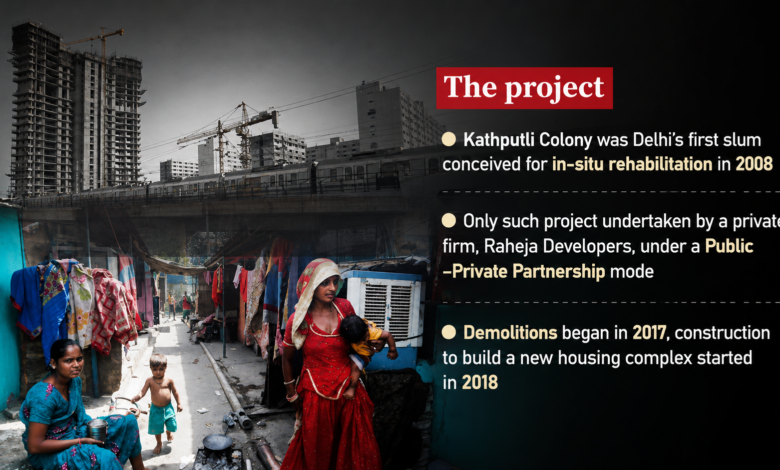
Kathputli Colony was projected as Delhi’s pioneering in-situ rehabilitation under a public-private partnership with Raheja Developers. The promise was that the dense settlement of artists, puppeteers, musicians and magicians in West Delhi’s Shadipur would be redeveloped on the same land. Families were shifted to transit camps at Anand Parbat and elsewhere with the assurance that the temporary arrangement would last only a couple of years.
Demolitions began in 2017; construction started in 2018. The full project of 2,800 Economically Weaker Section flats was supposed to be completed by June 2026, with the first batch earlier projected for December 2025. Both deadlines have been missed. Residents continue to live in conditions many describe as worse than the original colony, open drains, unreliable water, cramped porta cabins, and the constant uncertainty of whether permanent homes will ever materialise. Children have grown up in transit camps; elderly performers have spent their later years waiting. The cultural identity that made Kathputli famous has been strained by years of displacement.
Is this the model of EWS delivery that is now being invoked to seek leniency in a money-laundering probe? The irony is bitter. A project meant to demonstrate that the poor need not be pushed to the city’s margins has instead become a cautionary tale of permanent temporariness. Responsibility is shared, the Delhi Development Authority as the public partner and Raheja Developers as the private entity that undertook to build, yet the daily cost falls almost entirely on those with the least power.

When successive deadlines slip and the developer simultaneously faces intensive ED scrutiny over other projects, the claim of having “constructed around 2,000 flats for economically weaker sections” rings hollow. It does not forgive the thousands of plots and flats that remain undelivered, nor does it justify the alleged diversion of funds that left so many waiting. If the group could not even deliver on a high-visibility, symbolically important rehabilitation project, what confidence can ordinary homebuyers place in its other commitments?
The legal defence advanced by Nayan Raheja centres on the argument that no offence under the Prevention of Money Laundering Act is made out against him because he has not been charge-sheeted in the predicate offences forming the basis of the money-laundering case. The court, however, held that the fact that he was not named, or not charge-sheeted, in the FIRs forming part of the Enforcement Case Information Report did not automatically absolve him of liability under PMLA proceedings. This judicial observation is critical.
PMLA is not a mere adjunct that collapses the moment the predicate charge sheet omits a name. Section 3 of the Act reaches any person who directly or indirectly attempts to indulge or knowingly assists or is a party or is actually involved in any process or activity connected with the proceeds of crime. The special judge correctly refused to treat non-inclusion in the predicate charge sheets as an automatic clean chit.
Just because an individual has not yet been charge-sheeted in the underlying FIRs does not mean nothing wrong has occurred or that the person has no connection to the proceeds of crime. The ED’s investigation material, as reflected in court submissions, indicates that Nayan Raheja was overseeing affairs of Raheja Developers Ltd or its subsidiary companies where diverted funds from homebuyers were used for non-construction purposes. The agency has also pointed to the receipt of certain sums alleged to be linked to proceeds of crime.
The recent arrest of Vatika Group founders Anil Bhalla and Gautam Bhalla under PMLA illustrates the trajectory that such cases often follow. In that matter, the ED arrested the promoters in connection with alleged non-delivery of residential plots for which buyers had paid approximately Rs 260 crore upfront years earlier; the agency quantified proceeds of crime and moved to custodial interrogation. The pattern is instructive: initial technical arguments about charge sheets or absence of naming frequently give way, sooner or later, to deeper scrutiny and coercive steps when the trail of funds is followed.
The defence further maintains that no proceeds of crime are attributable to Nayan Raheja and that the very basis for invoking PMLA provisions against him is absent. This assertion invites the most searching interrogation. How does one reconcile the claim of zero proceeds with the ED’s successive attachment orders that have frozen assets whose market value approaches the scale of the alleged collections? How does one square the assertion of no basis for PMLA with the documented non-appearance on five of seven summonses and the trial court’s explicit finding that such conduct disentitles the applicant from anticipatory bail?
The suggestion that luxurious lifestyles can continue, homebuyers can remain harassed, and technical non-charge-sheeting can still yield protection strikes at the credibility of the enforcement process itself. If taking funds collected for construction, allegedly diverting large portions, and then resisting full cooperation with investigators can still be framed as the absence of proceeds of crime, then the protective purpose of PMLA is severely undermined.
The human cost of these patterns cannot be reduced to ledger entries or legal technicalities. Thousands of families who paid instalments over years, often the bulk of their savings have been left without the homes they were promised. Projects carrying names such as Raheja Revanta, Raheja Shilas, Raheja Trinity, Raheja Oma, Raheja Aranya, Raheja Atharva and others stand as monuments to delayed or incomplete delivery. The same developers who market lifestyle and aspiration to middle-class buyers appear, on the agency’s account, to have treated those buyers’ money as a flexible resource for other purposes.
When the investigating agency attempts to follow the money, the response is partial appearance, legal challenges, and claims that the individual in question was only briefly a director, holds a small shareholding, or functioned merely as an adviser on architectural drawings. Even if those factual assertions are accepted at face value, they do not erase the possibility of knowledge, assistance, or actual involvement in processes connected with the proceeds of crime, the very language of Section 3 of PMLA.
The broader systemic concern is inescapable. India’s real-estate sector has repeatedly witnessed large-scale collection of public money followed by incomplete projects, insolvency proceedings, and prolonged litigation. Regulatory frameworks such as RERA were meant to impose discipline, yet the persistence of cases on this scale suggests that deterrence remains incomplete.
When a developer’s non-cooperation with the ED becomes a recorded judicial fact, and when EWS rehabilitation projects themselves become examples of prolonged displacement rather than timely delivery, public confidence erodes. The Kathputli residents who still wait in transit camps after more than a decade embody the human face of that erosion. The homebuyers who paid into commercial projects and now watch provisional attachment orders accumulate while possession remains elusive embody another face of the same failure.
One is compelled to ask: if the premier investigating agency of the nation must repeatedly summon an individual only to secure partial compliance, what leverage does an ordinary homebuyer possess when the same entity delays possession or refuses refunds? If claims of having built some EWS flats can be advanced as a mitigating narrative while a flagship EWS project remains unfinished, what standards of accountability actually operate? If non-charge-sheeting in predicate offences is treated as a shield even when the court itself rejects that shield, how long before the protective architecture of PMLA is hollowed out by technical manoeuvres?
And if the defence can maintain that no proceeds of crime are attributable despite multi-thousand-crore collections and near-matching attachments, what does “proceeds of crime” mean in practical enforcement terms?
The courts have so far refused to grant anticipatory bail and have underscored the relevance of non-cooperation. Protection from coercive action has been extended at certain stages, and the High Court continues to hear the matter. These are procedural realities. They do not, however, extinguish the larger questions of justice to the thousands who paid for homes they still do not possess.

The Enforcement Directorate’s opposition to bail is not merely an institutional posture; it is a reflection of the difficulty of securing accountability from those who command resources sufficient to litigate every step. Until cooperation becomes genuine, until diverted funds are demonstrably restored to the projects or the buyers, and until the Kathputli families and the other homebuyers receive the keys they were promised, the critique must remain sharp and the interrogation relentless. The alternative is a quiet normalisation of the idea that big builders can treat both investigating agencies and ordinary citizens with a measure of impunity—an outcome no rule-of-law society can afford to accept.