When 42 Paise Of Every 1 Rupee Is Diverted: The Jaypee Saga!
The Enforcement Directorate has told the Delhi High Court that 42 paise of every rupee paid by Jaypee homebuyers was allegedly diverted away from construction. Yet the assets attached so far are a sliver of that sum, homes remain unfinished, and thousands of families are still waiting. Courts have refused bail, the Supreme Court has issued notice, tribunals have appointed committees, and a rescue developer is racing to finish towers. How could so much money move so far without stopping the clock? Who will restore what was lost? This article questions the numbers, the delays, the institutions and the silences surrounding the Jaypee saga.

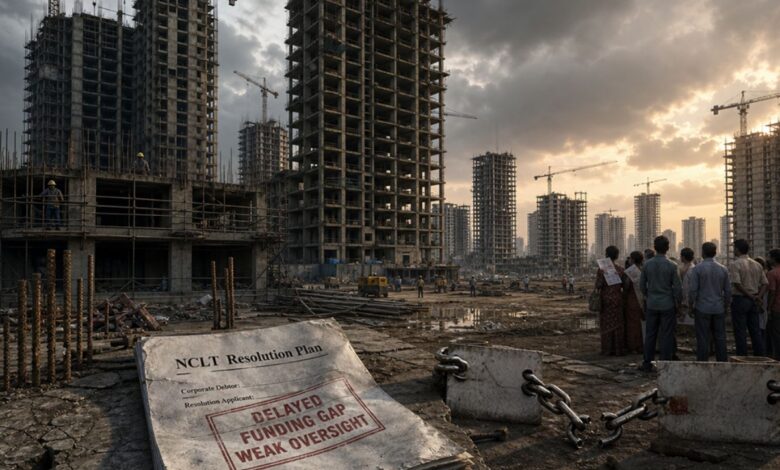
When 42 Paise of Every Rupee Given To Jaypee Group Vanishes: How Did Homebuyers’ Money for Homes End Up Funding a Formula One Track?
Imagine handing over one rupee toward the purchase of a future home and learning, years later, that 42 paise of that rupee never touched a single brick of the building you were promised. That is the picture the Enforcement Directorate painted before the Delhi High Court in August 2026.
According to the agency, Jaiprakash Associates Limited and Jaypee Infratech Limited collected ₹32,825 crore from approximately 25,000 homebuyers across Noida and Greater Noida. Out of that pool, roughly ₹13,833 crore was siphoned away through six primary channels into entities the ED said were controlled by former Jaypee Infratech CMD Manoj Gaur. The diverted funds were allegedly used to finance the Jaypee Group’s Formula One circuit through Jaypee Sports International Limited, the Yamuna Expressway project, Jaypee Healthcare Limited, and a charitable trust named Jaiprakash Sewa Sansthan.
These figures were placed on record during a bail hearing. Even as an allegation the scale is extraordinary, and the public is entitled to examine it number by number, destination by destination, and year by year, because behind each figure sit families who trusted a promise of shelter.
Start with the collection itself. ₹32,825 crore from roughly 25,000 buyers is not institutional capital raised from sophisticated lenders. It is, on the ED’s account, money entrusted by ordinary families who booked flats on the assurance that the payments would build their homes. Every rupee in that total represents a decision made at a kitchen table, often after years of saving, frequently supported by a bank loan that the buyer must continue to repay whether or not a flat is ever delivered. The average implied by a simple division of the two figures is approximately ₹1.31 crore per buyer.
A buyer who booked in 2011 and is still waiting in 2026 has watched children grow up in rented accommodation, watched parents age, and watched the real value of the original payment erode through inflation. Neither the ED’s figures nor any tribunal order reviewed here assigns a monetary value to those lost years. Without that accounting, any eventual “recovery” will always mean less than it sounds.
The diverted amount is the heart of the allegation. ₹13,833 crore moved, according to the ED, through six primary channels into entities controlled by Gaur. A single transfer can be explained as a loan or an inter-company arrangement. Six channels, each leading to a controlled entity, is the language investigators use when they argue for a pattern. The arithmetic is stark. ₹13,833 crore across 25,000 buyers equates to roughly ₹55 lakh per buyer on a simple average. Its purpose is to make the abstraction concrete. A sum of this size is not a rounding error in a corporate ledger. On the ED’s account it is large enough to have materially determined whether buyers received finished homes at all.
Why was a movement of this magnitude not detected and stopped earlier? Companies of this size are audited. Lenders monitor cash flows. Regulators supervise real-estate projects. Homebuyer money is supposed to be ring-fenced for the specific towers against which it was collected. If funds could move through six channels over many years, then every checkpoint failed in sequence. Which auditors signed the accounts year after year?
Which lenders reviewed the inter-company flows and raised no red flag? Which regulators were responsible for ensuring that money paid for residential construction remained inside residential construction? The ED’s allegation is directed at an individual, but the facts it describes implicate a system of oversight that either did not look or did not act.
The destinations named by the agency sharpen the critique. The diverted funds were allegedly used to finance the Formula One circuit via Jaypee Sports International Limited, the Yamuna Expressway, Jaypee Healthcare Limited, and Jaiprakash Sewa Sansthan, of which Gaur was managing trustee. A motor-racing circuit, a hospital business, an expressway and a charitable trust are not residential construction.
The central question, however, remains simple: why were buyers’ deposits, collected for specific homes, available to fund those ventures at all? In a properly ring-fenced arrangement a payment for Tower X ends up in Tower X. If it ended up on a racetrack, the arrangement was not ring-fenced, and someone must explain who permitted that.
The irony for the buyers is almost insulting. Families who could not obtain keys to their flats were, on the ED’s allegation, indirectly financing an expensive sporting facility they would never use. Whatever the final legal outcome, the optics alone should trouble anyone who believes that money paid for shelter ought to be protected. The wider public deserves to know whether those ventures were profitable, who benefited from them, and whether any of that value can still be traced and recovered for the buyers. The sources reviewed do not answer these questions.
The 42-paise figure itself is the most memorable element of the case. Dividing the ED’s ₹13,833 crore by its ₹32,825 crore produces approximately 42.1 percent, matching the agency’s headline. In plain terms, for every ₹100 buyers paid in, about ₹42 allegedly went somewhere other than their homes. If that proportion held across the life of the projects, the developer was working with only a little over half of the money buyers believed was funding construction.
A construction schedule built on 58 paise of every rupee will be slow, patchy and prone to collapse. That is arguably exactly what happened. The unfinished towers, the missed deadlines and the prolonged insolvency are not mysteries if the allegation is substantially true; they are the predictable result of building with a fraction of the intended funds. That is perhaps the most damning reading of the 42-percent figure: it does not merely describe a financial wrong; it explains the physical failure.
One further detail presented by the ED is particularly striking. Standing counsel Rahul Tyagi pointed out that despite continuous financial losses between 2009-10 and 2021-22, Gaur drew ₹48.91 crore in salary, at times making up to 93 times the median pay of regular employees. Executive pay in the absence of profit is not itself a crime; the defence may argue that the remuneration was approved through proper corporate processes. As a governance and moral question, however, it is difficult to defend. Averaged over the thirteen financial years, the figure equates to roughly ₹3.76 crore a year.
Against that background the buyers waited for homes. The 93-times ratio, which the ED said applied at times rather than throughout, suggests a pay structure wildly out of step with the realities of a company in persistent loss. Who approved it? Did the board scrutinise it? Did the lenders and auditors raise any objection? The salary figure is small relative to the alleged diversion—about 0.35 percent of ₹13,833 crore by simple arithmetic—but its significance is symbolic. A buyer waiting a decade for a flat will not calculate percentages; they will simply ask why the person at the top was paid so well while their home stayed unbuilt. That question has not been answered in any source reviewed here.
The legal timeline that frames these revelations is itself part of the critique. Gaur was arrested on 13 November 2025. By the time of the August 2026 hearing he had been in custody for approximately nine months, interrupted by periods of interim bail granted on humanitarian grounds. Justice Purushaindra Kumar Kaurav observed that no prima facie case for bail had been made out, noting that the alleged diversion of over ₹13,000 crore was simply too substantial and that nine months of custody could not justify release.
The matter was adjourned for the defence to reply. The court did not find Gaur guilty; it held, at the bail stage, that the scale of the allegations weighed heavily against liberty. That is a significant but limited ruling. It reflects a judicial judgment that a sum of this size, if true, represents a serious economic offence. It is not a verdict.
Still, the nine-month figure invites reflection. A money-laundering case involving thousands of crore and tens of thousands of complainants can take years to try. Every month of custody for the accused is also a month in which buyers are no closer to restitution. The system appears to offer neither a quick determination of guilt nor a quick return of money—a combination that serves no one well.
The recovery figures sharpen the same concern. In January 2026 the ED provisionally attached immovable assets valued at approximately ₹400 crore. Later attachments added further sums. Even so, ₹400 crore is roughly 2.9 percent of the ₹13,833 crore the ED alleges was diverted, and about 1.2 percent of the ₹32,825 crore collected. After more than seven years of investigation, roughly 97 paise of every rupee alleged to have been diverted remains unattached.
Provisional attachment is not final confiscation, and further investigation continues. For the buyer, however, the distinction is academic. Money not attached is money that can still be moved, sold or hidden. Every year of delay reduces the chance of retrieving it. The Supreme Court’s notice to the ED on a homebuyer’s petition seeking a court-monitored investigation, flagging the limited attachment after seven years, is itself a public expression of concern about pace.
Numbers in this case do not always reconcile neatly. Earlier ED statements spoke of ₹14,599 crore. Later presentations used ₹32,825 crore collected and ₹13,833 crore diverted. These may measure different things—claims admitted in insolvency, total collections across two companies, or the portion alleged to have been diverted. The sources do not provide a single authoritative table that reconciles them. Which figure represents what homebuyers actually paid?
Which will be used when a court eventually determines restitution? A case that turns on money must be able to say, in one clear statement, how much came in, how much went where, and how much remains. The absence of such clarity is itself a failure of transparency, and it disadvantages ordinary buyers who lack the resources to navigate the shifting figures.
Meanwhile the project itself remains in the hands of a new owner under an insolvency resolution plan. Buyers continue to report that occupancy certificates have been issued for dozens of towers while lifts, water supply, fire-safety arrangements and common amenities remain incomplete.
The density of oversight has increased—monitoring committees, state government panels, tribunal-appointed experts—yet the principal complaint a resident notices on the first day is still a non-functioning lift. If money was allegedly diverted for years under the eyes of auditors, lenders and regulators, and if even now multiple committees are required to verify whether basic services work, then what exactly has oversight achieved?
Several questions arise from the record and remain unanswered. How will the ED prove the diversion at trial, and how long will that take? Why has only a fraction of the alleged sum been attached after seven years? Who will compensate buyers for the delay itself, over and above the cost of their flats? What happens if the rescue developer falls short of the commitments in the resolution plan? What reforms will prevent a future generation of buyers from facing the same risk that their deposits can leave the construction site and fund a racetrack or a hospital?
The Jaypee saga is often discussed in terms of towers and certificates. The ED’s 42-paise allegation shifts the lens decisively to money. If 42 paise of every rupee truly left the project, then the unfinished towers are not an accident of bad luck but, on the agency’s case, the consequence of a deliberate pattern. That remains to be proven in a court of law. Even as an allegation, however, it demands an answer, and the answer must come from evidence tested at trial, not from press statements. What emerges from the available record is a picture of institutions that have all acted, and none that has acted fast enough.
Courts have refused bail but taken months. The ED has attached assets but only a sliver of the alleged sum. Tribunals have approved a rescue but years passed before construction accelerated. Committees have multiplied but lifts remain a complaint. Each step, taken alone, looks like progress; taken together, they look like a system that moves at the speed of paperwork while buyers live at the speed of time.
The remedy is clear even if difficult: reconcile the numbers publicly, accelerate the trial, trace and attach more assets where the law permits, publish committee findings, and ensure that every rupee of buyer money is tied to the project for which it was paid. Until then, the figure that will stay with the public is the simplest one—42 paise in every rupee—and the question that goes with it: if buyers paid for homes, who paid for everything else, and who will pay it back?