Arvind Tiku’s Experion Empire: How Does A Singapore-Backed Luxury Developer Keep Leaving Gurugram Homebuyers Fighting For Basic Infrastructure While Its Related Entity Faces An ED-Originated Fraud FIR?
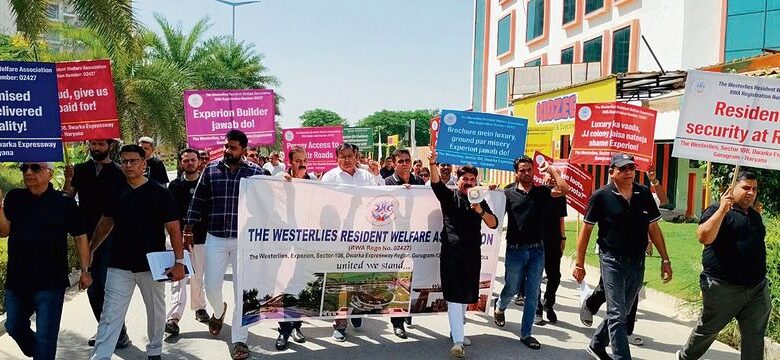
Residents of The Westerlies in Sector 108, Gurugram, have staged public protests over damaged security infrastructure, inadequate sewage capacity, non-operational community facilities and a reported near-doubling of maintenance charges, while a complaint already sits pending before Haryana RERA. This latest confrontation sits atop years of consumer-court findings on excess-area demands and delayed possession, regulatory show-cause notices, and most consequentially an Enforcement Directorate-linked investigation into the acquisition of distressed Sector 62 land that produced a Delhi Police Economic Offences Wing FIR in March 2026. The questions that remain unanswered go to the heart of transparency, related-party influence in insolvency proceedings, and the gap between luxury branding and the lived experience of buyers who paid crores for homes that still fall short.

Arvind Tiku’s AT Capital-Backed Experion Developer Continues Facing Homebuyer Protests Over Security, Sewage And CAM Hikes While an ED Originated FIR Remains Live!
The October 2026 demonstration by residents of The Westerlies in Sector 108, Gurugram, was not an isolated outburst of frustration. It was the public expression of grievances that had already been formalised before the Haryana Real Estate Regulatory Authority. Residents gathered to protest what they described as systemic deficiencies: damaged perimeter fencing and boundary walls, ineffective boom barriers, malfunctioning Park+ RFID tags, the absence of a functional MyGate visitor-management system at the Kite Gate, an inadequate trunk sewage line for a township of roughly nine hundred plots, incomplete parks and green areas, a non-operational community club, unreliable power backup, deficient internal roads and drainage, and the incomplete handover of common facilities and a religious site.
They also objected to a reported increase in common-area maintenance charges from ₹10 to ₹19 per square yard per month, an approximate 90 percent rise over two years, and demanded audited accounts, vendor details and the constitution of a special investigation team. The Residents’ Welfare Association gave Experion Developers and its maintenance agency, Mainage Facility Management, fifteen days to produce a written, time-bound action plan, failing which it threatened proceedings before HARERA, the Gurugram Metropolitan Development Authority, the district administration and other competent authorities.
A complaint filed by The Westerlies Resident Welfare Association against Experion Developers is already pending before HARERA. Hearings took place in August and September 2026; Experion filed a reply; and the next date is listed for 8 December 2026. The existence of an institutional regulatory case means the October protest cannot be dismissed as spontaneous or ephemeral. It is the visible manifestation of issues that remain unresolved years after buyers paid substantial sums and took or were offered possession.
The human impact of a near-doubling of maintenance charges is immediate and measurable. For a typical plot or apartment of several hundred square yards, the annual additional burden runs into tens of thousands of rupees. Families that budgeted for a certain level of recurring cost now face a material increase while alleging that core infrastructure — security, sewage capacity, power backup and community facilities — remains deficient.
The demand for audited accounts and vendor details is itself an expression of eroded trust. When residents feel compelled to seek an independent investigative team rather than ordinary regulatory redress, the relationship between developer, maintenance agency and homebuyers has already deteriorated beyond ordinary commercial disagreement.
The scale of the reported CAM increase invites sustained interrogation. A jump from ₹10 to ₹19 per square yard per month is not a marginal adjustment. Has the incremental collection been justified by documented cost inflation in security personnel, diesel for generators, sewage treatment chemicals or landscaping contracts? Or does it reflect an absence of competitive tendering and independent audit?
These questions remain open because the material that would answer them — full audited CAM accounts and supporting contracts — has not been placed beyond dispute. The RWA’s insistence on transparency is not unreasonable; it is the minimum expectation when residents are asked to pay substantially more for services they claim remain incomplete.
This latest resident revolt does not stand alone. It sits atop a longer record of consumer and regulatory disputes that have repeatedly tested Experion’s contractual and project-execution practices. One of the most extensively litigated issues concerns alleged excess-area charges at Experion Windchants in Sector 112, Gurugram. Multiple buyers approached the National Consumer Disputes Redressal Commission alleging that the developer had revised the “sale area” of their apartments and demanded additional payments even though, according to the complainants, the actual physical or carpet area of the apartments had not increased.

Among six complainants the additional amounts demanded included ₹8.05 lakh, ₹20.42 lakh, ₹7.98 lakh, ₹13.18 lakh, ₹13.31 lakh and ₹9.97 lakh. These are not trivial sums for middle- and upper-middle-class buyers who had already stretched to meet the original consideration. The human consequence is immediate: a family that calculated its EMI and long-term financial exposure on one figure suddenly confronted an unexpected additional liability measured in several lakhs of rupees.
The psychological and economic strain of such a demand — especially when the physical apartment remains the same size — cannot be understated. Buyers reported feeling that the developer was extracting further value from a completed transaction without delivering any corresponding enlargement of the living space they had purchased.
The NCDRC record further notes that an earlier decision on the same issue in the same project, Pawan Gupta versus Experion Developers Private Limited, had already attained finality. Experion challenged that decision before the Supreme Court. Civil Appeals numbered 3703–3704 of 2020 were dismissed on 12 January 2021. Review petitions were subsequently dismissed on 11 January 2022. The survival of the earlier finding through the highest court gives the excess-area controversy particular weight.
It is no longer merely an allegation circulating among residents; it is a judicial determination that withstood appellate and review scrutiny. Yet the larger policy question remains unanswered: how much unilateral power should a developer retain to redefine the chargeable area after the buyer has already entered the agreement and, in many cases, paid the bulk of the consideration?
The Windchants litigation illustrates the asymmetry of information and bargaining power that characterises many Indian real-estate transactions. Buyers rely on the developer’s representations of area; when those representations are later revised upward without physical change, the financial impact falls entirely on the buyer. The courts have intervened in individual cases, but the systemic practice that generates such disputes continues to surface.
Delayed possession formed another recurring strand of litigation at Windchants. In the matter involving Renuka Nair, the Apartment Buyers Agreement was dated 15 July 2013. Under its terms, possession was to be offered within forty-two months plus a six-month grace period, fixing the outer contractual date at 15 July 2017. The NCDRC found that possession was offered only on 7 December 2017 and actual handover occurred on 20 April 2018. The developer argued that contractual delay compensation had already been credited and attributed the delay to construction-related circumstances, National Green Tribunal restrictions, demonetisation and contractor issues.
The Commission ultimately treated the relevant delay as approximately five months rather than the entire period claimed by the complainant, and characterised the deficiency as technical rather than gross, intentional or reflective of gross negligence on the specific facts of that case. Even this comparatively limited finding of delay carries human consequences. A family that planned school admissions, job transfers or the sale of an existing home around a mid-2017 possession date was forced to adjust its entire life calendar by several months.
Temporary accommodation costs, continued rent, interest on loans and the emotional toll of uncertainty accumulate even when the formal finding of deficiency is narrow. The case also demonstrates that not every consumer complaint against Experion produced a sweeping adverse order; the Commission carefully calibrated the relief. That calibration, however, does not erase the underlying reality that contractual timelines were missed and buyers bore the practical cost.
A further Supreme Court-level dispute arose in Experion Developers Private Limited versus Sushma Ashok Shiroor. The buyer had paid approximately ₹2.064 crore. The litigation concerned delay, refund and compensation. The Supreme Court dismissed the developer’s appeal while partly allowing the consumer’s appeal, directing that interest on the refund be calculated from the dates of deposit and retaining the 9 percent interest rate awarded.
The figure of ₹2.064 crore is itself significant. It represents the life savings or long-term borrowing capacity of a typical upper-middle-class Indian family. When such a sum is locked in a delayed project, the opportunity cost — foregone interest, inability to deploy capital elsewhere, continued dual housing expenses — becomes substantial.
The Supreme Court’s intervention confirms that the dispute was neither trivial nor confined to lower fora. It also leaves open the broader question of why possession timelines continue to slip across multiple projects and multiple years, imposing repeated financial and emotional costs on buyers who have already performed their side of the bargain.
The pattern of cancellation and forfeiture appears in still other proceedings. In a 2026 consumer matter involving the Heartsong project, buyers alleged that they had been led to believe that 1,758 square feet represented usable or carpet area. The Commission examined the contemporaneous documents and found that the figure was described as “Sale Area,” not carpet area, and therefore rejected that particular allegation.
Yet the same Commission scrutinised the forfeiture of approximately ₹10.79 lakh out of ₹26.27 lakh paid, while only ₹15.48 lakh was refunded. It invoked the established principle that forfeiture exceeding 10 percent of the sale price ordinarily requires justification and proof of actual loss. The human impact of forfeiture is severe.
A buyer who has already parted with more than ₹26 lakh faces the abrupt loss of a substantial portion of that sum, often after years of waiting and financial commitment. Even when the developer succeeds on the area-description point, the quantum of forfeiture remains subject to judicial scrutiny. The unanswered question is whether the contractual clauses that permit such forfeiture are drafted and applied with genuine proportionality, or whether they function primarily as one-sided levers.
A parallel cancellation dispute involving Sanjiv Anand produced a criminal complaint filed with Gurugram Police on 27 May 2023 against Experion Developers Private Limited, Arvind Tiku and Hemant Tikoo. The buyer had allegedly paid approximately ₹19.5 lakh as an initial deposit in 2013. After reminders for the balance and eventual cancellation, the deposit was forfeited in 2017. Experion and the named individuals responded to the police on 13 June 2023.
A later HARERA decision reported in 2025, however, rejected the homebuyer’s refund claim, concluding that cancellation resulted from continued failure to make timely payments and that the amount paid, being below 10 percent of the sale consideration, could be forfeited as earnest money. The dual track — criminal complaint followed by regulatory affirmation of the developer’s contractual position — illustrates the complexity of these disputes.
Buyers experience the loss of deposit as a severe financial setback; the developer frames it as enforcement of contractual terms against a defaulting allottee. The existence of both a police complaint and a subsequent adverse regulatory finding against the buyer underscores the need for careful, case-by-case evaluation rather than blanket characterisation.
The Lucknow project, Experion Capital in Gomti Nagar, generated another substantial consumer-commission order. Buyers who booked in 2017–18 alleged that they paid substantial sums, faced additional demands, were offered possession despite incomplete amenities, and then saw their allotments cancelled with significant forfeiture.
The Uttar Pradesh State Consumer Disputes Redressal Commission, in its order dated 7 June 2024 in Preeti Yadav & others v. Experion Developers Private Limited, directed delivery of physical possession of the allotted flat along with the Occupancy Certificate and Completion Certificate, ordered interest at 10 percent per annum on the deposited amount, directed refund of ₹21,29,741.11 as alleged excess payment with interest, and awarded ₹10 lakh as compensation for mental agony, economic loss, physical torture and unfair trade practice, plus ₹50,000 as litigation costs.
The figure of more than ₹21 lakh in alleged excess payment, and the ₹10 lakh compensation award, again quantify the human stakes. A family that has already paid beyond the agreed consideration and then faces cancellation experiences both financial haemorrhage and profound uncertainty about housing security. The Commission’s willingness to award substantial compensation for mental agony and unfair trade practice signals that, at least on the facts before it, the buyers’ experience went beyond ordinary commercial friction. Experion appealed; the National Commission later partly modified the order while retaining core directions on possession and excess-payment refund.
Regulatory scrutiny has not been limited to consumer fora. In August 2025 the Department of Town and Country Planning issued a show-cause notice to Experion Developers and the Windchants Condominium Association concerning alleged violations of the approved layout plan and licence conditions. The inspection reportedly identified conversion of two fire-tender paths into green areas, reduced emergency access, and alleged sale of setback land between buildings that the approved plan required to remain vacant.
The notice directed restoration to the sanctioned plan and warned of further legal action, including consequences for licences. Fire-tender access is not a cosmetic issue; it is a life-safety requirement. Any reduction in emergency access raises the interrogative possibility that residents could face heightened risk in the event of fire. The alleged sale of setback land, if established, would represent a departure from the very plan on the basis of which buyers made their purchase decisions. These are not minor technicalities; they go to the integrity of the physical environment that buyers paid to inhabit.
The most consequential controversy, however, lies outside the ordinary homebuyer and RERA track. It concerns the Enforcement Directorate’s investigation into the acquisition of distressed assets belonging to Dignity Buildcon Private Limited in Sector 62, Gurugram, and the subsequent registration of a Delhi Police Economic Offences Wing FIR. The underlying ED investigation originated in the money-laundering probe into Religare Finvest Limited and the former promoters of the Religare group, Malvinder Mohan Singh and Shivinder Mohan Singh.
According to the ED investigation cited in the subsequent FIR, approximately ₹2,036 crore was allegedly siphoned from Religare Finvest through entities controlled directly or indirectly by the Singh brothers. Of that sum, approximately ₹150 crore was allegedly used to acquire a 27.86-acre land parcel in Sector 62. The ED attached the land on 4 February 2020; the attached property included a roughly 9.1-acre parcel associated with Dignity Buildcon.
Dignity Buildcon entered the Corporate Insolvency Resolution Process before the National Company Law Tribunal, Delhi Bench, on 24 April 2019. The process concluded in May 2023 with Experion Developers emerging as the successful resolution applicant. The ED’s concern was not merely that Experion acquired a distressed real-estate asset.
The agency alleged that the mechanism through which Experion and related entity Experion Capital participated in the insolvency process gave the Experion group substantial control over the Committee of Creditors, thereby potentially allowing the prospective resolution applicant to influence the very process through which its own resolution proposal would be evaluated.
According to the FIR based on the ED complaint, Experion Capital acquired a loan exposure originally held by Standard Chartered Bank. The loan had a face value of approximately ₹490 crore, but Experion Capital acquired it for approximately ₹160 crore under an agreement dated 26 December 2022. That acquisition allegedly conferred approximately 49.3 percent voting rights in the Committee of Creditors. Experion Capital subsequently increased its voting share to approximately 60 percent by acquiring debentures having admitted claims of approximately ₹58 crore from three Blackstone-linked entities for approximately ₹25 crore.
The theory is that control over distressed debt was used to acquire control over the insolvency decision-making mechanism itself. The disparity between face value and acquisition cost — ₹490 crore acquired for ₹160 crore — raises immediate questions about the commercial rationale and the source of funds deployed for the purchase. The subsequent acquisition of additional voting power for a further ₹25 crore intensifies those questions.
When a related financial entity of the prospective resolution applicant suddenly holds nearly half, and then three-fifths, of creditor voting power, the independence of the Committee of Creditors becomes an unavoidable subject of scrutiny.
A further allegation concerns Alchemist Asset Reconstruction Company. The ED complaint and FIR cite a letter dated 24 January 2023 in which Experion Capital directed Alchemist ARC to consult Experion before voting on a resolution plan. More significantly, the FIR records a statement dated 23 August 2024 from Sachin Gupta, the authorised representative of Alchemist ARC, to the effect that Experion Capital compelled Alchemist ARC to vote in favour of Experion Developers’ resolution plan. This allegation has not been judicially established as a conviction.
From an investigative standpoint, however, it goes directly to the integrity of the insolvency process. If a related entity of the resolution applicant can direct or compel another creditor’s vote, the protective architecture of the Insolvency and Bankruptcy Code is placed under severe strain. The human and systemic consequence is that other creditors, and ultimately the broader market’s confidence in the CIRP mechanism, may be compromised.
In March 2026 the Delhi Police Economic Offences Wing registered FIR No. 64/2026 against Experion Developers Private Limited and Experion Capital Private Limited following the ED complaint. The FIR reportedly invokes cheating and conspiracy provisions and was registered by the EOW, Mandir Marg. Experion and its co-petitioner approached the Delhi High Court seeking to challenge the FIR and obtain interim protection. Justice Girish Kathpalia declined to stay the investigation and refused the request for a “no coercive steps” order, observing that the investigation was at a nascent stage and directing investigators to file a status report.
The High Court’s refusal means the FIR remains live, the investigation continues, and Experion did not obtain interim insulation against coercive action. Equally important, the Court did not hold Experion guilty; the matter remains under investigation. No publicly verified chargesheet in FIR No. 64/2026 against Experion or Experion Capital has been located in the material reviewed. No credible evidence of a CBI raid or CBI chargesheet against Experion Developers has been found.
No reliable primary source establishing a conventional ED search-and-seizure raid at Experion premises in connection with this case has been identified. The verified chain is therefore ED investigation, ED complaint, Delhi Police EOW FIR, High Court challenge, and High Court refusal to stay.
Corporate ownership adds another layer of complexity. Experion Developers was incorporated in July 2006 as an unlisted private company. It describes itself as a subsidiary of Experion Holding Pte Ltd, Singapore, the real-estate investment arm of AT Capital Group. Arvind Tiku is the founder and chairman of AT Capital Group and has historically been identified among Experion’s directors. Public records and reporting identify Experion Developers and Experion Capital as wholly owned subsidiaries of the Singapore-based group.

Any examination of Experion’s history must therefore consider the broader AT Capital structure rather than treating the Indian company as an isolated entity. Historical tax and offshore scrutiny surrounding Tiku further complicates the picture. A Delhi High Court judgment concerning tax reassessment records that the Directorate of Income Tax (Intelligence & Criminal Investigation) investigated funding structures involving Gold Singapore and Indian entities, describing Tiku as a key person.
The Office of the Attorney General of Switzerland opened a criminal investigation in September 2010 concerning allegations of money laundering against Tiku and others; those proceedings were dismissed or closed on 27 November 2013 without charges or findings of wrongdoing. The same historical material later supplied “tangible material” sufficient for the Income Tax Department to reopen assessments; the Delhi High Court upheld the reopening in earlier proceedings, but in October 2024 the Court quashed the challenged Section 148 reassessment notices after noting that subsequent assessments had accepted the identity and creditworthiness of Gold Singapore and the genuineness of the transactions.
Tiku has also appeared in Pandora Papers reporting in connection with offshore structures including the Sai Charan Trust and AT Investments Limited, a British Virgin Islands entity. Offshore ownership is not itself proof of illegality; the documented fact of the structures must be distinguished from any allegation of illegal concealment. Tiku’s solicitors have publicly stated that Swiss and Kazakh investigations closed in 2013 without charges and that a due-diligence firm later agreed to delete certain reports after reviewing documentation supplied by him.
The cumulative picture that emerges is therefore multi-layered. At the project level, Experion has faced repeated disputes over delayed possession, excess-area demands, cancellation and forfeiture, incomplete or disputed amenities, maintenance-charge increases, and layout compliance. Some of those disputes have produced consumer-favourable relief that survived Supreme Court challenge; others have resulted in findings that upheld the developer’s contractual position.
At the regulatory level, DTCP show-cause notices and multiple HARERA proceedings indicate ongoing friction with planning and registration requirements. At the criminal and enforcement level, an ED-originated investigation into the manner in which related entities acquired creditor voting power in the Dignity Buildcon insolvency has produced a live Delhi Police FIR that the High Court has declined to stay. None of these strands has produced a criminal conviction of Experion or of Arvind Tiku. The absence of conviction does not erase the volume or seriousness of the questions that remain open.
The most pressing investigative questions therefore concern governance and transparency. When a related financial entity of a prospective resolution applicant acquires nearly half and then three-fifths of Committee of Creditors voting power, was there sufficient structural separation to preserve the independence of the insolvency process? When residents of a large Gurugram township face a reported 90 percent CAM increase while alleging that sewage capacity, security infrastructure and community facilities remain deficient, why have audited accounts and vendor details not been placed beyond dispute?
When excess-area charges of several lakhs per apartment survive judicial scrutiny at the Supreme Court level, what systemic reform would prevent the same practice from recurring? These are not rhetorical flourishes. They are the concrete, unanswered questions that the public record of Experion Developers continues to pose to regulators, courts, homebuyers and the market itself.
Until those questions receive clear, documented answers supported by primary records — the complete ED complaint, the full FIR, CoC voting minutes, assignment agreements, audited CAM accounts, and technical infrastructure audits — the gap between the company’s luxury positioning and the lived experience of many of its buyers will remain a legitimate subject of sustained public concern.
The human cost of these disputes is not abstract. Families who locked their savings into Windchants apartments faced unexpected additional demands measured in lakhs while waiting for possession that arrived months after the contractual deadline. Buyers in Lucknow who paid more than the agreed consideration then confronted cancellation and forfeiture. Residents of The Westerlies who budgeted for one level of maintenance charges now confront a near-doubling while living with what they describe as incomplete security, sewage and community facilities.
Each individual case may be explained by contractual clauses, construction delays or payment defaults; the cumulative pattern invites a deeper interrogation of whether the balance of power between a well-resourced developer and individual homebuyers remains fair, transparent and accountable. The Dignity Buildcon matter raises a different but equally serious set of questions about the integrity of the insolvency process itself.
When related entities can acquire large voting positions and, according to the ED complaint, influence other creditors, the protective purpose of the Insolvency and Bankruptcy Code is placed under strain. The fact that the investigation remains at the FIR stage does not diminish the gravity of the allegations; it underscores the need for a thorough, transparent inquiry whose findings, whatever they may be, are placed in the public domain.
The record does not support a simplistic narrative of universal wrongdoing. Some consumer cases have produced findings favourable to Experion; the Swiss investigation closed without charges; the Delhi High Court quashed certain tax-reassessment proceedings after subsequent assessments accepted the transactions. Yet the volume of disputes, the seriousness of the ED-originated criminal investigation, and the persistence of resident grievances at The Westerlies collectively demand sustained scrutiny.
The questions that remain open are not merely technical. They go to the heart of whether homebuyers who place their life savings in a project marketed as luxury can reasonably expect timely delivery, transparent area calculations, proportionate forfeiture clauses, functional infrastructure and accountable maintenance regimes — and whether the insolvency process that transfers valuable land assets remains insulated from related-party influence. Those questions have not yet received satisfactory public answers.