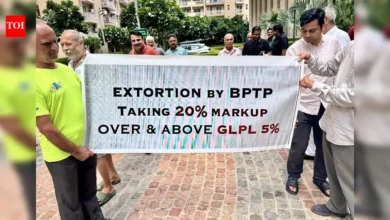
2nd ED Raid: How Raheja Developers Allegedly Defrauded Thousands Of Indian Homebuyers!
A report spanning twelve years of legal battles, regulatory failures, Enforcement Directorate raids, insolvency proceedings, and a ₹1,113 crore asset seizure — and the ordinary Indian families trapped at the centre of it all

The Promise of Raheja — And How It Was Sold
To understand how one of Delhi NCR’s most recognisable real estate names stands accused of defrauding over 4,600 families out of nearly ₹2,500 crore, you must first understand the environment in which those families handed over their money.
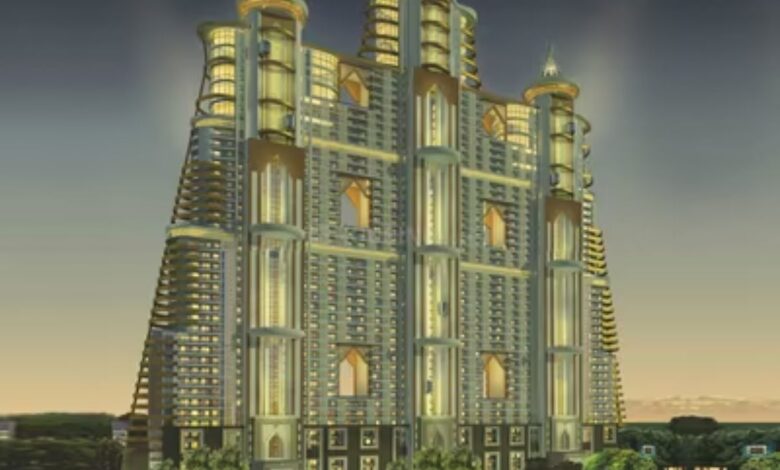
The year is 2011. Gurugram is booming. Glass towers are rising from the dusty flatlands of Haryana at a pace that feels almost cinematic. Raheja Developers Ltd., led by its Chairman and Managing Director Navin M. Raheja, is among the most prominent names in this landscape. The company’s own promotional material claims that Navin Raheja started the business with an investment of just $100 and built it into a real estate empire managing projects worth approximately $2 billion, spread across over 27 million square feet. The crown jewel of this portfolio is Raheja Revanta — a proposed 61-storey luxury condominium complex in Sector 78, Gurugram, marketed as one of the tallest residential towers in the country.
For a middle-class Indian family, the kind that saves methodically for twenty years, carefully weighs every rupee, and treats a home purchase as the defining financial act of a lifetime — the pitch was irresistible. Raheja Revanta promised world-class architecture, premium finishes, international-standard amenities, and possession within three to five years. Similar promises accompanied the company’s other projects: Raheja Shilas in Sector 109, Raheja Sampada, Raheja Atharva, Raheja Vanya, and Raheja Aranya, all spread across Gurugram and the broader Delhi NCR region. Buyers poured in. Many liquidated fixed deposits, took out bank loans, and committed to years of EMI payments, all on the strength of glossy brochures and the credibility of a developer with a visible track record.
What unfolded over the next decade, through the corridors of the Enforcement Directorate, the National Company Law Tribunal, the Haryana Real Estate Regulatory Authority, police stations across Gurugram, and the Supreme Court of India, is a story about what happens when that trust is allegedly weaponised on an industrial scale.
The Early Warning — Cobrapost’s 2014 Sting
Before the homebuyer crisis reached its full intensity, there was a warning that should, in retrospect, have set alarm bells ringing much louder than it did. In November 2014, investigative outlet Cobrapost published the findings of an 18-month undercover operation called Operation Black Ninja, in which its correspondent posed as a representative of a prominent politician seeking to convert large quantities of black money into legitimate assets through bulk property purchases.
Raheja Developers was among the 35 real estate companies caught in the sting. Cobrapost found these companies willing to do bulk transactions in black money, with the black money component in proposed deals ranging from 10 per cent to 90 per cent of the unit price. Many of them agreed to collect cash from cities other than their operational bases — even from countries such as Dubai, via hawala. Senior officials said that accepting payments in black was nothing new and that it was an accepted norm of the real estate industry.
In Raheja’s specific case, Director-cum-CEO Karthik Ramachandran was allegedly caught on camera agreeing to accept black money payments routed through Dubai and Sharjah. The sting was damaging enough to trigger a Central Board of Direct Taxes inquiry into Raheja and the other named developers.
The Cobrapost exposé was not the first time the company had faced scrutiny from tax authorities. There are reports that show that Raheja Developers was under the lens of the Income Tax Department, that conducted searches on the company in February 2010, recovering evidence pointing to potential tax evasion of approximately ₹80–118 crore. The Rahejas subsequently entered proceedings before the Income Tax Settlement Commission (ITSC). In a significant legal development, the Delhi High Court, in a judgment dated February 10, 2014, quashed the immunity that had been granted to the Rahejas through those ITSC proceedings. The Supreme Court was then approached via Special Leave Petition.
These events, the 2010 IT raids, the 2014 ITSC immunity being quashed, and the Cobrapost sting, form the prehistory of the crisis that would erupt in full a decade later. They indicate a pattern of alleged financial opacity that long predated the homebuyer fraud complaints.
Also in December 2014, the Prime Minister’s Office sent a communication to the Haryana government asking it to probe complaints from buyers of the Raheja Atharva project. The PMO’s involvement at that early stage, over construction irregularities and resident grievances, was a signal that something was deeply wrong — a signal that appears to have gone insufficiently heeded.
The Spiral Begins When There Is A Regulatory Collapse at Raheja Revanta
The Raheja Revanta project in Sector 78, Gurugram, became the focal point of the homebuyer crisis not merely because of its size but because of the particular cruelty of its timeline. Buyers who had booked flats between 2011 and 2012, paying upfront or in instalments, were given possession dates that fell between 2015 and 2017. Those dates came and went. New dates were issued. They were missed again. By 2023, more than a decade after booking, many buyers had paid over 95% of the total cost of their flats, and the towers were still not ready.
Under Indian real estate law, developers are required to deposit at least 70% of funds collected from buyers into a dedicated escrow account, to be used exclusively for construction of that specific project. The allegation at the heart of almost every FIR and the subsequent ED investigation is that this fundamental safeguard was systematically violated and that buyer money was being moved elsewhere, while construction ground to a halt.
In April 2023, the Haryana Real Estate Regulatory Authority (HRERA) took sweeping action. It banned all sales and purchases of units in Raheja Revanta, directed the freezing of all unsold inventory and bank accounts associated with the project, and ordered a forensic audit into the company’s financial conduct. The HRERA’s rationale was stark: the project’s licence had expired on January 31, 2023, including the COVID-19 grace period of six months, and the developer had not even applied for renewal. Homebuyers had, by that point, been waiting for keys for what HRERA recorded as seven years of alleged harassment. The forensic audit ordered by HRERA was specifically intended to determine whether funds collected from buyers had been diverted.
Separately, HRERA also issued show-cause proceedings against Raheja Developers’ directors over resident grievances regarding construction quality and missed deadlines at the Raheja Atharva project — confirming that the regulatory concern extended well beyond a single scheme.
The Courts Enter — NCLT, NCLAT, and the Insolvency Battle
By 2019, the homebuyer complaints had graduated beyond police stations and regulatory bodies into insolvency courts. An insolvency petition was filed against Raheja Developers in 2019 over the Raheja Sampada project. In a somewhat unusual development, the proceedings were set aside in January 2020 after the National Company Law Tribunal found that the delay at Sampada was attributable not to the developer’s mismanagement but to the absence of clearances from competent government authorities — a finding that temporarily gave Raheja a degree of legal breathing room.
That respite was temporary. By November 2024, the legal architecture had shifted dramatically. The NCLT admitted an insolvency petition filed by flat allottees of the Raheja Shilas project in Sector 109, Gurugram. The NCLT’s 29-page order is a document of considerable weight.
It found that Raheja Developers had a “debt due and default” against the flat allottees, that possession had been contractually promised between 2012 and 2014 with a six-month grace period, and that — a full decade later — the default was still continuing. Over 40 flat buyers had filed claims, cumulatively asserting a default of ₹112.90 crore. Manindra K. Tiwari was appointed as the Interim Resolution Professional, and the company’s own board of directors was suspended from exercising its powers over the entity.
Within days, Raheja sought relief from the National Company Law Appellate Tribunal (NCLAT). The appellate body granted a partial concession: it restricted the Corporate Insolvency Resolution Process (CIRP) to only the Raheja Shilas (Low Rise) project, rather than applying it to the company as a whole. This limitation was not a victory so much as a narrowing of the battlefield — the insolvency proceedings were alive, active, and continuing.
The company then attempted a legal manoeuvre to close the insolvency process entirely. In March and April 2026, NCLAT firmly rejected this plea, ruling that an application for withdrawal of CIRP could be filed only after the issues between the flat buyers and the company were “resolved” and any settlement had been formally entered. The tribunal’s message was unambiguous: the buyers’ grievances remained unaddressed, and the process was not going to be quietly wound down.
The Enforcement Directorate Enters — Raids, Seizures, and the ₹1,113 Crore Attachment
While the insolvency battles played out in tribunal courtrooms, India’s premier financial investigation agency was building an independent and potentially far more consequential case. The Enforcement Directorate’s money laundering investigation against Raheja Developers stems from multiple FIRs registered by the Economic Offences Wing (EOW) of the Delhi Police, as well as the Gurugram Police EOW. These FIRs, which run to more than fifty in Gurugram alone, allege that the company collected vast sums from homebuyers for residential projects and then failed to deliver — and that the failure was not accidental but the result of deliberate financial diversion.
On June 27, 2025, the ED conducted its first major search operation, covering 13 locations across Delhi, NCR, and Mohali under the Prevention of Money Laundering Act (PMLA). Incriminating documents, digital devices, and records relating to movable and immovable assets were seized. The findings of that operation provided the foundation for what came next.
On April 25, 2026, the ED returned, this time with greater precision. Fresh searches were conducted at approximately seven premises across Delhi-NCR, including locations in Noida, Greater Noida, Sainik Farms, and New Friends Colony. The search teams targeted premises linked not only to the company itself but to its Managing Director Naveen Raheja personally, his son Nayan Raheja, and associated entities. During the search proceedings conducted on April 25, 2026, various incriminating documents, digital evidence, jewellery, and bullion valued at approximately ₹15.82 crore, along with foreign currency amounting to approximately ₹15 lakh, were recovered and seized.
Three days later, on April 28, 2026, the ED moved from investigation to formal legal action. The Directorate of Enforcement, Delhi Zonal Office, issued a Provisional Attachment Order (PAO) under the PMLA, attaching immovable properties belonging to N.A. Buildwell Pvt. Ltd. and Riyasat Palaces Ltd., which are related entities of Raheja Developers Ltd., as well as immovable properties of Navin M. Raheja and his family members. The total estimated current market value of the attached properties is approximately ₹1,113.81 crore.
This is not a fine or a penalty — it is a provisional seizure of physical assets. A Provisional Attachment Order under PMLA means that the ED has determined, with sufficient preliminary evidence, that these properties represent the proceeds of money laundering and must be frozen to prevent them from being further transferred, sold, or hidden while the investigation continues.
The Anatomy of the Alleged Fraud — How the Money Was Moved
The most technically significant aspect of the ED’s investigation is its reconstruction of how ₹2,425.99 crore in homebuyer money allegedly disappeared from the projects it was meant to fund. Analysis of the documents seized during the search proceedings, along with other evidence collected during the course of investigation, has revealed that a substantial portion of the funds collected from homebuyers was siphoned off. These funds were routed through a complex web of related entities and shell companies and were ultimately transferred to entities controlled by the Director, his family members, and close associates. The diverted funds were utilised for purposes unrelated to the projects, including the acquisition of assets and other personal uses.
This is the architecture of the alleged scheme, as the ED has described it. Rather than a simple theft — a director writing company cheques to himself — what the investigation describes is a layered structure in which buyer funds are moved first into “related entities,” then through shell companies, and then into assets or personal accounts that are at several removes from the original real estate projects. This is textbook money laundering methodology: distance and complexity are used to obscure the trail between the victim’s money and the criminal’s assets.
The scale of the web is suggested by the very names in the attachment order. N.A. Buildwell Pvt. Ltd. and Riyasat Palaces Ltd. — neither of which is Raheja Developers Ltd. itself — hold the bulk of the attached assets. That the properties of these entities, totalling over ₹1,113 crore, are being seized in connection with a homebuyer fraud case against Raheja Developers tells you something important: investigators believe these companies are nodes in the same financial network, used to park and protect assets originally sourced from buyer collections.
The statutory basis for the RERA escrow rule makes the alleged violation particularly grave. Under the Real Estate Regulation and Development Act, 2016, a developer is legally required to deposit 70% of all money collected from a project’s buyers into a dedicated escrow account, to be withdrawn only for construction-related purposes and only to the extent certified by an engineer and architect. If the ED’s findings are correct — that substantial portions of ₹2,425.99 crore were routed into shell companies and personal assets — then the developers were not merely making poor financial decisions. They were allegedly committing a crime against the statutory protections that RERA was specifically designed to enforce.
The Human Cost — 4,600 Families in Limbo
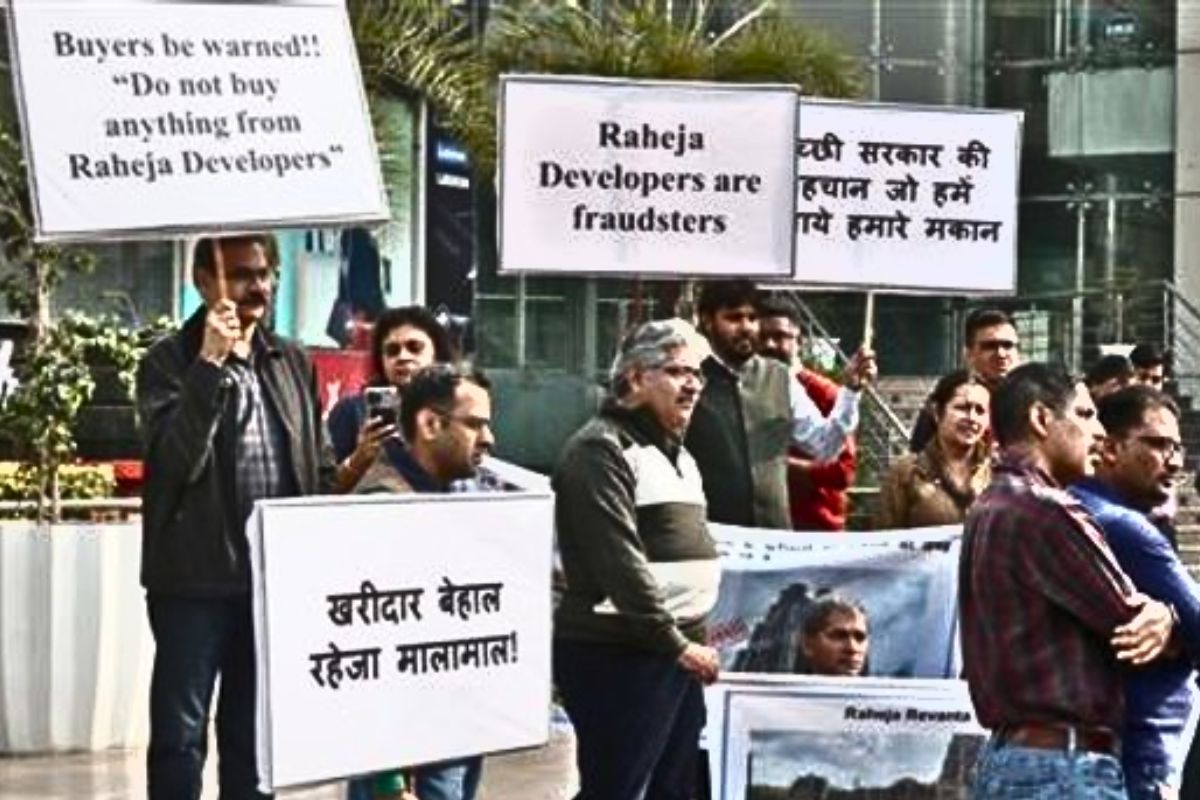
Legal proceedings, attachment orders, and tribunal judgments are, ultimately, abstractions. The concrete reality of this case is the lived experience of the buyers themselves — and their numbers are staggering. The ED has confirmed that approximately 4,600 homebuyers are affected across Raheja’s various projects. The NCLT insolvency petition for Raheja Shilas alone was backed by over 40 buyers asserting a collective default of ₹112.90 crore on that one project. The HRERA ban on Revanta was precipitated by buyers who had waited, and paid, for seven years.
The characteristics of the victim population are consistent and documented across every legal forum. These were buyers, many of them middle-class professionals and salaried families, who had paid 90% or more of the total purchase price of their flats. In many cases, the NCLT petition noted, buyers had paid 100% of every demand letter ever issued by Raheja Developers. They were not in default; they had fulfilled every obligation asked of them. The company, by contrast, had allegedly failed on its core contractual commitment: delivering a habitable flat.
The consequence for these families is not merely financial, though the financial dimension is severe. Many took home loans to fund their purchases — loans on which they continue to pay EMIs, every month, for flats they do not yet occupy, while also paying rent for the homes they actually live in. The dual financial burden of a home loan EMI and market rent, sustained over ten or more years, represents a form of quiet, grinding economic damage that the headline figures of crores cannot fully capture.
Some buyers approached consumer courts and won orders directing the developer to pay compensation and refund money, only to find enforcement of those orders slow and contested. Others filed writ petitions in the Delhi High Court and were given audience at the Supreme Court. The cumulative judicial attention — across consumer courts, RERA, NCLAT, the High Court, and the Supreme Court — is a testament to how thoroughly the normal resolution mechanisms failed to produce results before the ED stepped in.
Raheja’s Defence — Infrastructure, Government Failure, and Denial
Navin Raheja and his company have maintained a consistent public defence, and it is important to engage with it seriously before assessing its plausibility. The company’s position, repeated in statements reported across multiple outlets following the April 2026 raids, rests on two principal arguments.
The first is that the delays at Raheja Revanta and other projects were caused primarily by the government’s failure to provide essential infrastructure — water supply, sewage connectivity, electricity connections, and road access — despite the developer having paid all required External Development Charges and Internal Development Charges. The company argues that it would be irresponsible and potentially dangerous to hand over possession of a 61-storey building without these services in place, and that the blame for the delay lies with the Haryana government agencies that failed to deliver the promised infrastructure.
The second argument is that the company has invested considerably more into its projects than the amount collected from buyers, and that a RERA-supervised forensic audit previously found no evidence of fund diversion.
These are not arguments without weight. Infrastructure failure is a genuine and recurring problem in Gurugram’s development history. Many builders across the NCR have faced legitimate delays caused by delayed road approvals, water connections, and power sanctioning. And a forensic audit finding no diversion is, on its face, a significant defence.
However, several countervailing facts make these defences more difficult to sustain in full. On the infrastructure argument, the project’s licence had expired by January 2023 — a lapse that is entirely within the developer’s control to address through timely renewal applications. The developer did not apply for renewal, which HRERA noted as a separate and independent ground for regulatory action.
On the audit argument, the ED’s PAO explicitly states that its own analysis of seized documents revealed a complex web of fund transfers to related entities — a finding that either contradicts the earlier audit or reveals conduct that was not within its scope. The ED is, by institutional design, a more forensic and adversarial investigator than an audit commissioned through a regulatory authority.
A Pattern Across a Decade — From PMO Probe to ₹1,113 Crore Seizure
The most sobering way to read the Raheja Developers story is as a timeline — to lay out every red flag, in sequence, and ask how a company so repeatedly flagged by so many institutions across so many years could have continued operating with full access to buyers’ money.
2010: Income Tax Department raids; evidence of ₹80–118 crore in tax evasion recovered. ITSC proceedings initiated.
2014: Delhi High Court quashes immunity granted by ITSC to the Rahejas. Supreme Court SLP filed. Simultaneously, PMO asks Haryana to probe Raheja Atharva complaints. And Cobrapost sting catches Raheja officials allegedly willing to accept black money via Dubai.
2019: First insolvency petition over Raheja Sampada. Set aside in 2020, but the pattern of buyer complaints is now fully established.
2023: HRERA bans Revanta sales, freezes accounts, orders forensic audit. The housing regulator specifically created by RERA to protect buyers is now intervening with its most powerful tools.
2024: NCLT admits insolvency petition for Raheja Shilas; board suspended. The corporate insolvency mechanism is now formally activated.
2025: ED raids 13 locations across Delhi, NCR, and Mohali. Money laundering case formally launched under PMLA.
2026: NCLAT rejects Raheja’s bid to close insolvency. ED conducts second raid; seizes bullion worth ₹15.82 crore. ED attaches assets worth ₹1,113.81 crore belonging to related entities and the personal properties of Navin M. Raheja and family.
This is a twelve-year record of escalating institutional concern, each agency picking up where the previous one left off, each finding the same pattern of alleged financial misconduct beneath the polished surface of a branded real estate developer.
What Happens Now — And What It Means for Indian Real Estate
The Provisional Attachment Order of April 28, 2026 is not the end of the case — it is, in the terminology of the PMLA process, a beginning. A PAO must be confirmed by the Adjudicating Authority under PMLA within 180 days. If confirmed, the attached properties can eventually be used to compensate victims. If the ED’s investigation leads to a prosecution complaint (charge sheet) before the Special Court under PMLA, the case moves into the criminal trial stage. For the 4,600 buyers, this is the mechanism through which they may someday recover a portion of what they lost — not through the developer voluntarily honouring their contracts, but through the state seizing and liquidating assets acquired with their money.
In the broader context of Indian real estate, the Raheja case raises a question that policy-makers and buyers alike must answer: why did RERA’s 70% escrow rule, designed precisely to prevent this kind of diversion, prove insufficient? Part of the answer lies in enforcement. RERA’s monitoring of escrow accounts has historically been inconsistent, with limited capacity to audit complex intercompany transactions in real time. The Raheja case has demonstrated that when a developer with sufficient legal and financial resources is determined to move funds, the visible surface of compliance — filed returns, submitted balance sheets, a single forensic audit — can mask an underlying structure of diversion for years.
The second lesson concerns the gap between regulatory action and criminal enforcement. HRERA banned Revanta sales in 2023. That decision, while significant, had no teeth powerful enough to compel the developer to either deliver the project or disgorge the allegedly diverted funds. It was only when the ED — armed with the PMLA’s powers of search, seizure, and provisional attachment — entered the picture that the alleged financial architecture was laid bare.
For the 4,600 families who gave Raheja Developers their life savings, the ED action is simultaneously a vindication and a complication. It is a vindication because it publicly confirms, through India’s most powerful financial agency, that their complaints were not imagined or exaggerated. It is a complication because an arrested board, attached assets, and ongoing investigations do not automatically build a flat. The question of who will actually complete — or appropriately compensate buyers for — Raheja Revanta’s towers, Raheja Shilas’ low-rise blocks, and the other stalled projects remains unresolved, a question that the insolvency process and any eventual PMLA adjudication will need to address.
Conclusion — A Dream That Was Sold, and the Price of Breaking It
The Raheja Developers saga is, at its core, a story about a specific and uniquely Indian aspiration: the desire to own one’s own home. In a country where property ownership carries deep social, emotional, and financial meaning, the act of booking a flat is rarely a casual transaction. It is usually the product of years of saving, family planning, and hope. The buyer who signs a flat booking agreement is not merely purchasing a commodity; they are purchasing a future.
What the Raheja Developers case alleges — and what the ED, the NCLT, the HRERA, and over fifty FIRs collectively suggest — is that this aspiration was instrumentalised. That buyers’ trust was converted into a pool of capital that allegedly flowed not into the towers they were promised, but into shell companies, related entities, personal assets, and bullion stored against a future no one had told the buyers about.

The ₹1,113.81 crore attached by the ED in April 2026 is the number that most headlines lead with. But behind it lies a quieter arithmetic: 4,600 families, many of them paying EMIs for a decade or more, many of them elderly parents who bought for the security of old age, or young couples who bought for the certainty of raising children somewhere stable. Their wait is not yet over. The legal process has years ahead of it. The towers are not built.
The case of Raheja Developers is not merely an indictment of one company. It is a stress test of every institution — regulatory, judicial, and enforcement — that was supposed to stand between a real estate developer’s promises and the savings of ordinary Indian families. Some of those institutions responded late. Some responded partially. The ED has now responded with the full force of PMLA. Whether that will be enough, and whether it will arrive in time to matter for the 4,600 people still waiting for keys, remains the central, unresolved question of this story.