The Cockroach in the Corridors of Power: How IAS Officer Dhiman Chakma Was Caught Red-Handed Taking Bribes, Went to Jail, and Was Quietly Given His Job Back — While India’s Justice System Looks the Other Way

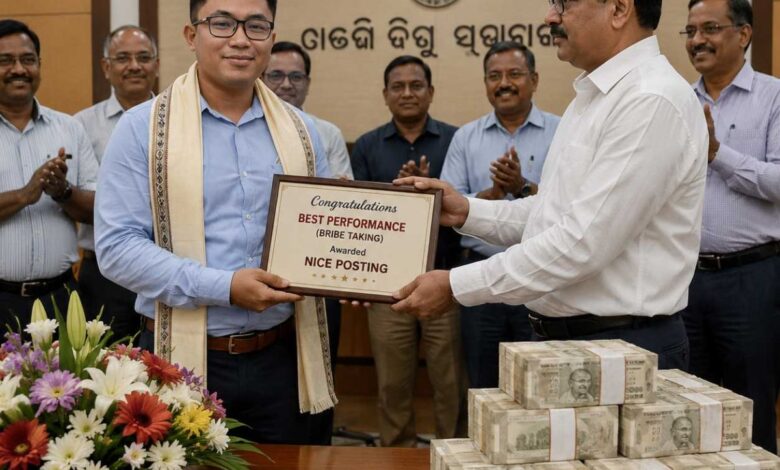
On 8 June 2025, Odisha Vigilance officials laid a trap that should have ended the career of a young IAS officer before it truly began. Dhiman Chakma, a 2021-batch officer of the Odisha cadre and a native of Kanchanpur in Tripura, was caught allegedly accepting ₹10 lakh in bribe money — the first instalment of a demanded ₹20 lakh — from a stone crusher businessman in Kalahandi district.
He was the Sub-Collector of Dharmagarh. A powerful post. A post that controls land, mining permissions, regulatory actions, and the fate of small businesses. According to the complaint, Chakma allegedly threatened the businessman: pay up or face fabricated cases and jail. The businessman recorded the conversation and approached Vigilance.
Vigilance did its job. They prepared marked currency. They set up the trap at Chakma’s own government quarters in Dharmagarh. On that day in June 2025, the complainant allegedly handed over the ₹10 lakh. Chakma was allegedly caught red-handed. Chemical tests on his hands and even the table drawer reportedly tested positive for the bribe money. The entire ₹10 lakh was recovered on the spot.
Then came the house search. Vigilance recovered approximately ₹47 lakh in cash from his official residence. Unaccounted. Unexplained. A 36-year-old IAS officer, not even five years into service, sitting on nearly half a crore in cash while allegedly extorting a local businessman.
He was arrested. Produced before court. Sent to judicial custody. On 10 June 2025, the Odisha government suspended him. For a brief moment, it looked like the system had worked. A corrupt officer had been caught with damning evidence — trap, chemical wash, recovery, and a recorded demand.
Then the familiar Indian story began.
He got bail from the Orissa High Court on 24 July 2025. The case is still pending. There has been no full trial. No conviction. No acquittal. In May 2026 — less than a year after being caught red-handed — the same government that suspended him reinstated him as Deputy Secretary in the Revenue and Disaster Management Department. A sensitive posting. A powerful desk. Back in the game. Back in the corridors of power. Back to deciding the fate of citizens and businesses.
This is not justice. This is a sick joke played on the people of India.
The Evidence Was Not Weak. It Was Brutal.
Let us be very clear about what was reportedly against Dhiman Chakma:
- A specific complaint from a businessman who said Chakma demanded ₹20 lakh and threatened him with false cases.
- Alleged audio recording of the demand and threat.
- A meticulously laid trap by Vigilance.
- Alleged physical acceptance of ₹10 lakh in marked notes.
- Positive chemical test on his hands and the place where the money was allegedly kept.
- Recovery of ₹47 lakh cash from his government residence with no credible explanation.
- The fact that this was not some junior clerk. This was a full-fledged IAS officer who had cleared UPSC twice — first AIR 722 in 2019 (IFS) and then AIR 482 in 2021 (IAS). Educated at NIT Agartala. From a humble background. The first from his family and town to achieve this.
And still, he stands accused of behaving like a common extortionist.
Instead of being hounded out of service, he has been rewarded with a comeback posting while the case drags on. This is the civil services lobby at its most shameless. This is the “we protect our own” culture that has made ordinary Indians lose all faith in the system.
Why Was He Given His Job Back Without Being Acquitted?
Because in India, for the powerful, suspension is temporary punishment and reinstatement is the default. Service rules apparently do not allow keeping an officer suspended for too long without “final disposal.” So the government, instead of fast-tracking the case and throwing the book at him, chose the easiest option: bring him back.
This is not administrative necessity. This is institutional cowardice and protection of the tribe. The same tribe that screams “political interference” the moment any government tries to act against a corrupt officer, but stays deafeningly silent when one of their own is caught with bribe money and unaccounted cash.
Dhiman Chakma is not an aberration. He is a symptom. He represents everything that is rotten in India’s permanent government — the IAS, IPS, and other elite services that have become unaccountable, arrogant, and increasingly corrupt. They enjoy enormous power with almost zero real accountability. They can ruin lives with a single note or file, but when caught, the system bends over backwards to protect them.
These are the real cockroaches of India. Not the small-time criminals on the street. The ones who wear crisp white shirts, sit in air-conditioned offices, clear UPSC with great ranks, and then treat government positions as personal fiefdoms for extortion. They bring shame to the very idea of civil service. They make a mockery of every honest officer who actually works for the people.
The Judiciary Is Not a Solution. It Is Part of the Disease.
The real enabler here is India’s broken judicial system. Cases drag on for 20–25 years. By the time a final verdict comes (if it ever does), the accused has already enjoyed the best years of his life, retired with full pension and benefits, and in many cases, died peacefully. The case continues against a dead man’s ghost.
The Supreme Court has famously said “bail is the rule and jail is the exception.” In theory, it sounds liberal and just. In practice, for the corrupt and the powerful, it has become a licence to commit crimes and roam free. Commit the crime, get anticipatory or regular bail within weeks or months, and then use the endless delays of the system to your advantage.
Dhiman Chakma’s case will likely drag on for another 15–20 years. He will probably retire as a senior officer with full benefits. The case will remain pending even after his retirement. Maybe even after his death. And nothing will happen.
This is why corruption is increasing every single day in India. Because the risk-reward ratio is completely skewed in favour of the corrupt. The reward is huge — power, money, influence. The risk is almost zero. You get caught? You get bail. You get suspended for a few months? You get reinstated. You face trial? The trial never ends in your lifetime.
This is not justice. This is judicial terrorism against the honest and judicial mercy for the corrupt.
Corruption Deserves Death Penalty. Nothing Less.
India has been independent for nearly 80 years. We have 150+ crore people. We still call ourselves a “developing country.” Why? Not because of lack of resources. Not because of lack of talent. Not because of external enemies alone.
It is because of systemic, all-pervasive corruption that eats away at every institution, every scheme, every rupee meant for the poor. Roads collapse, hospitals kill patients, bridges fall, scams run into lakhs of crores — all because someone, somewhere, took a bribe and looked the other way.
If this country is serious about becoming a developed nation, it must treat corruption as an existential threat. Not as a “service matter” or a “long-drawn legal process.”
Corruption must carry the death penalty. Corruption cases must be tried in fast-track courts with a strict 3-month timeline. The accused must remain in jail from the moment of arrest until the trial concludes. No bail for corruption cases involving public servants. Disproportionate assets must lead to immediate dismissal and confiscation.
Anything less is just playing games while the country bleeds.
Dhiman Chakma being reinstated as Deputy Secretary while his bribery case is still pending is not an administrative decision. It is a national insult. It tells every young IAS officer that even if you are caught red-handed with bribe money and unaccounted cash, the system will eventually protect you. It tells every common citizen that in India, if you have the right uniform and the right lobby, you are above the law.
The cockroaches are not just in the drains anymore. They are sitting in government quarters, signing files, and deciding the fate of ordinary Indians. And the worst part? We keep feeding them, protecting them, and giving them bigger and better posts.
Until we change this fundamental reality — with harsh, swift, and final punishment for corruption — India will remain exactly where it is: a nation of 150 crore people still begging for development after eight decades of so-called independence.
Dhiman Chakma’s story is not just about one officer. It is about the rot at the very heart of the Indian state. And until we burn that rot out with fire, nothing will change.