Give Him Any Award and He’ll Come Running: Narendra Modi’s Desperate Global Trophy Hunt, the Farce of Invented Honours, and the Personality Cult That Demands Constant Validation While India Bleeds
This Clearly Shows The Narcissist Behaviour Of Narendra Modi

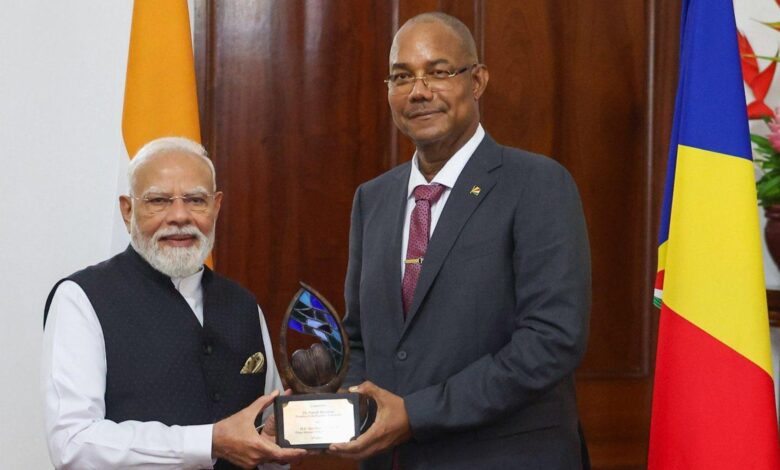
Give him any award, and he’ll come running. The opposition got the line perfect. In late June 2026, as Narendra Modi’s plane touched down in the Seychelles, that tiny Indian Ocean archipelago — population smaller than many Indian cities — scrambled to invent a brand-new “highest” honour just three days before his arrival. The Guardian of the Blue Horizon award. First recipient: Narendra Modi. Only recipient so far. They even threw in a trophy and a certificate.
Except the certificate looked like it was spat out by a rushed AI prompt at 3 a.m. “Repubblic” instead of Republic. “Seycheeles” instead of Seychelles. Spelling errors so basic that schoolchildren would be embarrassed. Software flagged it as AI-generated. The Seychelles foreign ministry later admitted a “working draft” had leaked and promised a corrected version. The award, they insisted, was “genuine.”
Genuine in intent, perhaps. Genuine in desperation, definitely.
This is not diplomacy. This is a middle-aged man with an insatiable appetite for shiny objects, and a host of small nations willing to play along because they know what he wants. Last month it was Israel rushing out the brand-new Medal of the Knesset — another “highest honour,” another first-and-only recipient, created days before Modi landed. In 2019 it was the Philip Kotler Presidential Award, marketed as a serious recognition of “outstanding leadership of the nation” but handed out by a marketing summit and apparently reserved exclusively for one man. Ethiopia’s Great Honour Nishan. Trinidad and Tobago’s Order of the Republic. And now the Seychelles bauble. Over thirty foreign honours in total, many of them invented or dusted off specifically for him.
One wonders what the next small nation on the itinerary will be forced to conjure up. A “Supreme Guardian of the Indian Ocean” medal? A “Eternal Friend of Small Islands” sash? A participation trophy with his name misspelled in Comic Sans because the protocol officer was too terrified to say no?
This is not the behaviour of a confident leader of a rising power. This is the behaviour of a man who needs constant external validation because the domestic record is too threadbare to sustain the myth on its own. Every foreign trip has become less about advancing India’s interests and more about feeding the insatiable domestic propaganda machine that screams “Vishwaguru” while the rest of the world quietly rolls its eyes.
The biographer Nilanjan Mukhopadhyay put it bluntly: the entire exercise is about convincing supporters that Modi’s personal greatness is what is lifting India’s global standing. Not institutions. Not policy. Not collective effort. Just one man. The awards are not for India. They are for the cult.
And what a cult it has become. Statues, stadiums, airports, and expressways bear his name or his mother’s. Government advertisements feature his face and almost nothing else. The prime minister’s office has swallowed the authority that once belonged to cabinet, parliament, and even the states. Criticism of policy is instantly reframed as treason against the leader. The media — or what remains of the independent kind — has been tamed, raided, or bought. The rest cheer on cue like trained seals every time another foreign dignitary pins another medal on the kurta.
Meanwhile, back home, the real India struggles under the weight of this personality project.
Unemployment remains a chronic crisis, especially for the young. Demonetisation — that midnight surgical strike on the poor and the informal economy — still stands as one of the most spectacularly destructive policy decisions in modern Indian history, delivered with the same theatrical flair that now demands new awards on every trip. GST was rolled out in a similarly chaotic, poorly prepared manner. Farm laws were rammed through and then withdrawn only after prolonged, bloody protests that the government first ignored and then tried to crush. The second wave of COVID-19 exposed a healthcare system in collapse while the leadership was busy protecting its image. Bodies floated in rivers. Families begged for oxygen on social media. The supreme leader’s government responded with denial, censorship, and eventually a victory lap once the wave receded.
Democratic institutions have been hollowed out with clinical efficiency. Opposition leaders find themselves raided by the Enforcement Directorate or the CBI at politically convenient moments. Some sit in jail. Others have their parties split or their funding choked. The Election Commission, once a proud institution, now faces accusations of bias so routine that even former officials have expressed alarm. Press freedom rankings have plummeted. Academic and civil society spaces have been systematically intimidated. V-Dem and other democracy trackers have reclassified India from a flawed democracy toward something closer to an electoral autocracy. These are not the complaints of sore losers. These are measurable erosions documented by institutions that once praised India’s democratic resilience.
And still the awards keep coming. Still the planes take off for the next photo-op and the next hastily invented honour. Still the domestic media machine converts every foreign bauble into proof of global adoration. The man who cannot stop collecting certificates has turned the prime minister’s office into a personal legacy project. Everything — every policy, every institution, every foreign visit — must ultimately orbit around one individual’s image.
The Seychelles episode is not an aberration. It is the perfect metaphor. A small nation panics, invents an award overnight, botches the certificate so badly that even AI detectors laugh, then has to issue a sheepish clarification. Why? Because the visitor expects to be honoured. Because the domestic narrative demands it. Because in the Modi era, optics are policy and ego is statesmanship.
One can almost picture the scene in the Seychelles protocol office: senior officials sweating over ChatGPT at the last minute, trying to produce something grand enough for the man who has made collecting foreign validation a central pillar of his political brand. The spelling mistakes are almost poetic. In their haste to flatter, they couldn’t even get the name of their own country right. That is how much pressure the Modi machine exerts on even the smallest hosts.
The taunt from the opposition lands with precision: give him any award, and he’ll come running. The tragedy is that while he runs after these trinkets, the country he leads is left running after jobs, after dignity, after functioning institutions, after a basic sense that the state exists for citizens rather than for the glorification of one man.
History will remember the medals. It will also remember the institutions weakened, the voices silenced, the promises broken, and the quiet desperation of a leadership that needs constant external applause because it cannot generate enough legitimacy from results alone. The trophy cabinet may be full. The nation’s cupboard, in far too many respects, remains bare.
Come running, indeed. The world’s smallest countries are happy to oblige. The question that should haunt every Indian is: at what cost?