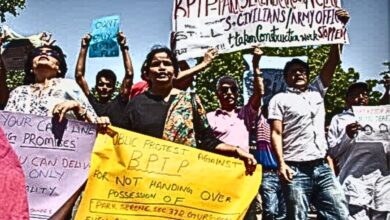
How Kotak Bank Officials Ran A Criminal Nexus To Loot The Public Funds Of Municipal Corporation Panchkula And Used The Proceeds Of Crime To Fund Their Private Luxuries?
Porsches, Watches and a Wife's Law Firm: Inside the Kotak Mahindra Bank Fraud That Robbed Panchkula

Inside the Closed Criminal Nexus: How Kotak Mahindra Officials Allegedly Looted Panchkula to Fund Their Private Luxuries
Some frauds happen because a system has a gap. This one, according to the Enforcement Directorate, happened because the people responsible for closing gaps decided to open one deliberately, and then spent over a year, across three separate ED disclosures, building an elaborate architecture to keep it hidden.
The ED has, over the course of four months, issued three press releases charting the evolution of a single case: the alleged embezzlement of Municipal Corporation Panchkula’s funds through Kotak Mahindra Bank. Read individually, each release adds a layer of detail. Read together, chronologically, they tell a far more damning story, of what the agency itself has called, verbatim in two separate releases, a “closed criminal nexus” of “Municipal Corporation Official, Bank Officials and Private Persons” who “hatched a conspiracy for siphoning of Government funds.”
Chapter One: The Searches (April 23, 2026)
The first public signal that something had gone badly wrong at Kotak Mahindra Bank’s Panchkula branch came on April 23, 2026, when the ED announced it had conducted searches the previous day at 12 premises spread across Chandigarh, Panchkula, Zirakpur, Dera Bassi and Rajpura (Patiala). The searches, the agency said, resulted in the seizure of sale-purchase agreements and other documents linked to the case.
The origin of the case, as described in this first release, was almost mundane: an FIR filed by Haryana’s Anti-Corruption Bureau (ACB) in Panchkula, under provisions of the Bharatiya Nyaya Sanhita and the Prevention of Corruption Act, against unnamed officers of Kotak Mahindra Bank. That FIR alleged the embezzlement of ₹145 crore belonging to MC Panchkula through what the ACB itself described as a “deep rooted, well-organised criminal conspiracy.”

But it was the ED’s own investigation, layered on top of the ACB’s initial FIR, that began to name names and expose mechanics. According to this April release, the agency’s PMLA investigation had already revealed a “closed criminal nexus of Municipal Corporation Official, Bank Officials and Private Persons” working in concert. Three individuals were identified at the core of it: Dileep Kumar Raghav, a Customer Relationship Manager at Kotak Mahindra Bank; Pushpinder Singh, the bank’s Deputy Vice President; and Vikas Kaushik, then a Senior Accounts Officer at MC Panchkula.
The ED alleged that this trio opened two unauthorised bank accounts using forged and fake authorisation documents, all bearing the name of the Municipal Corporation. Genuine funds sitting in MC Panchkula’s real accounts were then allegedly transferred into these unauthorised accounts, using forged fund-migration authorisation letters — paperwork designed to look, on paper, exactly like the routine instructions a municipal body would send its bank.
What makes this April disclosure particularly significant is a detail that would recur, in sharper form, in the ED’s later releases: the alleged manipulation of email verification. The agency stated that “unauthorised email IDs were used by Bank Officials for seeking authorisation for transaction in response to fake and forged authorisation letters” — while the actual, authorised email IDs on record, as confirmed by MC Panchkula officials in statements recorded under Section 50 of PMLA, were entirely different. In plain terms: the bank’s own internal verification loop was, according to the ED, allegedly being answered by the wrong people — people who had every incentive to say yes to fraudulent transactions.
From there, the ED alleged, the diverted funds moved to a set of financiers — Rajat Dahra, Swati Tomar, Kapil Kumar and Vinod Kumar — before being routed back to Pushpinder Singh himself and to his wife, Preeti Thakur. Additional funds, the agency said, were pushed into real estate firms and other private individuals. Throughout all of this, MC Panchkula’s own records reportedly showed no sign that any of this was happening — because the corporation had been handed forged Fixed Deposit Receipts.
According to the ED, these fake documents purported to show 16 FDs worth approximately ₹145.03 crore, with a maturity value of roughly ₹158.02 crore, safely invested with Kotak Mahindra Bank’s Sector-11 Panchkula branch. On paper, the money looked untouched and growing. In reality, if the ED’s account is accurate, it had already been bled out.
The April 23 release ends with searches conducted at the premises of Singh, Dahra, Raghav, Kaushik, Sanat Realtors, Sunny Garg and Kapil Kumar — a list that, even at this early stage, hints at a network extending well past three men into a wider circle of financiers and real estate interests.
Chapter Two: The Arrest (June 1, 2026)
Five weeks after the first searches, the ED moved from investigation to arrest. On June 1, 2026, the agency announced it had taken Pushpinder Singh into custody under Section 19(1) of PMLA, formally labelling him the “master-mind” of the Kotak Mahindra Bank Fraud Case.
The June release largely restates the architecture laid out in April — the two unauthorised accounts, the forged authorisation letters, the diversion of genuine MC Panchkula funds — but sharpens the picture of Singh’s alleged centrality to the operation in one crucial respect. Where the April release had named Dahra, Tomar, Kapil Kumar and Vinod Kumar simply as “financers” receiving diverted funds, the June release goes further: it states that these financiers were “working under the control and directions of Pushpinder Singh,” and that the bank accounts of Rajat Dahra and Swati Tomar specifically — the accounts allegedly used to siphon the bulk of MC Panchkula’s money — were themselves “in control of Pushpinder Singh.”
This is not a small distinction. It is the difference between a fraud in which multiple parties independently benefited, and a fraud in which one man allegedly sat at the centre of a hub-and-spoke network, using other people’s identities and bank accounts as instruments of his own design, before pulling the proceeds back to himself and his wife. The June release states plainly that funds received by these financers were “routed back to Pushpinder Singh and Preeti Thakur,” and that further sums were transferred “to real estate firms and other private persons on the directions of Pushpinder Singh” — language that leaves little ambiguity about who investigators believed was directing the operation.
The Special Judge (PMLA) in Panchkula granted the ED custody of Singh for nine days, until June 9, 2026 — a period presumably used for the custodial interrogation that would go on to inform the far more detailed account the agency would publish two months later.
Chapter Three: The Chargesheet and the Lifestyle It Exposed (August 5, 2026)
If the April and June releases established the mechanics of the fraud, the ED’s August 5, 2026 press release — issued alongside a prosecution complaint filed on July 30 against nine accused, and a Provisional Attachment Order issued on July 29 — is where the human cost, and the alleged personal enrichment, comes into full view.
By this point, the ED’s account of the core conspiracy had solidified: Pushpinder Singh, “in connivance with” Vikas Kaushik and “with the connivance of” Dilip Raghav, had opened the two unauthorised accounts by disregarding genuine MC Panchkula communications entirely and substituting a parallel stream of forged ones. The agency added a new name to the list of alleged conspirators at this stage — Satish Kumar of Kotak Mahindra Bank — describing him too as involved in the siphoning of MC Panchkula’s funds.
The August release also filled in a detail the earlier two had only gestured at: how the alleged fraud evaded detection for as long as it did. The mobile numbers and email IDs linked to both the fake accounts and the genuine MC Panchkula accounts, the ED said, had been quietly updated to numbers and addresses under the “effective control” of Kaushik and Singh — meaning every SMS alert, every email confirmation, every safeguard designed to flag unauthorised activity was, allegedly, being answered by the very people orchestrating the fraud. “In this manner,” the ED stated, “the entire system of checks and balances was completely compromised.”
From the unauthorised accounts, the ED alleges, money flowed onward to Rajat Dahra, Swati Tomar, Kapil Kumar, Vinod Kumar and a person named Sonia, and to entities called S.K. Agrotech and S.K. Agrofirm — a further layering step “to disguise the source of the Proceeds of Crime,” in the agency’s words. Accounts belonging to Tomar and Dahra, again described as under Singh’s effective control, were allegedly used to pull the money back into Singh’s own accounts and those of his wife, Preeti Thakur, and to fund the purchase of immovable property along with luxury cars, watches and furniture.
It is here that the ED’s account moves from forensic accounting into something closer to a lifestyle audit. The agency states that Singh used the laundered proceeds to acquire a fleet that reads like a luxury dealership inventory: a Porsche Cayenne, a BMW 740Li, a BMW X7, a BMW 749i, two Jeep Wranglers (2021 and 2024), a BMW Z4, a Land Cruiser, and a Harley Davidson motorcycle. Several of these vehicles, the ED notes, were sold off to third parties after the fraud came to light — a detail investigators appear to be treating as an attempted scramble to liquidate and disperse assets once exposure became likely.
The August release also alleges that Singh advanced unsecured loans — to individuals named Sunny Garg, Priyanka Garg, Samar Mohan Ranga and Aryan Singh, and to entities including Sanat Realtors, Central Infradevelopers, Sanat Ventures Enterprises, Savage Rechords and Sanat Enterprises — in exchange for interest payments of 3% per month, or 36% annually, paid in cash. If accurate, this represents a second, parasitic layer of illicit enrichment: not merely stealing public money, but redeploying it as high-interest, untraceable private capital, extracting profit twice over from funds that were never his to begin with.
Perhaps most striking is what the ED alleges happened to Singh’s wife’s professional life during this period. The agency states there was an “abnormal increase” in Preeti Thakur’s income from FY 2022-23 onward, alongside a “significant growth in the turnover and profits” of her firm, M/s Chaudhary & Sethi Legal Advisory Pvt. Ltd., beginning FY 2023-24 — a period the ED notes “coincides with the period of the offence.” The agency alleges this firm was used for the “disposal of movable and immovable properties acquired from the Proceeds of Crime” — in effect, allegedly providing a professional, legitimate-looking wrapper around the disposal of stolen assets.
The most brazen single allegation in the August release, however, concerns a property in Sector 2, Panchkula. According to the ED, after the fraud had already been detected, Singh sold this property to his own sister, Gunita Sethi — using funds that had themselves originated from Preeti Thakur’s law firm. The agency describes this as “round tripping,” alleging it was done specifically “to disguise the ownership of these properties for the purpose of alienation from attachments under provisions of PMLA.” If true, this is not merely fraud — it is an alleged real-time attempt to outmanoeuvre the ED’s own asset-freezing powers, using a family member as a legal shield after the walls had visibly begun closing in.
The Numbers, Set Side by Side
Laid end to end, the three press releases chart a case that grew sharper and larger with each disclosure. The April release quantified the alleged fraud through the lens of forged FDRs — 16 fixed deposits worth roughly ₹145.03 crore, with a maturity value of ₹158.02 crore, that existed only on paper. The June release added no new financial figures but confirmed Singh’s arrest and his alleged command over the network of financiers. The August release, drawing on the deeper custodial interrogation and forensic tracing conducted in the intervening months, arrived at a more precise figure: total net funds of MC Panchkula retained in illegal accounts and among intermediaries and beneficiaries amounting to ₹107.24 crore.
Against that embezzlement figure, the ED’s Provisional Attachment Order — issued July 29, 2026 under Section 5(1) of PMLA — covers assets worth ₹131.13 crore: ₹12.85 crore in bank balances and ₹118.28 crore in immovable property. The agency states this constitutes 100% of the embezzled MC Panchkula funds, plus a portion of the cash interest Singh allegedly earned through his private lending operation — a full recovery, the ED notes with evident emphasis, achieved within four months of the FIR’s registration.
Nine accused persons now stand named in the prosecution complaint filed on July 30, 2026, under Sections 44 and 45 of PMLA — a formal escalation from the “unknown officers/officials” language of the original ACB FIR to a fully identified cast of individuals and entities.
What the Pattern, Not Just the Persons, Reveals
It would be easy to read this case as the story of one greedy banker. The ED’s own language resists that framing. Across all three releases, the agency repeatedly uses the phrase “criminal nexus” — not “fraud by an individual,” but a coordinated structure involving a municipal official, multiple bank employees, and a web of financiers, real estate entities and family members.
That structure, if the allegations hold, required cooperation and silence at several distinct points: someone had to approve the opening of unauthorised accounts bearing a government body’s name; someone had to redirect verification alerts away from genuine oversight; someone had to accept forged FDRs as sufficient assurance that ₹145 crore of public money was safe; and someone had to keep processing high-value transactions without a single internal audit catching the pattern for over a year.
This is the uncomfortable core of the case, and it is worth stating plainly, independent of any individual’s guilt or innocence: a municipal corporation’s money was allegedly diverted not through some sophisticated external cyberattack, but through the ordinary internal machinery of a scheduled private bank — the same kind of machinery millions of depositors, and thousands of government bodies across India, rely on every day without a second thought. If the ED’s chronology is accurate, the safeguards that exist specifically to prevent this — SOPs for account opening, verification callbacks, SMS and email alerts — were not bypassed through technical sophistication. They were allegedly answered, calmly and repeatedly, by the very insiders they were meant to catch.
The Question That Outlasts the Chargesheet
The ED’s swift attachment of 100% of the embezzled sum will, understandably, be presented as a success story — proof that the agency can move fast when it chooses to. And it is, in narrow terms, good news for MC Panchkula and the residents whose civic services depend on that money eventually finding its way back.
But recovery of funds is not the same as restoration of trust. Three press releases and four months apart, the ED’s own account has grown from “unknown officers/officials” to a Deputy Vice President, a bank relationship manager, a municipal accounts officer, a second bank employee, a wife’s law firm, a sister’s property, five vehicles worth crores, and a private lending racket charging rates that would make a loan shark blush. Every one of the details assembled in this article is drawn from the agency’s own words — words that describe, allegation by allegation, how completely an institution’s internal controls can be turned inside out when the people entrusted to run them decide otherwise.
The trial, when it comes, will determine guilt. But the question this case leaves hanging over every other municipal body banking with a private institution is one no verdict will resolve: how many other “closed criminal nexuses,” quietly running in plain sight, are waiting for their own reconciliation exercise, their own whistleblower, their own accident of discovery — and how long, this time, will it take?