How Did IDFC First And Kotak Mahindra Looted The Haryana Government Machinery?
Two Banks, One Blueprint: What The IDFC and Kotak Mahindra Frauds Reveal About Haryana's Missing Millions

Coincidences happen once. Patterns happen twice. And when two of India’s most closely watched money-laundering cases of 2026, the ₹645-crore IDFC First Bank–AU Small Finance Bank scam and the ₹107-crore Kotak Mahindra Bank–Municipal Corporation Panchkula scam, turn out to share almost the exact same architecture, it stops being coincidence and starts looking like a documented failure mode. Both cases unfolded in Haryana.
Both involved private banks entrusted with government money. Both were allegedly executed by an inside team pairing a bank official with a government official. And in both cases, once the investigating agencies dug into where the money actually went, the answer was strikingly similar: real estate, luxury vehicles, and a level of personal indulgence that reads less like white-collar crime and more like a spending spree with someone else’s money.
Here is what the two cases, read side by side, actually reveal.
Same State, Same Government Machinery
Both frauds drained the accounts of public institutions functioning under the government apparatus of Haryana. The IDFC-AU case targeted the bank accounts of eight departments of the Haryana Government and two departments of the Chandigarh Administration, alongside two private schools — a sprawl that included the Development and Panchayat Department, the Haryana School Shiksha Pariyojana Parishad, HPGCL, the Haryana State Agricultural Marketing Board, the Pollution Control Board, and Chandigarh Smart City Ltd, among others. The Kotak Mahindra case, by contrast, was narrower in scope but structurally identical in method: it targeted a single civic body, Municipal Corporation Panchkula, but used the exact same technique of forged authorisation to divert its funds.
Both cases surfaced within months of each other in 2026, and both were pursued by overlapping arms of the state: the ED for the money-laundering trail, and either the CBI or Haryana’s Anti-Corruption Bureau for the underlying conspiracy, forgery and corruption charges. The two cases were, quite literally, running on parallel tracks through the same court complexes in Panchkula and Chandigarh.

The Insider Pairing: A Bank Official and a Government Official
Neither fraud was pulled off from outside the system. Both, according to the ED, required someone inside the bank and someone inside the government department to work in concert.
In the IDFC case, the ED names Abhay Kumar, a Relationship Manager at IDFC First Bank, as having “played a key role in facilitating unauthorized banking transactions” and “preparation and processing of forged banking documents.” His government-side counterpart, per the ED, was Naresh Kumar alias Naresh Bhuwani, a Superintendent in the Development and Panchayat Department, described as having acted as a “middle-man for certain Public Servants” involved in the fraud.
In the Kotak Mahindra case, the pairing is even more explicit. The ED states that Pushpinder Singh, the bank’s Deputy Vice President, worked “in connivance with” Vikas Kaushik, then a Senior Accounts Officer at MC Panchkula, along with a second bank employee, Dilip Raghav. Both cases, in other words, needed exactly the same two-sided key: one person who could make a bank’s systems say yes, and one person who could make it look like the government had asked.
Forged Paperwork as the Common Weapon
Strip away the different bank names, and the actual mechanism used in both frauds is nearly identical. Both relied on forged authorisation letters and fabricated fund-transfer instructions to move money out of genuine government accounts. And in both cases, the most damning detail is the same: fake Fixed Deposit Receipts were used to reassure the government body that its money remained safe and was earning interest, when in fact it had already been siphoned away.
In the IDFC case, government departments were reportedly shown forged FDRs, forged RTGS/NEFT request letters, forged debit notes and manipulated bank statements. In the Kotak case, MC Panchkula was allegedly handed forged FDR documents purporting to show 16 fixed deposits worth roughly ₹145.03 crore, maturing to ₹158.02 crore — money that, per the ED, no longer existed by the time those documents were issued. In both cases, the victims were shown a paper trail engineered specifically to delay the moment of discovery.
Hijacking the Alarm System
Perhaps the most technically alarming parallel between the two cases is how both allegedly defeated the verification systems designed to prevent exactly this kind of fraud.
In the Kotak Mahindra case, the ED states plainly that the mobile numbers and email IDs linked to both the fake and genuine MC Panchkula accounts were switched to numbers and addresses under the “effective control” of the accused — meaning every SMS alert and email confirmation meant to flag suspicious activity was, allegedly, being received and approved by the people committing the fraud. The IDFC case shows the same fingerprint: reporting on the broader Haryana scandal has noted that transaction alerts were similarly being routed to a mobile number under the control of an insider rather than the genuine account holder, allowing unauthorised transactions to sail through unnoticed.
In both cases, this is arguably the most damning detail of all — not that forged documents were created, but that the very safeguards meant to catch forged documents were allegedly rerouted to serve the fraud instead.
Layering Through Shell Entities and Intermediaries
Both cases used a similar layering strategy to break the money trail before it reached its final destination. The IDFC case routed funds through shell entities with official-sounding names — Capco Fintech Services, Swastik Desh Projects, RS Traders, SRR Planning Gurus Pvt Ltd, and Maa Vaibhav Laxmi Interiors. The Kotak case relied on a chain of individual “financers” — Rajat Dahra, Swati Tomar, Kapil Kumar and Vinod Kumar — along with entities called S.K. Agrotech and S.K. Agrofirm.
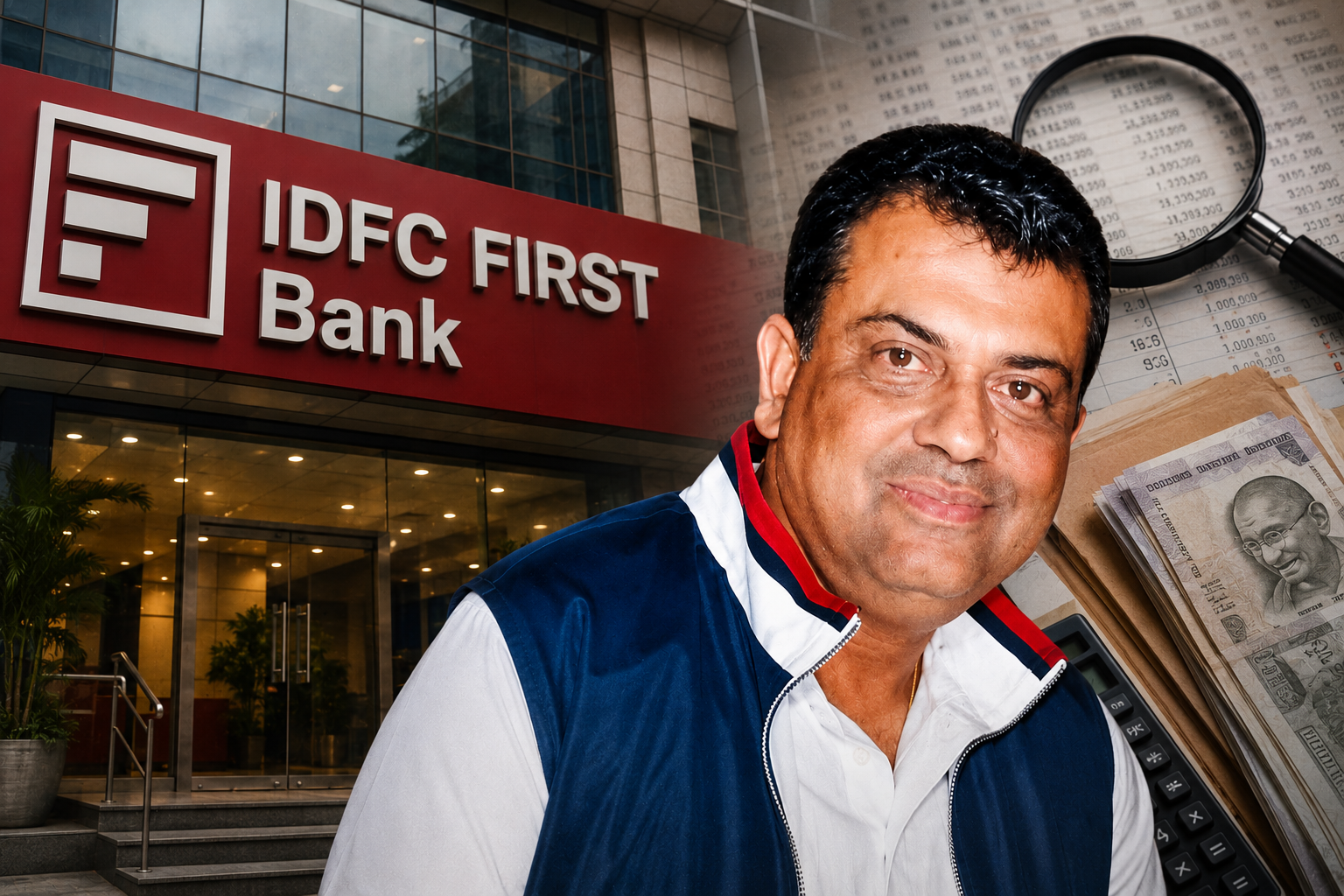
Where the Money Actually Went
This is where the comparison stops being about mechanics and starts being about character — and where both cases converge most uncomfortably.
According to the ED’s July 2026 attachment order and subsequent Tribune reporting, the IDFC scam‘s proceeds funded a lifestyle that went well beyond property investment. Ribhav Rishi, described as the scam’s mastermind, allegedly used siphoned funds to host lavish parties at a rented Zirakpur property, at costs of roughly ₹1 lakh per day and ₹20–25 lakh per event, reportedly including arrangements for entertainment and companionship services that the ED says Rishi himself admitted to during questioning.
Investigators also allege that embezzled money funded foreign and domestic trips — to Thailand, Dubai and Goa — for associates, bank officials and family members, with payments of roughly ₹2.01 crore made on five occasions toward hospitality and companionship arrangements connected to these trips. Separately, the ED alleges roughly ₹4.92 crore was spent on six luxury vehicles, including a Mercedes and a Toyota Fortuner for Rishi, a Range Rover worth ₹2.64 crore for Vikram Wadhwa, and SUVs purchased in the names of Naresh Kumar and Abhay Kumar and their family members.
Wadhwa himself, per the ED, received ₹69.58 crore through his bank account and a further ₹120 crore in cash, which investigators allege he used to purchase multiple houses and plots across Chandigarh and SAS Nagar — paying, the agency claims, tens of crores more in unaccounted cash on top of registered sale prices — along with ₹28.11 crore invested across three real estate firms.
In the Kotak Mahindra case, the ED’s account reads similarly, if with different props: Pushpinder Singh allegedly used diverted MC Panchkula funds to acquire a Porsche Cayenne, multiple BMWs, two Jeep Wranglers, a Toyota Land Cruiser and a Harley-Davidson, alongside luxury watches, furniture and immovable property — several of which, the ED notes, were quietly sold off once the fraud was detected. Funds were also allegedly routed through his wife Preeti Thakur’s law firm, whose turnover the ED says grew abnormally during the period of the offence, and one property was allegedly “round-tripped” to his sister in an attempt to shield it from attachment.
Set beside each other, the pattern is unmistakable: in both cases, the proceeds of crime followed the same predictable path — first into real estate, treated as the safest and most respectable place to park stolen money, and then into personal indulgence, whether that meant a fleet of luxury cars, imported motorcycles, five-star parties, or overseas trips. Family members in both cases — spouses, sons, siblings — appear repeatedly as recipients, intermediaries or, in Kotak’s case, as an alleged instrument for shielding assets from the law.
Banks Fighting Back, and a Shared Institutional Blind Spot
Both cases also produced an unusual second act: the banks themselves pushing back publicly once accountability questions turned toward them. AU Small Finance Bank denied wrongdoing and accused the Haryana government of “forced recovery,” while Kotak Mahindra separately approached the Bombay High Court alleging that Haryana Police had sealed 109 of its branches statewide until it deposited ₹127.27 crore into MC Panchkula’s account — a dispute over whether the institution, not just its employees, should bear the cost of an alleged insider fraud.
The Uncomfortable Conclusion
Two banks. Two sets of insiders. Two entirely separate FIRs, filed months apart, investigated by different teams. And yet, laid side by side, these are not really two different frauds — they are the same fraud, executed twice, with the amounts and the specific luxury purchases as the only meaningful variables. A bank official, a government official, forged paperwork, a hijacked verification system, a chain of shell entities or financers to break the trail, and finally, proceeds converted into property, vehicles and personal excess.

That repetition is the real story here — not just what these individuals are alleged to have done, but what it says about how replicable this scheme apparently was. If two structurally identical frauds could be executed against two different Haryana government banking relationships within roughly the same eighteen-month window, the uncomfortable question is not whether more such cases exist, but how many are currently running, undetected, using precisely the same blueprint — waiting, like these two, for a routine reconciliation to finally give them away.