The ₹6,812 Crore Advertisement Blitz: How Uttar Pradesh Converted Taxpayer Funds Into Political Propaganda While Schools And Hospitals Waited

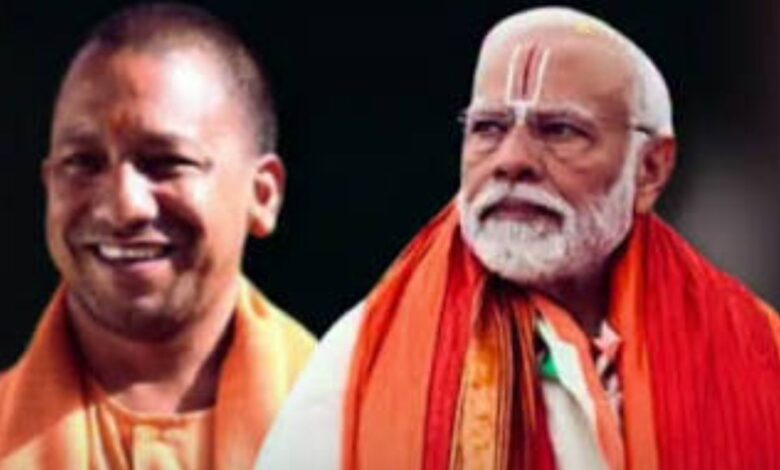
Between the financial years 2017-18 and 2024-25, the Uttar Pradesh government under Chief Minister Yogi Adityanath spent ₹6,811.94 crore on advertisements and publicity through its Information and Public Relations Department. That works out to an average of ₹2.32 crore every single day for 8 years. More than 83 percent of this amount, ₹5,658.16 crore, went specifically to advertising and visual publicity across newspapers, television, and other media.
By comparison, the central government under Prime Minister Narendra Modi spent roughly ₹6,000 crore on advertising over an 11-year period, averaging about ₹1.5 crore per day. In absolute terms and on a daily basis, the Uttar Pradesh state government outspent the Centre. For the ongoing 2025-26 financial year, the state has budgeted another ₹918.83 crore under the same heads. If fully spent, the nine-year total would approach ₹7,731 crore.
These figures come from the state government’s own budget documents, as analysed by Newslaundry. The department’s spending rose steadily after a temporary dip during the first year of the Covid-19 pandemic, more than doubling in subsequent years and peaking around election cycles. Attempts to obtain a detailed breakdown of which media houses, agencies, or platforms received the bulk of the money through Right to Information applications were unsuccessful; the state’s information department declined to share the data.
This is not a minor accounting line. It is a sustained, large-scale deployment of public resources into image management. The question is not whether governments should communicate with citizens. Every democratic administration has a legitimate need to inform people about schemes, welfare programmes, public health measures, and administrative decisions. The question is whether spending at this scale, intensity, and opacity represents communication in the public interest or political branding funded by taxpayers.
Uttar Pradesh is India’s most populous state, home to more than 240 million people. Its development challenges remain formidable: high rates of malnutrition in certain districts, uneven learning outcomes in government schools, gaps in rural healthcare infrastructure, and persistent demands for better roads, sanitation, and employment. Against this backdrop, an average daily outlay of ₹2.32 crore solely on publicity stands out.
Consider what ₹6,812 crore could have financed over eight years if redirected with the same determination. At current construction costs, it could have built tens of thousands of additional classrooms or fully equipped hundreds of primary health centres. It could have funded large-scale teacher training programmes, nutrition supplementation for undernourished children, or last-mile connectivity projects in underserved blocks. Even a fraction of the amount channelled into measurable service delivery would have produced tangible public goods rather than transient media impressions.
The state’s own budget documents show that advertising and visual publicity consistently dominated the Information Department’s outlay. Field publicity, photo services, film production, and community radio received comparatively modest sums. The overwhelming priority was mass-media placement. This pattern suggests a strategic choice: saturation visibility over granular public information or capacity-building within the communication system itself.

Legitimate Communication Versus Political Amplification
Governments everywhere advertise. Central schemes such as Ayushman Bharat, PM-KISAN, or vaccination drives require outreach. State governments similarly need to publicise scholarships, housing schemes, or law-and-order initiatives. Transparent, factual communication strengthens accountability and improves scheme uptake.
Yet the volume and trajectory of Uttar Pradesh’s spending raise structural concerns. When publicity budgets expand rapidly in the years preceding elections, when detailed beneficiary lists of media expenditure remain opaque, and when the daily spend exceeds that of the national government, the line between informing citizens and manufacturing consent becomes difficult to ignore. Public money is being used to project the performance and persona of the ruling dispensation at a scale that private political parties would struggle to match from their own funds.
This is not unique to one party or one state. Successive governments at both central and state levels have increased advertisement spending. What distinguishes the Uttar Pradesh numbers is the absolute magnitude relative to the Centre and the sustained daily average over nearly a decade. The result is a permanent campaign infrastructure funded by the exchequer.
Opportunity Cost: What the Money Could Have Built
Every rupee spent on advertising is a rupee not spent elsewhere. In a state where learning poverty, child stunting, and inadequate primary healthcare continue to constrain human development, the opportunity cost is concrete.
₹6,812 crore could have financed the construction or upgradation of thousands of Anganwadi centres with proper nutrition and early-childhood education facilities. It could have supported the recruitment and training of additional teachers or auxiliary nurse-midwives in districts with the worst human development indicators. It could have accelerated rural road connectivity under schemes that already exist but often suffer from funding gaps or implementation delays. It could have expanded skill-development programmes linked to actual employment outcomes rather than publicity events.
Even within the domain of public communication, the same resources could have been used differently: investing in robust, independent public broadcasting; creating accessible, multilingual information portals that citizens can use without intermediaries; or funding community-level awareness campaigns on health, education, and legal rights that do not require continuous paid media placement. Instead, the dominant channel has been commercial advertising whose primary measurable output is visibility for the government of the day.
The refusal to disclose detailed media-wise or agency-wise expenditure compounds the problem. Without transparency on who received the contracts, at what rates, and under what criteria, it is impossible for citizens or legislatures to assess value for money or potential conflicts of interest. Public funds demand public scrutiny. When that scrutiny is blocked, trust erodes.
The Politics of Permanent Campaigning
Modern politics rewards visibility. Continuous media presence shapes perception, crowds out opposition narratives, and creates an atmosphere of inevitability around the ruling party. Large advertisement budgets amplify this advantage. They allow governments to dominate the information space in a way that opposition parties, civil society, or independent media cannot easily counter with their own resources.
In Uttar Pradesh, the scale of spending has effectively institutionalised a permanent campaign. Scheme launches, infrastructure inaugurations, and administrative claims are packaged into high-production advertisements that air repeatedly. The cumulative effect is not merely information; it is brand reinforcement. The Chief Minister’s image, the government’s claimed achievements, and selective narratives of transformation become the default content of public communication.
This has consequences beyond electoral arithmetic. When the state’s primary communication apparatus is oriented toward political branding, space for critical scrutiny, policy debate, and citizen feedback shrinks. Journalists and citizens encounter a media environment saturated with official messaging. The boundary between the government as administrator and the government as political actor blurs.

A Broader Pattern and a Democratic Cost
Uttar Pradesh is not alone in prioritising publicity. Other states and the Centre have also expanded advertisement budgets. The difference is one of degree and of relative scale. When a single state outspends the national government on a daily basis, it signals that political communication has become a core, well-funded function of governance rather than a supporting activity.
Defenders of high spending argue that effective communication is essential for scheme delivery and that the government has a right — even a duty — to publicise its work. This argument holds only if the communication is primarily informational, cost-effective, and subject to independent evaluation of impact. When the volume of spending rises year after year, peaks around elections, and resists detailed disclosure, the informational justification becomes thinner.
The deeper democratic cost is the normalisation of using public resources for political advantage. Once this becomes accepted practice, every successive government has an incentive to expand the machinery further. The public, whose taxes fund the exercise, is left with fewer resources for schools, hospitals, and roads, and with a media environment tilted toward the incumbent.
What Responsible Public Communication Would Look Like
A different approach is possible. Governments can maintain clear, factual websites and helplines that provide real-time information on schemes without continuous paid campaigns. They can invest in community radio, local language materials, and partnerships with civil society for last-mile awareness. They can subject advertisement budgets to legislative scrutiny and independent audit of outcomes — not merely of expenditure, but of whether the spending improved scheme uptake or public understanding.
Transparency is the minimum requirement. Detailed, real-time disclosure of media placements, rates paid, and selection criteria would allow citizens to judge whether the money is being used efficiently. Caps linked to measurable development outcomes, rather than open-ended annual increases, would force prioritisation.
Most importantly, governments can choose to treat communication as a public service rather than a political investment. The distinction is not semantic. One serves citizens; the other serves the ruling party’s electoral interests with citizens’ money.
Conclusion: Priorities Revealed by Spending of Advertisements
The ₹6,811.94 crore spent by the Uttar Pradesh government on advertising and publicity between 2017-18 and 2024-25 is a matter of public record drawn from its own budget documents. The daily average of ₹2.32 crore exceeds the comparable central government figure. More than four-fifths of the money went into commercial media placement. Requests for detailed recipient data were declined.
These facts do not prove malfeasance. They do demonstrate a clear prioritisation. In a state still grappling with foundational deficits in education, health, and infrastructure, the sustained allocation of thousands of crores to image management reveals what the government values most: visibility.
Public money is finite. Every crore spent on advertisements is a crore not spent on classrooms that lack teachers, health centres that lack medicines, or roads that remain incomplete. The same resources, directed with equal intensity toward measurable public goods, could have altered life outcomes for millions of citizens. Instead, they have financed an eight-year exercise in political branding.

That is not communication in the public interest. It is the conversion of taxpayer resources into political capital. Until advertisement budgets are subjected to the same standards of transparency, economy, and outcome evaluation that apply to other forms of public expenditure, the suspicion will remain that the primary beneficiary is not the citizen but the permanent campaign.