Why Are Global Financial Giants Suddenly Lining Up Behind Jio’s Attempt To Build A Financial-Services Empire?
Bank of America has just made a $1.9 billion bet on Jio Credit, buying its way into one of the world's fastest-growing lending markets. But this isn't just another foreign investment. From BlackRock to Allianz and now BofA, Mukesh Ambani is quietly assembling some of global finance's biggest names around Jio.

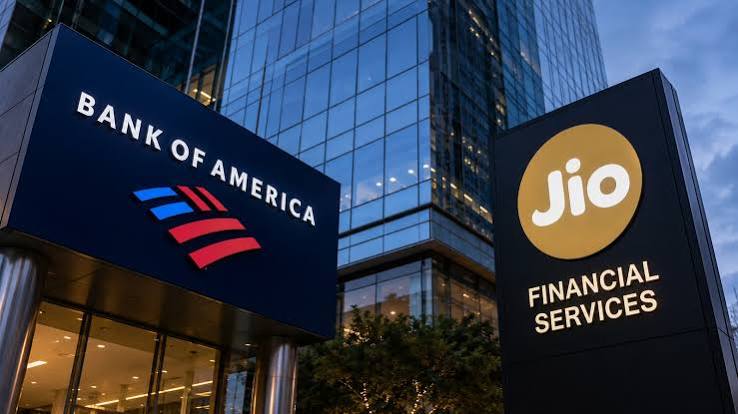
Bank of America is putting $1.9 billion into Mukesh Ambani’s financial-services ambitions, buying up to 49.9% of Jio Credit Limited, the lending arm of Jio Financial Services. The deal starts with BofA taking a 26.5% stake through a preferential allotment of equity shares and warrants. Once those warrants are exercised, its holding could rise to 49.9%, subject to regulatory and statutory approvals.
For Jio, the deal is another sign that it isn’t building its financial empire alone. Instead, it is bringing some of the world’s biggest financial institutions to the table.
Jio has already partnered with BlackRock in asset management and Allianz in insurance. Now, with BofA entering its lending business, the company is adding one of America’s biggest banks to that list.
And the timing matters.
Jio Credit already had ₹30,667 crore in assets under management as of June 30, 2026, with mortgages accounting for 46% of its portfolio, loans against securities for 10%, and corporate and SME lending making up the remaining 44%.
In other words, this isn’t a tiny financial venture waiting to be built. Jio already has the lending business. BofA is buying into the machine. The bigger question is why one of America’s biggest banks wants a piece of it.
Jio Has The Reach BofA Cannot Build Overnight
The logic behind the partnership is fairly simple.
BofA brings the global financial muscle. Jio brings something that is much harder to replicate – access to millions of Indian consumers and a digital ecosystem already woven into everyday life.
That combination is precisely what makes the deal interesting.
Jio’s financial-services business is still relatively young compared with India’s established banks and lenders. But its parent company has spent years building an enormous consumer-facing network through telecom, digital services and retail.
For BofA, plugging into that ecosystem offers a way to participate in India’s expanding lending market without having to build the same local distribution and consumer relationships from scratch.
Analysts say this has been central to Jio’s strategy.
Siddhartha Khemka, head of research for wealth management at Motilal Oswal Financial Services, said Jio has consistently chosen global giants as partners for its financial businesses because they bring capital, credibility and established financial-services practices, while Jio contributes its reach and understanding of the Indian market.
There is also a practical reason for Jio to prefer this model.
Reliance Industries may be a giant, but its traditional strengths have been manufacturing, energy, telecom and consumer businesses – not decades of running a conventional banking franchise.
So rather than trying to become a financial institution entirely on its own, Jio is increasingly doing something else. It is bringing the financial institutions to itself.
BofA Is Getting Into a Market It Cannot Ignore
For Bank of America, the Jio deal is about more than owning a slice of another lending company. It gives the US banking giant a much deeper foothold in India’s rapidly expanding financial-services market.
BofA already has a significant presence in India, particularly across investment banking and other institutional businesses. But retail banking is a different game. Its consumer banking operations are largely focused on its home market in the US.
Jio Credit changes that equation.
Through the partnership, BofA gets exposure to an Indian lending business that already has scale, an established portfolio and a massive local ecosystem behind it.
And the opportunity is hard to overlook.
India has hundreds of millions of consumers moving deeper into formal credit, digital payments and organised financial services. Housing finance, consumer lending, loans against securities and financing for small businesses are all markets where scale can become a serious competitive advantage.
That is where Jio’s reach becomes valuable.
The company does not have to convince consumers to download yet another financial app or discover an unfamiliar lender from scratch. It can potentially use an ecosystem that already reaches consumers across telecom, digital commerce and other services.
For BofA, that makes Jio a useful entry point. For Jio, it provides access to one of the world’s largest financial institutions. And that explains why the deal is being viewed as part of a much larger shift.
Global banks are increasingly looking at India not simply as a market to serve – but as a market worth owning a piece of.
But $1.9 Billion Does Not Automatically Make Jio Credit Stronger
There is another side to the deal.
While the headline number is enormous, analysts are not convinced that BofA’s entry immediately changes the fundamentals of Jio Credit.
One analyst at a private-sector brokerage pointed out that the transaction does not, by itself, improve Jio Financial’s credit rating or materially alter its capital position. The analyst also questioned how much new technology or lending expertise BofA would actually bring, given that its core strength is not running a large retail lending franchise in India.
That raises an uncomfortable question. What exactly is Jio getting for giving away almost half of its lending arm?
The answer may not be visible immediately.
Jio already has the distribution, the customer ecosystem and a lending business with more than ₹30,000 crore in assets. BofA, meanwhile, brings global financial experience, institutional credibility and enormous financial resources.
But translating those advantages into faster loan growth, better risk management or higher profitability will take time.
The partnership could eventually give Jio Credit access to stronger financial expertise and global practices. It could also help BofA understand India’s consumer-credit market from inside a local platform.
But none of that happens simply because the paperwork is signed. The real test begins after the investment. If Jio Credit grows faster, expands its lending products and improves returns, BofA’s entry could look like a masterstroke.
If little changes, the $1.9 billion headline may end up looking far more impressive than the actual impact.
Jio Is Not Giving BofA the Keys
Despite BofA’s near-50% stake, Jio is not handing over control of its lending business.
The two companies will have equal representation on Jio Credit’s board, while the existing management team will continue to run the business and determine its strategy and operations.
Jio Credit will also remain a subsidiary of Jio Financial Services and continue to be consolidated into JFSL’s financial statements.
That detail matters. This is not a foreign bank taking over an Indian lender. It is a partnership in which both sides bring something different to the table. Jio retains operational continuity and its broader financial-services strategy.
BofA gets a significant economic interest in a business positioned inside one of the world’s fastest-growing major economies. And that arrangement fits the larger pattern emerging around Jio’s financial ambitions.
Rather than building every capability internally, Jio appears increasingly willing to share ownership with global specialists in exchange for scale, expertise and credibility.
BlackRock in asset management. Allianz in insurance. And now Bank of America in lending. The names are getting bigger. So is the ambition.
Jio is no longer merely testing the waters of financial services. It is assembling a financial business with some of the world’s biggest institutions sitting on the other side of the table.
The Bigger Bet Is on India’s Borrowers
The BofA-Jio Credit deal ultimately comes down to one thing – the size of India’s credit opportunity.
As more Indians enter the formal financial system, demand for mortgages, business loans, secured lending and other forms of credit is expanding. For global financial institutions, that creates an opportunity that is difficult to replicate in mature markets where growth is slower.
Asutosh Mishra, head of institutional equities research at Ashika Securities, said the reasoning behind foreign institutions taking sizeable stakes in Indian financial companies is fairly straightforward: India’s financial sector is performing well, while the country’s enormous population creates a vast potential customer base.
That is the opportunity BofA is buying into. But Jio is also buying something. A global financial giant now has a direct interest in making its Indian lending operation work. If the partnership delivers, Jio gets access to international expertise and financial muscle while BofA gets a front-row position in India’s expanding credit market.
The immediate market reaction was positive. Jio Financial Services shares rose around 3% to ₹263.35 in early trading after the announcement.
But the market’s first reaction is the easy part. The harder question is what happens over the next few years. Because the real story isn’t that BofA has invested $1.9 billion in Jio Credit.
It is that one of America’s biggest banks has decided India’s borrowers are worth betting billions on.
Jio’s Financial Empire Is Taking Shape
The BofA deal may eventually be remembered as another piece of a much larger Jio experiment.
Reliance has spent years building businesses that put it directly in front of Indian consumers. Telecom gave it the distribution. Digital services added the platform. Retail added another layer of everyday consumer access.
Financial services could tie much of it together. But Jio is approaching that ambition differently from a traditional financial conglomerate. It is not trying to build every capability from the ground up.
Instead, it is bringing in companies that already understand the business. BlackRock for asset management. Allianz for insurance. BofA for lending. The strategy is striking because Jio supplies the scale and local consumer access, while its partners bring decades of financial expertise and global credibility.
That could become increasingly important as Jio Credit moves beyond its existing loan book. The company already has a sizeable presence across mortgages, loans against securities and corporate and SME lending. The next challenge is turning that scale into a consistently profitable and well-managed financial franchise.
For BofA, meanwhile, the calculation is equally straightforward. India is too large, too young and too financially underpenetrated to ignore. And if Jio can turn its enormous consumer ecosystem into a serious lending platform, owning nearly half of that business could prove to be a very valuable way into the market.
The $1.9 billion cheque is therefore only the beginning. The real bet is whether Jio can turn reach into finance and whether BofA can help make that happen.
The $1.9 Billion Question
For now, the deal gives both sides exactly what they want.
BofA gets a sizeable position in one of the world’s most promising financial markets without having to build a retail lending operation from scratch.
Jio gets a heavyweight global financial institution alongside its lending business, adding another layer of credibility as it tries to turn Jio Financial into a serious financial-services player.
But the numbers will ultimately have to justify the partnership.
Jio Credit already has scale. BofA already has expertise and money. What remains to be proven is whether putting the two together creates something significantly bigger than either could have built separately.
That answer will not come from the announcement. It will come from the loan book, growth, profitability and returns over the years ahead.
For now, though, one thing is clear.
BofA has made a $1.9 billion bet that India’s credit boom is only getting started. And it wants Jio sitting next to it when the next phase begins.
And Jio Has Something Global Banks Cannot Buy
There is a reason the world’s biggest financial institutions are willing to partner with Jio. Money is not the problem. Distribution is.
Building a financial-services business across a country as large and diverse as India takes years. It requires customers, data, digital infrastructure, local relationships and the ability to reach people at enormous scale.
Jio already has much of that machinery.
That makes its financial-services push different from a conventional lending startup trying to acquire customers one at a time.
BofA’s investment is therefore as much a bet on Jio’s ecosystem as it is on Jio Credit itself.
And if Jio succeeds in converting that ecosystem into a profitable financial-services platform, the BofA deal could look less like a one-off investment and more like the moment global finance formally bought into the Jio model.
The $1.9 billion cheque gets the headlines. What Jio does with BofA’s money, expertise and global credibility will decide whether it deserves them.
The Last Bit, The Real Test Starts Now
The excitement around the deal is easy to understand.
A $1.9 billion investment from Bank of America is a serious vote of confidence. It puts Jio Credit in the company of a global financial giant and reinforces the growing appetite for India’s lending market.
But the partnership still has something to prove. Jio needs to show that its enormous consumer reach can translate into a larger, smarter and more profitable lending business.
BofA needs to show that its presence adds more than a famous name to the shareholder list. And both companies need to prove that the combination of global financial expertise and Jio’s local scale can produce better results than either could achieve alone.
The early share-market reaction has already delivered its verdict. Now comes the harder one. The next verdict will come from the numbers.