Uber And Rapido Were Ready To Join Forces Until One Question Blew It All Up
Uber came looking for a combination. Rapido came back with a plan to buy Uber India. What followed was less a merger discussion than a fight over who would hold the keys. The talks collapsed, but the rivalry has only intensified, with both companies now racing to dominate India's booming ride-hailing market.

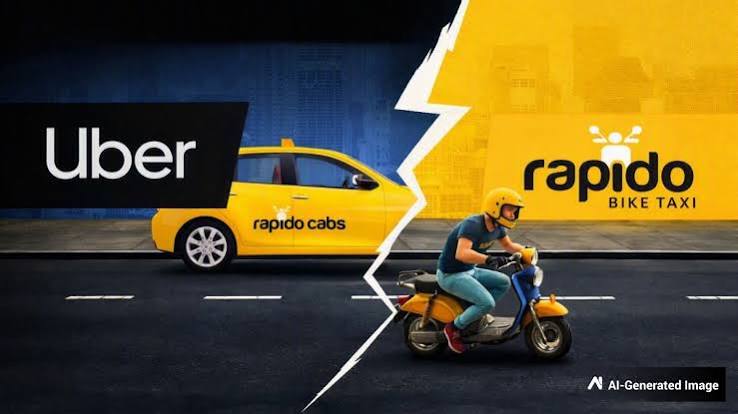
Uber was looking for a way to bring its India business together with Rapido. Instead, it found itself staring at a proposal that could have put its Indian operations in the hands of its biggest rival.
The talks took place during Uber CEO Dara Khosrowshahi’s visit to India, when he met government officials, business partners and Uber employees. He also sat down with Rapido cofounder and CEO Aravind Sanka and other senior executives to explore a possible combination of the two businesses.
But this was not a straightforward merger.
Uber was reportedly looking at bringing its India operations together with Rapido under Rapido’s management. For Uber, the idea was to combine two competing businesses while creating a stronger position in a market where Rapido had pulled ahead, particularly in two-wheelers.
Rapido, however, had a different idea. The Bengaluru-based startup proposed acquiring Uber’s India operations through a cash-and-stock transaction, with Uber retaining a minority stake in the combined business.
And that is where the conversation changed.
What Uber was considering as a combination looked increasingly like an acquisition from Rapido’s side. The two companies were no longer discussing simply how to put their businesses together. They were discussing who would actually control what came next.
That difference proved too big to bridge. The talks eventually collapsed without a deal.
Then Came The Control Problem
On paper, a combination of Uber and Rapido could have made plenty of sense.
Uber brought a global brand, a large cab business and years of experience in India. Rapido brought something Uber has struggled to dominate – the country’s massive two-wheeler mobility market.
But a merger only works when both sides agree on who gets to call the shots.
That was the problem here.
Uber’s proposal reportedly involved bringing the two India businesses together under Rapido’s management. Rapido’s counterproposal went much further. It offered to acquire Uber’s India operations through a mix of cash and stock, while allowing Uber to retain a minority holding.
For Rapido, that would have meant gaining control of one of its biggest competitors. For Uber, it was a very different proposition.
The US-based company was not prepared to effectively exit India or hand over control of an operation it had spent years building. What Uber saw as a possible combination, Rapido appeared to be positioning as an acquisition.
And the distinction mattered.
As one source told, Uber was looking at a combination, while Rapido’s proposal was closer to an acquisition of Uber’s India business. Once the two sides were looking at fundamentally different endgames, the talks had nowhere obvious to go.
The merger wasn’t killed by valuation, technology or market opportunity.
It was killed by the most basic question in any corporate deal – who gets the keys?
Uber Was Not Ready To Walk Away
For Uber, India is not a market it appears ready to abandon.
The company has spent years building its presence across Indian cities, competing with Ola, Rapido and a growing list of newer mobility platforms. Giving up control of that business would have meant surrendering more than an operating unit. It would have meant stepping back from one of the world’s fastest-growing ride-hailing markets.
That helps explain why Rapido’s counterproposal was a problem.
A cash-and-stock deal that left Uber with only a minority stake would have fundamentally changed Uber’s position in India. Instead of running its own operation, it would effectively become a financial stakeholder in a business controlled by its former rival.
Uber was unwilling to go that far.
The talks therefore ended without an agreement. Rapido later denied that it was planning such a transaction, telling Inc42 that there was “no truth to the speculation” and that it remained focused on independently building its mobility business.
Uber, meanwhile, declined to comment on what it called market speculation and private conversations. But what happened next is perhaps more revealing than either company’s response.
Rather than retreating, Uber has been pushing deeper into the very segment where Rapido has built its biggest advantage – bike taxis.
And that puts the failed talks in a rather different light. This was not simply two companies exploring a merger and walking away. It was two rivals testing whether they could become one – while neither was prepared to surrender the wheel.
Rapido Is No Longer The Scrappy Challenger
There was a time when Rapido was the smaller player trying to find space in a market dominated by Uber and Ola.
That is no longer the picture.
Rapido has steadily turned its early advantage in bike taxis into a much broader ride-hailing business. Industry estimates now put the startup at nearly half of India’s overall ride-hailing volumes, with an estimated 60% to 75% share of the two-wheeler segment.
It has also built a meaningful presence in four-wheelers, commanding an estimated 20% to 30% share of the cab market. That scale has given Rapido something it did not have a few years ago – the ability to negotiate from a position of strength.
The startup also added serious firepower to its balance sheet in May, raising $240 million in primary capital in a round led by existing investor Prosus, with WestBridge Capital, Accel and other investors participating.
The fundraise was part of a larger $730 million primary-and-secondary transaction that valued Rapido at around $3 billion post-money.
The money is earmarked for exactly the kind of expansion that makes Uber’s India challenge harder – entering new markets, expanding its driver network, strengthening existing operations, and spending more on technology and hiring.
In other words, Rapido is not simply defending the territory it has already captured. It is using fresh capital to expand it. And that helps explain why a company that began as a bike-taxi startup could sit across the table from Uber and propose buying its India operations.
Rapido may still be younger than Uber. But in India’s ride-hailing battle, it is no longer the underdog.
Uber Is Fighting Back
If Rapido is using its new war chest to expand, Uber is doing something similar – only from a very different starting point.
Earlier this week, Uber announced that it was taking its Bike service to 100 more cities, expanding its overall India footprint to more than 220 cities across 18 states and one Union territory.
The new markets include places such as Jammu, Tirunelveli, Silchar and Jamnagar. On the surface, it is simply another expansion announcement. But look at where Uber is expanding and the move becomes more interesting.
Bike taxis are Rapido’s strongest territory. The startup has built its dominance around two-wheelers, making them one of the biggest reasons it has been able to challenge Uber on its own turf.
Uber is now going after that territory more aggressively.
The expansion also takes the battle beyond India’s biggest metros. Smaller cities are becoming increasingly important to ride-hailing companies as they look for the next pool of passengers and drivers.
For Uber, that means building scale before newer competitors can lock up those markets. For Rapido, it means defending an advantage that helped turn it from a bike-taxi startup into a major mobility company.
And with both companies expanding at the same time, the logic behind a possible combination becomes easier to understand.
They had something the other wanted. Rapido had the two-wheeler dominance. Uber had the established cab business and global scale. What neither side could agree on was who should control the combined business.
India’s Ride-Hailing Market Is Getting Crowded
The Uber-Rapido talks were unfolding at a time when India’s ride-hailing market was becoming far more crowded.
The opportunity is hard to ignore. India’s ride-hailing services market is estimated at around $2.9 billion in 2026 and is projected to reach nearly $11 billion by 2033, representing a compound annual growth rate of about 20.7%.
That growth is attracting companies well beyond the traditional Uber-Ola-Rapido triangle.
Automakers are getting into the business too. VinFast-backed Green SM entered India with an all-electric ride-hailing service, while platforms such as Bharat Taxi, Trevel and Plush Miles are also trying to establish themselves.
And they are not necessarily trying to win by copying the old playbook.
Some are betting on electric fleets. Others are offering lower commissions or trying to build more driver-friendly models. The objective is the same – find a weakness in the established platforms and use it to carve out market share.
That makes the Indian market increasingly difficult for the incumbents.
For passengers, the competition can mean more choices and potentially more competitive fares. For drivers, platforms are competing for their availability and loyalty. And for the companies themselves, every additional ride has to make sense against incentives, commissions, fuel or charging costs, and the cost of keeping the network running.
The result is a market where scale alone is no longer enough.
Companies need drivers. Drivers need enough rides to stay. Passengers need cars and bikes available when they want them. And the platforms need to make the economics work on both sides.
That is why the fight between Uber and Rapido matters beyond the two companies. India’s ride-hailing market is getting bigger. But it is also getting harder to win.
The Battle Is Moving Beyond Uber And Ola
For years, India’s ride-hailing story was largely framed around Uber and Ola fighting for the same passengers.
Rapido changed that equation.
Its rise showed that India’s mobility market could be attacked from a different direction – starting with two-wheelers, building a large driver network and then expanding into four-wheelers.
Now, even that three-way contest is beginning to look outdated.
The next phase of the battle is likely to be decided by who can build the strongest combination of drivers, vehicles, fares and economics.
Driver retention is particularly important. A platform can have millions of potential customers, but if there are not enough drivers willing to accept rides, the service quickly falls apart. That makes commissions, incentives and earnings just as important as passenger demand.
Fleet availability matters too. So does pricing. Platforms have to remain attractive enough for passengers without making every ride a loss-making exercise.
And underneath all of it sits the issue that every mobility company eventually has to confront – unit economics. This is where the growing number of competitors could make things uncomfortable for everyone.
New entrants can afford to experiment with lower commissions, EV fleets or different driver models. Existing players have to defend their market share while continuing to invest heavily in technology, incentives and expansion.
That creates a strange contradiction. The market is growing rapidly, but there are also more companies fighting over it. Which brings the failed Uber-Rapido talks into sharper focus. A combination between the two would not simply have removed one competitor.
It could have brought together Uber’s scale and Rapido’s two-wheeler dominance at a time when everyone else is trying to find a way into the same market.
The Deal That Could Have Changed The Market
Had Uber and Rapido actually managed to put their India operations together, the country’s ride-hailing market could have looked very different.
The combination would have brought together two very different strengths.
Uber has the established cab network, a globally recognised brand and years of experience operating at scale in India. Rapido has built an unusually strong position in two-wheelers and has expanded that advantage into the broader ride-hailing market.
Put those pieces together and the resulting company would have had a formidable presence across both bikes and cars. It could also have changed the competitive pressure on everyone else.
Ola would have faced a much larger rival. Newer players would have had to compete against a company with significant scale on both sides of the mobility market. Even drivers could have found themselves dealing with a more concentrated platform ecosystem.
But that is precisely what makes the collapse of the talks interesting. The opportunity was clearly large enough for the two rivals to sit down and explore a combination. The problem was that the two sides appeared to have very different ideas about what that combination should actually look like.
Uber wanted a deal that kept it from simply disappearing from India. Rapido wanted a transaction that would effectively put Uber’s India operations under its control.
The potential prize was enormous. But so was the question of who would get to run it. And in the end, that question proved bigger than the deal itself.
The Last Bit, The Deal Is Dead But The Fight Is Not
The Uber-Rapido talks may have ended, but the competition that brought the two companies to the same table is only getting fiercer.
Rapido has fresh capital, a growing presence across India’s mobility market and a commanding position in two-wheelers. Uber, meanwhile, is expanding its Bike service into another 100 cities and pushing deeper into markets where Rapido has built its strongest advantage.
Neither company appears to be preparing to step aside. And that may be the biggest takeaway from the failed talks. For a brief moment, two fierce competitors considered whether combining their businesses made more sense than continuing to fight each other.
They couldn’t agree on who would control the combined company. So they went back to competing.
Now the race is moving into smaller cities, deeper into bike taxis and further into the economics of keeping drivers and passengers on the platform.
The merger didn’t happen.
But the question that brought Uber and Rapido together in the first place remains.
In a market growing this fast, is it better to beat your biggest rival — or own it?
For now, both companies have chosen to keep fighting.