₹35,715 Crore In Technical Write-Offs, ₹7,817 Crore In Haircuts: The Missing Names Behind Bank Of Baroda’s Loan Losses
Bank of Baroda has disclosed a staggering ₹35,715 crore in technical write-offs involving loans above ₹100 crore, alongside ₹7,817 crore surrendered through settlements and haircuts. The numbers are public. The borrowers are not. First, what exactly is privacy protecting when the underlying transaction involves public money and a public-sector institution? Second, does borrower confidentiality serve the same public interest after a loan has resulted in a massive write-off or a settlement involving a substantial haircut? Third, where does legitimate commercial confidentiality end and public accountability begin?


Bank of Baroda has disclosed a number that is difficult to ignore: between FY2020-21 and FY2025-26, the public-sector lender technically wrote off ₹35,715 crore in loans belonging to accounts with exposure of more than ₹100 crore. Over the same period, it reported recoveries of ₹9,946 crore from such accounts, while separately disclosing ₹7,817 crore in write-offs or haircuts arising from settlements. What the bank has not disclosed, however, is who the borrowers were.
The figures emerge from an RTI response to activist Vivek Velankar, who had sought details of large loan accounts that were technically written off, including the names of borrowers and the amounts involved, as well as information on borrowers whose accounts were settled through the NCLT or similar mechanisms after banks accepted haircuts. Bank of Baroda provided aggregate figures, but declined to provide borrower-wise details, citing provisions of the RTI Act relating to personal information, third-party information and commercial confidentiality.
That creates an unusual information gap. The public can see the scale of the financial concessions made by one of India’s largest public-sector banks, but cannot see the individual accounts that produced those numbers. The bank’s response therefore tells us how much was written off and how much was recovered, but not which borrowers were involved, what circumstances led to the write-offs, how much was recovered from each account, or what decisions were taken before the bank concluded that writing off or settling those exposures was the appropriate course.
There is an important distinction here. A technical write-off does not necessarily mean that a bank has abandoned its right to recover the money, nor does a haircut accepted during an insolvency or settlement process automatically indicate that a borrower received an improper concession. Banks routinely write off loans for accounting purposes while continuing recovery efforts, and insolvency proceedings can require creditors to accept less than the amount originally owed when that represents the most realistic recovery available.
But the distinction does not make the numbers any less significant.
When accounts involving more than ₹100 crore each result in technical write-offs running into ₹35,715 crore, and settlements involving such large accounts separately involve ₹7,817 crore in write-offs or haircuts, the question moves beyond accounting treatment and into the territory of public accountability: who were the borrowers behind these amounts, why did the bank accept these outcomes, and how were those decisions scrutinised?
The Bank Disclosed The Numbers, But Not The Names
Velankar’s RTI application was more specific than simply asking how much Bank of Baroda had written off. He sought the names of borrowers whose loans above ₹100 crore had been technically written off during the relevant financial years, together with the amounts involved, and separately sought borrower-wise information on accounts settled through the NCLT or similar mechanisms where the bank had accepted haircuts. The intention was to connect the aggregate numbers to the individual loan accounts that had produced them.
Bank of Baroda declined to provide that information. For the technical write-off query, the bank treated the requested borrower information as personal and third-party information and invoked Section 8(1)(j) of the RTI Act, 2005, which concerns information whose disclosure would cause an unwarranted invasion of privacy. For the request concerning NCLT and other settlement mechanisms, the bank additionally relied on Sections 8(1)(d) and 8(1)(e), relating respectively to commercial confidence and information held in a fiduciary capacity.
The response therefore draws a sharp line between what the bank considers permissible public disclosure and what it considers protected information. The aggregate value of the write-offs can be disclosed, as can the broad period over which they occurred, but the identities of the borrowers and the account-wise amounts that would allow individual cases to be reconstructed have been withheld.
That distinction matters because an aggregate figure, however large, does not reveal the circumstances behind it. A ₹1,000-crore account and ten ₹100-crore accounts may produce the same headline number, but the recovery prospects, collateral position, litigation history, settlement terms and reasons for the eventual write-off could be entirely different. Without borrower-level information, there is no way from this RTI response alone to determine whether the amounts represent routine commercial losses, unsuccessful recovery efforts, insolvency resolutions, settlements reached after prolonged litigation, or cases involving allegations of borrower misconduct.
The bank’s refusal, therefore, does not establish that anything improper occurred in the accounts it has declined to identify. Equally, the aggregate disclosure cannot by itself explain whether the public interest was adequately served in each individual case.
It leaves the central question unresolved: when a public-sector bank discloses that thousands of crores have been written off or surrendered through settlements, how much information should the public be entitled to see about the borrowers and decisions behind those numbers?
The ₹35,715 Crore Figure Needs To Be Read Carefully
The ₹35,715 crore figure is the most striking number in the RTI response, but it also needs to be understood correctly. Bank of Baroda describes these as technical write-offs, which are accounting actions through which a bank removes a loan from its books after recognising the corresponding loss; they do not, by themselves, mean that the underlying borrower has been released from the obligation to repay or that recovery proceedings have necessarily come to an end.
That distinction becomes important when the write-off figure is considered alongside the ₹9,946 crore that Bank of Baroda says it recovered from accounts above ₹100 crore during the same period. The recovery figure demonstrates that a technical write-off and an end to recovery are not necessarily the same event, although the RTI response does not provide sufficient account-wise information to determine how much of those recoveries came from particular written-off accounts or when those recoveries took place in relation to the original write-offs.
The bank has also disclosed ₹7,817 crore in write-offs or haircuts associated with the settlement of large accounts through the NCLT and similar mechanisms. That number represents a different category of concern because a haircut involves the creditor accepting that it will recover less than the amount it had originally claimed, typically because the recovery available through a resolution or settlement is considered preferable to the alternatives. In an insolvency process, accepting such a reduction can be a rational commercial decision if the alternative is a substantially smaller recovery or a prolonged and uncertain legal process.
Yet the sheer scale of the numbers makes the underlying decisions worthy of scrutiny. A cumulative technical write-off of ₹35,715 crore across accounts above ₹100 crore, alongside ₹7,817 crore in settlement-related write-offs or haircuts, represents a substantial amount of lending exposure that has ultimately failed to return to the bank in full. The RTI figures do not establish that these losses were caused by misconduct, negligence or preferential treatment, but they do establish the financial magnitude of the problem.
There is also a crucial difference between asking whether the bank was entitled to write off a loan and asking whether the bank made every reasonable effort to prevent the loss from occurring in the first place.
The first is largely an accounting and recovery question; the second goes to the quality of credit appraisal, monitoring, collateral management, recovery strategy and institutional accountability. The RTI response does not answer the second set of questions, because it provides neither the borrower identities nor the individual histories of the accounts.
That is ultimately why the missing names matter. Without them, the ₹35,715 crore remains a powerful aggregate statistic, but it cannot yet become a transparent account of how individual lending decisions went wrong, how much money was ultimately recovered from each borrower, what settlements were accepted, or whether anyone was held accountable where a loan had deteriorated because of failures that could have been prevented.
The Recovery Number Tells Another Story
The ₹9,946 crore recovered by Bank of Baroda from large accounts during the same period provides an important second measure of what happened to these loans, although the RTI response does not provide enough account-wise information to establish how those recoveries relate to the ₹35,715 crore in technical write-offs. The two figures therefore should not simply be presented as opposite sides of the same transaction, because a recovery may occur after a technical write-off, may relate to an account that was written off earlier, or may arise from recovery action that continued even after the loan had been removed from the bank’s active books.
What the figures do establish is that recovery activity continued alongside the write-offs, and that the bank was able to recover a significant amount from large accounts even within the period for which it disclosed the data. That is important because it complicates any simplistic reading of the ₹35,715 crore figure as money that the bank simply abandoned. A technical write-off is an accounting recognition of a loss, whereas the subsequent recovery process can continue through settlements, enforcement of security, legal proceedings and other mechanisms available to the lender.
At the same time, the aggregate recovery figure leaves several questions unanswered because the RTI response does not identify the accounts from which the ₹9,946 crore was recovered or explain the proportion recovered before and after technical write-off. Without that information, it is impossible to determine whether the recoveries were concentrated in a relatively small number of accounts or distributed across a much larger pool of borrowers, just as it is impossible to establish from the aggregate figures whether some of the largest written-off accounts eventually produced substantial recoveries while others produced very little.
The same problem applies to the ₹7,817 crore in settlement-related write-offs or haircuts. A haircut can represent a difficult but commercially defensible decision when a bank calculates that accepting a reduced amount is preferable to pursuing an uncertain recovery for years, particularly where the borrower is already before the insolvency forum and the value of the available assets is deteriorating. But the financial logic of such a decision can only really be assessed when the underlying account, the amount originally owed, the assets available, competing claims, the recovery offered and the alternatives considered are known.
That is the information the RTI response does not provide. Instead, it gives the public the final aggregate outcomes without the underlying case histories. The result is that the numbers reveal the scale of the banking problem, but not yet the quality of the decisions made in dealing with it. For a public-sector lender, that distinction is significant because the question is not merely how much was ultimately recovered, but whether the bank’s lending, monitoring and recovery decisions gave it the best possible chance of recovering the money in the first place.
The NCLT Haircut Question Is More Complicated
The ₹7,817 crore figure relating to write-offs and haircuts through the NCLT and similar settlement mechanisms needs to be examined separately because a reduction in the amount recovered from a borrower is not, by itself, evidence that the bank acted improperly. The insolvency framework is specifically designed to maximise recoveries from distressed companies, and creditors may accept an amount below their original claim when the available resolution offers a better outcome than liquidation, prolonged litigation or further deterioration in the value of the underlying assets.
The difficulty lies in the fact that Bank of Baroda has disclosed the aggregate value of these concessions without providing the borrower-wise information requested through the RTI application. That makes it impossible to assess the commercial reasoning behind the ₹7,817 crore figure on a case-by-case basis. The public cannot determine from the response which borrowers were involved, what their original outstanding liabilities were, what assets or securities were available, how much was ultimately recovered, what competing resolution proposals existed, or why the bank concluded that accepting a particular haircut represented the best available recovery.
This distinction becomes particularly important when the amounts involved are measured in thousands of crores. A haircut of 20% on a large account and a haircut of 90% on another may both appear in an aggregate figure, but they raise very different questions about the circumstances surrounding the underlying loans. Similarly, a settlement that produces a substantial recovery from an otherwise distressed borrower cannot automatically be placed in the same category as an account in which the bank ultimately recovers only a small fraction of the amount originally owed.
The NCLT process also introduces another layer of complexity because banks do not make these decisions in a vacuum. Resolution plans are considered within a statutory framework, and the eventual recovery can depend on the value of the distressed company, the claims of other creditors, the availability of assets and the competing proposals placed before the insolvency process. The fact that a bank accepts a haircut therefore does not, by itself, establish that it has been excessively accommodating towards a borrower.
But the absence of borrower-wise disclosure makes it difficult for an outside observer to determine whether that principle applies consistently across all the accounts represented by the ₹7,817 crore figure. It prevents a meaningful comparison between the amount originally owed, the amount eventually recovered and the extent of the concession accepted in individual cases. It also makes it difficult to establish whether the largest haircuts were driven by genuine insolvency constraints or whether there were other circumstances that warranted closer scrutiny.
That is where the question of transparency becomes more important than the simple question of whether a haircut is justified. The issue is not whether Bank of Baroda should recover every rupee from every distressed borrower; it is whether the public can meaningfully examine the decisions through which thousands of crores of public-sector banking exposure were ultimately written down.
Why The Missing Names Matter
The refusal to disclose borrower identities becomes more consequential when the scale of the underlying amounts is considered. Bank of Baroda is not dealing here with a series of small, routine retail loans in which the identity of an individual borrower might reasonably raise straightforward privacy concerns; the RTI request concerns accounts above ₹100 crore, and the aggregate value of the technical write-offs disclosed by the bank runs into tens of thousands of crores. At that scale, the question of confidentiality inevitably comes into contact with a different principle: the public interest in understanding how a public-sector bank manages very large exposures and what happens when those exposures ultimately fail.
That does not mean that every borrower whose account has been written off should automatically be labelled a defaulter, much less accused of wrongdoing. A company can become financially distressed for reasons that have nothing to do with fraud or deliberate default, and a technical write-off can take place even while the bank continues to pursue recovery. Similarly, a settlement through the insolvency process may reflect the economic reality that recovering the full amount is no longer possible. The RTI response itself does not provide evidence that the borrowers behind the ₹35,715 crore figure acted improperly.
The transparency question is therefore narrower, but arguably more important. If the bank can disclose the aggregate value of the losses, the number of years over which they occurred and the amount recovered from large accounts, why should the public interest necessarily end at the point where the figures need to be connected to individual cases?
Without that information, there is no practical way for an outside observer to examine whether the largest losses arose from genuinely unavoidable business failures, aggressive lending decisions, inadequate monitoring, weak collateral protection, unsuccessful recovery efforts or some combination of these factors.
This becomes particularly relevant for a public-sector institution because the consequences of large credit failures do not remain confined to the relationship between a private lender and a private borrower. Bank of Baroda is a state-owned bank, and its lending decisions ultimately form part of a financial system in which public capital, depositor confidence and institutional credibility are involved. That does not eliminate legitimate confidentiality protections, but it does make the question of where confidentiality should end and public accountability should begin considerably more significant.
Velankar’s criticism rests on precisely this tension. He argues that banks are often far more willing to expose small borrowers to public recovery pressure while large borrowers whose accounts involve substantially greater sums remain protected from comparable scrutiny.
Whether that comparison is valid across the banking system cannot be established from this RTI response alone, but the underlying question is difficult to dismiss: if the public is told that ₹35,715 crore in large loans has been technically written off and another ₹7,817 crore has been given up through settlements or haircuts, should it not also be able to understand the individual decisions that produced those numbers?
The answer cannot simply be that the numbers have already been disclosed. Numbers tell the public how large the loss is; accountability requires enough information to understand how the loss came about.
The Accountability Question Goes Beyond The Borrower
The debate over the identities of large borrowers also raises a second question that is easier to overlook: who is accountable when a very large loan ultimately turns into a write-off or a settlement involving a substantial haircut? The RTI response provides no information on this aspect, and the figures themselves cannot establish whether any individual bank officer, credit committee, senior executive or board member acted improperly. Nevertheless, once the scale of the amounts involved reaches tens of thousands of crores, it becomes difficult to treat the outcome solely as a matter between the bank and its borrowers.
Large corporate loans are not approved through a single individual decision. They generally pass through layers of appraisal, sanction, monitoring and review, with different levels of authority depending on the size and nature of the exposure. When such an account subsequently deteriorates, questions naturally arise about whether the original assessment of the borrower was adequate, whether warning signs were identified in time, whether collateral was properly assessed and monitored, and whether recovery action began early enough to protect the bank’s interests.
None of these questions can be answered from the aggregate figures disclosed by Bank of Baroda, but they are the questions that ultimately determine whether a large loan loss was simply an unfortunate commercial outcome or reflected a deeper failure of institutional decision-making.
Velankar has taken the argument further by questioning why accountability appears to be more visible when banks deal with small borrowers than when they deal with large corporate accounts. His criticism is that small borrowers can find their names and properties exposed during recovery action, while the identities of borrowers connected to much larger financial losses remain protected behind statutory exemptions. That is an argument about consistency in public accountability rather than simply about the disclosure of individual names.
There is, however, an important evidentiary boundary that has to be maintained. Nothing in the RTI response establishes that Bank of Baroda sanctioned these loans recklessly, that its officials failed in their duties, that the borrowers were wilful defaulters, or that any particular settlement was improperly structured. Nor does the disclosed data establish that the bank could have recovered substantially more money if different decisions had been taken. Those are questions that would require examination of individual loan files, sanction documents, internal assessments, recovery records, collateral valuations and settlement decisions.
That limitation should not, however, make the accountability question irrelevant. It makes it more important to ask what information is available to determine the answer. If ₹35,715 crore in large loans has been technically written off and ₹7,817 crore has been surrendered through settlement-related haircuts, then the real public-interest story is not simply that a large amount of money has disappeared from the bank’s books. It is whether the system has sufficient transparency to establish why those losses occurred, whether they were avoidable, how much was recovered, and whether the people responsible for the original lending and subsequent recovery decisions were ever held accountable.
What The Bank’s RTI Response Still Does Not Tell Us
The Bank of Baroda’s response provides enough information to establish the scale of the problem, but not enough to explain the decisions behind it. The disclosed figures tell us that accounts above ₹100 crore generated ₹35,715 crore in technical write-offs between FY2020-21 and FY2025-26, that ₹9,946 crore was recovered from such large accounts, and that another ₹7,817 crore was written off or sacrificed through settlements and haircuts. What remains unavailable is the information that would allow those figures to be properly interrogated at the level of individual cases.
The RTI application sought precisely that missing layer of information, including the names of borrowers and the amounts involved. The bank declined to provide it and, for some portions of the request, also said that the information was not readily available in the form sought and that compiling it would disproportionately divert resources under Section 7(9) of the RTI Act. It nevertheless supplied the aggregate and year-wise numbers that were available for large accounts from FY2020-21 onwards.
This creates an interesting contradiction in the way the information is presented. The bank has sufficient records to report the overall financial impact of large-account write-offs and settlements, yet the public record stops short of identifying the individual cases that make up those totals. The result is that the public can see the consequence without being given enough information to examine the underlying decisions.
There is also a chronological limitation. The RTI application sought information covering a wider period, but the year-wise technical write-off, recovery and haircut figures supplied by Bank of Baroda begin only in FY2020-21. The bank’s explanation was that the information sought was not readily available in the requested form and that compiling it would disproportionately divert resources. That means the figures disclosed cannot automatically be treated as a complete historical account of every large loan written off or settled by the bank over the entire period contemplated in the application.
That qualification matters because the headline number of ₹35,715 crore is substantial enough to invite comparisons across years, borrowers and lending cycles. Yet the available data does not permit all of those comparisons. It does not reveal whether the write-offs were concentrated in particular years, sectors or borrowers, nor does it establish how much of the recovery came from accounts that had previously been technically written off. It also does not allow the ₹7,817 crore in settlement-related haircuts to be traced to individual insolvency resolutions.
The absence of this information does not prove that the bank has acted improperly, but it does leave the most important accountability questions unanswered. A disclosure that stops at the aggregate level can establish the scale of financial loss; it cannot, on its own, establish the quality of the decisions that produced that loss. That distinction is precisely where the reporting ends and the larger public-interest debate begins.
The Bigger Question Is Whether Transparency Stops At The Aggregate Number
There is a legitimate argument for protecting borrower information, particularly where disclosure could reveal commercially sensitive information or genuinely private details belonging to third parties. The issue becomes more complicated, however, when the information concerns very large corporate credit exposures at a public-sector bank and the disclosure being sought is not merely personal information, but the identity of borrowers connected to loans of more than ₹100 crore that have ultimately resulted in substantial write-offs or haircuts.
The public-interest argument does not require every borrower to be presumed guilty. It requires the opposite: enough information to distinguish between different kinds of failure. A company that suffered an unforeseen business collapse after a perfectly sound lending decision is not equivalent to a borrower that deliberately defaulted, stripped assets, diverted funds or repeatedly ignored recovery efforts. Likewise, a settlement that produces the maximum realistic recovery available to the bank is not equivalent to one in which a large amount is surrendered without adequate justification. Those distinctions matter precisely because the aggregate figures do not make them.
There is therefore a wider transparency question that extends beyond Bank of Baroda. Public-sector banks routinely disclose financial results, provisions, gross and net non-performing assets and aggregate recovery figures, but the individual stories behind some of the largest credit losses can remain remarkably difficult for the public to reconstruct. By the time a loan appears in a technical write-off figure, the original lending decision may have been made years earlier, the borrower may have undergone restructuring or insolvency proceedings, the collateral may have changed in value, and multiple layers of recovery action may already have taken place.
The result is a peculiar asymmetry. The public is expected to absorb the cost of failed lending through the financial performance of institutions that ultimately depend on public capital and the broader banking system, while the specific chain of decisions that produced some of the largest losses can remain largely invisible. That does not mean borrower identities should always be disclosed without restriction, but it does raise the question of whether the existing framework provides enough meaningful transparency when the amounts involved become exceptionally large.
And this is where the story moves beyond Bank of Baroda itself. ₹35,715 crore is not simply an accounting number; it is the accumulated outcome of thousands of individual credit decisions, risk assessments, monitoring exercises and recovery attempts.
The real public-interest question is whether the system allows anyone outside the bank to understand enough of those decisions to determine whether these were unavoidable commercial losses or losses that could, at some stage, have been prevented.
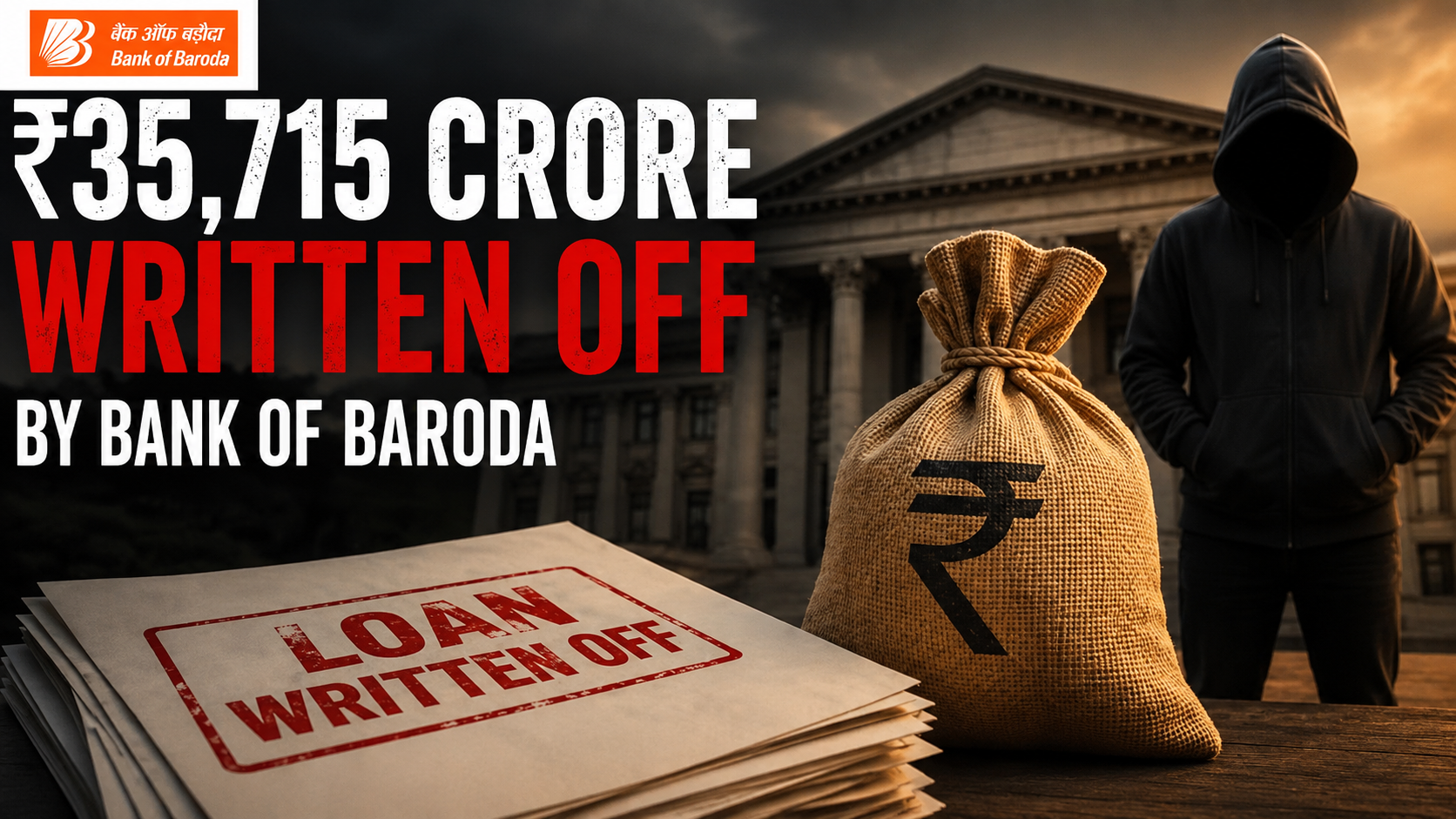
The Opinion Question – Who Gets Protected When Big Money Goes Wrong?
This is where the story stops being only about Bank of Baroda’s RTI response and becomes a larger question about the way India treats financial failure at different levels of the borrowing hierarchy.
The law may have perfectly legitimate reasons for protecting certain categories of borrower information, and no responsible account of the issue should turn a technical write-off into an accusation of wrongdoing, but transparency cannot become meaningful only after the money has been lost; it has to be capable of explaining how the system reached that point.
The uncomfortable reality is that the consequences of a failed large loan are rarely experienced equally by everyone involved. The borrower may enter a restructuring or insolvency process, the bank may recognise a loss and continue recovery proceedings, and the eventual settlement may be presented as the best commercial outcome available. Meanwhile, the public sees another large number added to the banking system’s accumulated credit losses, without necessarily being able to see who borrowed the money, what happened to the underlying business, what security was available, what recovery efforts were made and why the final concession was considered acceptable.
That does not mean large borrowers should be publicly named simply to satisfy public anger. It means that a system handling tens of thousands of crores in public-sector credit losses should be capable of demonstrating that the same standards of scrutiny, diligence and accountability apply regardless of the size or status of the borrower. If a small borrower can face aggressive recovery action over a comparatively modest unpaid amount, while the identities and histories behind multi-hundred-crore or multi-thousand-crore exposures remain inaccessible, the perception of unequal treatment becomes almost inevitable.
And perception matters because public-sector banking ultimately depends on public trust. Depositors may never know the name of the company behind a large write-off, but they are entitled to ask whether the institution that lent the money did everything reasonably possible to protect it. They are entitled to ask whether the borrower was properly assessed before the loan was sanctioned, whether warning signs were acted upon, whether collateral was adequately protected, whether recovery began early enough, whether settlements represented the best available outcome and whether institutional responsibility was examined when losses became unavoidable.
The strongest criticism, therefore, is not that every rupee written off represents corruption, nor that every haircut represents a favour to a powerful borrower. The stronger criticism is that a system can become very good at accounting for losses without becoming equally good at explaining them.
Bank of Baroda has disclosed the scale of what was lost and what was recovered, but the public still cannot see enough of the individual stories behind those numbers to judge whether the system worked as it was supposed to.
And that is the uncomfortable question the ₹35,715 crore figure leaves behind: when the borrower’s obligation becomes a bank’s loss, who is ultimately accountable for the gap?