The Strange New Economics Of Indian Jewellery: Fewer Grams, More Money. India’s ₹7 Lakh Crore Jewellery Market Is Learning To Sell Value, Not Gold

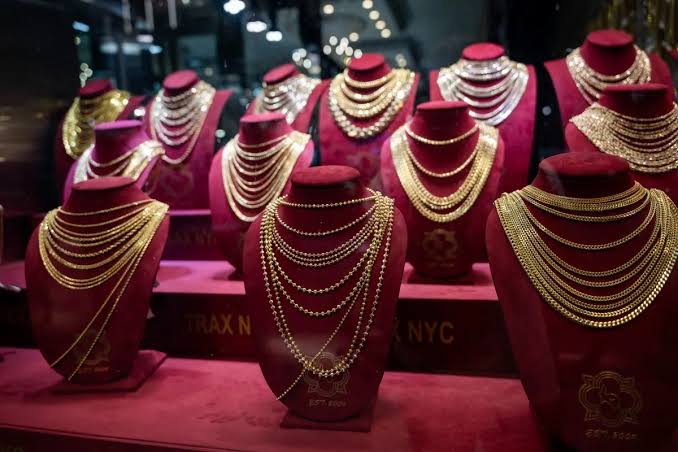
For several years, the basic logic of India’s jewellery business was fairly simple: sell gold, sell more gold, and grow as the value of gold rises. That equation is beginning to break down. Gold prices have climbed so sharply that consumers are buying fewer grams, yet the money flowing into jewellery has not fallen in the same proportion. In fact, it has moved in the opposite direction.
India’s jewellery demand fell 15.4% year-on-year in the second quarter of 2026 to 75.1 tonnes, according to the World Gold Council. Yet the value of that demand rose 34.4% to ₹1.13 lakh crore. The first half of the year tells an even starker story: jewellery volumes fell 17.1%, while the value of demand jumped 40% to ₹2.13 lakh crore.
That gap is now becoming the defining feature of the market. Consumers have not necessarily stopped spending on jewellery; they are simply getting less gold for the money they spend. Lighter pieces, lower-carat gold, studded jewellery and design-led products are allowing buyers to stay within categories they still want, even as the underlying price of gold makes traditional heavy jewellery increasingly difficult to afford.
The organised jewellers are already benefiting from that change. Titan’s jewellery business grew 43% in the June quarter, with buyer growth in the early double digits and average ticket sizes rising in the high double digits. Kalyan Jewellers reported a 46% increase in consolidated revenue to ₹10,589 crore in Q1 FY27, while Senco Gold entered the year with strong growth across its newer, lighter and more design-oriented categories.
The numbers point to a market that is learning to separate the value of a jewellery purchase from the quantity of gold inside it. That may sound like a subtle change, but for a market built for generations around gold weight, purity and accumulated bullion value, it is a significant shift.
The ₹7 lakh crore Indian jewellery market is therefore being forced to answer a different question. Not how to sell more gold, but how to persuade consumers to spend more on jewellery when gold itself has become increasingly expensive.
That is where the real transformation has begun.
The Consumer Has Not Left. The Consumer Has Changed.
The easiest way to read falling jewellery volumes would be to assume that Indians are simply walking away from jewellery because gold has become too expensive. The numbers suggest something more complicated. Consumers are still spending, but they are changing what they buy, how much gold they put into a piece and, increasingly, what they expect the piece to do for them.
The World Gold Council says higher gold prices are pushing consumers towards lighter-weight, lower-carat and studded jewellery, while exchange-led purchases have also gained traction across retailers. The shift is important because it allows consumers to remain in the jewellery market without absorbing the full cost of a heavy 22-carat purchase.
The change is particularly visible in the way organised jewellers are building their product mix. Titan’s jewellery business saw plain and studded jewellery each grow in the mid-thirties in Q1 FY27, while the company’s overall jewellery business grew 43%. Buyer growth was only in the early double digits, but average ticket sizes rose in the high double digits. In other words, fewer additional buyers were required to produce substantially higher revenue.
Senco Gold is seeing a similar change from a different direction. The company said consumers were moving towards lightweight, design-led everyday wear, while its diamond jewellery value grew 43% year-on-year and volumes increased 18%. It is also prioritising 9-carat and 14-carat lightweight collections, alongside a titanium jewellery range for men priced between ₹20,000 and ₹1 lakh.
This is where the younger consumer becomes important. CareEdge says buyers, particularly in metros and Tier-I cities, are becoming more receptive to branded jewellery and increasingly value design innovation, certification and customer experience. Its research also points to a move away from traditional heavy jewellery towards lightweight, trendy and customised pieces, with younger consumers showing interest in alternatives such as lab-grown diamonds.
The result is a jewellery purchase that looks increasingly different from the traditional image of gold accumulated for weddings, inheritance or investment. A lighter 14K or 18K piece combined with diamonds or other stones can offer a design-led product at a lower entry price than a heavier 22K piece, depending on weight, stone quality, design and making charges. The consumer is still buying jewellery, but the gold itself is no longer the only thing determining its appeal.
That may be the industry’s most important adjustment to expensive gold: instead of asking consumers to buy more gold, jewellers are giving them more reasons to buy jewellery.
Old Gold Is Becoming the New Supply Chain
There is another way organised jewellers are dealing with expensive gold, and it has little to do with convincing customers to spend more on newly mined bullion. They are increasingly looking towards the gold already sitting inside Indian households.
Kalyan Jewellers offers the clearest example. Recycled gold accounted for more than 46% of the company’s revenue in Q1 FY27, and after its “Shine with India” gold recirculation campaign was launched in May, the share crossed 55% in June. The company says it wants to maintain recycled gold at around 55%-60% of its revenue.
The logic is straightforward. Instead of depending entirely on freshly imported bullion, jewellers can encourage customers to bring old jewellery back into the formal retail system and use that gold to make new pieces. For a market where record prices are making fresh gold increasingly expensive, household holdings become an important source of supply.
Kalyan has been explicit about the strategic reasoning. Ramesh Kalyanaraman, executive director of the company, said the larger objective was to increase the share of recycled gold and reduce dependence on imported gold, making the business more resilient.
That changes the role of old jewellery. It is no longer simply something a customer exchanges when buying a new piece. It is becoming part of the retailer’s sourcing strategy.
And this matters in India because the amount of gold held by households is enormous, accumulated over generations through weddings, gifts, savings and purchases made at very different prices. When gold prices rise sharply, some of that dormant wealth suddenly becomes economically attractive to unlock.
The organised jeweller, therefore, gets something more valuable than another transaction. It gets access to a pool of gold that is already inside the country.
But there is an important distinction emerging within this market. Customers do not always want to exchange their old gold for new jewellery anymore. Some simply want the cash. That is where the next shift in India’s gold economy begins.
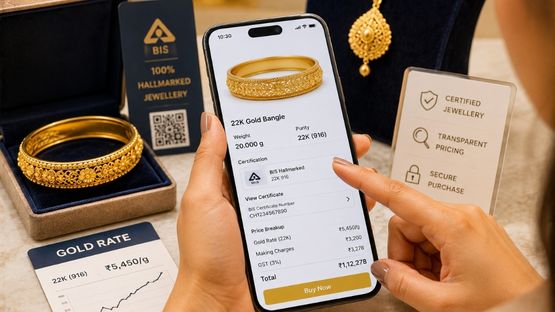
Cash for Gold: When Jewellery Becomes a Household ATM
The bigger change is happening at the other end of the transaction. Indians are not only bringing old jewellery back to jewellers to exchange it for something new; an increasing number are simply selling it for cash.
Old-gold-for-cash transactions have risen to around 20% of business in August so far, from just 5% a year ago, as consumers look to monetise household gold at a time when prices have reached record levels and living costs are rising. Gold prices have crossed ₹1.6 lakh per 10 gm and have risen 14% so far this month, making jewellery accumulated years ago suddenly worth considerably more in rupee terms.
The development is significant because cash-for-gold has traditionally been associated more closely with smaller and regional jewellers. That is changing. Kalyan Jewellers and Tanishq have introduced or expanded cash-for-gold options since June, while Joyalukkas also offers the facility. Organised retailers are now stepping into a business model that allows them to source recycled gold without necessarily having to sell the customer another piece of jewellery in return.
For consumers, the calculation is different from an exchange. Selling old jewellery converts an asset that may have been sitting unused for years into immediate liquidity. For the jeweller, it creates another source of gold at a moment when buying fresh bullion is becoming more expensive and fresh jewellery demand is under pressure.
Kalyan’s numbers show how quickly this is moving. The company said its cash-for-gold share had moved into double digits in the June quarter from single digits previously. Ramesh Kalyanaraman said the growing cash business could help offset the margin dilution that can occur through exchanges, while gold trade analyst Bhargav Vaidya linked the increase to inflationary pressure and consumers realising that household gold can be used to fund other expenses.
That is a crucial distinction. The same high gold price that makes a new jewellery purchase harder can make an old jewellery holding more attractive to sell. Record prices are therefore working in opposite directions at the same time: they are discouraging some fresh purchases while increasing the value of the gold already sitting in Indian homes.
The behaviour is visible at the retail counter. Varghese Alukkas, managing director of Jos Alukkas, said footfall had increased as consumers felt they should take advantage of the current price in case the rally did not continue. The gold trade is no longer only about persuading Indians to buy the metal. Increasingly, it is about persuading them that now is the right time to unlock the gold they already own.
The Jeweller Is No Longer Selling Jewellery Alone
Once gold becomes expensive enough to alter what consumers are willing to buy, the obvious response is to make the business less dependent on gold itself. That is increasingly what India’s organised jewellers are doing, building brands and product categories that can capture spending even when customers are unwilling or unable to buy heavy gold jewellery.
Titan is perhaps the clearest example of this multi-brand approach. Its jewellery portfolio now spans Tanishq, Mia, Zoya and beYon, while CaratLane operates as another major part of the business. Together, Tanishq, Mia, Zoya and beYon grew 39% in Q1 FY27, while CaratLane grew 42%. Titan also added 33 jewellery stores during the quarter, taking its jewellery network to 1,227 outlets.
Kalyan is pursuing a similar strategy through Candere and regional propositions, while Senco Gold is pushing beyond its traditional gold-jewellery identity through Sennes. The latter spans lab-grown diamond jewellery, leather accessories and fragrances, giving the company a lifestyle platform that is not entirely dependent on the price or weight of gold. Sennes also became EBITDA-positive in its second year, according to Senco’s FY26 earnings commentary.
The product expansion is visible even within jewellery itself. Senco is prioritising lightweight 9-carat and 14-carat collections, has introduced titanium jewellery for men, and says it introduces around 1.5 lakh new designs a year. The company has also said that while small-ticket and high-ticket purchases are both taking place, the larger share of demand is coming from the mid-range segment.
This is more than a response to a temporary spike in gold prices. The organised jewellery business is gradually being built around the idea that the consumer should have several reasons to walk into the store, and several categories in which to spend once inside.
Gold remains the anchor. But diamonds, lower-carat jewellery, lab-grown stones, fashion jewellery, men’s accessories and lifestyle products can widen the addressable market and reduce the dependence on a single commodity whose price is increasingly beyond the retailer’s control.
That is why the industry’s transformation is ultimately about more than selling lighter jewellery. The big jewellers are trying to make the brand itself valuable enough that consumers do not walk into the store simply to buy gold.
From Trust in the Family Jeweller to Trust in the Brand
For generations, the biggest advantage of the local jeweller was not the size of the showroom or the number of brands on the wall. It was trust. Families knew the jeweller, the jeweller knew the family, and a purchase worth several months or years of savings was often built around that relationship.
Organised jewellery chains are now trying to replace that relationship with something that can travel across cities: a recognisable brand, standardised purity, certification, transparent pricing, exchange policies, digital discovery and a more predictable store experience.
CareEdge says consumers are increasingly receptive to branded jewellery, particularly in metros and Tier-I cities, where greater media exposure and Western influences are increasing their willingness to pay a premium. Its research also identifies certification, design innovation and customer experience as increasingly important competitive factors.
The shift matters because jewellery remains a high-value purchase where uncertainty can be expensive. Consumers are not merely deciding whether they like a design; they are also deciding whether they trust the purity, certification, pricing and future exchange or buyback value attached to that purchase.
A recognised chain can standardise much of that experience.
“Organised players have increasingly replaced relationship-based trust with brand-based trust,” said Akhil Goyal, director at CareEdge Ratings.
That is one of the quieter but more consequential changes taking place in the market. The organised jeweller is not simply opening another showroom in another city. It is attempting to take something that was historically personal and local — trust and turn it into a repeatable retail proposition.
Formalisation is helping that process. GST, mandatory hallmarking and PAN disclosure requirements have reduced some of the advantages historically enjoyed by unorganised jewellers, while organised chains are using the shift to expand into smaller cities and invest in regional brands, digital platforms and new retail formats.
The result is a market where the battle is no longer only over who has the best gold or the widest catalogue. Increasingly, it is over who can make a customer feel safest spending a large amount of money on something that is becoming less about the gold itself.
The Showroom Has Become Part of the Product
The transformation is visible not only in what jewellers are selling, but in where and how they are selling it. The traditional jewellery shop, built around a relatively straightforward transaction, is increasingly giving way to larger stores designed to make the visit itself part of the purchase.
A May 2026 CBRE report, All That Glitters: Jewellery Brands Recast India’s Retail Footprint, found that jewellery’s share of organised retail leasing increased from 2% in 2019 to 8% in 2025. More strikingly, showrooms larger than 8,000 sq ft accounted for half of jewellery retail leasing in 2025, compared with just 14% in 2019.
That is a dramatic change in physical retail for a category that was traditionally associated with smaller, relationship-driven stores. The larger footprint allows jewellers to do more than display gold. It gives them room to separate brands, create distinct experiences, showcase a much wider range of designs and encourage customers to spend time browsing rather than arriving with a specific purchase already in mind.
CBRE describes the broader movement as a shift towards organised retail, branded formats and experience-driven environments. It also identifies lab-grown diamonds and the rise of fashion jewellery among the forces reshaping the category.
The logic is particularly relevant when gold itself is becoming harder to sell in large quantities. If the retailer cannot rely on heavier jewellery to increase the bill, the store has to create other reasons for the customer to spend. Design, variety, discovery and brand experience begin to carry greater commercial weight.
This also changes the economics of the showroom. A larger store is not simply a bigger place to display the same products. It is a physical expression of the industry’s attempt to move jewellery away from a commodity-led purchase and towards a branded retail experience.
And that shift matters because the industry’s next generation of consumers may not enter the category with the same relationship to gold as their parents did.
For them, the jewellery store increasingly has to sell style, identity and experience – with gold being only one part of the proposition.
The New Indian Jewellery Customer Is Buying Identity, Not Just Gold
The younger jewellery buyer is changing the category in a way that goes beyond affordability. The question is no longer simply how much gold a customer can buy, but what the jewellery says about the person wearing it, how often it can be worn and whether it fits into a lifestyle that has little interest in keeping expensive pieces locked away for weddings or family occasions.
CareEdge’s 2026 industry research points to greater acceptance of branded jewellery among consumers in metros and Tier-I cities, alongside rising importance of design innovation, certification and customer experience. It also identifies a movement away from traditional heavy jewellery towards lightweight, trendy and customised pieces, with younger consumers showing interest in alternatives such as lab-grown diamonds.
That is a meaningful departure from the older idea of jewellery as something bought primarily for its gold content, investment value or status within a family. The newer buyer appears to be looking for pieces that can move between occasions, work with everyday clothing and reflect individual taste rather than simply represent accumulated wealth.
CBRE’s research captures the same shift from another angle. It describes fashion jewellery as a higher-frequency lifestyle category and lab-grown diamonds as an accessible luxury for younger consumers. The significance is not merely that these products are cheaper alternatives. They allow jewellery to become something consumers can purchase and wear more frequently, rather than an occasional high-value transaction.
Lower-carat gold is part of that transition as well. Consumers now have a wider range of choices across 9K, 14K, 18K and 22K, while diamonds and other stones can be combined with lower-purity gold to produce designs at more accessible price points. A lighter 14K or 18K piece can offer a different proposition from a heavy 22K design: less gold, potentially lower upfront cost and greater emphasis on design and wearability.
This is why the industry’s shift cannot be explained simply as consumers buying less because gold has become expensive. They are also being offered a different definition of what jewellery can be.
And that may ultimately prove more important than the current gold-price cycle. If jewellery becomes a lifestyle purchase rather than an occasional gold purchase, the market can grow even when the amount of gold inside each purchase keeps falling.
But There Is a Problem With This New Growth Story
There is a temptation to look at the revenue numbers coming out of India’s organised jewellery chains and conclude that the sector has successfully beaten the gold-price problem. That would be too simple.
The market is growing in rupee terms at a time when consumers are buying materially less gold by weight. That distinction matters. When the price of the underlying commodity rises sharply, a jewellery business can report higher revenue without selling anything close to the same quantity of gold.
The World Gold Council’s numbers make that gap impossible to ignore. Jewellery demand fell 15.4% by volume in Q2 2026 even as its value rose 34.4%. In the first half, volumes fell 17.1% while value rose 40%.
So the industry’s current growth story has two very different components. One is genuine change in consumer behaviour — lighter jewellery, diamonds, lower-carat gold, new designs and more frequent purchases. The other is simply the arithmetic of a commodity whose price has risen dramatically.
That creates a question for the organised chains: how much of this growth can survive if gold prices stop doing the heavy lifting?
The answer will depend on whether consumers have genuinely developed a stronger appetite for branded, design-led and lifestyle jewellery, or whether some of the apparent resilience is simply the result of customers paying more for less gold.
There is also a more uncomfortable possibility. The rise of cash-for-gold suggests that high prices are not only changing what Indians buy; they are changing what they do with the gold they already own. Consumers selling household jewellery for cash may provide jewellers with recycled supply, but it also signals financial pressure and a willingness to liquidate assets rather than make fresh purchases.
That is why the current numbers need to be read carefully. A bigger jewellery bill does not necessarily mean a stronger gold market.
It may instead be evidence of a market in transition – one where jewellers are learning to grow around the commodity rather than simply by selling more of it.
The Last Bit, India’s Jewellery Market Is Changing Its Definition of Growth
India’s jewellery market is not shrinking so much as changing the meaning of growth. The old measure was straightforward: more customers, more gold, more grams and, eventually, more revenue. The new model is considerably less dependent on any one of those things.
Organised jewellers are building growth through a combination of higher value per purchase, lighter and lower-carat products, diamonds and other stones, newer designs, branded formats, recycled gold and an expanding range of occasions on which consumers might buy jewellery. At the same time, they are building businesses around customers who may want to sell their old gold for cash rather than exchange it for something new.
That is why the industry’s response to record gold prices is more interesting than the headline revenue numbers suggest. High prices are squeezing traditional volume demand, but they are also forcing retailers to rethink their products, their stores, their brands and even their sources of gold.
The shift towards organised retail gives them another advantage. Consumers are increasingly looking for branded products, quality assurance and standardised buying experiences, while organised players are expanding through omnichannel distribution, regional brands and new formats.
The result is a market where gold remains indispensable but is no longer sufficient. The jeweller of the past primarily needed access to gold and the trust of a customer. The jeweller of the future needs the brand, the design, the retail experience, the technology, the product range and the ability to keep the customer within its ecosystem even when gold prices make a traditional purchase difficult.
Record prices may therefore have done something that years of competition could not. They have forced India’s organised jewellers to confront the limits of a business built around selling more gold.
The irony is that the less affordable gold becomes, the more aggressively the jewellery industry is learning to sell everything else around it.