Deliberate Digital Harassment? How FlexiLoans Repeatedly Uses Fake Approval Language To Drive Clicks And Damage Your CIBIL?
“Your Loan Is Ready for Disbursal” — Until You Click, Then Suddenly It Needs More Documents


FlexiLoans’ Repeated “Pre-Approved” Messages: A Pattern of Pressure, Not Service
A new WhatsApp message from “FlexiLoans Technologies P…” lands on the phone. It is polite, official-looking, and carefully worded:
“Dear Customer,
This is an update regarding your FlexiLoans CGTMSE business loan of Rs. 2290737. Your loan has been pre-approved at 1% Interest and is ready for disbursal.
Please review and complete your application using the link below.
Team FlexiLoans”
A short while later, another message follows:
“Dear Customer,
Your Rs. 2290737 business loan application is being reviewed.
Ref ID: 352104
Kindly submit the pending details to move ahead with the verification process.
Team FlexiLoans”
The language has shifted slightly. The earlier message said “pre-approved.” This one says “reviewed” and asks “submit of details.” An attractive interest rate is dangled. The customer is told the money is essentially waiting. All that remains is to click the link and finish a few formalities.
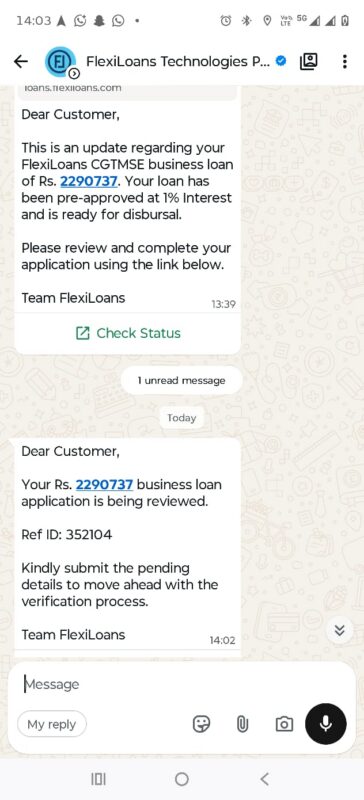
This is not customer service. It is a deliberate nudge designed to generate a click. This is the systematic fraud that Flexiloans is doing.
The contradiction is immediate and glaring. If the loan is already “pre-approved” and “ready for disbursal,” why does the very next message say the application is still “being reviewed” and that “pending details” must be submitted for verification? Either the first message overstated the status of the application, or the second message reveals that the approval was never as final as claimed. In either reading, the customer is being pulled into a process under a false or exaggerated sense of certainty.
This is not an isolated incident. An unsolicited communication creates the impression that a substantial credit facility has already cleared underwriting. The recipient is invited to complete an application or submit documents. Once inside the funnel, the reality is different: further checks, possible rejection, or a shift toward a different product. The psychological design is clear. “Your loan is ready” converts far more effectively than “you may be eligible if you apply.” The stronger the language of approval, the higher the likelihood that the person will open the link, share data, and remain engaged.
The regulatory problem begins with the language itself. The Reserve Bank of India’s digital lending framework and Fair Practices Code emphasise transparency. Key terms, the actual status of the offer, the identity of the lender, the interest rate, fees, and tenure, are supposed to be communicated clearly. Calling a facility “pre-approved” and “ready for disbursal” when further verification and document submission are still required stretches the ordinary meaning of those words. An ordinary customer reading the message is entitled to believe that the heavy lifting of underwriting is largely complete. When that belief is immediately undercut by a demand for more details, the communication has created a misleading impression.
Consent and commercial communication rules add another layer. Promotional or marketing messages from financial entities are subject to TRAI regulations and the Digital Consent Acquisition framework. Numbers registered on the Do Not Disturb list are not supposed to receive promotional content without explicit, verifiable permission. Even where some prior interaction exists, the use of strong “approved / pre-approved / ready for disbursal” language for what is effectively a lead-generation or incomplete-application reminder raises questions about whether the communication remains within the bounds of fair practice.
The potential consequences for the customer extend beyond annoyance. Clicking the link and submitting additional information can trigger further credit checks. Multiple hard enquiries in a short period are known to affect credit scores. A person who never intended to take this particular loan can still find their CIBIL report marked by recent searches. If the application is later declined, the customer is left with the enquiry impact and no corresponding benefit. Some earlier complainants also described subsequent approaches for higher-cost or secured products.

FlexiLoans operates under the brand of Epimoney Private Limited, an RBI-registered NBFC. That registration carries obligations. It does not grant a licence to use the language of final approval as a conversion tool. The company maintains grievance channels and publishes Fair Practices documentation. Those mechanisms exist on paper. The repeated appearance of these messages suggests that the operational reality has not fully absorbed the lessons of the earlier complaint.
The public-interest dimension is straightforward. Digital lending was promoted as a way to expand access to credit for small businesses and individuals who struggle with traditional banking. That promise is undermined when the first contact is a message that overstates the status of an application in order to secure a click. Trust is a scarce resource. Every time a regulated entity uses language that creates a false sense of certainty, that trust is eroded. Customers who feel they have been manipulated become less willing to engage with legitimate digital credit channels. The entire sector pays a reputational price for practices that prioritise conversion over clarity.
The sequence in the latest messages is particularly revealing because the two texts sit so close together in time. One declares the loan pre-approved and ready for disbursal. The next, only minutes later, states that the application is still under review and that pending details are required. No sophisticated analysis is needed to see the tension. Either the first message was premature, or the second message reveals that “ready for disbursal” was never an accurate description. In both interpretations, the customer is being managed rather than informed.

This is not an isolated technical glitch. It is the continuation of a pattern that was already flagged, documented, and complained about by many reddit users. The customer is left with the impression that the company is testing how many times it can push the same button before the recipient either clicks or escalates further. This is nothing but a systematic scam that Flexiloans is running!