Mukesh Ambani Makes 3 Big Moves At Once – JioHotstar Goes Global, Bombay Creamery Takes On Ice Cream And Jio IPO Nears The Market
Mukesh Ambani is making moves across three very different markets. JioHotstar is going global, Reliance is taking Bombay Creamery into India’s crowded ice cream market, and Jio Platforms is moving closer to a potentially record-breaking IPO. Three businesses, three fronts - and another major expansion push from Reliance.

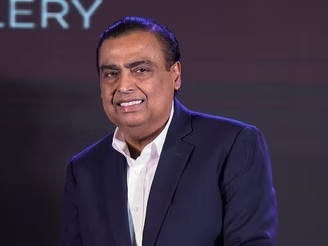
Mukesh Ambani’s Reliance is making moves across three very different markets at almost the same time.
JioHotstar is stepping outside India for the first time, taking its streaming business to the UK, Canada and Singapore. Reliance Consumer Products has entered the crowded ice cream market with Bombay Creamery, with products starting at just ₹10. And Jio Platforms has cleared a crucial regulatory hurdle for what could become India’s biggest-ever IPO, estimated at around ₹37,700 crore.
On the surface, the three developments have little in common. One is about taking Indian entertainment overseas. Another is about putting a new Reliance brand on supermarket shelves. The third is about taking one of the group’s biggest businesses to the public markets.
Together, however, they underline the breadth of Reliance’s current expansion – from content and consumers to capital markets. And each move puts a different part of Ambani’s sprawling empire in a new arena.
JioHotstar Takes The India Story Overseas
JioHotstar is taking its first major step outside India, launching in the UK, Canada and Singapore as Reliance and Disney look to turn the streaming platform’s enormous domestic reach into a larger international business.
The platform, operated by JioStar – the media joint venture between Walt Disney and Reliance Industries – will bring more than 1.6 lakh hours of programming to viewers across more than 12 languages. Hindi, English and Gujarati will be among the offerings, with the catalogue aimed squarely at audiences with an existing connection to Indian entertainment.
The timing is significant. JioHotstar already has more than 500 million active users in India, giving it a scale that few streaming platforms globally can match. The international launch now offers the business another avenue for growth in a domestic market where competition for viewers and subscription revenue has intensified.
The target audience is equally clear: the Indian diaspora.
India’s overseas community has grown to more than 37 million, driven by decades of migration as well as the steady movement of skilled professionals and students abroad. Canada has around 3.2 million people of Indian origin, while the UK has roughly 1.3 million. Singapore is home to about 483,000 Indians, according to Indian government data.
But JioHotstar is not pitching itself simply as an Indian streaming service transplanted overseas.
Amit Malhotra, head of international business at JioStar, has positioned the expansion as an attempt to build for a wider global audience interested in Indian stories, languages and culture.
That ambition will be tested by the content itself.
Bigg Boss is expected to be one of the platform’s major draws. Over nearly two decades, the reality franchise has expanded from a Hindi television programme into a six-language property with a substantial streaming following. Its latest season repeatedly ranked as India’s most-watched non-fiction show on streaming last year, drawing around 8 million viewers a week, according to Ormax Media.
JioHotstar is also bringing familiar Bollywood names into its international offering. Anil Kapoor, who previously hosted Bigg Boss OTT, is among the stars fronting new programming, including a prime-time game show.
The service goes live on September 2 through its mobile app and connected TVs, with quarterly and annual subscription plans. Existing Hotstar subscribers will be able to use their existing accounts to access JioHotstar, according to the company.
There is, however, a notable limitation. Hollywood programming from Disney and HBO Max will not be available in these international markets because the relevant US studio licensing agreements are restricted to India.
For JioHotstar, the overseas launch therefore represents more than a geographical expansion. It is a test of whether an entertainment platform built at Indian scale can convert cultural familiarity into a viable international subscription business.

After Telecom And Cola, Ambani Takes On Ice Cream
Reliance is now coming for another mass-market category: ice cream.
Reliance Consumer Products, the consumer arm of Mukesh Ambani’s Reliance Industries, has launched Bombay Creamery, marking the group’s entry into a market already dominated by established names such as Amul, Vadilal Industries, Mother Dairy and Hatsun Agro’s Arun Icecreams, alongside a long tail of regional players.
The pricing is where Reliance is making its intentions particularly clear.
Bombay Creamery products will start at ₹10, putting the brand firmly in the mass-market segment. The ice creams are initially available across western India, with a nationwide rollout planned soon, according to the company.
The group transformed India’s telecom market with Jio roughly a decade ago, using low-cost offerings to rapidly build scale. It later revived the Campa brand in beverages, entering a cola market dominated by entrenched players and reigniting competition on price.
Its consumer business has since expanded well beyond beverages. Reliance Consumer Products now houses brands including Campa and Independence, along with a growing portfolio of snacks, confectionery and other everyday consumer products.
Ice cream gives that portfolio another large, highly competitive category to attack.
The challenge, however, is different from telecom. This is a market with deeply established brands, extensive distribution networks and strong regional loyalties. Amul has built enormous reach over decades, while players such as Vadilal and Arun have developed powerful positions in their home markets.
Bombay Creamery will therefore have to do more than arrive on shelves.
At ₹10, Reliance is signalling that it wants the brand to reach the mass market quickly. The bigger question is whether the company can use its distribution muscle and pricing strategy to carve out meaningful share in a category where consumers already have plenty of familiar choices.
Jio Platforms Moves Closer To India’s Biggest IPO
The biggest of Ambani’s three moves is taking shape in the public markets.
Jio Platforms has received the observation letter from the Securities and Exchange Board of India (SEBI) for its proposed initial public offering, clearing a key regulatory hurdle for an issue that could become the largest IPO in India’s history.
The offering is expected to raise around ₹37,000 crore to ₹37,700 crore. At that size, it would comfortably overtake the ₹27,870-crore IPO of Hyundai Motor India in October 2024, which currently holds the record for India’s largest public issue.
The Jio IPO would also be larger than the proposed ₹30,000-crore offering of the National Stock Exchange.
Reliance Industries disclosed the SEBI observation letter to the stock exchanges on August 28. The development follows Mukesh Ambani’s announcement at Reliance Industries’ 49th Annual General Meeting on June 19 that the board of Jio Platforms had approved the draft red herring prospectus.
A Fresh Issue And No Offer For Sale
According to the DRHP, the IPO will consist entirely of a fresh issue of 27 crore shares.
There will be no offer-for-sale component. That means the money raised will flow into the company rather than being used by existing shareholders to sell down their holdings.
A substantial portion will be used to repay certain outstanding borrowings of Reliance Jio Infocomm, Jio Platforms’ material subsidiary. The remainder will be used for general corporate purposes.
The structure is significant because the IPO is not simply an exit event for Jio’s existing investors. It is also designed to strengthen the balance sheet of the business that sits at the heart of Reliance’s telecom operations.
Reliance Industries currently owns 66.43% of Jio Platforms. Meta Platforms owns 9.98% through its affiliate Jaadhu Holdings LLC, while Google International LLC holds 7.73%.
Neither Meta nor Google is expected to sell its stake through the IPO, according to the offer documents.
The Valuation Question
The size of the issue is only part of the story. Investors will also be watching the valuation at which Jio Platforms eventually comes to market.
Morgan Stanley and Citi Research have valued Jio Platforms at around $133 billion, implying a multiple of roughly 13 times estimated enterprise value to EBITDA for FY27.
The business is already producing substantial earnings. Jio reported a 9.2% year-on-year rise in net profit to ₹7,764 crore in Q1FY27, while revenue from operations increased 11.8% to ₹39,173 crore.
The final price investors pay, however, will only become clear once Jio Platforms announces its price band and issue dates.
For now, the regulatory clearance brings the IPO materially closer to the market — and puts what could be India’s biggest public issue yet firmly on the horizon.
The Jio IPO Machine Is Already In Place
The scale of the offering is matched by the financial machinery being assembled around it.
Jio Platforms has appointed a long list of global and domestic financial institutions as book-running lead managers for the issue. The lineup includes Morgan Stanley India Company, BofA Securities India, Citigroup Global Markets India, Goldman Sachs (India) Securities, HSBC Securities and Capital Markets, ICICI Securities, Jefferies India, J.P. Morgan India, SBI Capital Markets, UBS Securities India and several other major investment banks.
KFin Technologies has been appointed as the registrar to the issue.
For investors, however, the biggest details are still missing.
Jio Platforms has not yet announced the price band or the exact issue dates. Those numbers will determine how the proposed ₹37,000–₹37,700 crore issue is ultimately valued and how much of that headline figure translates into the company’s market capitalisation at listing.
That leaves the Jio IPO at an important but unfinished stage.
SEBI’s observation letter removes a major regulatory hurdle. The offer documents are in place. The bankers and registrar have been appointed. The proposed size would make it India’s biggest IPO yet.
Now the market is waiting for the numbers that will decide what Jio Platforms is actually worth to public-market investors.
The Last Bit, Three Moves, One Larger Reliance Push
Taken separately, JioHotstar, Bombay Creamery and the Jio Platforms IPO are three very different stories. Together, they show the sheer range of Reliance’s current expansion.
JioHotstar is taking an Indian entertainment platform into overseas markets, starting with three countries where large Indian and South Asian communities already provide a natural audience.
Bombay Creamery is taking Reliance deeper into everyday consumption, entering a fiercely competitive category with products priced from ₹10 and a national rollout ahead.
And Jio Platforms is preparing to enter the public markets with an offering that could set a new record for India.
The three moves also represent three different ways of expanding the Reliance ecosystem – new geographies, new consumer categories and new capital.
The Jio IPO is likely to attract the greatest attention because of its size. But the other two moves point to where Reliance is continuing to look for growth beyond its traditional businesses.
The immediate focus now shifts to execution: how quickly JioHotstar can build an international audience, whether Bombay Creamery can find space in an already crowded ice cream market, and when Jio Platforms finally puts a price on its public debut.
For Mukesh Ambani, the expansion continues on multiple fronts and the market is watching all three.