23,000 Security Personnel for a Protest, But Pulwama Still Demands Answers: When the State Can Mobilise Aircraft, Why Is Accountability So Difficult?
The Centre’s massive security mobilisation in Delhi, the detention of thousands of protesters, and the Supreme Court’s intervention over restrictions on public movement have revived an uncomfortable question about the government’s priorities. More than seven years after the Pulwama terror attack killed 40 CRPF personnel, allegations by former Jammu and Kashmir Governor Satya Pal Malik concerning a rejected request for aircraft remain a matter of public concern. The two situations are not operationally identical. But the government’s willingness to deploy extensive resources in one situation makes transparency about the other all the more necessary.

India has no shortage of speeches about national security. It has no shortage of ceremonies honouring fallen soldiers, no shortage of patriotic slogans, and certainly no shortage of political leaders eager to invoke the sacrifices of security personnel when addressing the nation.
What India needs more urgently is a government prepared to answer difficult questions about administrative decisions, even when those questions lead towards the corridors of power.
The unfolding controversy surrounding the October 2026 deployment of Central Armed Police Forces in Delhi and the unresolved allegations surrounding the February 2019 Pulwama attack presents precisely such a test.
The issue is not whether the government has the authority to deploy security personnel to maintain public order. It does. Nor is the deployment of thousands of personnel, by itself, proof of political wrongdoing.
The harder question is this: when the machinery of the Union government can mobilise thousands of security personnel across states for an anticipated political confrontation, why should the public be expected to accept an incomplete account of decisions concerning the safety of soldiers travelling through a terror-affected region?
The answer cannot be another speech about patriotism. It must be a record of decisions, a clear explanation of responsibility, and an accounting of what the authorities knew and did.
And until those questions are answered, the comparison will remain uncomfortable for the government.
Delhi’s security mobilisation: Thousands of personnel, extraordinary urgency
The scale of the Delhi deployment ahead of the October 10 protests demanding the resignation of Chief Election Commissioner Gyanesh Kumar has been substantial.
On October 8, The Indian Express reported that the Ministry of Home Affairs had made 221 companies of Central Armed Police Forces, comprising approximately 23,000 personnel, available to Delhi Police for deployment between October 8 and 12.
These forces were being brought in from Jammu and Kashmir, West Bengal and Chhattisgarh. Their stated purpose was to assist Delhi Police in managing demonstrations, protecting important government buildings and maintaining law and order in central Delhi.
The newspaper described it as one of the largest deployments of central forces for law-and-order duties in the capital during a protest.
A separate report published by The Telegraph carried the headline that 12,000 paramilitary personnel were being airlifted to Delhi. Its detailed account, however, quoted officials describing approximately 12,000 personnel already deployed in the capital and another 11,000 CRPF personnel being airlifted as reinforcement. These figures broadly align with a deployment of approximately 23,000, but the headline and the breakdown in the report are not identical claims.
That distinction matters. A serious investigation must distinguish the number of personnel deployed, those newly mobilised and those specifically transported by air.
Nevertheless, the larger fact is clear: the Union government was prepared to mobilise a very substantial force from multiple states for the anticipated demonstrations.
The question is not why the government took precautions. The question is what this capacity to mobilise personnel, transport resources and coordinate a rapid security response tells us about the importance the state assigns to different situations.
When authorities anticipate a major demonstration in the national capital, they can draw on a vast institutional apparatus.
That is what government capacity looks like when it is activated.
And that is precisely why allegations concerning earlier security decisions deserve more than dismissive political exchanges.
Pulwama: Forty CRPF personnel died, and the questions did not die with them
On February 14, 2019, a suicide bomber drove an explosives-laden vehicle into a CRPF bus near Lethpora in Jammu and Kashmir’s Pulwama district.
Forty CRPF personnel were killed.
The bus was travelling as part of a convoy of 78 vehicles carrying approximately 2,547 CRPF personnel from Jammu towards Srinagar. The attack was claimed by the Pakistan-based terrorist organisation Jaish-e-Mohammed.
The scale of the convoy was extraordinary. So was the human cost.
Forty personnel who had been entrusted with serving the country were dead. Forty families were left to absorb a loss that no compensation, medal or public ceremony could ever fully repair.
The attack was a terrorist atrocity, and responsibility for carrying it out lies with those who planned and executed it. Questioning government decisions does not diminish the terrorists’ culpability.
But neither does the terrorists’ responsibility absolve the state of its separate obligation to examine security arrangements, intelligence assessments, transportation decisions and preventable vulnerabilities.
Those are different questions, and a serious government should have the confidence to address both.
Contemporary reporting also described the operational circumstances preceding the attack. Days of snowfall had disrupted movement on the Jammu–Srinagar highway, while a bandh call contributed to the combining of two groups of personnel into the large convoy.
Those circumstances provide important context. They also demonstrate why the movement of such a large number of personnel through a vulnerable route warranted careful examination.
In the aftermath, the CRPF introduced changes to convoy procedures, including a limit of 40 vehicles per convoy and a requirement for a senior, SP-rank officer to lead convoys, according to contemporaneous reporting.
These changes do not, by themselves, establish that one particular transport decision caused the attack. They do, however, underline the seriousness of convoy management and force protection in a terror-affected region.
The five-aircraft allegation: A former governor’s account that demands verification
The issue returned to national attention in April 2023, when former Jammu and Kashmir Governor Satya Pal Malik gave an interview to The Wire.
Malik, who was governor when the Pulwama attack occurred, alleged that the CRPF had requested aircraft from the Union Home Ministry to transport personnel and that the request was refused.
He claimed that five aircraft had been sought.
Malik further alleged that he raised his concerns with Prime Minister Narendra Modi after the attack and was told not to speak publicly about the issue. He also referred to National Security Adviser Ajit Doval in recounting the subsequent conversations.
These are serious allegations. They are also allegations, not established findings of an independent inquiry.
A particularly important point is that Malik did not publicly produce the original CRPF requisition or a written order rejecting it in the interview. When The Indian Express asked him whether he had evidence to support his claims, he responded that he had been the head of the state and understood what had happened, adding that such matters did not necessarily occur through written notes.
That answer does not independently establish the truth of the allegation.
But it also identifies precisely what a proper investigation must resolve: whether the request was actually made, who received it, what decision was taken, and on what basis.
A responsible investigation cannot convert Malik’s words into a proven finding. Equally, it cannot treat a former governor’s account of an allegedly consequential security decision as a matter that should simply be forgotten.
The public record needs to establish what happened.
Amit Shah questioned Malik’s credibility. But where is the operational answer?
The government’s public response in April 2023 included a challenge to Malik’s credibility and timing.
Union Home Minister Amit Shah questioned why Malik had not spoken out while serving as governor, asking why such concerns appeared to emerge after people left positions of power. Shah also argued that the public and media should question the credibility of those making such allegations.
That is a legitimate question to put to any former official. The timing of an allegation can be relevant to evaluating it.
But timing is not the same as proof or disproof.
A question about why a former governor spoke when he did cannot, on its own, establish whether the CRPF requested aircraft. Nor does an allegation become true merely because a politician questions its timing.
The government’s obligation is to address the underlying facts, not merely the person raising them.
If Malik’s account is false, the administration should be able to identify the facts that demonstrate why it is false. If he has misremembered the sequence of events, contemporaneous records should help establish the correct sequence. If an aircraft request was made and rejected, the relevant decision-making process deserves scrutiny.
An evidence-based response could include the transport requisition, the official record of its consideration, the applicable operational and aviation constraints, and the subsequent movement orders for CRPF personnel.
Sensitive operational information may need appropriate redactions. That does not justify withholding every relevant fact from public scrutiny.
The government need not accept Malik’s version of events. It must, however, give citizens a credible basis for reaching their own conclusions.
Otherwise, the public is left with two competing political narratives and insufficient independently verifiable information to settle the question.
For an incident of Pulwama’s magnitude, that is an unsatisfactory position.
The comparison with Delhi: Different operations, one common test of accountability
The October 2026 deployment and the 2019 Pulwama movement were not identical operations.
In Delhi, forces were being mobilised to reinforce law-and-order arrangements in anticipation of political protests. In Pulwama, thousands of personnel were moving along a route through a region affected by terrorism.
It would be irresponsible to suggest that the two situations were interchangeable or that the Delhi deployment proves that five aircraft were available for the CRPF in 2019.
Nor can anyone establish, without supporting evidence, that air transport would certainly have prevented the Pulwama attack. That is a counterfactual claim, not a proven conclusion.
But these limitations do not eliminate the public-interest question.
The Delhi deployment demonstrates the state’s ability to coordinate large-scale force movement when authorities consider a situation sufficiently urgent. The Pulwama allegations concern whether a request for alternative transportation was made and whether that option was refused before a devastating attack.
The relevant comparison is therefore not simply the number of aircraft or personnel.
It concerns the decision-making process: what risks were identified, what options were available, what requests were made, and why particular decisions were taken.
A government that expects unquestioning faith in its national-security credentials should be especially willing to explain the security decisions for which it was responsible.
It cannot demand that citizens celebrate the state’s efficiency when its operations succeed while treating scrutiny of its decisions as an act of political hostility.
That would turn patriotism into a convenient one-way obligation: applause for the administration, silence about its failures.
Delhi’s protests: Security planning or an excessive response to dissent?
The controversy over the deployment is inseparable from the circumstances that prompted it.
The October 10 protests were directed against Chief Election Commissioner Gyanesh Kumar and the Election Commission’s Special Intensive Revision of electoral rolls.
Critics have questioned whether the revision process could unfairly exclude eligible voters and affect electoral fairness. The BJP and the Election Commission have denied allegations of wrongdoing.
The scale of the voter-roll exercise is significant. Reuters reported that Election Commission data showed approximately 130 million voter entries removed during the verification exercise. The reported categories included around 63 million entries associated with people who had relocated, 30 million people who could not be traced and 28 million people who had died.
These figures require careful interpretation. They do not establish that 130 million eligible citizens were wrongly disenfranchised. The Election Commission’s position has been that the removals related to entries identified during the draft-revision process and that eligible voters wrongly excluded can re-enrol.
Nevertheless, the size of the exercise places a substantial responsibility on the authorities to establish that the process is accurate, transparent and accessible to people who may have been incorrectly removed.
At that scale, reassurance is not an adequate substitute for accessible verification, clear appeal procedures and credible evidence that eligible voters can exercise their franchise.
The integrity of electoral rolls is not a trivial administrative issue. It goes to the heart of representative democracy.
Where citizens and political parties raise concerns over the exclusion of voters, the proper response should be to provide transparent evidence and an effective remedy—not to assume that every criticism is an attack on the institution.
The allegations of bias remain contested. The evidence must be examined before conclusions are reached. But the public has a right to demand that examination.
Thousands detained, transport disrupted, internet services suspended
The police response on October 10 was extensive.
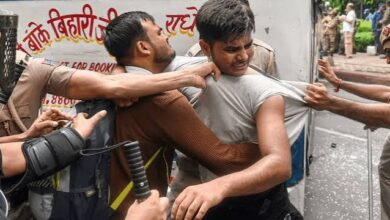
Reuters reported that more than 2,000 protesters were detained in Delhi that day. Security forces sealed off parts of the capital, mobile internet services were suspended in the central business district, and dozens of metro stations and markets were shut as authorities moved to prevent the planned rally.
The restrictions on public transport were also challenged in the Supreme Court. The court heard allegations concerning metro closures, railway-station restrictions and mass detentions. The Centre argued that entry and exit had been restricted at 45 of Delhi Metro’s 303 stations on October 10.
On October 11, the Supreme Court directed the authorities to ensure that people gathering peacefully were not illegally detained, and called for normal metro and railway services. It also directed that lawyers, journalists and others not be obstructed from performing their professional duties, while addressing internet-service restrictions subject to lawful public-order considerations.
These were directions issued in response to the unfolding controversy; they should not be misrepresented as a final judicial finding that every police action was unlawful.
But they carry an unmistakable message: the exercise of police powers must remain subject to law, proportionality and judicial scrutiny.
A government cannot invoke public order as a magic phrase that answers every question about the necessity of closing transport networks, restricting communications or detaining people far from the location of a prohibited gathering.
Every restriction needs a defensible connection to the risk it is intended to address.
And the wider the disruption, the stronger the case for explaining why less restrictive alternatives were insufficient.
When the Supreme Court has to ask for an explanation, “law and order” is not the end of the story
The legal position is not that every protest must be allowed without conditions.
Articles 19(1)(a) and 19(1)(b) of the Constitution protect freedom of speech and the right to assemble peacefully and without arms. Articles 19(2) and 19(3) permit reasonable restrictions, including those required for public order.
The Supreme Court has recognised that authorities may regulate demonstrations to protect residents, commuters and public safety. In Mazdoor Kisan Shakti Sangathan v. Union of India (2018), it emphasised the need to balance the rights of protesters with the rights of others rather than extinguishing one set of rights in favour of another.
The question, therefore, is not whether the government may impose any restrictions. It is whether the restrictions are justified, proportionate and fairly applied.
That distinction becomes particularly important when authorities simultaneously deploy enormous resources to secure the capital and impose broad constraints on the people seeking to protest.
Delhi Police subsequently announced that Jantar Mantar was no longer a designated protest site and identified alternative venues. Those sites vary substantially in their distance from Parliament: The Indian Express reported approximate distances of six kilometres for Ramlila Maidan, 14 kilometres for the CBD ground in Shahdara and 23 kilometres for Burari.
Alternative venues can be a legitimate way to manage safety, traffic and crowd capacity. But the location of a demonstration also affects its practical ability to bring public grievances to the attention of those in power.
A right that exists on paper but is made disproportionately difficult to exercise in practice deserves scrutiny.
The administration must demonstrate that it is regulating dissent, not using regulation to make dissent politically invisible.
The allegations concerning women journalists add another serious concern
The handling of the October 10 protests has also raised questions about press freedom and the safety of journalists.
On October 13, the Supreme Court asked Delhi Police to have a senior officer present in court to respond to allegations that women journalists covering the protests had been heckled, manhandled, sexually harassed or detained despite identifying themselves as members of the media.
The allegations were raised in a petition filed by the Network of Women in Media, India.
They remain allegations requiring investigation and a response from the police. The court’s decision to seek an explanation is not a finding that every allegation is true.
Nevertheless, the matter cannot be brushed aside.
Journalists covering a public demonstration perform a function that extends beyond the interests of the protesters themselves. They document the conduct of the police, the actions of demonstrators, the scale of restrictions and the decisions made by public authorities.
If journalists cannot safely document state action, the public’s ability to assess whether that action was justified is diminished.
A government confident in the legality and proportionality of its conduct should welcome independent documentation, investigate credible complaints and hold responsible personnel accountable where misconduct is established.
The press cannot be expected to accept the official version of an operation without being able to independently observe it.
The five-day judicial custody order: The government has a defence, but not a blank cheque
The latest confrontation at Jantar Mantar also requires a careful account of the police’s position.
On October 13, CJP members entered the now-de-notified protest area despite restrictions. According to police accounts reported by The Indian Express, a group of 14 members used a narrow lane, climbed over a locked gate and entered the site before being detained.
On October 14, CJP leaders Saurav Das and Ashutosh Ranka were remanded to five days of judicial custody following preventive arrests. Another leader, Ajinkya Shinde, was released on a personal bond subject to conditions intended to maintain public peace.
The police cited the alleged unauthorised entry and related breaches. The protesters maintained that they were demonstrating by waving the national flag and raising patriotic slogans.
Those descriptions should not be collapsed into a simplistic narrative. Waving a flag does not automatically place someone above the law, and a protester who breaches a lawful restriction can face legitimate legal consequences. Conversely, the existence of a restriction does not automatically make every detention proportionate or every police action lawful.
The relevant questions are what order was in force, whether it was lawfully imposed and communicated, what conduct is alleged against each individual, and whether the resulting preventive action was justified.
These questions matter because the state has extraordinary coercive powers. Their exercise must be accompanied by a correspondingly high standard of accountability.
It is not enough to say that the police were maintaining order. The police must be able to explain how their specific actions were necessary and lawful.
And the government must accept that judicial examination of those actions is part of constitutional governance, not an insult to it.
The broader problem: National security cannot become an excuse for avoiding scrutiny
The Pulwama controversy and the Delhi protest response are separated by more than seven years and involve different operational circumstances. Yet both raise questions about how the state handles information, risk and public accountability.
In one case, a former governor alleged that an alternative mode of transportation had been requested for CRPF personnel and refused. In the other, the authorities demonstrated their capacity to mobilise thousands of personnel to address a foreseeable public-order situation.
The comparison does not prove that aircraft were available for the Pulwama convoy, that the request was denied, or that the attack would have been prevented through air transport. Those conclusions require evidence that has not been established in the public material reviewed here.
What the comparison does demonstrate is the need for a transparent decision-making record when security arrangements become the subject of serious public controversy.
That requirement is not anti-government. It is a basic principle of responsible administration.
The same logic applies to electoral fairness and civil liberties. The Election Commission must be able to explain a verification exercise involving approximately 130 million removed voter entries. Police must be able to justify significant restrictions on assembly and movement. Allegations of mistreatment of journalists must be investigated. Courts must be allowed to examine whether preventive powers have been exercised lawfully.
A government that regards itself as the guardian of national security should have no difficulty understanding why transparent records and independent scrutiny are essential to that mission.
Security without accountability can become a slogan. National pride without scrutiny can become a political performance. And remembrance without a willingness to investigate uncomfortable questions can become a substitute for responsibility.
The families of the 40 personnel killed in Pulwama deserve better than a debate in which their loved ones are repeatedly invoked but the relevant administrative questions remain contested.
They deserve a credible explanation of what the authorities knew, what decisions they took, and whether any avoidable lapse occurred.
The public deserves equally clear answers on why such extensive security and transport restrictions were considered necessary in Delhi, what evidence supported them, and whether the response respected constitutional protections.
These are not mutually exclusive demands. The safety of soldiers and the rights of citizens are both obligations of the state.
What the government should disclose about Pulwama
The most constructive way to resolve the controversy is not to demand that the public accept either Malik’s allegations or the government’s political rebuttals on faith.
The Union government should clarify whether a CRPF request for aircraft was made before the Pulwama attack. If it was, it should explain when the request was received, who considered it, what options were evaluated, and why the request was accepted or rejected.
The government should also clarify what transportation and convoy-security assessments were conducted, what intelligence alerts were available to the relevant agencies, and whether subsequent reviews identified administrative shortcomings.
Any disclosure should protect legitimate operational secrets, but sensitive details should not be used as a blanket excuse to withhold the basic decision-making record.
A fact-based review should distinguish between the terrorist operation that directly caused the deaths, the administrative decisions that preceded it, and the separate question of whether any particular measure could have prevented the attack.
That is how an investigation should work: by testing claims against records and evidence, not by deciding in advance which political side deserves to be believed.
If Malik’s allegations are unsupported, a transparent review can establish that. If the records reveal a serious failure, the country deserves to know that as well.
What is unacceptable is allowing such questions to persist indefinitely while political leaders continue to invoke national security as a badge of unquestionable competence.
Patriotism is not a shield against accountability
The government has the right to defend its security decisions. The police have the right to maintain public order within the law. The Election Commission has the right to explain and defend its electoral-roll procedures.
None of these institutions has the right to be beyond scrutiny.
The ability to mobilise thousands of security personnel is evidence of administrative capacity. It is not, by itself, proof of good governance. The ability to prevent a protest is not proof that public grievances have been resolved. And the ability to invoke the sacrifices of soldiers is not a substitute for investigating whether those soldiers were adequately protected.
Patriotism is not measured by how loudly a political leader invokes a martyr’s name. It is measured, in part, by whether the institutions responsible for that martyr’s safety are willing to account for their decisions.
The contrast between Delhi’s extraordinary security mobilisation and the still-contested aircraft allegation surrounding Pulwama should therefore be treated neither as conclusive proof of government culpability nor as a question to be dismissed for political convenience.
It should be treated as a demand for documentary clarity.
If the government believes its decisions were correct, it should have the confidence to demonstrate why. If its critics have exaggerated or misrepresented the facts, the same records should expose those errors.
The state cannot reasonably ask the public to trust every security decision while treating questions about those decisions as an inconvenience.
Forty CRPF personnel lost their lives at Pulwama. Thousands of citizens were detained during the October 2026 protests. The Supreme Court has had to address restrictions on transport, detentions and allegations concerning the treatment of journalists.
These are distinct events, but they all lead back to a fundamental question: how does the state use its extraordinary powers, and how is it held accountable when citizens challenge its decisions?
India does not need less security. It needs security decisions that can withstand scrutiny.
It does not need less patriotism. It needs patriotism that refuses to confuse unquestioning loyalty with responsible citizenship.
And it does not need another round of political accusations about Pulwama.
It needs answers supported by records.
Jai Jawan must mean more than remembering soldiers after they die. It must mean demanding that every decision affecting their safety be examined honestly, however uncomfortable the findings may be for those in power.