Madhya Pradesh Cop Caught Allegedly Threatening To Frame Unmarried Couple By Planting Ganja, Can Criminal Law Become A Weapon Against Innocent Citizens And What Happens To The Constitutionally Protected Right To Personal Freedom?
What happens when those entrusted with enforcing the law allegedly threaten to manufacture a crime? A disturbing incident in Madhya Pradesh, involving a police officer accused of threatening to plant ganja on an unmarried couple, raises troubling questions about police power, constitutional freedoms and the possibility of criminal law becoming a weapon against innocent citizens.

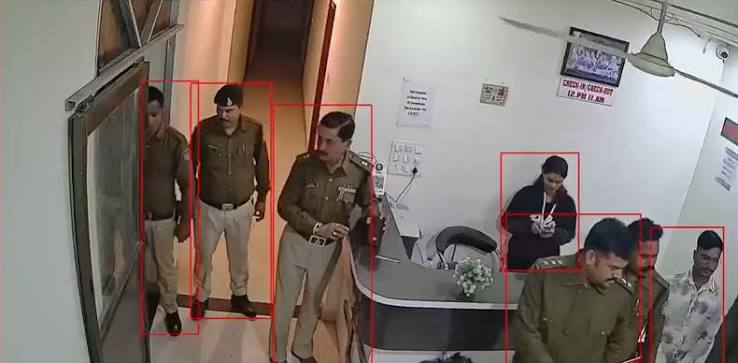
A police officer threatening to plant ganja on a citizen because he refused to comply with an officer’s demands is the kind of allegation that raises serious questions about the very institution entrusted with enforcing the law.
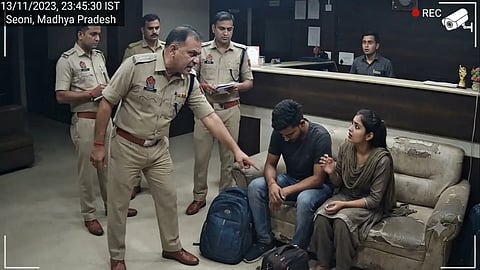
A disturbing CCTV recording from Seoni district in Madhya Pradesh has brought this concern into focus after Additional Superintendent of Police Deepak Mishra was allegedly caught threatening to frame a man in a narcotics case. The incident, which reportedly took place on November 13, has since drawn attention after the footage surfaced publicly.
What makes the episode particularly concerning is the alleged manner in which the threat was made. According to reports, the officer was seen instructing his colleagues to plant ganja on the man after the woman accompanying him refused to call her parents. The footage has raised questions about the conduct of the police personnel involved, particularly because the threat allegedly involved fabricating evidence of a criminal offence rather than investigating any established wrongdoing.
The allegations are especially serious given the consequences that can follow from a narcotics case.
A person accused under India’s Narcotic Drugs and Psychotropic Substances (NDPS) Act can face arrest, prosecution and severe legal consequences, depending on the offence and quantity involved. The possibility of such a case being manufactured against an individual, if the allegation is established, raises concerns that extend well beyond the conduct of one officer.
What Happened At The Hotel And Why Was The Couple Being Questioned?
The incident reportedly unfolded when police personnel arrived at Sidarth Hotel in Seoni, where the unmarried couple was staying. The CCTV footage shows officers questioning the two individuals, with much of the confrontation centred on their decision to spend time together without informing their respective families.
The woman reportedly told the officers that both were adults, belonged to the same caste and intended to get married. However, the officers continued insisting that she contact her parents.
The exchange becomes particularly revealing when the woman refuses to unlock her mobile phone and call her family. Rather than treating her refusal as a personal choice, Additional SP Deepak Mishra is allegedly heard instructing his colleagues to plant ganja on the man. The footage also reportedly captures the officer reprimanding the couple over their decision to meet without considering or informing their parents.
The incident raises an important question about the basis on which the couple was being questioned in the first place. The news reports do not establish that the two individuals were suspected of committing any criminal offence. Nor does it identify any specific legal grounds that necessitated police intervention.
Instead, what emerges from the reported exchange is an uncomfortable picture of law enforcement personnel questioning consenting adults over a personal decision and allegedly threatening one of them with a fabricated criminal case when the woman refused to comply with their demands.

The Hotel Owner’s Extortion Allegations Add Another Layer To The Controversy
The controversy surrounding the Seoni incident extends beyond the alleged threat to implicate the couple in a narcotics case.
Sanju Sanodiya, the owner of Sidarth Hotel, has accused local police personnel of repeatedly demanding money from him in exchange for allowing the hotel to operate without interference.
According to his allegations, Kotwali police station in-charge Satish Tiwari, SDOP Chanchlesh Markam and Traffic Inspector Vijay Baghel had demanded a monthly payment of ₹25,000. Sanodiya has claimed that the police raided the hotel after he refused to meet the demand.
The hotel owner has also alleged that the officers had previously visited the establishment and pressured him to make payments. In a separate account reported, Sanodiya claimed that he had earlier paid ₹10,000 each to two officers in envelopes, but was subsequently asked to increase the amount. The hotel was reportedly being operated on lease by Yash Meshram, who has also levelled allegations of police harassment and physical assault against personnel.
Sanodiya has claimed that the CCTV footage was released on social media to expose the alleged misconduct of the officers.
The emergence of the recording has therefore brought two separate but potentially connected allegations into public view: the alleged attempt to frame a hotel guest in a drug case and the alleged use of police authority to extract money from a business establishment.
These claims raise questions about the circumstances surrounding the police visit and whether the confrontation at the hotel was connected to the alleged monetary demands. If substantiated, the allegations would point towards a more serious problem involving the misuse of official authority for purposes entirely unrelated to law enforcement.
Police Order Inquiry As Seoni Incident Triggers Action Against Officers
The viral footage has prompted the Seoni police administration to initiate an inquiry into the conduct of the personnel involved. Seoni Superintendent of Police Krishna Lalchandani took cognisance of the video on November 18 and ordered an investigation into the circumstances surrounding the incident.
As an immediate measure, Kotwali police station in-charge Satish Tiwari was attached to the police lines, effectively removing him from his existing posting while the inquiry proceeds.
The police administration has also indicated that the original digital video recorder (DVR) footage will be examined to establish the authenticity of the recording and determine the sequence of events. According to reports, the police are examining the footage to establish what transpired during the hotel visit and the circumstances under which the officers confronted the couple. The roles of the other officers visible in the recording, including Additional SP Deepak Mishra and SDOP Chanchlesh Markam, are also likely to come under scrutiny.
When Police Officers Assume The Role Of Moral Guardians
Perhaps the most disturbing aspect of the Seoni incident is not merely what the officer allegedly threatened to do, but why two consenting adults found themselves being questioned by the police over a personal decision in the first place.
The couple was reportedly staying at a hotel, and the woman had made it clear that both individuals were adults and intended to marry. Yet, the interaction appears to have shifted towards pressuring her to contact her parents, raising questions about whether the police were responding to a genuine legal concern or allowing social and moral expectations to dictate their conduct.
India’s relationship with unmarried couples continues to be complicated by social attitudes that often treat relationships outside marriage as something requiring explanation, justification or even intervention.
Couples checking into hotels, travelling together or choosing to live independently still encounter suspicion and scrutiny, particularly when their choices do not conform to conventional expectations. However, social disapproval does not automatically translate into a criminal offence. The police cannot assume that an unmarried couple staying together is doing something unlawful, nor can personal discomfort with their choices become a justification for coercive intervention.
This distinction is fundamental to the functioning of a constitutional democracy.
The responsibility of law enforcement is to investigate offences, prevent crime and protect citizens, not to enforce a particular interpretation of morality.
There is a difference between intervening when there is credible information suggesting coercion, exploitation or another cognisable offence and questioning consenting adults simply because their personal decisions do not meet the approval of their families or the wider community.
The Seoni episode therefore raises a larger concern about the tendency to blur the boundaries between law enforcement and moral policing.
When police officers begin treating personal relationships as matters requiring their approval, the question is no longer simply about individual misconduct. It becomes a question of how much authority the state can exercise over the private lives of its citizens.
A constitutional democracy cannot allow the personal beliefs of those entrusted with enforcing the law to determine which freedoms citizens are entitled to exercise.
The Constitution Does Not Make Personal Freedom Conditional On Social Approval
The right to personal freedom is not a privilege that citizens must earn by conforming to society’s expectations. It is a constitutional guarantee.
Article 21 of the Indian Constitution protects the right to life and personal liberty, and the Supreme Court has repeatedly interpreted this protection to include individual dignity, autonomy, privacy and the freedom to make deeply personal decisions.
The question of whom an adult chooses to spend time with, love or marry cannot simply be placed under the supervision of the state or subjected to the approval of family members.
In its landmark 2017 judgment in Justice K.S. Puttaswamy (Retd.) v. Union of India, a nine-judge bench of the Supreme Court unanimously recognised privacy as a fundamental right protected under the Constitution.
The judgment went beyond the narrow understanding of privacy as merely the protection of personal information or physical spaces. It recognised that individual autonomy and the ability to make decisions about intimate aspects of one’s life are central to human dignity. Matters concerning family, marriage, procreation and personal relationships were recognised as integral to this constitutional protection.
The Supreme Court reinforced this principle in its 2018 judgment in Shafin Jahan v. Asokan K.M., popularly associated with the Hadiya case. While examining the right of an adult woman to choose her partner, the court made it clear that the decision to marry and the choice of whom to marry belong to the individuals concerned. Neither the state nor society can intrude into that domain.
The judgment also warned that interference with personal choices can have a chilling effect on individual freedoms, discouraging others from exercising their rights out of fear of reprisal.
These judicial principles become particularly relevant when examined against the allegations emerging from Seoni. If two adults are exercising their freedom to be together, their decision does not become a matter of police authority merely because they are unmarried.
A woman’s refusal to call her parents does not, by itself, establish an offence, nor does it give law enforcement personnel the authority to compel her to seek familial approval.
The police can intervene where there are legitimate grounds to suspect a violation of law, but such intervention must remain within the boundaries of legality, necessity and constitutional rights.
The larger concern, therefore, is not whether society approves of unmarried relationships or whether families agree with the decisions made by their adult children.
It is whether the constitutional freedoms guaranteed to citizens remain protected even when their choices are unpopular, unconventional or socially disapproved. The Constitution does not make personal freedom conditional on social approval, and the authority of the police cannot be used to impose such a condition.
When Criminal Law Itself Becomes A Weapon Against Innocent Citizens
The most troubling dimension of the Seoni incident is the possibility that criminal law, rather than being used to protect citizens, could allegedly have been invoked as a means of intimidating them.
A threat to plant ganja on an individual is not an ordinary instance of police overreach. It raises the far more serious question of what happens when those entrusted with investigating crime are accused of manufacturing the very evidence required to prosecute someone. If the allegation is established, it would represent an inversion of the purpose of law enforcement, turning the machinery of criminal justice into a potential instrument of coercion.
The implications become even more serious when viewed against the provisions of the Narcotic Drugs and Psychotropic Substances (NDPS) Act, 1985. The legislation provides for stringent punishment for offences involving narcotic substances, with penalties varying according to the nature of the offence and the quantity involved.
Certain offences involving commercial quantities can attract a minimum imprisonment of ten years, extendable to twenty years, along with substantial fines. The Act also contains provisions relating to presumptions arising from possession of illicit substances. Under Section 54, for instance, a court may presume that an accused has committed an offence concerning an illicit substance found in their possession, unless the contrary is established.
This does not mean that an accusation automatically establishes guilt or that the burden of proof disappears. The Supreme Court has clarified that the prosecution must first establish the foundational facts necessary to invoke the statutory presumptions.
In Mohan Lal v. State of Punjab (2018), the court emphasised that the stringent provisions of the NDPS Act do not relieve the prosecution of its obligation to establish a prima facie case through a fair investigation.
Similarly, in Tofan Singh v. State of Tamil Nadu (2020), the Supreme Court underscored the importance of procedural safeguards in prosecutions under the legislation. The legal protections exist precisely because the consequences of an NDPS prosecution can be severe.
Yet, the existence of these safeguards does not eliminate the hardship an individual may face when falsely implicated in a criminal case. Arrest, custodial interrogation, legal expenses, social stigma and the uncertainty of prolonged proceedings can impose an enormous burden even before a court determines whether an offence has been committed.
For someone without financial resources or access to effective legal representation, the consequences can be particularly devastating. The process itself can become a form of punishment, regardless of the eventual outcome.
This is precisely why the alleged threat in Seoni deserves scrutiny beyond the immediate confrontation between the officers and the couple. A police officer’s authority to investigate, search, seize and arrest comes with an equally significant responsibility to ensure that these powers are exercised lawfully.
The NDPS Act itself recognises this through Section 58, which provides for punishment in cases involving vexatious and unnecessary searches, seizures or arrests, as well as wilfully and maliciously providing false information that results in an arrest or search.
The larger danger is that a citizen confronted with such authority may have little immediate ability to challenge it. An ordinary person may not have the resources, influence or legal understanding necessary to question an officer’s actions, particularly when threatened with a criminal case carrying serious consequences.
If the machinery of law can allegedly be used to manufacture an offence rather than investigate one, the presumption of innocence and the right to a fair investigation risk becoming principles that exist on paper but offer little reassurance to the person facing the immediate threat.
The question, therefore, is not simply whether one officer crossed a line in Seoni. It is whether citizens can be expected to trust a system in which the very authority empowered to investigate criminal conduct could itself be accused of threatening to fabricate it.
From Alleged Extortion To Abuse Of Authority, When Police Power Becomes A Business
The allegations made by the Seoni hotel owner introduce another dimension to the controversy: the possibility that police authority was allegedly being used not only to intimidate individuals but also to exert financial pressure on a private business.
Sanju Sanodiya’s claim that police personnel demanded ₹25,000 every month raises questions about the relationship between local law enforcement and establishments that depend on operating without arbitrary interference. While these allegations remain subject to investigation, they point towards a larger institutional concern that cannot be dismissed as a private dispute between a hotel owner and the police.
For small businesses, the police possess considerable discretionary power. They can investigate complaints, conduct inspections where legally authorised, register cases and take action when an offence is suspected. These are legitimate functions of law enforcement. However, when such authority is allegedly used to extract money, threaten establishments or punish business owners who refuse to comply with unofficial demands, the distinction between lawful enforcement and coercion begins to collapse.
The consequences extend beyond the immediate financial demand. Businesses operating in an environment where they fear arbitrary police intervention may find themselves spending time and resources navigating informal pressures rather than focusing on their operations. More importantly, such allegations raise concerns about whether access to lawful business activity is being made contingent on maintaining financial arrangements with those entrusted with enforcing the law.
If the allegations in Seoni are substantiated, the matter would go beyond the question of individual police misconduct. It would point towards a possible misuse of public authority for private financial gain, undermining the very purpose for which that authority exists. A police force is expected to protect citizens and businesses from intimidation and extortion. It cannot be allowed to become a source of either.
What Happens Behind Closed Doors When Nobody Is Recording?
Perhaps one of the most consequential aspects of the Seoni incident is the role played by CCTV footage in bringing the allegations into public view. Without the recording, the confrontation between the police personnel and the couple could easily have remained an account disputed by the individuals involved and the officers concerned.
The footage has provided an opportunity to examine what allegedly transpired, raising an uncomfortable question: how many instances of intimidation, coercion or misconduct go unchallenged simply because there is no recording to establish what happened?
The relationship between an ordinary citizen and a police officer is inherently unequal. An officer has access to the machinery of the state, the authority to initiate criminal proceedings and the power to investigate, question and arrest individuals within the framework of the law.
A citizen, on the other hand, may have little immediate recourse when confronted with an officer who refuses to respect those boundaries. Even lodging a complaint against a police official can be intimidating, particularly when the complainant fears further harassment or retaliation.
This imbalance makes independent evidence and accessible complaint mechanisms particularly important. CCTV cameras, body cameras, digital records of police interactions and documented arrest procedures can help establish accountability, provided such evidence is preserved and independently examined. Equally important is ensuring that citizens who report misconduct are not subjected to further intimidation for questioning the conduct of those in uniform.
However, accountability cannot depend entirely on the availability of surveillance footage or the possibility of an incident going viral. Not every citizen has access to a camera, and not every confrontation takes place within the range of CCTV surveillance.
A system in which wrongdoing attracts attention only when recorded and circulated on social media is not an adequate substitute for institutional oversight. The responsibility to investigate allegations of police misconduct must exist irrespective of whether the complainant can produce a viral video.
The Seoni incident therefore brings into focus a larger problem: the question is not simply whether citizens can record the conduct of police officers, but whether they can confidently challenge that conduct without fearing the consequences. In a functioning democracy, accountability must be built into the institution itself, rather than left to the possibility of a camera capturing the right moment.

Who Watches The Watchmen? India’s Unfinished Police Reform Agenda
The allegations emerging from Seoni also bring India’s long-standing debate over police accountability and institutional reform back into focus. The police are among the most powerful arms of the state at the level of everyday citizen interaction.
Their authority extends to investigating offences, maintaining public order and exercising coercive powers under the law. Yet, the effectiveness of these powers depends on public confidence that they will be exercised fairly, independently and without personal or institutional prejudice. When allegations of intimidation, fabricated cases or extortion emerge, the question of accountability becomes impossible to avoid.
India’s police reform debate has been shaped significantly by the Supreme Court’s 2006 judgment in Prakash Singh v. Union of India. The court issued a series of directions intended to address structural weaknesses in policing, including political interference, arbitrary transfers and inadequate accountability mechanisms.
Among its key recommendations was the establishment of Police Complaints Authorities at the state and district levels to examine allegations of serious misconduct by police personnel, including custodial death, grievous hurt, rape and other serious abuses of authority. The judgment also called for measures such as State Security Commissions, Police Establishment Boards and fixed tenures for key police positions.
The significance of these directions lies in recognising that police accountability cannot depend entirely on internal disciplinary procedures. An institution cannot be expected to inspire public confidence if allegations against its personnel are examined without sufficient independence or transparency.
Complaints authorities, independent investigations and clearly defined disciplinary procedures are intended to ensure that allegations of misconduct receive scrutiny beyond the immediate chain of command.
However, the implementation of police reforms across states has remained uneven, and the existence of judicial directions does not automatically translate into effective accountability on the ground. The challenge is not merely to establish oversight mechanisms but to ensure that they are accessible to ordinary citizens, adequately empowered and capable of acting without undue interference.
The Seoni episode illustrates why these reforms matter. If the allegations are established, administrative action against an officer or a transfer of personnel would not, by itself, answer the larger questions raised by the incident.
There must be a credible investigation into the alleged threat to plant narcotics, the circumstances surrounding the police intervention and the hotel owner’s allegations of extortion. Where evidence establishes criminal wrongdoing, appropriate legal proceedings must follow.
Ultimately, police reform cannot be reduced to changes in administrative structures or the transfer of officers. It must also involve a fundamental shift in institutional culture, one in which constitutional rights are understood as limits on police power rather than obstacles to its exercise. The authority to enforce the law must always be accompanied by the responsibility to remain within it.
The Uniform Is Not Above The Constitution
The Seoni incident is a reminder that the relationship between citizens and the police cannot be built on fear. It must be built on trust, fairness and the assurance that the authority of the state will not be used arbitrarily.
An officer’s uniform represents the power of the law, but it does not place the wearer above it. If the allegations emerging from Seoni are established, they would expose precisely the kind of abuse of authority that constitutional safeguards are meant to prevent.
Two adults should not have to justify their personal choices to law enforcement in the absence of a legitimate legal concern. Nor should any citizen have to fear that refusing an officer’s demand could result in a fabricated criminal accusation. The Constitution does not make personal freedom conditional on social approval, and the rule of law cannot survive if those entrusted with enforcing it are allowed to treat it as an instrument of intimidation.
The real test of a democracy is not how much power the state possesses, but how carefully that power is restrained.