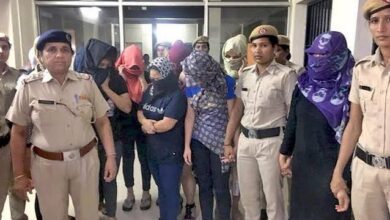
Meet Amarjit Bakshi Chairman and Managing Director Of Central Park – The Very Own Jeffrey Epstein Of Gurugram
An explosive complaint alleging an international prostitution and trafficking network, foreign women allegedly brought into India and accommodated at properties linked to Central Park, possible exploitation of minors, references to earlier police raids, and nine individuals named in a complaint. And then came the extraordinary 24-hour withdrawal of police notices. Is Gurugram witnessing a scandal that demands far more than routine police formalities?


Luxury real estate, exclusive residences and a carefully cultivated corporate image. That is the public-facing world associated with Central Park and its Chairman and Managing Director, Amarjit Bakshi. But an explosive complaint before Gurugram Police has now raised a far more disturbing set of questions.
An alleged international prostitution network. Foreign women allegedly brought into India through an organised network. Properties in Gurugram, Sohna and Bhondsi allegedly used to accommodate them. Claims of forced prostitution, possible trafficking and concerns about the involvement of minors.
And among the individuals named in the complaint is Amarjit Bakshi, the man at the helm of Central Park.
These are allegations of extraordinary gravity. They are not established judicial findings, but they are serious enough that they cannot be brushed aside through corporate silence, procedural explanations or the familiar exercise of waiting for public attention to move elsewhere.
The central question is straightforward:
What exactly was happening at the properties identified in the complaint, who was operating the alleged network, and what was the role, if any, of the individuals named in it?
1. The international prostitution racket allegations: The complaint that has put Central Park under the spotlight
In November 2026, a complaint submitted by Vanshani Foundation, a Gurugram-based organisation, brought an alleged international sex network involving properties associated with the Central Park Group into the public domain.
The complaint was filed by Swati Chaudhary, Director of Vanshani Foundation, based at Emerald Court, Gurugram. It was registered as Complaint No. 6410-DW on 6 November 2026.
The allegations are deeply disturbing.
According to the complaint, an organised network allegedly operating across several international locations, including France, Tunisia and Dubai, was involved in bringing foreign women into India.
The complaint also refers to women from countries including Russia and Tunisia.
These women were allegedly accommodated in residential societies and other properties said to be associated with the Central Park Group and its connected individuals.
The most serious allegation is that these premises were allegedly being used to facilitate prostitution and the sexual exploitation of women.
The complaint further raises concerns regarding the ages of certain women, suggesting the possibility of minor victims.
If these allegations are substantiated, the matter would go considerably beyond ordinary prostitution-related offences. It could involve organised trafficking, cross-border movement of vulnerable women, coercion and the exploitation of residential properties for criminal activities.
This is precisely why the complaint deserves an independent, comprehensive and time-bound investigation.
A residential development is supposed to provide safety and security to its occupants. It should never become a convenient environment for criminal networks to operate under the cover of legitimate accommodation.
2. Nine individuals named: Why does the complaint include Amarjit Bakshi?
The complaint has reportedly named nine individuals associated with the Central Park Group and its network of companies.
The names published in the newspaper report dated 16 November 2026 include:
- Amarjeet Bakshi (Amarjit Bakshi)
- Kawaljeet Bakshi
- Noor Bakshi
- Sanam Bakshi
- Sanjeet Bakshi
- Shiv Bakshi
- Chirag Gehlot
- Ashok Agrawal
- Saurabh Bhardwaj
The complaint also refers to other individuals.
The inclusion of Amarjit Bakshi makes the matter particularly significant.
He is the public face of Central Park and holds the position of Chairman and Managing Director. Consequently, the investigation must establish the nature of his association, if any, with the properties, individuals and activities described in the complaint.
Being named in a complaint does not establish criminal involvement. Nor does holding a senior corporate position automatically establish knowledge of an alleged offence.
But these distinctions should not become an excuse for avoiding legitimate questions.
Did the alleged activities take place at properties associated with the group? Who controlled those properties? Who managed accommodation arrangements? Were any employees, security personnel, property managers or associates involved? Did the individuals named have any knowledge of the alleged activities?
These are questions for the investigating agency to answer through documentary and electronic evidence.
3. Russia, Tunisia, Dubai and France: The alleged international network
One of the most disturbing aspects of the complaint is its alleged international dimension.
The complaint refers to an organised network operating across several locations, including France, Tunisia and Dubai.
It alleges that foreign women were brought into India through this network and subsequently accommodated at properties in Gurugram and surrounding areas.
The complaint also refers to arrangements for the movement of women, their accommodation and the circulation of photographs.
These are not incidental details.
Investigators need to establish how women were recruited, who arranged their travel, who paid for accommodation, who received them upon arrival, and whether any individuals in India coordinated their activities.
The investigation must also determine whether the alleged network had international facilitators, local operators, intermediaries or customers.
Were the women aware of the circumstances in which they were being brought into India?
Were they coerced, threatened, deceived or financially exploited?
Did they possess their own passports and travel documents?
Were their movements controlled by anyone?
Were any women underage?
These are questions involving potential trafficking and exploitation, and the investigation must prioritise the safety, dignity and protection of any possible victims.
The international dimension also makes it essential to examine immigration records, travel histories, accommodation records, financial transactions and communications between individuals in different jurisdictions.
A superficial inquiry confined to a few local statements will not be sufficient if the allegations point to an international operation.
4. The 2023 and 2024 police cases: The earlier trail that investigators must revisit
Perhaps the most important aspect of the foundation’s complaint is its reference to earlier police cases.
According to reporting by The Tribune and PTI, the foundation has referred to two cases registered at Sohna City Police Station during 2023 and 2024, as well as cases at Bhondsi Police Station.
The foundation’s authorised representative, Sanjana Yadav, has reportedly claimed that digital material recovered from mobile phones and laptops belonging to individuals arrested in these earlier cases contained information concerning the movement of women, accommodation arrangements and circulation of photographs.
The foundation alleges that these materials point towards a larger network.
It has also claimed that police raids in 2024 at certain properties allegedly associated with the group uncovered a racket involving foreign women.
This is an especially important allegation.
If earlier raids actually uncovered prostitution-related activities at premises connected with the individuals now named in the complaint, investigators must establish whether those incidents were isolated or connected to the alleged wider network.
The existence of earlier cases does not establish that Amarjit Bakshi or any other individual named in the present complaint participated in those activities.
However, the investigating agency must examine the earlier records rather than treating the November complaint as an isolated development.
The relevant questions are:
- What exactly was discovered during the alleged 2024 raids?
- Which properties were searched?
- Were foreign women rescued or questioned?
- Were any arrests made?
- What information was recovered from mobile phones and laptops?
- Were photographs, accommodation details, payment records or travel arrangements recovered?
- Did the previous investigations identify intermediaries or people coordinating the alleged activities?
- Were any of those people connected to the properties or individuals named in the November complaint?
- Were the previous investigations concluded, and what were their findings?
The answers could be crucial in establishing whether the allegations concern unrelated incidents or a coordinated network.
The police must not allow potentially relevant earlier investigations to remain disconnected from the present inquiry merely because the names or circumstances differ.
5. An even more disturbing allegation: Sexual services allegedly used to influence government officials
The complaint reportedly raises another disturbing dimension.
According to The Tribune’s reporting, the foundation has referred to the alleged provision of sexual services purportedly to influence government officials.
This is a serious claim that demands particularly careful examination.
The investigating agency must establish whether there was any organised arrangement involving the provision of sexual services to public officials, whether women were coerced into such arrangements and whether any payments or benefits were exchanged.
If substantiated, such allegations could raise questions not merely about prostitution or trafficking but also about possible corruption, criminal conspiracy and the exploitation of women for purposes beyond their own commercial exploitation.
Investigators should examine the alleged recipients, intermediaries, communications, financial records and any digital evidence relevant to this claim.
No government official should be presumed involved merely because such an allegation appears in a complaint. Equally, no potential avenue of investigation should be ignored because it is uncomfortable or involves influential individuals.
6. Gurugram Police’s 24-hour U-turn: Notices issued and then withdrawn
The police handling of the complaint has itself become a subject of public scrutiny.
On 15 November 2026, PTI reported that Gurugram Police had constituted a Special Investigation Team to investigate the international sex-racket allegations.
The investigation was assigned to ACP, Udyog, Yashwant.
Police had issued notices to the company’s director and eight associates, bringing the total number of individuals to nine.
However, the subsequent developments were extraordinary.
Notices issued on 14 November 2026 were withdrawn within approximately 24 hours.
According to subsequent reporting, a communication from the office of the Assistant Commissioner of Police (Industries), Gurugram, stated that the notices were being withdrawn with immediate effect for administrative and technical reasons.
The individuals were reportedly not required to appear before the police at that stage.
This development raises an obvious question.
What changed within approximately 24 hours?
Were the notices procedurally defective?
Was additional verification required?
Was there a problem with the manner in which the notices were issued?
Or was there some other reason for this sudden reversal?
The police have a responsibility to explain the procedural basis of their decision.
The withdrawal of notices does not establish that the complaint is false. Equally, the issuance of notices does not establish the guilt of those named.
The important point is that the investigation must continue independently and transparently.
A procedural withdrawal should not become an informal closure of a complaint involving allegations of trafficking and sexual exploitation.
If the allegations are baseless, the investigation should establish that clearly. If there is credible evidence, the police must act in accordance with law.
The public cannot be expected to accept a situation in which notices concerning an alleged international prostitution network are issued one day and withdrawn the next, with no meaningful explanation of the procedural circumstances.
7. The properties: Who controlled them and what happened inside?
The property angle is perhaps the most critical part of the entire investigation.
The complaint refers to properties in Gurugram, Sohna and Bhondsi allegedly associated with the Central Park Group and the individuals named.
However, public reporting has not established that any particular Central Park project or apartment has been judicially identified as a venue for prostitution.
That is precisely why the investigation must identify the actual premises rather than rely on broad corporate or property associations.
Investigators must establish:
Ownership: Which legal entities or individuals owned the properties mentioned in the complaint?
Management: Who was responsible for their day-to-day operation?
Accommodation: Who arranged the stay of the foreign women allegedly brought into India?
Access control: What do visitor registers, access-card records, security logs and CCTV footage reveal?
Financial transactions: Who received accommodation payments, commissions or other transfers associated with the premises?
Communications: Were there messages, photographs, call records or other digital material connecting the alleged operators?
Corporate involvement: Did any director, executive, employee or property-management associate have knowledge of or involvement in the alleged activities?
Victim protection: Were any women subjected to coercion, threats, financial exploitation or restrictions on movement?
A serious investigation should not end with identifying a few local intermediaries.
It must follow the entire chain: recruitment, transportation, accommodation, alleged exploitation, financial beneficiaries and those exercising control over the premises.
8. The questions Amarjit Bakshi cannot afford to ignore
The allegations are serious enough to warrant a clear and detailed response from Central Park’s leadership.
Amarjit Bakshi should address several questions concerning the properties and individuals identified in the complaint:
- Does he acknowledge that the complaint names him in connection with the alleged international prostitution network?
- What is his explanation regarding the allegations involving properties associated with the Central Park Group?
- Has he ordered an internal investigation into the properties and personnel mentioned in the complaint?
- Which legal entities own, lease, manage or operate the premises referred to by the complainant?
- Were any foreign women accommodated at these premises during the relevant period?
- What records are available concerning their accommodation, entry, exit and visitor movements?
- Did Central Park or any associated entity receive complaints concerning prostitution, trafficking or suspicious accommodation activities?
- What is his explanation regarding the foundation’s claims about earlier police raids in 2024?
- Has he examined whether any employees, contractors, property managers or associates were involved in the alleged network?
- Will Central Park voluntarily cooperate with the SIT and preserve all relevant digital, financial and security records?
- What does he have to say about the complaint’s references to earlier cases at Sohna City and Bhondsi police stations?
- What is his response to the allegation that sexual services were allegedly arranged to influence government officials?
These are legitimate public-interest questions.
A chairman of a prominent real-estate group should not view questions about the alleged misuse of properties as an attack on his corporate brand.
The allegations concern the possible exploitation of women and potentially vulnerable foreign nationals. The priority must be establishing the truth.
9. The ‘Jeffrey Epstein of Gurugram’ question: An explosive allegation demands an equally serious investigation
The headline deliberately invokes Jeffrey Epstein, whose criminal activities exposed an international sexual exploitation network and raised profound questions about the protection afforded to powerful individuals.
The comparison is provocative, but it must not be mistaken for a finding of guilt or equivalence.
There is currently no judicial finding establishing that Amarjit Bakshi committed crimes comparable to Epstein’s.
Nevertheless, the allegations now reported in Gurugram concern subjects that cannot be trivialised: international movement of women, alleged forced prostitution, possible trafficking, concerns about minors and the potential use of residential properties to facilitate exploitation.
These allegations demand a level of scrutiny proportionate to their seriousness.
The investigation must determine whether there was an organised prostitution network, whether foreign women were trafficked or coerced, who arranged their accommodation, who financially benefited and whether the properties referred to in the complaint were knowingly used for illegal activities.
If the allegations are substantiated, those responsible must face the full consequences under applicable law, irrespective of their corporate position, financial resources or social standing.
If the allegations are false, the investigating agency must establish that too.
What cannot be permitted is an endless cycle of sensational allegations, procedural reversals and eventual silence.
10. The SIT must establish the truth, not merely complete another formality
The formation of an SIT is an important development, but it is only the beginning.
This investigation needs to go beyond routine questioning and examine the evidence comprehensively.
The SIT should:
- Obtain and examine the records of the 2023 and 2024 Sohna City cases and relevant Bhondsi cases.
- Verify the foundation’s claims concerning police raids at properties in 2024.
- Identify the exact properties and their ownership and management structures.
- Examine relevant mobile phones, laptops and digital records through lawful procedures.
- Verify the travel and immigration history of the foreign nationals concerned.
- Identify and protect any possible victims.
- Examine accommodation registers, CCTV footage, visitor records and electronic access logs.
- Follow the financial trail of payments allegedly connected with accommodation and prostitution.
- Investigate the identity and role of local and international intermediaries.
- Establish the individual role, if any, of all nine persons named in the complaint.
- Clarify the procedural reasons behind the withdrawal of notices issued on 14 November 2026.
The SIT should also ensure that potential victims are not exposed to intimidation, public identification or further exploitation.
Investigators must follow evidence wherever it leads, whether that evidence implicates local operators, property managers, intermediaries or senior corporate functionaries.
Conclusion: Gurugram deserves answers. Alleged victims deserve justice.
There is a fundamental difference between selling luxury residences and ensuring that the properties associated with a corporate group are never used for unlawful activities.
The allegations against individuals associated with Central Park are extraordinary. They involve possible international prostitution, alleged trafficking of foreign women, possible exploitation of minors and claims concerning the use of residential properties.
The complaint names Amarjit Bakshi alongside eight other individuals. The police have formed an SIT, issued notices and subsequently withdrawn them within approximately 24 hours.
Yet the central questions remain unanswered.
What happened at the properties?
Who arranged the accommodation?
Who brought the women into India?
Was there an organised prostitution network?
Were any women coerced or trafficked?
Did earlier police cases contain evidence of a larger operation?
And what, if anything, was the involvement of the individuals named in the complaint?
These questions cannot be answered through corporate publicity or administrative explanations.
Amarjit Bakshi deserves the opportunity to respond to the allegations and the protection of due process. But the public also deserves a credible investigation, and any women who may have been exploited deserve protection and justice.
The SIT must not allow this matter to fade into procedural ambiguity.
If an international prostitution and trafficking network operated through properties in Gurugram, the entire chain of people responsible must be exposed.
If the allegations cannot be substantiated, that conclusion must also be reached transparently.
The truth must not depend on the stature of the individuals named, the corporate value of the properties involved or the influence they may command.
Gurugram needs answers. The alleged victims deserve justice. And the investigation must establish the truth.