From Online Promise To Doorstep Disappointment: The Recurring Pattern Of Price Cuts, Fake Parts And Unresolved Complaints At Cashify
Unpaid Vendors and Angry Customers: The Growing Resentment Behind Cashify’s Push Toward a Multi-Thousand-Crore IPO

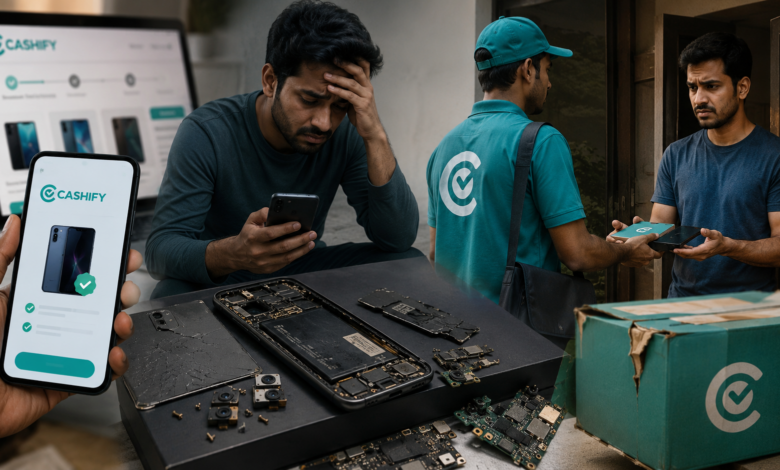
Cashify presents itself as the simplified, trustworthy solution for buying and selling used electronics in India. The marketing emphasises convenience, transparent pricing, reliable refurbished devices and hassle-free after-sales support. The public record of consumer feedback and commercial disputes tells a markedly different story. Across multiple review platforms and formal forums, a consistent set of grievances has accumulated over several years. Sellers describe systematic reductions in the price offered once an agent arrives.
Buyers report refurbished phones and laptops that develop faults soon after purchase, often with allegations of non-original parts. Warranty claims are frequently contested or delayed. At the same time a reported vendor payment dispute has added a layer of commercial resentment. These issues form the core of documented criticism even as Cashify reports revenue above ₹1,000 crore and prepares for a public listing.
The most frequently repeated complaint concerns the gap between the online quote and the final offer at pickup. Customers enter device details on the Cashify platform and receive an attractive valuation. When the agent reaches the doorstep, the amount is reduced, sometimes substantially. Reviews repeatedly describe reductions of 30 to 50 per cent or more. Agents cite scratches, paint peel, minor defects or the absence of original packaging. Sellers who reject the revised offer often report that the agent still records images and IMEI numbers before leaving.
The pattern appears across hundreds of accounts on Trustpilot, MouthShut and consumer complaint portals from 2022 through mid-2026. One detailed account described an online quote of ₹16,790 for a Samsung S21 FE that the diagnostic tool itself rated highly; after prolonged inspection and negotiation the final figure settled near ₹15,000 only after haggling. Another seller was quoted ₹6,500 for an iPhone SE and then offered ₹4,500. The consistency of these reports suggests that the online calculator functions more as a lead-generation tool than as a binding valuation. The resulting sense of bait-and-switch has become a central source of customer anger.
Buyers of refurbished devices encounter a parallel set of problems. Multiple reviews allege that phones arrive with non-original screens, batteries or other components described as Chinese or aftermarket. Devices that function adequately for a short period develop battery drain, overheating, display lines or complete failure. When warranty claims are raised, support teams are accused of attributing the fault to water damage, physical misuse or other exclusions even when the customer disputes those findings. Several accounts describe the “no-questions-asked” replacement window as ineffective in practice.
One buyer of a refurbished iPhone reported that the device stopped working within weeks and that subsequent inspection at an independent shop revealed multiple non-original internal parts. Another customer who purchased a MacBook under warranty found the battery failed and received no satisfactory resolution. Repair services generate their own complaints: quoted prices change at the counter, devices are returned in non-working condition, and disputes arise over whether genuine parts were installed. These experiences stand in direct contrast to Cashify’s public emphasis on quality-checked inventory and reliable service.
After-sales support emerges as one of the weakest points in the customer experience at cashify.
Reviewers describe long waits for responses, repeated transfers between teams, and cases in which devices sent for warranty service come back with additional damage or unresolved faults. Resolution rates on certain complaint aggregators have been reported as low. The volume of similar grievances across platforms indicates that the friction is not limited to isolated service centres or individual agents. It points to systemic challenges in quality control of the refurbished inventory, transparency in the valuation process, and the capacity or willingness of support teams to honour stated warranty terms.
Cashify is approximately a decade old, having evolved from earlier waste-management and recycling activities into the current recommerce platform. Complaints about quote reductions and refurbished-device quality have been documented for several years and intensified in the 2024–2026 period. No public record supports claims of grievances stretching across multiple decades; the relevant timeline begins with the platform’s growth phase. The concentration of negative feedback in recent years coincides with Cashify’s expansion of offline stores, higher transaction volumes and preparations for a public listing.

A separate commercial dispute has amplified resentment among suppliers. In February 2026 reporting detailed a legal notice from an MSME vendor alleging that Cashify’s related entity owed ₹36,24,770 in unpaid invoices. The total claim, after adding interest, contractual penalties, damages for alleged abrupt termination, reputational harm and legal costs, was stated at ₹92,54,770.
The vendor escalated the matter to the Micro and Small Enterprises Facilitation Council under a specific case reference and indicated readiness to pursue arbitration and further remedies. No public award, settlement confirmation or Cashify admission appears in the accessible record. The allegation nevertheless sits uneasily alongside the company’s growth narrative and IPO preparations. For smaller suppliers, delayed or disputed payments can create severe cash-flow pressure. The episode has been cited as evidence of uneven treatment of commercial partners at a time when the platform is positioning itself for public-market scrutiny.
Financially Cashify has scaled. Operational revenue rose to approximately ₹1,096 crore in FY25 from ₹935 crore in FY24. Net loss narrowed by roughly 80 per cent to about ₹10.5–10.6 crore. Cash balances declined year-on-year. The business has expanded its network of physical stores and maintains partnerships with major device brands for trade-in programmes. These figures demonstrate commercial traction in a growing recommerce market. They do not, however, erase the volume of unresolved customer friction or the reported supplier claim.
The IPO process itself is underway. Reports indicate the appointment of ICICI Securities, JM Financial and Nomura as bankers. Cashify aims to raise between ₹1,500 crore and ₹1,800 crore through a combination of fresh capital and an offer for sale that would allow early investors partial exits. Confidential filing of draft papers was anticipated around mid-2026, with a possible listing window in early 2027. Conversion to a public limited company and appointment of independent directors form part of the preparatory steps.

For prospective investors the consumer complaint patterns at cashify and the vendor payment allegation represent tangible risks. Pricing transparency failures and quality issues can damage brand trust and increase return or warranty costs. Unresolved supplier disputes can signal broader working-capital or governance concerns. Thin absolute profitability, even after sharp loss reduction, leaves limited margin for error. Cashify’s ability to demonstrate measurable improvement in customer satisfaction metrics and clean resolution of commercial claims will likely influence both valuation and post-listing performance.
Legal and regulatory records add further texture without supporting sweeping claims of systemic criminality. A 2019 Bengaluru police FIR under IPC Sections 392 and 411 involved the former corporate entity and led to a charge-sheet in 2020. The matter proceeded to a criminal court case; a High Court quashing petition was later disposed of as infructuous once the charge-sheet had been filed. Three persons were reported arrested in connection with the underlying occurrence, one of them identified as a local Cashify employee. No conviction of Cashify or its founders appears in the public record.
A separate pending prosecution under the Factories Act in Haryana is indexed against the former corporate name. Several consumer commissions have issued ex parte orders finding deficiency in service and unfair trade practice, directing refunds, compensation and costs. One order used the word “conspired” in the limited context of a non-delivery and non-refund dispute; that language remains confined to the consumer adjudication and does not constitute a criminal finding. An arbitration petition involving the refurbished-sales entity is indexed, though details of claim amount and outcome are not publicly available. No reliable records of ED, CBI, EOW, PMLA, income-tax or GST raids, property attachments or insolvency proceedings against the core entities were located.
The cumulative picture is one of a scaled platform whose operational practices have generated persistent customer dissatisfaction and at least one publicly reported supplier grievance. The online-to-doorstep price drop is the most repeated seller complaint. Refurbished device quality and warranty friction dominate buyer complaints. After-sales responsiveness is widely criticised. The ₹36.24 lakh principal vendor claim, escalated to an MSME facilitation body, has become a focal point of commercial resentment. These issues have been documented across multiple years of reviews and formal proceedings. They coexist with revenue growth, loss reduction and concrete steps toward an IPO valued in the range of ₹1,500–1,800 crore.
A platform that markets simplicity and trust must ultimately be judged by the experience of the people who sell devices into it and the people who buy devices out of it. When large numbers of sellers report systematic downward revision of quoted prices, and large numbers of buyers report early failures and contested warranties, the marketing claims lose credibility. When a supplier alleges unpaid invoices running into tens of lakhs and escalates the dispute formally, questions about commercial discipline arise.
Cashify’s financial progress and listing ambitions will be tested by its capacity to close these gaps. Until the volume of similar grievances declines and supplier claims are cleanly resolved, the criticism that Cashify’s growth has outpaced its service reliability will remain a central part of the public record.

The numbers are concrete. Revenue crossed the ₹1,000 crore threshold. Losses fell by approximately 80 per cent. An IPO of up to ₹1,800 crore is under preparation. Against those figures stand hundreds of customer accounts describing quote reductions of 30–50 per cent or more, refurbished devices that fail within months, warranty processes that customers find obstructive, and a reported vendor claim of ₹36.24 lakh principal rising to ₹92.55 lakh with ancillary demands.
The gap between the marketed promise and the documented experience is the core of the critique. It is a gap measured not in abstract reputation scores but in individual transactions that left sellers feeling short-changed and buyers feeling misled. Closing that gap is the practical test cashify faces as it moves toward public markets.