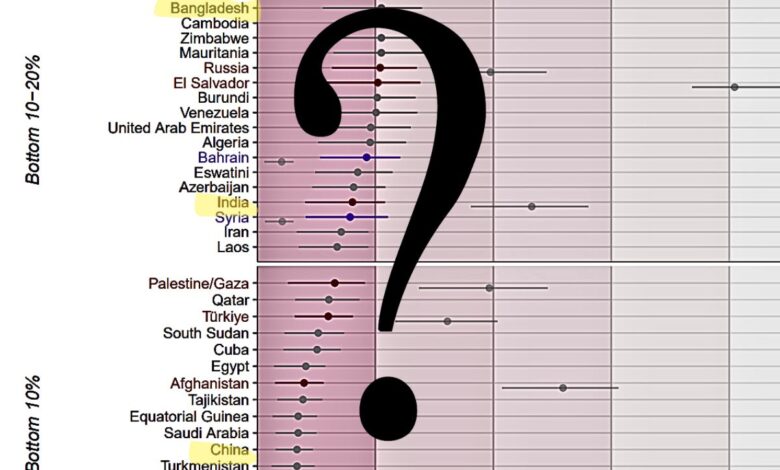
If we see the international rankings, especially the Academic Freedom Index that placed India in the lower 10-20%, most of us would feel that something is not right. It is not that we are shying away from accepting our issue, but we must wonder if these international comparisons are really capturing the nuanced picture of a plural, developing country like ours.
The Academic Freedom Index reveals to us a fascinating paradox. China falls below India, in the lowest 10%. How we would consider this, as China has emerged as a robust economy, on par with the United States in global trade and in creating new technologies. How is it possible that a nation with little academic freedom manages to produce ideas that compete globally? This paradox implies that perhaps something is amiss with the manner that these indices quantify academic environments.
It is more surprising that Bangladesh is placed above India. The reason is that Bangladesh is supposedly less “anti-pluralist.” Recent events in Bangladesh tell a different story. The country has had an enormous amount of political turmoil and violence, including violence against minorities and democratic institutions. One can be surprised that a country in such chaos would have greater academic freedom than India, which does have its own democratic foundations, albeit imperfect.
This is true with all major global rankings. Consider the World Press Freedom Index, for instance, where India ranked 161 out of 180 nations in 2024, below nations with more defined media restriction. India is typically ranked low in the Global Hunger Index despite the fact that it produces and exports so much food. India is ranked low by the Environmental Performance Index while most of the rest of the developed world with higher carbon emissions is ranked much higher.
These rankings are comparable to what occurred during colonial periods. The British labeled Indian systems of knowledge “unscientific” and “primitive” and deemed Western concepts superior. Colonial administrators generated lengthy reports and lists detailing Indian society to justify their dominance by highlighting our “backwardness.” Present-day world rankings, as non-colonial as they are intended to be, occasionally do so by applying Western criteria without sufficient historical context.
India does face serious challenges. Our schools and colleges need to get a lot better. We should pay attention when an IIT director says compromising things about cow urine, even though the Indian Veterinary Research Institute has proof against it. We should worry when a Delhi University principal uses cow dung in classrooms, claiming it will make the rooms cooler. We also expect our ministers to be better at literacy than misspelling “Beti Bachao, Beti Padhao” at a school event.
The issue is with how these things are measured and understood. The most global measures apply factors developed in Western nations that are not necessarily valid in the Indian context. Academic freedom in India, for instance, could be restricted not only by state intervention but also by social stratification, economic disparity, and historic injustice. Such nuances are lost in basic ranking systems.
Look at the Human Development Index. India is low, but the improvement from independence to today is amazing given where we began and our huge population. In 1947, roughly 12% of the population was able to read and write; today, more than 77% can. People live much longer today. These are not the things that are apparent when we only look at current rankings without comparing to the past.
In economic accounting, our over 90% informal economy of India is usually not brought into account. Indigenous knowledge, indigenous inventions, and the ways our communities survive are usually not considered because they cannot be put under Western concepts of development or of innovation.
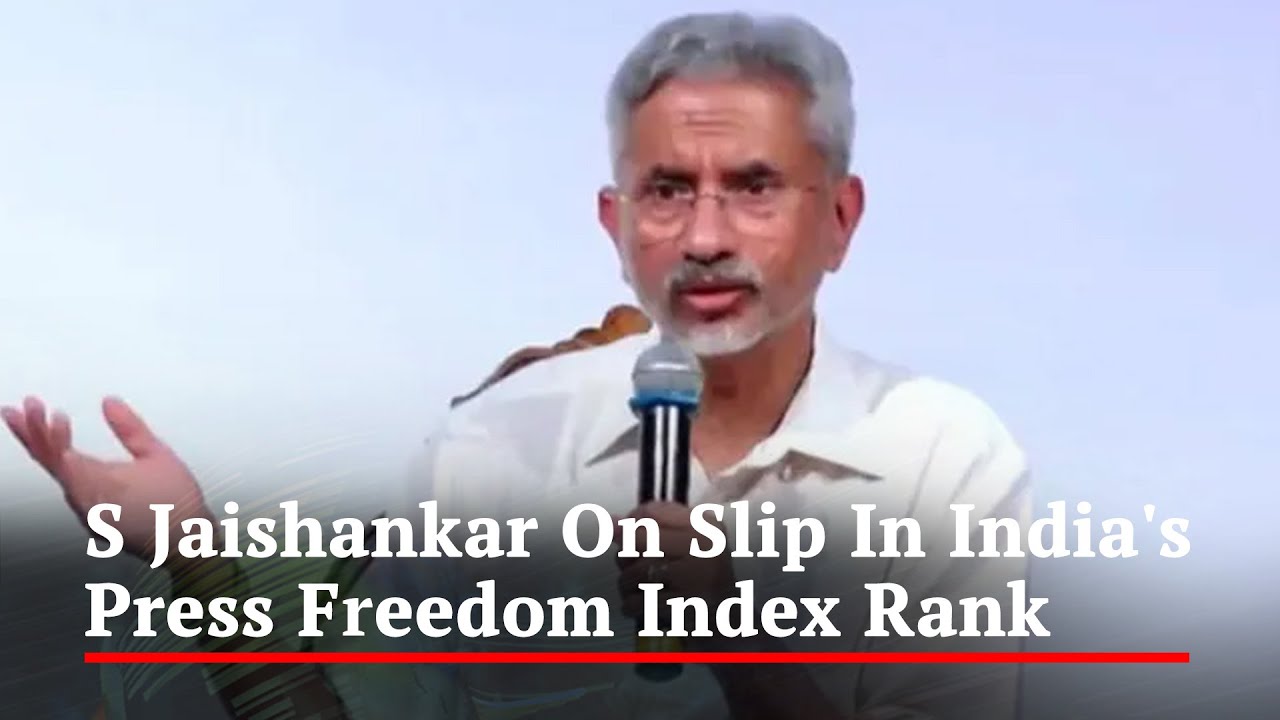
Recent trends have indicated that even so-called objective rankings are geopolitical in nature. When India produced a non-aligned perspective on the Russia-Ukraine conflict, suddenly there was a spate of negative news about Indian democracy. As External Affairs Minister S. Jaishankar noted, some of these rankings are merely “mind games” that are based on the agenda and mindset of the authors and not on the actual situation.
The World Bank Ease of Doing Business Index cautions us to exercise vigilance. India was thrilled when our ranking significantly improved, moving 79 ranks between 2014 and 2019. Later, the World Bank ceased publishing the index after considering it and finding issues with the data and methodology employed. This incident revealed that even widely recognized international rankings may be imperfect in their construction and application.
In India, we have witnessed rankings mislead us about the real picture. The Swachh Bharat Mission enhanced the availability of toilets in the nation immensely, but global sanitation rankings took an extremely long time to capture these improvements. On the other hand, states like Kerala, with strong social indicators, hardly get the right kind of attention in global comparisons because their achievements do not fit the conventional models of development.
As the Hindi proverb has it, “Diya tale andhera” (darkness under the lamp)—sometimes the people who are making the measurements themselves do not notice the boundaries of their own instruments. Global indicators tend to emphasize some values and outcomes and neglect others. They may emphasize individual freedoms but not value collective proximity, or examine formal institutions but overlook informal knowledge systems.
This is not to say we reject all criticism or disregard all rankings. Rather, it is to say we must be more cautious in creating and interpreting these indices. The indicators have to be sensitive to various cultures and contexts. Historical trajectories and resource constraints have to be taken into consideration in our judgments. Indigenous knowledge systems and other ways of developing have to be acknowledged alongside conventional measures.
India could be more proactively interacting with global ranking groups so that our voices are heard. We could create more indexes that better reflect our situation and needs. Most importantly, we could use both external and internal evaluations as tools to get better rather than as excuses to be defensive or despairing.
The great poet Rabindranath Tagore once wrote of a world “where knowledge is free, where the world has not been broken up into fragments by narrow domestic walls.” This vision encourages us to escape narrow thinking and embrace a wider vision of human development and accomplishment. Perhaps global indicators need to follow this concept, transcending traditional measurement to include alternative means of acquiring knowledge, freedom, and advancement.

So, are foreign indexes anti-Indian? Occasionally, yes.
Do they need to change their guidelines? Almost certainly in practice. But do we need to take this as an excuse to turn a blind eye to our real problems? By no means. The way forward is to neither wholly reject outside perspectives nor to take them on trust, but to weigh their wisdom and their limitations in both directions. For, as another popular Indian proverb goes, “Truth alone triumphs”—but identifying which truths are relevant and how to measure them is a challenge to us all.