India’s Income Inequality Hits 70-Year High: The Richest 1% Hoard Wealth While Millions Starve!
India’s wealth gap is now worse than in the 1950s! The top 1% owns more than 7% of the total income, while half the population barely survives. Is India headed for an economic disaster?

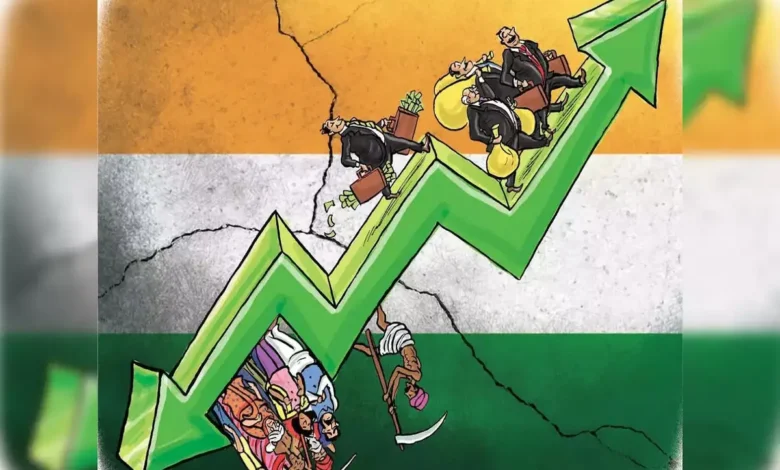
India has experienced a dramatic transformation in its economic landscape over the decades, yet income inequality persists and worsens alarmingly. India’s income inequality today is worse than in the 1950s, according to a recent report by People Research on India’s Consumer Economy (PRICE). The Gini coefficient has still shown a lot of skewness even after economic growth, where the top 10% of the country has close to 30% of total national income, and the bottom 10% only holds 2.4%. The top 1% has more than 7% of national income, and the bottom 50% only holds 23%.
A Look at the Gini Coefficient: Then and Now
The Gini coefficient measures income inequality. Its value ranges from 0 to 1, and 0 signifies perfect equality, while 1 is perfect inequality. According to the latest available data, India’s Gini coefficient for 2022-23 is 0.410, compared with 0.371 from 1953-55.
Although there is some improvement from the 0.506 recorded in FY21, today’s inequality levels are still more than in the decades since independence. That pattern speaks to a harsh reality: The growth in India’s economy, after decades of effort, has disproportionately accrued to the well-off and not enough to people with low incomes.
Rich Getting Richer, Poor Getting Poorer
One of the most worrying aspects of India’s economic divide is how it affects the lives of millions of people daily. According to World Bank data, in 2021, around 44% of the Indian population survives on less than $3.65 per day, the standard set worldwide to mark poverty. This implies that the world’s fifth-largest economy still has a significant proportion of people suffering from extreme poverty.

The report also sharply reminds us that the rich get richer in India, and the poor get poorer. With the concentration of wealth among the wealthy elite and no growth in real wages, living costs for the lower groups are growing, which exasperates the bitter truth. Unfortunately, this has become the rule rather than an exception.
Historical Context of Income Inequality in India
Policy choices, social institutions, and the international economy have determined India’s history of economic inequality. During the 1950s, just after gaining independence, India’s economy was primarily agricultural, and the distribution of wealth was less skewed since rural areas had relatively equal resources. However, rapid industrialization, globalization, and liberalization in the 1990s led to wealth creation, but only for a select few.
Economic liberalization brought benefits such as an expanding middle class, flourishing industry, and more foreign investment, but the gap between the affluent and the poor also grew. Urbanization and technopreneur industrialization have led to wealth accumulation by concentrating in cities, leaving the downtrodden and rural population behind.
Causes of India’s Widening Income Inequality
Several factors contribute to India’s worsening income inequality:
- Unequal Access to Education and Employment
- The lack of quality education in rural areas and among lower-income groups restricts opportunities for economic mobility.
- High-paying jobs remain concentrated in urban centres, creating a geographical wealth gap.
- Healthcare Disparities
- Access to quality healthcare remains limited in rural India, leading to higher disease burdens and lower productivity.
- Rising healthcare costs push millions into poverty each year.
- Urban-Rural Divide
- Metropolitan areas like Delhi, Mumbai, and Bengaluru have seen skyrocketing wealth accumulation, while rural India struggles with agricultural distress and low wages.
- Taxation Policies Favoring the Rich
- While India has a progressive tax system, loopholes and corporate tax benefits allow the ultra-rich to avoid paying a fair share.
- Inflation and Wage Stagnation
- Rising inflation disproportionately affects lower-income families, while wages for unskilled and semi-skilled labour have not kept pace with the cost of living.
- Gender and Social Inequality
- Due to systemic discrimination and blocked opportunities, women and other marginalized communities earn much less money.
Impact of Inequality on India’s Economic Growth
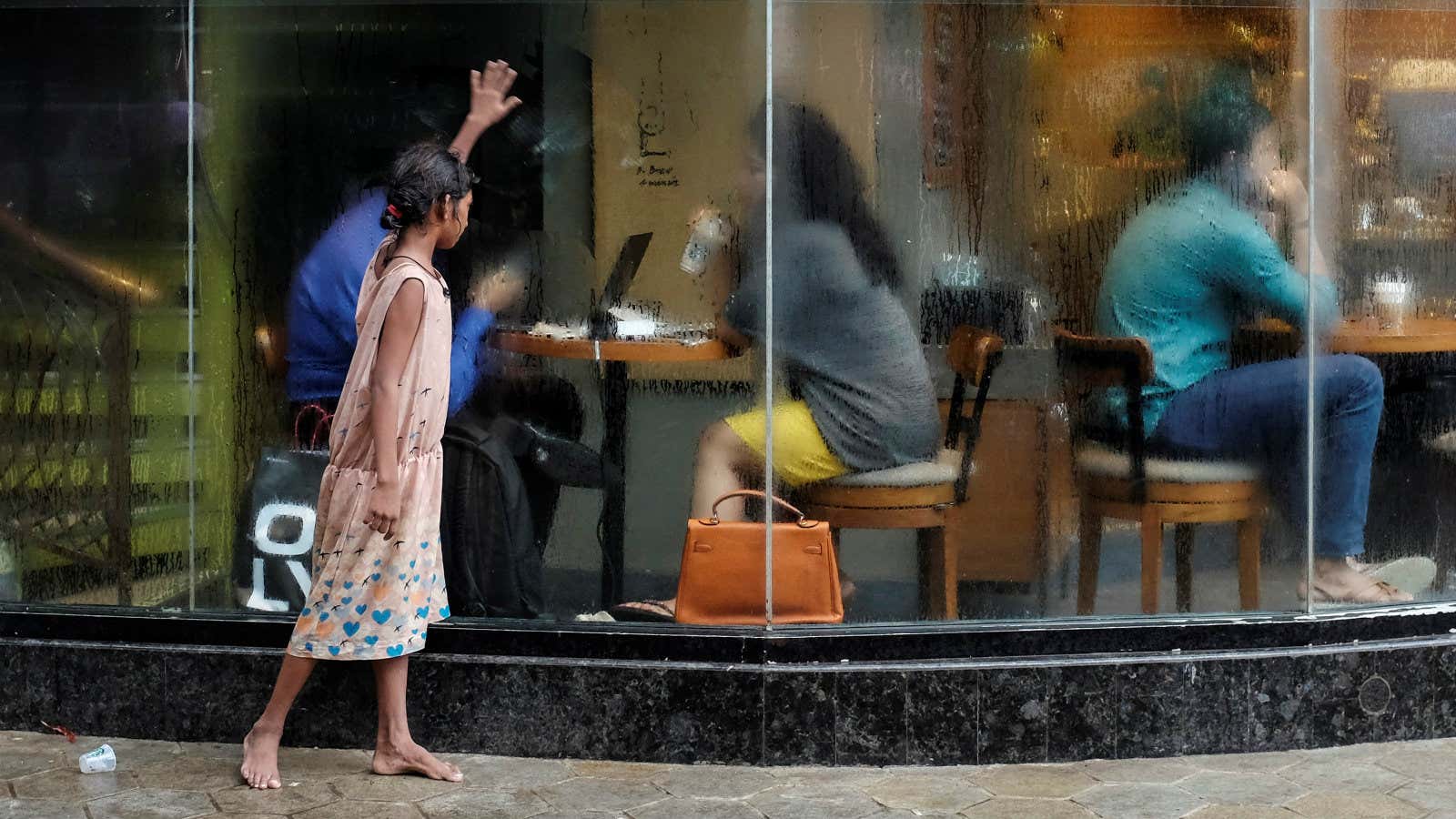
This is not just a social issue but also an economic one because India’s income gap is widening. A study has shown that higher levels of inequality can adversely affect economic growth, increase social unrest, and even weaken consumer expenditures. In this nation, most of the population struggles financially and cannot sustain long-term economic prosperity.
Key consequences of rising inequality include:
- Lower consumer demand: When wealth is concentrated among a small elite, overall consumer spending declines, slowing economic growth.
- Social unrest: Rising frustration over income inequality has resulted in protests and movements for economic justice.
- Brain drains: The skilled population from lower-income groups look for better opportunities outside India, which diminishes the Indian skilled workforce.
- Political instability: Economic inequality creates dissatisfaction with governance and policy volatility.
Solutions: How Can India Address Its Income Inequality?
Although the situation is serious, it has solutions and policies to bridge the gap between the rich and the poor. In the PRICE report, the measures considered are as follows:
- Increased Investment in Education
- Improving public education quality, especially in rural areas, will enable upward mobility.
- Digital literacy and vocational training should be paid more attention to prepare individuals for better occupations.
- Stronger Healthcare Reforms
- Expanding affordable healthcare services can reduce medical-related financial distress.
- More government funding for public hospitals and insurance schemes.
- Rural Development Programs
- Investing in agriculture, infrastructure, and technology to create employment in rural areas.
- Encouraging microfinance and entrepreneurship for small-scale businesses.
- Progressive Taxation and Wealth Redistribution
- Implementing higher taxes on the ultra-rich while reducing indirect taxes disproportionately affecting low-income people.
- Strengthening policies to curb corporate tax evasion.
- Minimum Wage and Labor Reforms
- Adjusting minimum wages in line with inflation.
- Ensuring labour laws protect informal sector workers, who comprise a large portion of India’s workforce.
- Social Safety Nets and Welfare Programs
- Strengthening food security programs, housing schemes, and direct benefit transfers.
- It can expand these initiatives like MNREGA to provide fixed employment.

Final Thoughts
India’s income inequality is deteriorating, and therefore high-level policy reform is required in the near term. Economic growth has undoubtedly pulled millions out of poverty, but the gains have slowed considerably and disproportionately benefited the rich in income. If sustained policies are not taken, results show that the scenario may further deteriorate economic and social instability.
Investing in education and health care, along with progressive measures for the Indian economy to promote help to masses other than the li, is how we can hope for future social and economic stability. If the proper measures are taken, India may progress toward a more sustainable and equitable financial future in which wealth is distributed among all people rather than being concentrated in the hands of a select few.