Kriti Sanon’s GIVA Ad: When Tradition Wears A Plunging Neckline!
When Cultural Appropriation Wears a Bralette- How Bollywood Turned Raksha Bandhan Into a Joke?


Kriti Sanon’s Raksha Bandhan advertisement for jewellery brand GIVA has been quietly removed after a predictable storm of outrage.
The brand issued the usual corporate apology, as highest regard for Indian culture, no intention to hurt anyone, and so on; then scrubbed the campaign from every platform. The damage, of course, was already done. And the real story is not that an ad was pulled. It is that a major brand, with a major Bollywood face, thought it was perfectly acceptable to treat a centuries-old festival of sibling protection as a quirky, lightly sexualised product placement for pets and midriff.
Let us be clear about what the ad showed. Kriti Sanon, dressed in a bralette-style blouse, sheer shrug and draped skirt, ties a rakhi first to a pet dog and then to her on-screen brother. The jewellery being sold included “pet rakhis.” The aesthetic was Indo-Western, deliberately contemporary, and, by any traditional standard, deliberately revealing for the occasion. Kangana Ranaut called it “intentionally creepy.” Many ordinary viewers simply asked why a woman would choose to mark a sacred sibling ritual looking as if she had just stepped out of a lingerie shoot.
Kriti’s defence was the standard progressive script: “Culture and traditions are in her heart, not in her neckline.” She added that she and her sister tie rakhi to each other, that the festival is about protection, and that pets are family too. All of this is emotionally tidy. It is also intellectually lazy.

No serious person claims that clothing is the sole measure of cultural respect. But clothing is not irrelevant either. Context matters. You do not wear a swimsuit to a funeral and then lecture the mourners about the purity of your feelings. You do not turn up at a temple in clubwear and insist the deity should only care about your bhakti. Festivals carry form as well as feeling. When the form is casually discarded for fashion and brand synergy, the feeling starts to look performative.
The pet angle is particularly revealing. Extending affection to animals is not the problem. Millions of Indian families treat pets as members of the household. The problem is the casual equivalence. Raksha Bandhan is not a generic “celebration of protection.” It is a specific ritual with a specific history, rooted in the brother-sister bond and the promise of mutual duty. Turning the dog into a co-equal recipient of the rakhi is not progressive inclusion. It is dilution. It is the same impulse that turns Diwali into “Festival of Lights” Instagram content and Holi into a colour-run party. The sacred becomes content. The content becomes commerce. And anyone who objects is told they are stuck in the past.
GIVA’s decision to pull the ad is equally instructive. The brand claims deep respect for Indian traditions. Yet it approved an ad that many Hindus found tone-deaf, then folded the moment the noise grew. This is not courage. It is risk management. Brands will experiment with “modern” takes on Hindu festivals as long as the experiment stays profitable and the backlash stays manageable. The moment it becomes costly, they discover sudden reverence. The same pattern appears every year: a vaguely desi-looking campaign that flirts with irreverence, a wave of criticism, a carefully worded withdrawal, and then silence until the next festival cycle.
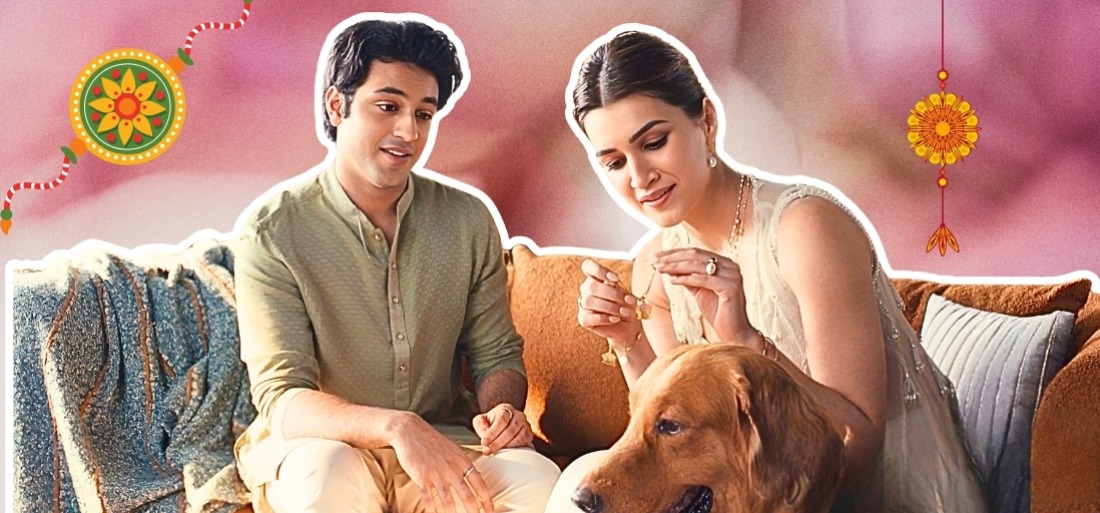
There is also a selective blindness at work. One can imagine the reaction if a similar ad had been made for Eid or Christmas — a female star in revealing Western-ethnic hybrid clothes, tying a symbolic thread to a pet while selling jewellery. The outrage would have been framed very differently, and the brand would have faced accusations of Islamophobia or cultural insensitivity long before any “modern interpretation” defence was allowed to take root. With Hindu festivals the rules are looser. Critique is often dismissed as orthodoxy or, worse, as the province of the politically inconvenient.
Kriti Sanon is not a villain. She is a successful actress doing what successful actresses do: endorse products, stay relevant, and defend her choices with the language of the moment. Her sister’s defence, telling critics to “evolve”, is equally predictable. Evolution, in this vocabulary, always means moving further from tradition and never the reverse. The question no one wants to answer is whether every evolution is improvement, or whether some of it is simply erosion dressed up as progress.
Raksha Bandhan will survive this ad, just as it has survived every previous attempt to rebrand it. What is harder to measure is the cumulative effect of a thousand such small dilutions. When festivals become primarily opportunities for celebrity styling, pet merchandising, and progressive signalling, something is lost. The loss is not dramatic. It is gradual. It is the slow replacement of a shared cultural grammar with individual sentiment and brand strategy.

The brand has removed the ad. Kriti has said her piece. Kangana has scored her points. The internet has moved on. But the underlying question remains. If culture truly lives only in the heart, why do we still need the neckline, the ritual, the thread, and the festival at all? And if those things still matter, why do so many powerful people act as if they are optional props in a marketing campaign?
That is the real controversy. Everything else is noise.