Two Streets, One Police Force
On Saturday, Delhi Police proved it can stop a crowd of four from forming anywhere in central Delhi. It also proved it can stand next to a mob beating teenagers and notice nothing.

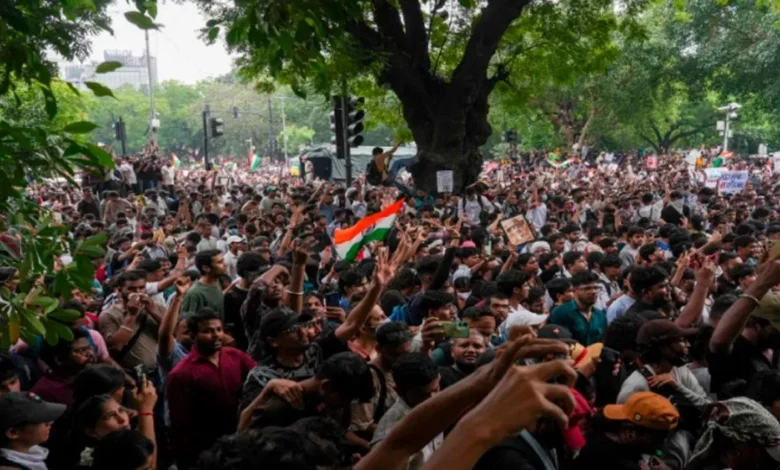
NEW DELHI: On 10 October the capital was run under Section 163 of the BNSS, the provision that bars gatherings of more than four people. On one street, that law was a steel wall. Students, lawyers, reporters, former chief ministers and a YouTuber in his own house were all swept up for the offence of intending to stand at Jantar Mantar.
On the next street, the same law took the day off. Men in saffron gamchhas gathered in groups, marched around Connaught Place, cheered the police by name and, on video, hit students and shoved women. The Quint, whose reporters filmed one such assault, put it plainly: a mob was allowed to assemble, shout and attack under the very order used to detain everyone else.
So the question is no longer rhetorical. Is Section 163 a law, or a guest list?
The day in numbers
| Measure | Figure | Source |
|---|---|---|
| Protesters detained across Delhi | More than 7,000 | PTI via ThePrint |
| Central armed police sanctioned for Delhi | 221 companies, roughly 23,000 personnel | ThePrint |
| Metro stations shut | About 45 | ThePrint |
| Mobile internet shutdown | 4 km radius of Jantar Mantar | ThePrint |
| FIRs over the protest attempts | More than 20 | India TV |
| Men arrested for attacking protesters | 4 | PTI via Deccan Herald |
Seven thousand to four. That is the ratio a force of this size produced on a day when camera after camera recorded protesters being beaten by civilians. Detention counts shifted through the day, from about 500 in the police’s own morning statement to more than 7,000 in PTI’s tally. The count of arrested attackers never moved past four, and it only reached four after the video went viral.
Street one: where the law never blinks
The Cockroach Janta Party (CJP) had called a protest at Jantar Mantar demanding the resignation of Chief Election Commissioner Gyanesh Kumar over the Special Intensive Revision of electoral rolls. Delhi Police refused permission, saying notice came too late. What followed was not crowd control. It was pre-emption on an industrial scale, logged hour by hour by ThePrint.
- The founders never reached the street. Police boarded the aircraft carrying Abhijeet Dipke, Ashutosh Ranka and Saurav Das after it landed at IGI airport and took them off it.
- A YouTuber was picked up at home. The CJP said Dhruv Rathee was detained from his Gurugram residence around 8 am. He was later released.
- The party’s lawyer was held in a car. Legal head Ratna Singh said she was stopped outside her Jangpura home with no written order, only word of instructions from above. She has moved the Saket court seeking an FIR for wrongful confinement.
- Lawyers were detained for walking. A group marching from the Supreme Court was picked up. The Supreme Court Bar Association asked the Chief Justice to intervene and to have the reported use of force examined.
- A gurdwara offered no shelter. Hundreds who had waited inside Bangla Sahib were detained outside it. ThePrint’s ground report says protesters were dragged.
- Seniority was no protection. Arvind Kejriwal, Mamata Banerjee, Pinarayi Vijayan and Yogendra Yadav were all detained. Atishi alleged Kejriwal was taken brutally.
- Stadiums became holding pens. The police statement said New Delhi was cut into 20 zones with a detention centre for each.
The three CJP leaders were held under Sections 126 and 170 of the BNSS, the preventive provisions for people who might breach the peace. On Sunday an executive magistrate freed them on Rs 50,000 bonds and a condition to keep the peace for one year, PTI reported. Their offence, for the record, was landing.
The treatment of detainees is now its own set of allegations. CJP’s Ajinkya Shinde told a press conference that protesters, Dipke included, were treated inhumanely in custody. Journalist Rana Ayyub said on video she watched 16-year-olds being dragged, Siasat reported. Filmmaker Onir shared a detainee’s account of being bused for an hour and a half to the city’s edge and dropped after dark in a wooded area, where men the detainee called Bajrang people were waiting, according to National Herald. None of these accounts has been tested in court. All of them deserve to be.
The press got the same bus
Reporters filming the detentions were detained themselves. Newslaundry said three of its journalists were held and their office phones seized, and that officers answered their press cards with “Koi media nahin hai”. Scroll said its reporter was detained too.
Four bodies, the Press Club of India, the Indian Women’s Press Corps, the Delhi Union of Journalists and the Delhi unit of KUWJ, issued a joint statement. It lists journalists from The Quint, The Wire, Scroll, Reporter TV, Navbharat Times and Newslaundry among those held, along with Paranjoy Guha Thakurta. It demands their equipment back, a public apology and an inquiry into the officers who ordered it. The same bodies say they gave the Commissioner a memorandum on exactly this problem earlier in the week. It was evidently filed under miscellaneous.
Street two: where the law looks at its shoes
Now walk a few hundred metres. The same prohibitory order is in force. The same 23,000 central personnel are on the ground. Drones are overhead. And groups of men, far more than four at a time, are moving through Connaught Place unbothered.
The Quint’s reporters filmed a right-wing mob thrashing a protester in Connaught Place. They report the mob attacking protesters, women among them, through the afternoon, and circling the area with a chant urging the police to use their lathis. One man told the outlet, with evident pride, that the protesters were being beaten everywhere. He identified himself as a member of Bajrang Dal and Hindu Rashtra Parishad. Asked what his quarrel was, he said he had no objection to the CEC resigning.
So these were not counter-protesters with a counter-demand. By their own account, they came for the protesters.
National Herald collected accounts from people on the ground:
- Scientist and poet Gauhar Raza, at Connaught Place with activist Shabnam Hashmi, said a woman who appeared to be a journalist ran to them saying she had been beaten and molested. Police, he said, then pushed her into a bus. A second woman came to them with a similar account.
- Raza estimated about 100 men had been brought to the area by bus.
- Journalist Mandeep Punia said the groups had come from Ghaziabad, Loni and Bulandshahr, shouted “Delhi Police zindabad”, and picked on young women and boys who looked least able to resist.
- Fact-checker Mohammed Zubair posted that the groups surrounded and beat protesters in Connaught Place all day while police and paramilitary personnel took no action.
- The paper reports that journalist Ajit Anjum pointed the groups out to security personnel, who paid no heed.
These are eyewitness allegations, not findings. But they come from several people, in several places, describing the same thing. And one of them is on tape with a policeman in the frame.
The DDU Marg video
The clip that forced the police’s hand was shot on Deen Dayal Upadhyay Marg, in the Kamla Market police station area. According to PTI, it shows men assaulting young students and pushing and hitting women. PTI adds one more detail: a police personnel is visible at the spot while it happens.
Read that again. An officer of a force that detained 7,000 people for walking towards a protest site is present while students are hit, and the arrests come only a day later, after the internet has done the identification work.
The four arrested are Raman Saini, 50, Vivekanand alias Vivek, 32, Kapil Kumar, 27, and Ravinder Singh alias Govind Hindu, 35. A senior officer said all four claim membership of the Hindu Raksha Dal. Police say no complaint had been filed and they acted on their own, moved by the video’s circulation and a tip that the men might leave Delhi-NCR. The four are accused, not convicted, and are entitled to that distinction.
The police call this suo motu action. A plainer description: the force acted on its own roughly a day after one of its own stood at the spot.
The threats were public. The prevention was not.
This was not an ambush nobody could foresee. The Quint reports that right-wing influencers, naming Pinky Chaudhary and Swatantra Bhardwaj, had said publicly beforehand that CJP protesters would be attacked. Its reporters also note a man on video openly threatening Dhruv Rathee.
Pinky Chaudhary is not an unknown quantity to this police force. As Hindu Raksha Dal chief he was arrested by Delhi Police in August 2021 in the Jantar Mantar communal slogans case. Same organisation, same venue, same police.
Now compare the preventive record. Dipke, Ranka and Das announced a protest and were arrested on the tarmac under Section 170, the power to arrest in order to prevent a cognisable offence. Men who, by The Quint’s account, announced violence faced no reported preventive step at all. The day before, the Home Secretary had written to every state police chief to stop CJP supporters entering Delhi. Busloads from Ghaziabad, Loni and Bulandshahr apparently did not trigger the same alarm.
If intelligence was good enough to find Dhruv Rathee’s front door at 8 am, it was good enough to find men who posted their plans.
One statute book, two readings
The selective reading is easiest to see provision by provision.
| Legal tool | Used on CJP side | Used on vigilante side |
|---|---|---|
| Section 163 BNSS, no gatherings above four | Thousands detained citywide | Groups assembled and marched in Connaught Place, per The Quint and eyewitnesses |
| Sections 126 and 170 BNSS, preventive arrest and peace bonds | Three leaders arrested off a flight, bound for one year | No preventive arrest reported despite public threats |
| FIRs | More than 20, for obstruction, breach of order and assault on police | Four arrests in one incident, after a viral video |
| Movement curbs | Home Secretary’s letter to all states, trains curtailed, Metro shut | Groups reportedly bused in from western UP |
None of this needed new law. The Supreme Court’s 2013 ruling in Lalita Kumari makes FIR registration mandatory when information discloses a cognisable offence. Its 2018 ruling in Tehseen Poonawalla puts a positive duty on police to prevent mob violence and to act against officers who fail to. Its 2018 ruling in Mazdoor Kisan Shakti Sangathan recognised protest at Jantar Mantar as a right to be regulated, not erased.
The court had also spoken directly to this weekend. On Friday it cautioned the Centre and police against blanket closures of Metro stations, trains and roads in anticipation of trouble, ThePrint reported. Roughly 45 stations shut that night anyway. A contempt plea was listed for Sunday, and Deccan Herald’s live coverage reports the court directing that Metro services run normally and internet around Jantar Mantar be restored.
A familiar script
Delhi Police reports to the Union Home Ministry, not to the city’s elected government. It has faced this exact charge before.
- February 2020. A Delhi High Court bench led by Justice S. Muralidhar expressed anguish that no FIRs had been registered over alleged hate speeches by BJP leaders before the northeast Delhi riots, The Tribune reported.
- August 2021. Anti-Muslim slogans were raised at Jantar Mantar. Police registered a case after the video went viral, a sequence that should sound familiar.
- 3 October 2026. One week before this protest, the Press Club of India criticised police treatment of journalists at an earlier Jantar Mantar demonstration. Three women journalists alleged sexual harassment, and their complaints went to the Crime Branch, NewsBytes reported.
The pattern in each case is the same. Action against one side is preventive and immediate. Action against the other waits for a viral clip, and then for a second viral clip asking why nothing happened after the first.
What the police say
The police account deserves to be stated, and tested.
- Permission was refused because notice came at short notice, so every gathering was unauthorised.
- Two police personnel were injured in stone-pelting near Akashwani Bhawan, PTI reported. Protesters did clash with police and topple barricades at some points.
- Police said detainees other than the CJP leaders were released by late Saturday night, and that due legal process was followed for the three leaders.
- On DDU Marg, police say they acted without waiting for a complaint.
- The BJP called the protest a flop show.
Each point is fair to record. None of them answers the question. Stone-pelting at Akashwani Bhawan explains arrests of stone-pelters. It does not explain why men beating students in Connaught Place were left alone for hours under the same prohibitory order. As of Sunday afternoon, no detailed police rebuttal of the differential-treatment charge appears in the coverage reviewed for this report. Delhi Police should be asked directly, and its reply printed in full.
What must happen now, and fast
A force that can board an aircraft within minutes of landing cannot plead slowness. The speed it showed against protesters is the speed owed to their attackers.
- FIRs for every filmed assault, not one. Connaught Place, DDU Marg and every drop-off point named by detainees. Lalita Kumari leaves no discretion. Where women allege molestation, the relevant BNS sections must be invoked and statements recorded by women officers.
- Name the officer in the DDU Marg frame. Identify the personnel visible in the video, record why no one intervened, and start departmental proceedings if the footage shows what PTI says it shows.
- Follow the buses. Who hired them, who paid, who gave the route. If groups were transported from Ghaziabad, Loni and Bulandshahr into a sealed city, the conspiracy angle is not optional.
- Act on the advance threats. Preserve and examine the public statements The Quint attributes to named influencers. The standard applied to Dipke at the airport is the standard here.
- Preserve the evidence before it vanishes. CCTV, drone and body-camera footage from Connaught Place, DDU Marg, Bangla Sahib and every detention centre, sealed under a magistrate’s order this week.
- A time-bound, court-monitored probe. A charge sheet within the statutory 60 to 90 days, with a status report to the High Court at 30. Delhi Police investigating Delhi Police convinces no one.
- Fast-track the trials. Day-to-day hearings for the assault cases. Cases built on viral video do not need three years.
- Answer the detainees. A judicial inquiry into the alleged drop-offs at the city’s edge, the treatment in custody and the detention of minors, with a public list of who was held, where and under what order.
- Make the press whole. Return seized phones, apologise, and fix responsibility on the officers who ordered journalists held, as the four press bodies have demanded.
- Publish the orders. The Section 163 order, the internet suspension order and the Metro closure request, so courts and citizens can judge their legality.
Rahul Gandhi has said Home Minister Amit Shah must answer for police conduct towards protesters and journalists, National Herald reported. Whatever one makes of the politics, the chain of command is not in dispute. Delhi Police answers to the Home Ministry, and the Home Ministry should answer to Parliament.
The four arrests are a start that arrived late and stopped early. Until the other attackers on tape are booked and the officers who stood by are named, Delhi Police’s position is that a teenager with a placard is a threat to public order and a man hitting her is a matter for social media to sort out.