The Second Generation Biyani Business Empire: From Kishore Biyani’s Bank Fraud Case To Ashni And Avni Biyani’s Loss-Making Foodstories
The CBI’s ₹904.32 crore bank fraud case against Future Retail Limited, Kishore Biyani and Rakesh Biyani has reopened uncomfortable questions surrounding the wider Biyani business empire. Meanwhile, Ashni and Avni Biyani are building Foodstories, a premium grocery venture that reported ₹38.8 crore in losses against ₹32.64 crore in revenue. Their corporate histories extend beyond Foodstories, encompassing Koovs PLC’s administration, Future Consumer’s financial distress, Foodhall’s commercial disputes and SEBI proceedings involving Praxis Home Retail. With fresh investments financing ambitious expansion, the next generation’s entrepreneurial journey demands scrutiny of corporate governance, financial discipline, historical creditor obligations and the sustainability of its business model.


From Future Retail’s ₹904.32 Crore CBI Case To Foodstories’ ₹38.8 Crore Loss: Can The Next Generation Of Biyanis Escape The Financial Legacy Of The Previous One?
The corporate empire that once transformed the way millions of Indians shopped is today at the centre of another serious financial investigation. On 04.11.26, the Central Bureau of Investigation registered a bank fraud case involving ₹904.32 crore against Future Retail Limited and its promoters, Kishore Biyani and Rakesh Biyani, following a complaint from the State Bank of India.
On 06.11.26, the investigating agency conducted searches at multiple premises associated with the company’s promoters and directors, recovering documents relevant to the investigation. The case concerns allegations of criminal conspiracy, cheating and diversion of bank funds through associated companies, raising fundamental questions about the financial management of an enterprise that once commanded considerable confidence among institutional lenders, investors, suppliers and consumers.
According to the CBI, Future Retail obtained credit facilities, including working capital, term loans and letters of credit, from SBI and a consortium of nine banks. The investigating agency has alleged that the company diverted funds through associated entities rather than deploying them for their sanctioned purposes, resulting in a wrongful loss of ₹904.32 crore to SBI. The lender had classified Future Retail’s account as a non-performing asset in April 2021 and subsequently classified it as fraudulent in March 2026. By then, the retail giant had already entered liquidation pursuant to proceedings before the Mumbai Bench of the National Company Law Tribunal in 2024.
However, while lenders, creditors and commercial partners continue to confront the consequences of Future Retail’s collapse, the entrepreneurial ambitions of the Biyani family have hardly disappeared. A new generation has emerged with fresh corporate identities, new investors, ambitious expansion strategies and businesses operating in segments remarkably familiar to the former Future Group ecosystem. At the forefront of this transition are Kishore Biyani’s daughters, Ashni Biyani and Avni Biyani, whose premium grocery venture, Foodstories, has already recorded financial losses exceeding its annual revenue.
The pertinent question is whether the next generation of Biyanis has developed a fundamentally different approach to financial discipline, corporate governance and business sustainability, or whether the weaknesses that characterised parts of the earlier corporate empire risk reappearing in a different commercial format. The answer must be examined through their individual corporate records, regulatory history, financial performance and documented commercial relationships rather than their family identity alone.
Foodstories: A new retail enterprise incorporated while the old empire was struggling
The origins of Foodstories deserve considerably greater attention than the company’s promotional narrative surrounding gourmet food, premium ingredients and experiential shopping. Although Ashni and Avni Biyani commercially launched Foodstories in March 2024, the legal entity behind the business was incorporated on 07.09.21 under the name Honestly Italian Private Limited. Corporate records identify its registration number as 367139 and its revised Corporate Identification Number as U10309MH2021PTC367139. Records dated 13.07.26 show authorised share capital of ₹4.10 crore and paid-up share capital of ₹2,44,84,980. The company’s registered office is located at Shivsagar Estate, Worli, Mumbai.
The incorporation timeline is particularly important. Future Retail’s SBI account had already been classified as a non-performing asset in April 2021, approximately five months before the incorporation of the company that subsequently became Foodstories. Think9 Consumer Technologies Private Limited, the venture-building platform associated with both sisters, was incorporated on 02.02.21. Smartsters Private Limited, another company historically associated with Ashni Biyani, was incorporated on 22.09.21. The emergence of these corporate entities coincided with a period of considerable financial deterioration across the established Future Group ecosystem.
For institutional lenders and potential investors, the relevant questions concern the original capitalisation of these enterprises, their founding shareholders, the financial resources available to their promoters and any historical dealings with Future Group companies. The incorporation of a new company is a routine commercial activity, but where established businesses are simultaneously struggling to meet financial obligations, the movement of capital, personnel and commercial resources becomes a legitimate subject of corporate scrutiny.
The CBI’s allegation that Future Retail diverted borrowed funds through associated enterprises makes the tracing of financial transactions particularly important. Corporate investigators must follow the money wherever the documentary evidence leads, examining the recipients, purposes and ultimate utilisation of the funds. The present CBI case concerns Future Retail and its named accused; the relevance of the newer ventures depends on whether financial records establish transactional connections.
Foodstories is already reporting losses greater than its annual revenue
Foodstories projects itself as a premium food retail platform serving affluent Indian consumers through curated groceries, artisanal products, speciality food, imported ingredients and experiential shopping. However, behind its sophisticated retail presentation lies a financial performance that raises serious questions about the sustainability of its business model.
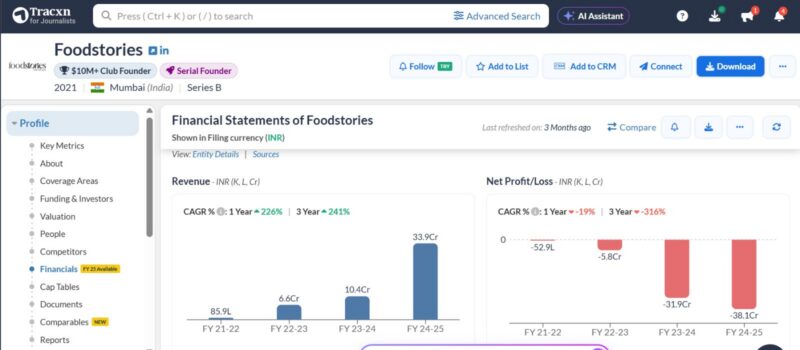
Published financial figures sourced from Tofler show that Foodstories generated revenue of ₹32.64 crore in FY2024–25 while recording a net loss of ₹38.8 crore. Its annual net loss exceeded its entire revenue by ₹6.16 crore, producing a negative net profit margin of approximately 118.87%. For every ₹100 of revenue generated during the financial year, the company recorded approximately ₹118.87 in net losses. On an arithmetic monthly basis, its losses averaged approximately ₹3.23 crore against revenue of ₹2.72 crore.
These figures demand attention because Foodstories operates in a capital-intensive retail segment. Premium commercial locations, sophisticated interiors, refrigeration infrastructure, speciality food procurement, perishable inventories, skilled employees and digital fulfilment networks impose substantial financial obligations. Every additional outlet introduces fresh expenditure before its commercial sustainability can be established. Expansion under such circumstances requires more than an attractive brand identity and an impressive geographical footprint; it requires demonstrable store-level profitability and disciplined management of working capital.
The history of Indian organised retail repeatedly illustrates the limitations of treating revenue growth as the principal indicator of commercial success. A company can increase its turnover, expand its distribution network and attract considerable public attention while simultaneously accumulating liabilities and weakening its financial position. Future Group’s collapse should make precisely this distinction impossible for the next generation of Biyanis to ignore.
The important question for Foodstories is whether its established outlets have achieved positive operating contributions and whether management can demonstrate that additional stores will improve rather than deteriorate its consolidated financial performance. A credible expansion strategy must explain how the existing loss-making structure will transition towards profitability, rather than merely presenting larger revenue ambitions to prospective investors.
₹50 crore in fresh funding and a ₹1,000 crore ambition: Has profitability become secondary?
On 15.06.26, Foodstories announced that it had secured ₹50 crore in funding from Zerodha co-founder Nikhil Kamath, with continued backing from existing investor Narotam Sekhsaria’s family office. The company stated that the investment would support the expansion of its physical retail operations, strengthen its digital commerce business and improve its delivery infrastructure. By then, Foodstories had established operations in Delhi, Bengaluru, Hyderabad and Mumbai, with further expansion planned.
Ashni Biyani articulated an ambition to build Foodstories into a ₹1,000 crore business. The scale of that ambition becomes particularly striking when compared with its FY25 financial performance. The proposed ₹1,000 crore business scale represents approximately 30.64 times its reported FY25 revenue. Meanwhile, the ₹50 crore funding round amounts to approximately 1.29 times its reported FY25 net loss.
The difference between attracting investment and establishing financial sustainability is fundamental. Fresh equity investment can finance operations, acquire inventory, establish additional stores and provide resources for experimentation. It cannot independently establish that a company’s underlying business model is economically viable. Indeed, aggressive expansion before existing operations mature can multiply the very expenditure responsible for accumulated losses.
For investors such as Kamath and the Sekhsaria family office, Foodstories’ financial performance should invite detailed scrutiny of operating margins, inventory turnover, rental commitments, supplier obligations, management compensation and the financial requirements of each additional outlet. The founders’ familiarity with retail should raise expectations of financial discipline rather than reduce the intensity of due diligence.
The Biyani family’s historical ability to attract capital and develop familiar consumer brands is beyond dispute. The more difficult question is whether the next generation can demonstrate an equally strong ability to protect invested capital, maintain healthy balance sheets and deliver sustainable returns without becoming excessively dependent on successive funding rounds.
From Foodhall to Foodstories: A new name cannot erase historical commercial disputes
Foodstories is not Avni Biyani’s first attempt at establishing a premium grocery enterprise. In 2011, she established Foodhall under the Future Group umbrella, developing a gourmet retail format that catered to affluent consumers through speciality food, imported products and carefully curated shopping experiences. Foodhall represented a significant departure from the mass-market retail formats associated with her father’s Big Bazaar business.
Foodstories now operates in substantially the same market segment. Its product positioning, customer demographics and experiential retail approach naturally invite comparisons with Foodhall. In March 2024, published reports examining the launch of Foodstories highlighted the unresolved commercial disputes surrounding the earlier enterprise. Promotional social media messaging preceding the launch also explicitly invoked Foodhall’s return in an expanded format.
The resemblance between the two businesses raises questions extending beyond branding. What happened to Foodhall’s historical supplier arrangements, intellectual property, commercial equipment and other operating assets? Were any commercial resources acquired by the newer company? If transactions occurred, what consideration was paid, and how were the interests of Future Retail’s creditors protected?
These questions become particularly relevant because Foodhall’s historical commercial arrangements became the subject of insolvency litigation. In an order dated 28.04.23, the Mumbai Bench of the National Company Law Tribunal examined proceedings initiated by Koinonia Coffee Private Limited concerning Foodhall’s operations. The dispute arose in connection with Future Retail’s insolvency and involved its resolution professional and TNSI Retail Private Limited.
Koinonia’s historical association with Foodhall dated back to 2018. A subsequent commercial arrangement dated 30.11.21 contemplated a five-year relationship with a three-year lock-in period. Payment difficulties resulted in revised arrangements in March 2022, while another agreement dated 14.04.22 transferred Foodhall’s operations to TNSI Retail, a subsidiary of Future Retail.
The tribunal proceedings addressed the protection of commercial proceeds and the examination of historical transactions. The resolution professional informed the tribunal that transaction review auditors were examining the arrangements. The tribunal directed that revenue attributable to Koinonia be protected through an escrow mechanism and contemplated appropriate insolvency proceedings if the transaction audit identified actionable transactions.
The NCLT order dated 28.04.23 provides an important historical record of the commercial complications surrounding Foodhall.
The emergence of another gourmet retail venture led by the same entrepreneurial figure makes the commercial transition worthy of public explanation. A new corporate identity may provide an independent legal and financial structure, but transparency concerning the relationship between the historical and contemporary businesses would strengthen confidence among investors, suppliers and creditors.
Ashni and Avni Biyani have already featured in a SEBI enforcement order
Perhaps the most important documented regulatory development involving both sisters is the Securities and Exchange Board of India’s adjudication order dated 28.04.23 concerning Praxis Home Retail Limited. Unlike the recent CBI investigation, which concerns Future Retail and its named accused, the Praxis proceedings explicitly identified both Ashni Kishore Biyani and Avni Biyani among the noticees.
On 12.12.19, Praxis Home Retail allotted 7,500 compulsorily convertible debentures to Future Corporate Resources Private Limited, one of its promoter entities. On 11.02.20, Future Corporate Resources exercised its conversion option over 3,180 debentures and received 30 lakh equity shares. Consequently, its individual shareholding increased from 47.43% to 53.13%, with SEBI recording an increase of 5.71%.
The acquisition triggered obligations under the SEBI Substantial Acquisition of Shares and Takeovers Regulations, 2011, concerning the announcement of an open offer. The promoter entities and individuals identified in the proceedings constituted persons acting in concert under the applicable regulatory framework.
The noticees contested the proceedings, pointing out that the aggregate increase in promoter-group shareholding was 4.66%, within the overall 5% creeping acquisition threshold, and maintained that the transaction did not change control of the company. SEBI, however, examined the separate increase in the individual promoter entity’s shareholding and concluded that the applicable open-offer obligation had been breached.
The SEBI imposed a ₹10 lakh penalty on Future Corporate Resources Private Limited and a further ₹10 lakh penalty payable jointly and severally by the remaining noticees, including Ashni and Avni Biyani. The aggregate penalty amounted to ₹20 lakh.
The significance of this order extends beyond its monetary penalty. Open-offer regulations exist to protect public shareholders when substantial changes occur in corporate ownership. Failure to comply with these requirements can deprive investors of an important exit opportunity. Both sisters’ inclusion in the proceedings establishes a direct regulatory history that deserves consideration when evaluating their contemporary corporate ventures.
Investors assessing Foodstories should therefore examine the founders’ approach to statutory compliance, board oversight, shareholder protection and related-party disclosures. These are not peripheral administrative matters. They are fundamental components of responsible corporate management, particularly when businesses depend heavily on external capital.
Avni Biyani and Koovs PLC: The international business that entered administration
Avni Biyani’s corporate history extends beyond Indian food retail. Her association with Koovs PLC, an online fashion retailer listed on London’s Alternative Investment Market, presents another important case for examining the financial decisions and corporate governance of enterprises with which she has been associated.
Koovs PLC, registered in the United Kingdom under company number 08166410, appointed Avni Biyani as a non-executive director effective 01.01.19. Her appointment followed the strategic investment relationship established between Koovs and Future Lifestyle Fashions Limited, where Avni also served as a director.
Less than one year after her appointment, Koovs entered administration on 10.12.19. Official United Kingdom Companies House records establish that the administration continued until 17.12.22.
The immediate financial crisis centred on Future Lifestyle Fashions‘ inability to complete an additional £6.5 million funding commitment. Historical reporting documented difficulties surrounding the proposed investment, including regulatory approval issues involving the Reserve Bank of India. Future Lifestyle Fashions had already reportedly invested approximately ₹88 crore through earlier transactions, while a further preference share investment remained outstanding.
Following unsuccessful efforts to secure alternative funding, Koovs’ operating business and assets were sold through the administration process to SGIK 3 Investments Limited, associated with its chairman and largest secured creditor, Waheed Alli.
Avni’s simultaneous association with the investing company and the investee makes this episode particularly relevant to an assessment of her corporate experience. Non-executive directors occupy positions that require oversight of management decisions, financial risks and corporate strategy. Although the funding commitment was a corporate obligation of Future Lifestyle Fashions, the circumstances surrounding the commitment and its eventual failure warrant examination through board minutes and historical regulatory disclosures.
The collapse of Koovs illustrates the consequences of a business becoming dependent on anticipated external funding. Once expected capital fails to materialise, an enterprise without sufficient independent financial resources can rapidly confront insolvency.
Foodstories’ reliance on external investment while recording substantial losses makes the lessons from Koovs particularly relevant. Avni’s experience should have reinforced the importance of conservative funding assumptions, adequate liquidity and sustainable underlying operations.
Ashni Biyani’s Future Consumer tenure and ₹2.10 crore executive remuneration
Ashni Biyani’s corporate background is equally extensive. She served as a whole-time director of Future Consumer Limited from November 2014 and became its managing director on 22.05.21, during a period of intensifying financial difficulties across the Future Group ecosystem. She subsequently resigned from the managing director’s position on 12.05.22 before leaving the company’s board in June 2023.
Future Consumer’s annual report for FY2021–22 disclosed remuneration of ₹210.67 lakh for Ashni, equivalent to approximately ₹2.1067 crore. The disclosure also recorded her ownership of 67,169 equity shares as of 31.03.22.
Executive remuneration during periods of financial distress deserves particular attention. Management compensation must ultimately be evaluated alongside financial performance, shareholder returns, creditor obligations and the executives’ effectiveness in addressing operational challenges. The historical experience of Future Group provides ample reason to examine whether remuneration policies remained adequately aligned with the interests of other stakeholders.
Future Consumer’s subsequent financial difficulties were substantial. On 15.02.24, the company reported a default involving non-convertible debentures issued to CDC Emerging Markets Limited. The default comprised ₹100 crore in principal and ₹32.97 crore in interest, amounting to ₹132.97 crore. The original debenture issue amounted to ₹200 crore, carried an annual coupon rate of 11.07% and dated back to 15.02.18, during Ashni’s tenure as whole-time director.
The payment default occurred after her departure from the board. Nevertheless, the borrowing history demonstrates the importance of assessing how earlier financing decisions contributed to the company’s longer-term financial obligations. Executive accountability must be examined with reference to the decisions made during an individual’s actual tenure, including borrowing approvals, capital allocation and operational performance.
As Ashni now promotes Foodstories’ ambitious expansion, her previous experience at Future Consumer makes questions about debt management, investor protection and executive compensation particularly relevant.
Smartsters, Future Ideas and the wider corporate histories of the Biyani sisters
The entrepreneurial histories of Ashni and Avni extend considerably beyond their most publicly promoted ventures. Corporate registry-derived records identify numerous historical directorships and commercial affiliations across investment companies, consumer goods enterprises, retail businesses, fashion brands, design consultancies and venture-building platforms.
Avni‘s identifiable corporate associations include
- Future Lifestyle Fashions Limited
- Praxis Home Retail Limited
- Future Ideas Company Limited
- Future Capital Investment Private Limited
- Surplus Finvest Private Limited
- Hain Future Natural Products Private Limited
- PIL Industries Limited
- Ryka Commercial Ventures Private Limited
- Idiom Design and Consulting Limited
- Srishti Mall Management Company Private Limited
- Qverse Foods Private Limited
- Think9 Consumer Technologies Private Limited
- Koovs PLC
Ashni‘s historical associations include
- Future Consumer Limited
- Future Corporate Resources Limited
- Future Ideas Company Limited
- FutureBazaar India Limited
- Future Value Retail Limited
- Future Brands Limited
- Futurefone Limited
- Fonterra Future Dairy Private Limited
- Amar Chitra Katha Private Limited
- House of Anita Dongre Private Limited
- Holii Accessories Limited
- Smartsters Private Limited
- Surplus Finvest Private Limited
- Foresight Bullion India Private Limited
- Think9 Consumer Technologies Private Limited
One particularly notable shared corporate affiliation is Future Ideas Company Limited, which was admitted into corporate insolvency resolution proceedings on 09.04.25 following an application by Axis Trustee Services Limited. Both sisters had historical board associations with the company, although their departures preceded the insolvency admission. Subsequent appellate proceedings further complicated its insolvency history.
Another important company is Smartsters Private Limited, incorporated on 22.09.21 and operating in children’s furniture and lifestyle products. Ashni was associated with its board from incorporation until July 2024. Commercial corporate records subsequently listed the company under liquidation. Its registered office is shared with other enterprises associated with the newer Biyani business ecosystem.
These corporate outcomes require individual assessment rather than treating every business failure as equivalent. Nevertheless, prospective investors evaluating the founders’ management records should examine the complete portfolio of their historical ventures, including unsuccessful enterprises, financial defaults and regulatory proceedings. Founder profiles that selectively celebrate successful brand launches while overlooking adverse corporate developments provide an incomplete account of business experience.
Think9 and the reconstruction of the Biyani commercial ecosystem
Foodstories represents only one component of a substantially larger attempt by the younger generation of Biyanis to establish new consumer enterprises. Think9, the venture-building platform associated with Ashni and Avni, provides institutional support to businesses operating across several consumer categories.
The wider entrepreneurial ecosystem includes Broadway, associated with Vivek Biyani, and SuperYou, the protein-focused consumer brand associated with Nikunj Biyani and actor Ranveer Singh. Think9’s support for Foodstories, Broadway and SuperYou demonstrates the family’s continuing ambitions across modern retail and consumer businesses.
The emergence of these ventures raises an important distinction between entrepreneurial diversification and financial interdependence. A venture-building platform can provide operational expertise, shared services, management resources and capital to multiple businesses. However, where several enterprises share promoters, board members or commercial infrastructure, transparent accounting becomes particularly important to establish how each business is financed and whether its financial performance is independently sustainable.
The collapse of Future Group should make intercompany financial transparency a central priority for its next generation. Related-party transactions, intercorporate loans, shared expenditure, brand licensing arrangements and management-service agreements influence the actual financial condition of individual enterprises.
For investors, the key issue is whether each business possesses sufficient operational independence and adequate financial resources to meet its obligations without depending excessively on other entities within the same entrepreneurial ecosystem.
Can the next generation demonstrate that it has learned from the previous one?
The ₹904.32 crore CBI investigation into Future Retail should prompt scrutiny of more than the immediate allegations concerning bank funds. It should encourage a broader examination of corporate governance practices, financial transparency and the treatment of stakeholders across the historical Biyani business ecosystem.
Foodstories’ ₹38.8 crore net loss, its ₹50 crore funding round and its ₹1,000 crore business ambition present a contemporary test of financial discipline. Avni Biyani’s historical involvement with Foodhall, Koovs and Praxis Home Retail, alongside Ashni Biyani’s tenure at Future Consumer and association with other financially distressed enterprises, provides substantial context against which their present management decisions can be evaluated.
Their documented inclusion in SEBI’s Praxis adjudication proceedings is particularly significant because it establishes an independent regulatory record involving both individuals. Investors should examine what governance safeguards have subsequently been introduced, how compliance responsibilities are allocated and whether independent oversight exists to protect shareholder interests.
Foodstories would benefit from greater transparency concerning its historical financial statements, operating cash flows, related-party transactions, shareholder structure, management remuneration and store-level profitability. Such disclosures would enable stakeholders to evaluate whether the company is progressively developing a commercially sustainable model or relying predominantly on investment-funded expansion.
The Biyanis’ entrepreneurial legacy cannot be assessed exclusively through the number of brands they establish, the size of the investments they attract or the sophistication of their retail outlets. It must also be assessed through the financial obligations their companies honour, the capital they preserve, the returns they deliver and the standards of corporate governance they maintain.
The central challenge confronting Ashni and Avni Biyani is therefore not whether they can replicate the scale and visibility once achieved by their father’s retail empire. It is whether they can demonstrate financial practices capable of avoiding its eventual fate.
A new generation deserves to be evaluated on its own conduct, but its documented management and regulatory history cannot be excluded from that evaluation. Foodstories’ future will ultimately be determined not by the attractiveness of its retail experience or the prominence of its investors, but by whether its founders can translate ambitious expansion into sustainable profitability, transparent governance and lasting financial credibility.