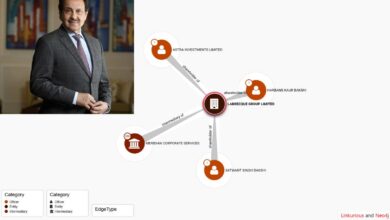
Terra Vision Investment, From Ltd To LLC: Why Ankiti Bose Renamed A Deadpooled Company?


Terra Vision Investment, From Ltd To LLC: Why Did Ankiti Bose’s UK Company Disappear After 21 Months While A Similarly Named UAE Entity Continued?
From Zilingo’s Collapse To Terra Vision’s Dissolution: Is Ankiti Bose Facing Another Corporate Transparency Question?
Ankiti Bose’s corporate history has acquired another uncomfortable chapter. This time, the controversy does not begin with a billion-dollar startup, hundreds of millions in venture capital or an internal investigation into financial irregularities. It begins with a comparatively modest British company incorporated with £100 in share capital, controlled by Ankiti Bose, joined by Adeeb Hussain as a director, and compulsorily dissolved less than two years later.
The company was Terra Vision Investments Limited, registered in the United Kingdom on 23.05.24. By 03.03.26, it had disappeared from the active Companies House register. Yet the Terra-Invest business identity continued internationally, now prominently associated with Ankiti Bose and financier Krishan Rattan through a similarly named UAE entity, Terra Vision Investments LLC. The contrast demands attention: why did a business associated with ambitious international investment plans leave behind a dormant British company, a missing statutory confirmation statement and a compulsory strike-off, while its founders continued promoting an investment platform through other corporate structures?
The question becomes more significant when examined against Ankiti Bose’s earlier experience at Zilingo. The Singapore-based fashion technology startup, which once approached a $1 billion valuation, collapsed following a financial governance crisis, management disputes, concerns about delayed financial reporting and an unsuccessful effort to rescue the business. Zilingo subsequently entered liquidation in 2023. Now, the public records surrounding Terra Vision Investments Limited present another episode in which the corporate structure associated with Ankiti Bose failed to remain active. The circumstances are different, but the underlying question about financial transparency deserves renewed scrutiny. What exactly happened to the British company? Why was it classified as dormant?
Why was Ankiti Bose’s Terra Vision Investment compulsorily struck off?
Let me remind you, it was a compulsory strike-off, not voluntary strike-off! Compulsory strike off is a legal process in which a corporate regulator, such as the Registrar of Companies (RoC) in India or Companies House in the UK, forcibly removes a company’s name from the official register and dissolves it, usually due to prolonged inactivity or non-compliance. And why does a similarly named UAE company, controlled by Ankiti Bose and Krishan Rattan, feature in the investment platform’s subsequent corporate structure? Also, this new entity, The Terra Vision Investment LLC, aka The Terra-Invest is not even registered in India!
The UK Company: Incorporated In May 2024, Dissolved In March 2026
The official UK Companies House register identifies Terra Vision Investments Limited under company number 15736307. It was incorporated on 23.05.24, with Ankiti Uday Bose appointed as its first director. Its registered address was 86–90 Paul Street, London, and the incorporation filing recorded initial share capital of £100. On 24.06.24, Adeeb Hussain joined as a second director. The persons-with-significant-control register identified Bose as holding 75% or more of the company’s shares. This was therefore not merely a business carrying a name similar to her later investment venture. Bose exercised substantial ownership control over the British entity, while Hussain held a formal statutory position as director.
What followed is more revealing than the incorporation itself. On 29.07.25, the company filed accounts for the period ending 31.05.25, expressly identifying itself as dormant. On 16.12.25, Companies House published the first Gazette notice for compulsory strike-off. On 03.03.26, the registrar recorded the company’s dissolution through compulsory strike-off. The entire corporate existence lasted approximately 21 months and eight days. The public filing history contains only five entries: incorporation, Hussain’s appointment, dormant accounts, the first compulsory strike-off notice and the final dissolution notice. There is no recorded voluntary application by the directors seeking to close the company. This was a registrar-initiated dissolution.
That distinction is fundamental. A voluntary strike-off generally reflects a formal decision by directors to close an eligible company. A compulsory strike-off is initiated by the registrar, commonly when statutory filings are outstanding or there is reason to believe the company is no longer carrying on business. The published record does not specify the precise reason Companies House initiated the action against Terra Vision Investments Limited. However, it reveals a particularly important omission: no confirmation statement appears in the company’s filing history.
Where Was The Mandatory Confirmation Statement?
A British private limited company ordinarily must submit a confirmation statement at least once every twelve months, even if it has not traded. The document confirms or updates essential corporate information, including the company’s registered office, directors, shareholders and persons with significant control. For Terra Vision Investments Limited, incorporated on 23.05.24, the first confirmation statement would ordinarily have become due in early June 2025. Yet the Companies House filing history contains no such submission before the company’s dissolution in March 2026.
This is a concrete corporate compliance issue, not simply a question of whether the company succeeded commercially. The directors of a UK company are responsible for ensuring that applicable filing obligations are met. The company’s dormant status does not remove the requirement to submit confirmation statements. The absence of that filing, followed by compulsory strike-off proceedings, raises direct questions about the attention given to statutory administration by the individuals responsible for the company.
Why was the confirmation statement not filed? Was the omission the result of administrative neglect, a decision to discontinue the British entity or some other circumstance? Did the directors receive correspondence from Companies House concerning outstanding obligations? Were steps taken to prevent dissolution after the first Gazette notice appeared on 16.12.25? The public filing history records no successful intervention before the final dissolution on 03.03.26. For a business associated with founders promoting financial sophistication and international investment expertise, such an elementary compliance gap deserves scrutiny.
The Dormant Accounts: A Company With An Investment Name But No Reported Trading Activity
The accounts filed on 29.07.25 present another striking feature. Terra Vision Investments Limited reported itself as dormant for the period ending 31.05.25. Under UK company reporting rules, dormancy generally means that the company undertook no significant accounting transactions during the relevant accounting period, apart from permitted exceptions. A dormant company may legally exist without conducting business, and dormant accounts do not automatically indicate financial distress. But the classification becomes important when compared with the investment platform being promoted under the Terra-Invest identity.
Public announcements surrounding Terra-Invest’s 2024 launch described ambitious international investment plans, a reported transaction portfolio of approximately $230 million and targets involving substantially larger assets under management. The contrast is obvious. A business identity associated with large investment ambitions existed alongside a British company of almost the same name reporting dormant accounts. If substantial investment transactions were being pursued, which legal entity was responsible for them? Were contracts signed through the UAE business, another affiliated company or a separate investment vehicle? Did the British company have any operational purpose beyond registration and establishing a corporate presence in London?
These questions matter because investors frequently encounter a commercial brand before identifying the legal entity responsible for its activities. A company website may advertise international operations, impressive transaction values and experienced founders, but those statements do not automatically establish which registered company owns the assets, receives funds or assumes contractual liabilities. In Terra Vision’s case, the dormant British entity provides no financial account of the ambitious commercial activities associated with the wider brand. The real issue is therefore not an established hidden loss within the UK company. It is the absence of a readily identifiable connection between the platform’s public investment claims and the financial reporting of the specific legal entities behind it.
The UAE LLC: Same Business Identity, Different Jurisdiction And Different Ownership
The corporate history becomes more complicated with Terra Vision Investments LLC. UK Companies House records identify this entity under overseas-entity number OE034483. Its incorporation jurisdiction is the United Arab Emirates, its reported registration number is 2178990, and the register identifies the Dubai International Financial Centre as the parent registry. Unlike the British company, whose controlling shareholder was Ankiti Bose and whose second director was Hussain, the UAE entity identifies Ankiti Bose and Krishan Rattan as beneficial owners.
The overseas-entity disclosure records each as holding more than 25% of shares and voting rights, together with rights to appoint or remove directors and significant influence or control. This is a substantial difference in the recorded governance arrangements. The British entity placed ownership control primarily with Bose. The UAE entity identifies both Bose and Rattan as significant controllers. Adeeb Hussain, meanwhile, remained associated with the wider Terra-Invest professional network, but the UK overseas-entity record does not identify him among the two disclosed beneficial owners of the UAE company.
Most importantly, the chronology does not support the simple explanation that the UAE LLC was created only after the British company was dissolved. The UAE company’s beneficial ownership disclosures record notification dates of 04.01.24, preceding the British company’s incorporation on 23.05.24. Although those dates do not independently establish the UAE entity’s incorporation date, they show that the reported ownership arrangements predate the UK company’s creation. The two entities therefore cannot automatically be treated as an old company legally converted into a new one. They are separately registered entities with overlapping names, different jurisdictions and different disclosed control arrangements.
Another Curious Development: The UAE LLC’s 21-Day Appearance On The UK Register
The UAE entity’s British registration history introduces another unusual sequence. Terra Vision Investments LLC registered on the UK’s Register of Overseas Entities on 30.10.25. On 20.11.25, the register recorded its removal. The interval was just 21 days. This happened while the British Terra Vision Investments Limited still existed and before Companies House issued its compulsory strike-off notice against that company.
The Register of Overseas Entities is principally concerned with overseas legal entities holding qualifying interests in UK land. Registration and removal are governed by specific statutory requirements. Removal from this register does not mean the overseas company has ceased to exist in its home jurisdiction. Nevertheless, such a brief registration period invites examination of the transaction or property interest that prompted the company to register in Britain and the circumstances that subsequently supported its removal.
Was the LLC preparing to acquire UK property? Did an intended transaction fail to proceed? Had it held an interest that no longer required registration? Why did the company enter and exit the register within three weeks? The public filing history establishes the dates but does not provide a comprehensive commercial explanation. It also leaves a larger question: what was the practical relationship between the UAE entity and the British company that was approaching compulsory dissolution?
The overlapping timelines make the corporate structure considerably more interesting than a routine decision to change a company’s name.
A Third Entity In Singapore: How Many Terra Vision Companies Exist?
The corporate structure extends beyond Britain and the UAE. Singapore corporate information identifies Terra Vision Investments Pte. Ltd., incorporated on 06.06.25 under registration number 202524726C. Commercial registry information associates the company with Krishan Rattan and describes business activities involving management consultancy and related services. The complete ownership and financial position of this Singapore entity would require examination of its official Accounting and Corporate Regulatory Authority records.
The existence of another similarly named company is important because Terra-Invest publicly describes itself as an international investment platform. Its website identifies Bose and Rattan as founding partners, and its business materials refer to operations and opportunities across multiple jurisdictions. Yet a global brand operating through different legal entities can create considerable complexity for outsiders trying to understand ownership and accountability.
Which Terra Vision company signs investment agreements? Which company employs staff? Which receives advisory fees? Which holds investments? Which entity’s financial statements reflect the transaction values promoted by Terra-Invest? Are the British, UAE and Singapore entities linked through formal ownership arrangements, service agreements or common beneficial owners? These are basic questions for any investment business claiming institutional credibility.
The existence of several entities across jurisdictions is not unusual in international finance. But the structure should not become an obstacle to identifying the entity legally responsible for a transaction. For Terra-Invest, that question becomes particularly pressing because one of the similarly named entities has already been compulsorily dissolved.
From Ltd To LLC: Does The New Structure Mean Fewer Reporting Obligations?
The change from a British Ltd to a UAE LLC raises an obvious question about regulatory transparency. British companies generally operate under a public filing system that makes incorporation documents, directors, significant controllers, annual accounts and confirmation statements accessible through Companies House. Other jurisdictions have different filing requirements and different rules governing public access to corporate information. This can make the practical visibility of a company’s finances and ownership considerably different.
However, an LLC is not a universal exemption from accounting or regulatory requirements. A company registered in the UAE, including one operating under the DIFC framework, may be subject to obligations concerning accounting records, corporate filings, beneficial ownership, taxation and licensing. Singapore companies likewise have statutory annual-return obligations, with financial reporting and audit requirements depending on their classification and applicable exemptions.
The important issue is whether the corporate structure results in less information being publicly available about the investment platform’s finances and activities. A reduction in public visibility can make independent scrutiny more difficult, even where the companies comply with their respective domestic rules.
If Terra-Invest’s founders chose a particular jurisdiction because of its corporate flexibility, that would be a commercial decision. If the objective was to obscure ownership, avoid applicable obligations or conceal liabilities, the implications would be very different. The present records establish overlapping entities and different reporting frameworks, but they do not identify the founders’ reasons for selecting those structures. The questions can be answered through incorporation records, intercompany agreements, financial statements and explanations from the people controlling the businesses.
Adeeb Hussain: What Changed Between The British Company And The New Investment Structure?
Adeeb Hussain’s involvement deserves attention because he was a statutory director of the original British company. His appointment on 24.06.24 placed him alongside Bose in responsibility for the company’s administration. Yet the UK register identified Bose, not Hussain, as the person exercising significant ownership control. In the UAE entity’s disclosed ownership arrangements, the two identified beneficial owners are Bose and Rattan.
This creates a question about the evolution of Terra-Invest’s leadership. Was Hussain originally involved in establishing the British corporate presence? Did his responsibilities change as Rattan became a central figure in the investment platform? Did the British company perform a function that was subsequently allocated to another entity? And what responsibilities, if any, did Hussain retain in the newer structure?
These are not merely questions about job titles. A director’s legal responsibilities differ substantially from those of an adviser, employee or member of a founding team. If an individual moves from a statutory directorship to a professional role without ownership or board authority, the change affects the formal allocation of responsibility. Understanding Hussain’s position could help establish whether the British company was an abandoned administrative vehicle or part of a wider corporate reorganisation.
Tracxn’s Deadpooled Classification: What Does It Actually Reveal?
Market-intelligence platform Tracxn reportedly classifies Terra Vision Investments Limited as deadpooled. The term is commonly used for startups or companies that have ceased operations or are no longer active. It is a commercial database classification, not a formal UK insolvency category. In this case, the company’s dissolved status is independently established by Companies House.
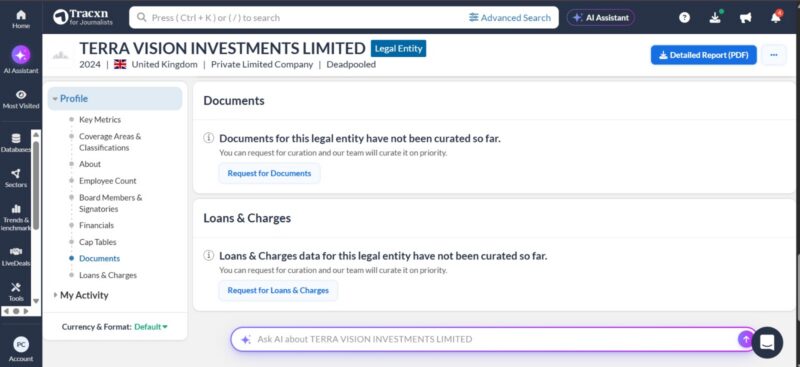
The distinction matters because dissolution, insolvency and commercial failure are different events. A dormant company can be struck off without having conducted substantial business. A trading company may enter liquidation after accumulating large debts. A venture-backed startup may cease operations after exhausting investor funding. All might be labelled deadpooled by a commercial database, but their financial histories can be entirely different.
Terra Vision Investments Limited’s public record establishes dormancy and compulsory dissolution. It does not establish that the company exhausted investment capital or incurred substantial trading losses. Nevertheless, the deadpooled classification draws attention to a clear outcome: the British company created under Bose’s control no longer exists as an active registered business.
For an entrepreneur whose previous major venture also ended in liquidation, that outcome inevitably invites comparison.
Zilingo: The Earlier Collapse And The Question Of Financial Reporting Discipline
Zilingo’s history provides the most consequential background to the Terra Vision investigation. Founded in 2015 by Ankiti Bose and Dhruv Kapoor, the Singapore-based fashion technology company attracted major venture-capital investors and reportedly raised approximately $310 million during its existence. At its peak, it approached a $1 billion valuation. Yet by 2022, the company was engulfed in a financial governance crisis involving complaints about accounting irregularities, concerns over financial reporting, management disputes and deteriorating liquidity.
Bose was suspended as chief executive in March 2022 and dismissed in May 2022 following an investigation commissioned by the company. She contested the allegations and challenged the circumstances of her removal. Zilingo’s difficulties continued, and the company subsequently moved into creditors’ voluntary winding up in February 2023. Its collapse became one of the most widely discussed failures in Southeast Asia’s startup ecosystem.
The financial consequences were substantial. The approximately $310 million raised represents historical investor funding, not a verified amount of losses or a precise total written off by every investor. Nevertheless, the destruction of Zilingo’s near-unicorn business was a serious setback for its investors, employees and creditors. The episode also exposed the dangers of rapid expansion without financial reporting and governance systems capable of supporting the scale of operations.
The comparison with Terra Vision is not that the British company suffered an equivalent financial collapse. The more relevant similarity concerns the importance of statutory filings, accounting transparency and management responsibility. At Zilingo, financial reporting became a central controversy. At Terra Vision Investments Limited, the publicly documented issues include dormant accounts, the absence of a confirmation statement and compulsory dissolution.
These are different circumstances, but both make financial discipline an important part of assessing Bose’s corporate record.
Why The Original British Company Matters Even After Dissolution
A company’s dissolution does not automatically erase its historical responsibilities or make its former activities irrelevant. UK law provides mechanisms for restoring eligible dissolved companies to the register in appropriate circumstances. Creditors and other affected parties may have legal avenues depending on the facts.
The more immediate question concerns the business activity, if any, that was associated with the British company before it disappeared. If the company remained dormant, what commercial purpose did it serve? If the wider Terra-Invest platform was conducting transactions, which other entities were responsible? Were any contracts, intellectual property rights, business relationships or assets transferred between companies? Did the British company have any outstanding obligations when it was struck off?
The published dormant accounts and dissolution notices do not answer these questions comprehensively. They establish the company’s formal status, but they do not provide a consolidated financial picture of the wider Terra-Invest business.
This is precisely where the investigation should focus. An investment platform operating through multiple jurisdictions should be capable of identifying the legal entity behind each material transaction. Without that clarity, prospective investors may find themselves relying on a brand’s reputation rather than the financial condition and legal responsibilities of the company with which they are actually dealing.
The Question For Ankiti Bose And Krishan Rattan: What Exactly Continued After The UK Company Disappeared?
The most revealing aspect of the Terra Vision story is the continuity of the commercial identity despite the discontinuity of the British legal entity. The UK company was incorporated under Bose’s control, joined by Hussain, classified as dormant and compulsorily dissolved. The UAE entity identifies Bose and Rattan as beneficial owners. A similarly named Singapore company also exists. Meanwhile, Terra-Invest continues presenting itself as an international investment platform with experienced leadership and ambitious investment activities.
The records therefore raise several questions that deserve direct answers from the founders.
Why was the British company established in the first place? Why was its first confirmation statement absent from the public filing history? Why was compulsory strike-off allowed to proceed? What relationship did the British company have with the UAE LLC? Were any assets or commercial activities transferred? What was the purpose of the UAE company’s brief appearance on the UK overseas-entity register? And which legal entity is responsible for the transactions and investment activities advertised by Terra-Invest?
There is also a broader question concerning accountability. If the founders are promoting substantial financial expertise and international investment experience, should investors not expect the corporate structure behind those claims to be equally transparent?
Conclusion: A Dissolved British Company, An International Investment Brand And Unanswered Governance Questions
The official records establish a striking corporate history. Terra Vision Investments Limited was incorporated in Britain on 23.05.24, with Ankiti Bose as its controlling shareholder and Adeeb Hussain subsequently appointed director. The company filed dormant accounts, recorded no confirmation statement in its public filing history and was compulsorily dissolved on 03.03.26. A similarly named UAE entity identifies Bose and Krishan Rattan as beneficial owners, while another company carrying the Terra Vision name was incorporated in Singapore.
The chronology reveals overlapping corporate structures rather than a straightforward legal conversion from Ltd to LLC. It also reveals a significant difference between the public presentation of Terra-Invest’s international investment ambitions and the limited financial activity reported by the British company.
The most serious questions concern the purpose of the original UK entity, the failure to maintain its statutory filings, the relationship between the similarly named companies and the identity of the legal entity responsible for Terra-Invest’s commercial activities.
Zilingo’s collapse makes the demand for transparency more pressing. Bose’s previous venture became associated with serious financial reporting and governance controversies before entering liquidation. Her subsequent investment platform should therefore be judged by the strength of its actual corporate controls, not merely the scale of its ambitions or the professional credentials of its leadership.
The public record does not establish that the UAE LLC was created to conceal losses or evade the law. It establishes something that deserves a more immediate explanation: a British company controlled by Bose was allowed to be compulsorily dissolved while an international investment platform bearing almost the same name continued through other entities.
For a business seeking credibility in global finance, the question is unavoidable.
If Terra-Invest can describe its international ambitions, investment opportunities and leadership credentials in detail, why should identifying the precise legal entities behind those activities be any less straightforward?
The disappearance of Terra Vision Investments Limited may ultimately have a routine corporate explanation. But the missing filing, compulsory strike-off, overlapping ownership arrangements and continuing investment brand make that explanation worth demanding.
Corporate transparency is not an optional accessory to financial credibility. It is the foundation on which that credibility should rest.