NOIDA’s Crisis: A City Crushing Under The Weight Of Its Own “Development
From Ghost Houses and Poor Construction Materials to Underprepared Firefighters — How the New Okhla Industrial Development Authority Is Crushing Under the Name of Development

NOIDA — A Planned City That Forgot to Plan for People
There is a particular cruelty hiding inside the name “New Okhla Industrial Development Authority.” It sounds like a promise. New. Development. Authority. It suggests order, intention, governance — a city built not by accident but by design, a city that learned from the chaos of Old Delhi and decided to do things differently.
And for a brief period in the 1980s and 1990s, when broad tree-lined sectors were being laid out on the Uttar Pradesh side of the Yamuna, when land was acquired in bulk, roads were planned on a grid, and drainage was mapped before a single building went up, Noida was different. It was, in fact, one of the most ambitious urban experiments in post-independence India: a city built from scratch on paper before it was built in concrete.
Today, that paper city and the concrete city that was built on top of it bear almost no resemblance to each other.
The same authority that once mapped drainage networks now ignores letters warning that sewer lines have collapsed and that “any accident can happen.” The same city that prided itself on being a corporate satellite of Delhi — an IT and pharmaceutical hub, a magnet for middle-class homebuyers priced out of the capital — now holds 103 stalled housing projects within its jurisdiction alone, with hundreds of thousands of families trapped in a limbo of paid EMIs and undelivered flats.
The fire department that is supposed to protect a skyline of increasingly taller towers does not have the equipment to reach their upper floors. The river that gives the city its geographic identity is one of the most polluted stretches of water on the planet. And the air that the city’s residents — its engineers, its executives, its children — breathe every single day is nearly 14 times more toxic than the level the World Health Organisation considers safe for human beings.
What follows is not a list of complaints. It is an accounting. A record of how a city that had every structural advantage, of intentional planning, a grid layout, an authority with legal and financial power systematically squandered that advantage in favour of real estate revenue, political patronage, and the comfortable performance of development over its actual practice.
The Ghost Housing Crisis — 146,000 Families, No Keys, No Answers
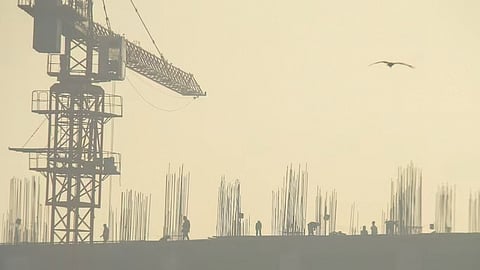
If you drive through Noida Extension on a weekend afternoon, you will see them: towers that are structurally complete but empty, or half-complete and silent, their facades weathered and their lobbies locked. Cranes stand frozen at angles they have held for years. Construction workers’ camps sit abandoned beside foundations that were poured a decade ago. These are not haunted houses in the paranormal sense, though locals have taken to calling them that. They are something far more disturbing: the physical monuments of a financial fraud conducted in broad daylight, with the implicit knowledge of the authority that was supposed to prevent it.
According to PropEquity, a real estate data analytics firm, five major property markets in Uttar Pradesh, including Noida and Greater Noida have 378 stalled housing projects comprising nearly 1.46 lakh units. Greater Noida alone has 167 stalled projects; Noida has 103. These are not projects delayed by a monsoon or a supply chain disruption. These are projects that have been stalled, in many cases, for over a decade.
Developers collectively owe approximately ₹46,000 crore to development authorities in Gautam Budh Nagar alone. That debt is not abstract; it is the reason that possession has not been handed over, that registries have not been completed, and that around three lakh people who legally purchased homes with documented payments are still waiting for keys to apartments they technically own.
The origin of this crisis is rooted in a political decision that seemed advantageous at the time. During the BSP government’s tenure, agricultural land was allotted to developers at just 10% of its total value, essentially subsidising mass housing construction to meet the demand of Delhi’s overflowing middle class.
Developers secured large loans against this cheap land, sold flats on pre-launch offers during the boom years, and then, when the real estate cycle turned in 2014–15, found themselves holding debts that exceeded expected revenues. Projects became financially unviable. Builders filed for bankruptcy or simply disappeared into the fog of corporate insolvency proceedings.
And the families who had paid 85 to 90% of the purchase price, often their life savings, their parents’ retirement funds, were left with nothing but a flat number on a booking form and years of litigation ahead. Rajesh Sahay, general secretary of the Noida homeowners’ federation, put the problem with painful clarity: even if builders now pay their outstanding dues, construction costs have more than doubled since projects were initiated. The money to finish what was started does not exist.
The Parallel Universe of Illegal Construction — 70,000 Units, Zero Oversight
While legitimate homebuyers wait in legal limbo for apartments they bought through every proper channel, a parallel real estate ecosystem has exploded in NOIDA’s villages and peri-urban fringes — operating outside every proper channel, with apparent impunity. As of late 2024, an estimated 70,000 builder-floor flats are under construction across more than 2,000 illegal residential projects in Noida and Greater Noida, with three-quarters of these units already booked by buyers who are themselves, in many cases, victims of the first crisis: people who could not get possession of their legal flat and were pushed by desperation into buying something cheaper, faster, and entirely without legal standing.
These buildings are going up without environmental clearances, without sanctioned structural plans, without conversion of agricultural land, and without any approval from GNIDA or the Noida Authority. They have no fire safety NOCs. They have no mandated setbacks from roads or neighbouring structures. Their foundations are calculated by no licensed engineer. Their construction materials are procured from wherever is cheapest — which, in a region with an active sand mafia and a thriving market in adulterated construction inputs, means that quality is whatever the builder decides it to be on a given day.
The National Green Tribunal took notice in December 2024, issuing an order banning all illegal constructions of residential apartments and commercial complexes in Noida and Greater Noida, and directing the UPPCB to prevent illegal plotting in the floodplain zones of the Hindon and Yamuna rivers. The Supreme Court followed in the same month, ruling that illegal and unauthorised construction cannot be perpetuated and must be necessarily demolished. Both orders are significant on paper. The 70,000 already-booked units standing on the ground are the response that the ground gives back to paper orders.
Since January 2024, the Noida Authority has reclaimed approximately 2.3 million square metres of encroached government land worth more than ₹2,200 crore. Over 100 complaints related to illegal construction and land grabbing have been filed. The Authority has announced plans to publish an online database of illegal constructions and the names of land mafias. All of this activity is real. None of it has stopped the construction. In Salarpur alone, multiple high-rise structures reportedly rose to completion without any approvals while enforcement notices were being drafted in Sector 6 offices a few kilometres away.
Tall Towers, Short Ladders — The Fire Safety Emergency No One Is Talking About
Noida is building upward. Every year, new residential and commercial towers rise taller than the last. Yet the city’s fire department is equipped for a Noida that stopped existing years ago. The region currently faces a documented shortage of adequate firefighting equipment — a gap that has been noted by officials, acknowledged in budget documents, and addressed with the speed and urgency that Indian municipal governance typically reserves for problems that have not yet made the front pages.
In response to a series of fire incidents that finally made the problem visible, GNIDA allocated ₹100 crore in its 2026–27 budget for the purchase of two 102-metre hydraulic platforms capable of reaching heights equivalent to approximately 35 floors. This announcement was made as a headline, a sign of progress. Read it again more carefully, and it says something else: that until this budget, the Greater Noida region — home to some of the tallest residential complexes in Uttar Pradesh — did not have equipment capable of fighting fires above a certain height. Not inadequate equipment. Not ageing equipment. No equipment at all for those upper floors.
Fires in Noida are not rare events. A major blaze gutted a pharmaceutical company’s building in Sector 59; factory fires in Sector 3 have sent black smoke visible across the expressway; fires in shopping complexes in Sector 18 and the Ganga Shopping Complex have demonstrated, repeatedly, that the response capabilities of the fire department are stretched beyond their limits. Gaur City in Greater Noida saw a fire that sent residents fleeing while dozens of fire tenders rushed to a spot that, under different equipment conditions, they might not have been able to reach effectively at height. Each incident produces the same cycle: breaking news, a dozen fire tenders, assurances, and then silence until the next one.
The underlying reality is a straightforward arithmetic problem. A city signs off on 30-storey, 40-storey, and 50-storey towers. The fire department’s tallest hydraulic platform, before the 2026 budget allocation, could reach a fraction of those floors. The residents living on the upper floors of those towers are, in the event of a serious fire above the equipment’s reach, dependent entirely on the building’s internal fire safety systems — systems that, in many of NOIDA’s older and illegally constructed buildings, are either non-functional, incomplete, or absent. The city built the towers. It did not build the capacity to protect the people inside them.
The Water That Killed — Drainage, Sewage, and the Price of Administrative Apathy
In January 2026, NOIDA’s infrastructure failure killed a young software engineer. Yuvraj Mehta’s car plunged into a waterlogged pit at a construction site in Sector 150. He survived the initial fall and called for help. He was heard. For nearly two hours, rescue efforts were attempted. He drowned anyway. His death was not an accident in any meaningful sense of the word. It was the predictable end of a sequence of failures that had been formally documented years earlier.
A letter written in March 2022 by developer MZ Wiztown Planners to the CEO of the Noida Authority — marked to senior officials of the planning and works departments, as well as the police commissioner and the local Station House Officer — explicitly stated that the sewer and main drain lines at Plot SC/02 in Sector 150 had collapsed, that sewage and drain water were continuously flowing into the site, and that “any accident can happen.” That letter sat in a file for almost four years while the pit filled with water and Sector 150 continued to be developed around it. No barriers. No safety signage. No lighting. No action.
The Sector 150 case is extreme in its consequences, but it is not exceptional in its cause. An approved drainage plan for the site existed on paper and was never implemented. Emergency services, when they arrived, were ill-equipped for a non-traditional urban rescue scenario. Multiple agencies — the Noida Authority, the traffic cell, the police — had overlapping jurisdiction and, in practice, no one took ownership of the hazard. This is not a description of one abandoned pit. It is a description of how governance works, or fails to work, across NOIDA’s expanding geography of construction sites, unlicensed structures, and unmaintained public spaces.
The Yamuna — A River in Name, a Drain in Practice
The Yamuna River is the reason NOIDA exists. “New Okhla” — the name tells you — sits across the Okhla Barrage on the Yamuna’s banks. The river was both the city’s boundary and, in the original conception, a natural ecological asset that would distinguish this planned city from the chaotic density of Old Delhi. Today, the stretch of the Yamuna that flows past NOIDA is one of the most degraded aquatic environments in the world.
The Okhla-to-downstream stretch receives a disproportionate share of the river’s total pollution load. Industrial zones at Noida, Ghaziabad, Faridabad, and Delhi together discharge effluent from oil refineries, pharmaceutical plants, chemical factories, electroplating units, and distilleries directly or indirectly into the river. Dissolved oxygen levels in the river drop to near-zero in this stretch, meaning it cannot support aquatic life.
The water’s biochemical oxygen demand, a measure of organic pollution is orders of magnitude above the standard for any recreational or ecological use. Despite a decade of Yamuna Action Plan spending and periodic judicial intervention, a 2025 review of a decade’s worth of research found that the river remains critically polluted and that the remedial measures so far have produced no meaningful improvement in water quality along the most affected urban stretches.
The NGT has separately directed the UPPCB to enforce 100% sewer connectivity in Greater Noida villages, citing public health risks — an order that reveals, in its necessity, what the baseline situation is: villages within the urban agglomeration of one of India’s fastest-growing cities are discharging raw sewage directly into the ground and, ultimately, into the river that is supposed to be NOIDA’s ecological spine.
Fourteen Times the Safe Limit — Breathing in NOIDA Is a Medical Risk
NOIDA’s air quality is not a seasonal inconvenience. It is a year-round public health emergency that its residents have been conditioned, through gradual exposure and institutional inaction, to treat as a background fact of life. According to IQAir’s real-time monitoring data, NOIDA’s PM2.5 concentration — fine particulate matter that penetrates deep into the lungs and bloodstream — currently runs at approximately 13.9 times the World Health Organisation’s annual safe guideline value. To translate that into human terms: breathing the air in NOIDA for one year delivers a cumulative dose of airborne toxins that no medical authority in the world would consider safe for any duration, let alone a lifetime.
The sources of this pollution are inseparable from the other crises documented here. Construction dust from hundreds of active sites, including the 70,000 illegal units going up in unlicensed colonies is a major contributor. Vehicular emissions from expressways that regularly see gridlock during peak hours add significantly. Industrial emissions from the Noida industrial areas and neighbouring Ghaziabad contribute.
Seasonal stubble burning from agricultural fields in the surrounding region sends a dense smoke layer across the entire NCR every October and November, driving AQI readings into “Severe” and “Hazardous” territory for weeks at a time. These are not separate pollution events. They are cumulative, concurrent, and they are worst for the people who can afford least to be sick: daily-wage construction workers, auto-rickshaw drivers, children who play outdoors, and the elderly.
The Multi-Agency Blame Architecture — How Accountability Disappears
The most sophisticated infrastructure in NOIDA is not its expressways or its metro connectivity. It is the architecture of institutional arrangements that ensures no single body is ever clearly responsible for any failure. The Noida Authority governs the planned sectors. The Greater Noida Industrial Development Authority governs Greater Noida. The Yamuna Expressway Industrial Development Authority governs the corridor beyond. The UPPCB oversees pollution.
The district administration handles law and order. The police handle FIRs. Each agency has a defined jurisdiction, and the spaces between those jurisdictions — the villages that fall outside authority limits but inside the urban sprawl, the construction sites that cross sector boundaries, the rivers that belong to everyone and no one — are precisely where the worst failures accumulate.
When a developer writes to the Noida Authority about a collapsed sewer line, it goes to the planning department, which copies it to the works department, which notes that the plot is a private development site, which is different from the authority’s maintained infrastructure, which means that the responsibility may lie with the developer, who has since moved on to other projects.
When an illegal building goes up in a village, it is technically outside GNIDA jurisdiction, even though it stands in the functional urban footprint of Greater Noida. When a fire breaks out above the reach of the tallest fire tender, the question of whether fire safety NOCs were obtained for that specific building leads back to approvals given under whichever authority had jurisdiction at the time — and the trail goes cold.
This is not accidental complexity. It is, functionally, a system designed to absorb accountability without producing it. Every crisis has multiple owners on paper and no owners in practice. Every inquiry produces a committee. Every committee produces a report. Every report recommends coordination between agencies. The agencies continue to operate in silos.
The Single, Unified Failure
It would be a consolation if these were eight separate problems with eight separate causes and eight separate fixes. They are not. They are one problem, expressed through eight different symptoms. The problem is this: NOIDA was built, and continues to be governed, for revenue rather than for residents. Land allotment at 10% of value generated political capital and developer profit; it also generated a housing crisis.
Construction approvals generated stamp duty and development charges; they also generated towers that the fire department cannot protect. Industrial zone permissions generated GDP contribution; they also generated a dead river and unbreathable air. Budget allocations for new airport roads generate headlines; allocations for fire equipment come only after people have died in fires that existing equipment could not reach.
The Noida Authority, GNIDA, YEIDA, and the Uttar Pradesh state government are all collectively presiding over this. In every case, the diagnosis was available. In every case, the resources — from an economy generating real estate transaction values in the hundreds of thousands of crores — were theoretically accessible. What was not accessible was the political will to spend those resources on what cities are actually for: the safety, health, and dignity of the people who live in them.
The bill is now being presented. It is being presented to the family of Yuvraj Mehta, who drowned in a pit that had been flagged as dangerous for four years. It is being presented to the three lakh homebuyers who paid for flats they cannot occupy. It is being presented to the 70,000 families who, driven to desperation by the failure of the legal market, invested their savings in buildings that courts have ordered demolished. It is being presented to every resident who fills their lungs with air that is fourteen times the safe limit every morning and calls it commuting to work.
NOIDA is not failing despite its development. It is failing because of how that development was conducted — with every approval signed in the name of growth, and every consequence absorbed silently by the people who were never asked whether this was the growth they wanted.
The expressways are wide. The towers are tall. The authority has a budget of thousands of crores. And somewhere beneath all of it, in a waterlogged pit that nobody repaired after the warning letter arrived, a young engineer waited two hours for rescue that came too late.

That is what governance failure looks like when it is not a flood or a fire or a headline. It looks like a letter, written in 2022, sitting in a file, unanswered, until 2026.